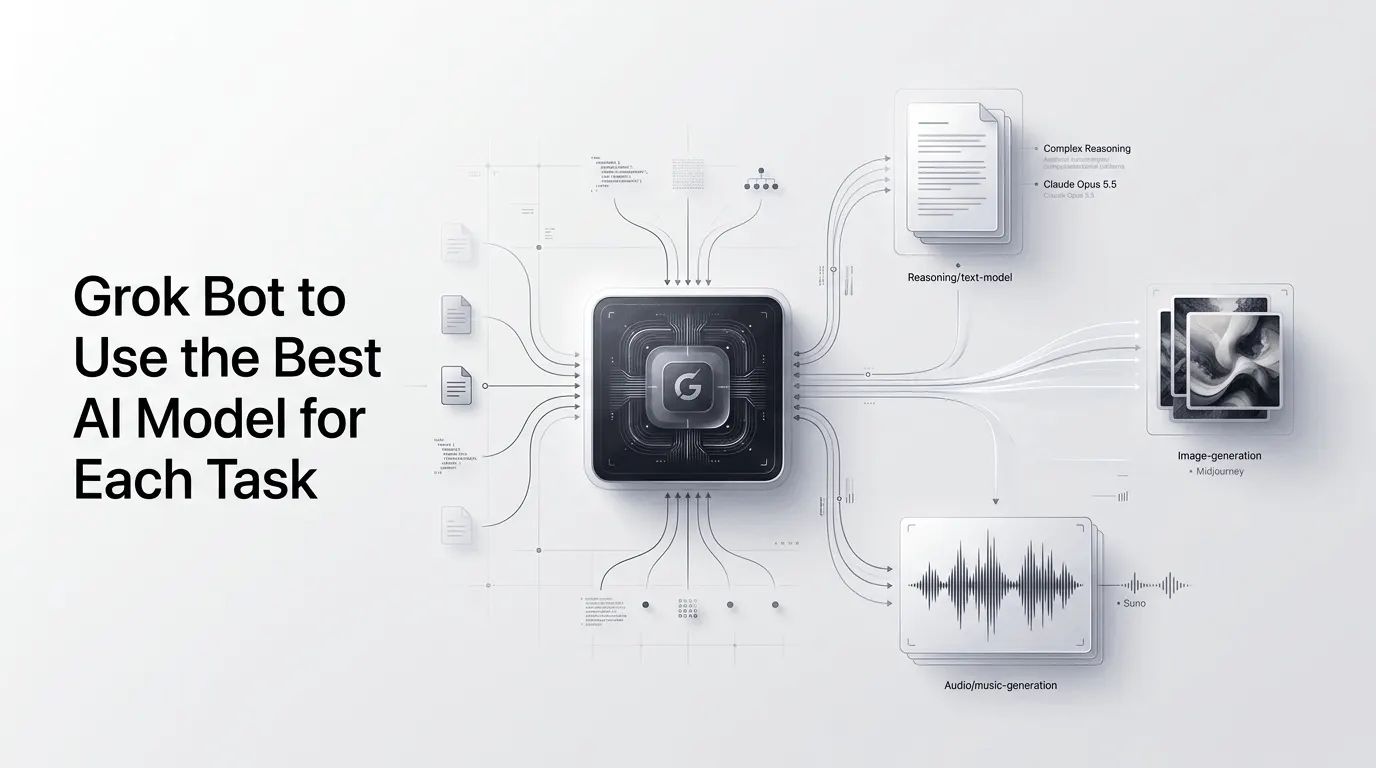
SpaceXAI is moving Grok Bot toward a model-agnostic approach in which the AI agent can use different backend models and services depending on the task, according to Elon Musk. In a post published October 7, Musk said SpaceX will use whichever backend is most likely to produce the best result, naming Claude Opus 5.5, Midjourney, Suno and other leading APIs as examples.
The announcement represents a notable shift in how Grok Bot is positioned. Rather than treating Grok as the only intelligence layer behind its agent, the system is being described as an interface that can select external AI capabilities when they are better suited to a particular job.
However, the precise routing mechanism and the availability of each named service have not yet been publicly documented in SpaceXAI’s official Grok Bot documentation. Musk’s statement therefore confirms the intended direction, but does not establish a detailed list of integrations, model-selection rules or user-facing controls.
Quick Summary
- SpaceXAI is moving Grok Bot toward a multi-model AI approach.
- Elon Musk says Grok Bot will use the best backend model for a particular task.
- Musk specifically named Claude Opus 5.5, Midjourney and Suno among the external AI services.
- The approach could allow agents to combine reasoning, image generation, music generation and other specialized capabilities.
- Grok Bot already supports external tools, connectors and MCP integrations.
- The exact automatic model-routing mechanism has not yet been publicly detailed.
- It has also not been confirmed that every named service is already universally available to Grok Bot users.
- The development positions Grok Bot more as an AI orchestration layer rather than simply a chatbot powered by one model.
What Musk’s Grok Bot Announcement Changes?
Grok Bot launched in August as SpaceXAI’s agent platform for delegating real-world tasks to persistent AI teammates. Each Bot operates through its own cloud computer, with access to browsers, files, terminals and connected tools. The system can continue working while the user’s device is closed and can coordinate work between multiple Bots.
Musk’s latest statement adds a different dimension to the product: the intelligence used to complete a task does not necessarily have to come from a single model.
In his post, Musk specifically cited Claude Opus 5.5 alongside Midjourney, Suno and other leading APIs. His wording suggests that Grok Bot will be able to select among specialized external AI capabilities based on which option is most likely to deliver the desired result.
That distinction matters because the named services perform different jobs. Claude is a general-purpose AI model, while Midjourney specializes in image generation and Suno focuses on music generation. The announcement therefore appears broader than simply allowing Grok Bot to switch between competing language models.
How Grok Bot Already Works?
Grok Bot is designed around persistent AI agents rather than conventional chat sessions.
SpaceXAI describes each Bot as an AI teammate with its own identity, job, conversation history and working context. Bots operate on a persistent cloud computer and can use connected applications, websites and files to complete multi-step assignments.
The platform can also run multiple Bots simultaneously. Bots can communicate with one another, share context and transfer ownership of tasks, allowing a user to create specialized agents for areas such as sales, operations, finance or software development.
That architecture provides a natural place for model routing. An agent could theoretically use one model for reasoning or coding, another service for image creation and a separate service for audio generation, while presenting the entire workflow through a single Bot interface.
Musk’s announcement indicates that this type of multi-model behavior is now part of SpaceXAI’s direction for the platform. The company has not, however, published a technical description explaining exactly how the selection process works.
Read More - Grok Bot Guides: How xAI Is Building Persistent AI Agent Workflows?
Claude Opus 5.5 Is a Significant Addition
The reference to Claude Opus 5.5 is particularly notable because Anthropic’s model competes directly with SpaceXAI’s own frontier language models.
SpaceXAI currently positions Grok 4.7 as its latest model for coding and knowledge work, while Claude Opus 5.5 is another leading general-purpose model. Independent model comparisons show meaningful differences between frontier systems depending on the workload, making task-specific model selection potentially useful for agentic applications.
The significance is therefore not necessarily that Grok Bot is abandoning Grok models. Instead, the announcement suggests that the agent could use Grok when it is the strongest choice while turning to another provider when a different system is better suited to the job.
This is increasingly relevant as AI agents move beyond answering questions and begin executing workflows involving multiple applications and media types.
Read More - Claude Opus 5.5 Launches With Stronger Coding and Lower Costs
Midjourney and Suno Point to a Broader AI-Agent Strategy
The inclusion of Midjourney and Suno is also important because they are not simply alternative text-generation models.
If Grok Bot can invoke specialized services such as image and music generation as part of broader tasks, the agent becomes less dependent on the capabilities built directly into its primary model.
For example, a user could potentially delegate a creative project to a Bot and have the agent combine text reasoning with image or music generation. That would move the product closer to an AI orchestration layer rather than a conventional AI chatbot.
Still, this should not be interpreted as confirmation that every named service is already available to every Grok Bot user. SpaceXAI’s public documentation currently highlights connectors and custom MCP integrations, but it does not provide a published matrix confirming Claude Opus 5.5, Midjourney and Suno as universally available Grok Bot backends.
Grok Bot Is Already Built for External Tools
The broader architecture makes the announcement less surprising.
Grok supports connectors for services including Canva, GitHub, Notion, Linear, Box, Gamma and Vercel. SpaceXAI also allows users to create custom MCP connectors that expose external APIs, databases and SaaS applications to Grok.
Grok Bot itself can use connectors where available and computer-use capabilities for other websites and applications. This allows agents to work across services without requiring every application to have a dedicated native integration.
The new model-selection announcement appears to extend that philosophy from tool access to intelligence access: the Bot can potentially choose not only which tools to use, but also which AI system should perform a particular part of the job.
Read More - Grok Bot 0.65.0 Brings Server-Side Agents as xAI Expands Cloud Workflows
What Has Been Confirmed and What Has Not?
The strongest confirmed information is Musk’s statement that SpaceX intends for Grok Bot to use the best backend model or service for a particular task, including the examples he named.
What remains unclear is how the feature will work operationally.
| Detail | Current status |
|---|---|
| Grok Bot can use persistent AI agents | Confirmed by SpaceXAI |
| Bots can use external tools and connectors | Confirmed |
| Custom MCP integrations are supported | Confirmed |
| Musk says Grok Bot will select the best backend | Confirmed by Musk’s post |
| Claude Opus 5.5 is specifically named | Confirmed in Musk’s post |
| Midjourney is specifically named | Confirmed in Musk’s post |
| Suno is specifically named | Confirmed in Musk’s post |
| Exact automatic routing mechanism | Not publicly documented |
| Universal availability of every named service | Not confirmed |
| Pricing for third-party model usage | Not announced in the available official documentation |
For now, the safest interpretation is that SpaceXAI is expanding Grok Bot toward a multi-model, multi-service agent architecture, while details of implementation and access remain to be clarified.
Why the Grok Bot Shift Matters?
The development reflects a broader change in the AI-agent market. As agents become responsible for completing tasks rather than simply generating responses, the best system for a job may depend on the individual step being performed.
A single agent could need strong reasoning for planning, coding capabilities for implementation, image generation for creative work and specialized software integrations for execution. A model-agnostic architecture can potentially handle those requirements without forcing users to manually switch between AI products.
For Grok Bot, that could make the platform more of an orchestration layer sitting above multiple AI capabilities.
SpaceXAI has already positioned Grok Bot as a persistent agent that can work across applications and continue operating in the background. Musk’s latest statement suggests the company now wants the system to be similarly flexible about the AI intelligence powering those tasks.
The next important details will be how the routing works, which providers are actually available at launch, whether users can select or override the model, and how third-party usage is handled within Grok Bot’s plans.
Also Read –
Grok 4.7 Launches With Stronger Coding and Reasoning
Grok Bot Guides: How xAI Is Building Persistent AI Agent Workflows?
Grok Bot: What Is It? And How It Works?