
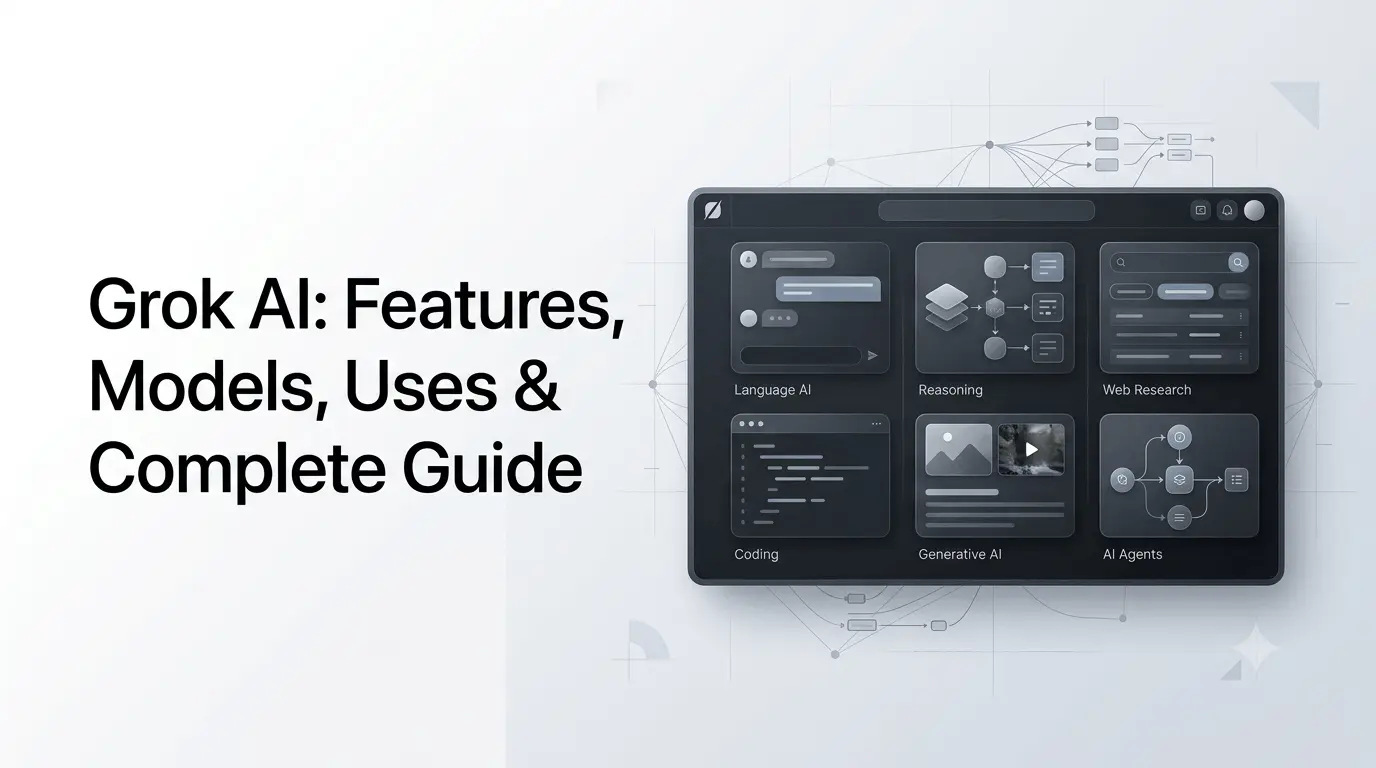
Grok AI is an artificial intelligence assistant developed by xAI. It can answer questions, analyze information, write and summarize content, help with coding, search for current information, understand images, generate and edit media, and perform increasingly complex agentic tasks.
Originally introduced through X in 2023, Grok has evolved into a broader AI platform available through X, Grok.com, mobile apps, developer APIs, enterprise platforms, and tools such as Grok Build. Its model family has also expanded from the early Grok-1 generation to newer systems such as Grok 4.5 and Grok 4.6.
This guide explains what Grok AI is, how it works, its major features, current models, practical use cases, availability, pricing considerations, limitations, and how it compares with the broader AI assistant market.
What Is Grok AI?
Grok AI is an AI assistant and model family created by xAI. It is designed to handle conversational questions, reasoning, coding, research, creative tasks, image and video workflows, and agentic work.
Grok originally became closely associated with X, where it could use information from the platform to help users understand current conversations and events. It has since expanded beyond X into a standalone consumer experience at Grok.com, mobile applications, APIs, and enterprise integrations.
According to X’s current help documentation, Grok is available on X across web, iOS, and Android wherever X is available. X describes Grok as an assistant capable of answering questions, solving problems, brainstorming, and completing other tasks.
The important distinction is that Grok AI is not simply one model. The name refers broadly to the Grok product and ecosystem, while xAI develops multiple underlying models for different workloads.
Who Created Grok?
Grok was created by xAI, an artificial intelligence company founded by Elon Musk.
The first public announcement of Grok came in November 2023. Since then, xAI has released multiple generations of models and expanded Grok from an X-based chatbot into a broader AI platform.
The progression has included:
- Grok
- Grok-1.5
- Grok-2
- Grok-3
- Grok 4
- Grok 4.1
- Grok 4.5
- Grok 4.6
- Specialized systems for coding, image generation, video, voice, and agentic workflows
xAI’s official timeline shows how quickly the platform has expanded. Grok-2 arrived in 2024, Grok-3 in February 2025, Grok 4 in July 2025, and Grok 4.1 in November 2025. By July and August 2026, xAI had introduced Grok 4.5, Grok 4.6, Grok Build, Grok Bot, and newer Imagine models.
How Does Grok AI Work?
At its core, Grok uses large language models trained to understand and generate language. Depending on the task and product configuration, it can also work with images, web information, code, external tools, and other forms of data.
Modern Grok systems increasingly use reasoning and tool use rather than simply generating a response from their trained knowledge.
For example, a complex request might involve:
- Understanding the user’s question.
- Determining whether additional information or tools are needed.
- Searching or retrieving relevant information.
- Reasoning through the problem.
- Generating an answer or completing an action.
- Presenting the result in a useful format.
Grok 4 introduced native tool use and real-time search capabilities, while later generations have increasingly focused on long-running agents and more complex workflows.
This shift is important because modern AI assistants are moving beyond simple chat. Instead of only answering questions, they can increasingly research, code, build, automate, and execute multi-step tasks.
What Are the Main Features of Grok AI?
Grok’s feature set has expanded significantly over time. Exact capabilities and usage limits can vary by plan, platform, model, and region.
1. Conversational AI
The most basic use of Grok is conversational assistance.
Users can ask Grok to:
- Explain difficult concepts
- Answer questions
- Brainstorm ideas
- Rewrite text
- Summarize information
- Create outlines
- Analyze documents or images
- Generate content
- Solve problems
Grok is also known for a more conversational personality, including humor and a less formal tone in some interactions.
2. Web and Real-Time Information
One of Grok’s major differentiators has been its connection to current information.
Grok has incorporated web search and X-related information into its experience, allowing it to investigate topics that may have changed after a model’s original training data.
Grok 4, for example, was introduced with native tool use and real-time search integration.
This can make Grok useful for tasks such as:
- Tracking breaking developments
- Researching current events
- Finding recent product announcements
- Investigating discussions on X
- Comparing current information
- Monitoring trends
However, real-time access does not eliminate the possibility of incorrect information. Users should still verify important claims, particularly for financial, legal, medical, or other high-stakes decisions.
3. Reasoning
Reasoning has become an increasingly important part of the Grok model family.
Grok 3 introduced dedicated reasoning variants such as Grok 3 Think, designed to spend more computational effort on difficult problems.
Grok 4 continued this direction, using large-scale reinforcement learning and native tool use to improve performance on complex reasoning tasks.
Newer models such as Grok 4.6 are designed for longer-running tasks involving research, coding, knowledge work, and interactive applications.
4. Coding
Grok can assist with software development, including:
- Writing code
- Debugging
- Explaining code
- Refactoring
- Generating scripts
- Building websites
- Working with APIs
- Solving programming problems
xAI has also developed specialized coding systems.
Grok Build, for example, is designed around agentic coding workflows. Its underlying grok-build-0.1 model was released through the xAI API for agentic coding tasks such as web development, debugging, and MCP-related work.
Grok 4.5 and Grok 4.6 have also been made available through developer environments such as GitHub Copilot.
5. Grok Build
Grok Build is one of the more significant recent additions to the Grok ecosystem.
It allows users to describe an application, website, game, or dashboard in natural language and have Grok build a working version.
The feature initially launched as an early beta for higher-tier subscribers. By August 2026, xAI had expanded Grok Build to every plan on web and mobile.
Examples of things Grok Build can create include:
- Websites
- Business tools
- Calculators
- Dashboards
- Games
- Simulations
- Interactive applications
This represents a shift from AI-assisted coding toward AI-assisted application creation.
6. Image Generation and Editing
Grok also has a dedicated image-generation ecosystem through Grok Imagine.
In August 2026, xAI introduced Imagine Image 2.0, which it describes as a model designed for image generation and editing with stronger instruction following, typography, layout handling, and consistency across generations.
Users can use Grok’s image capabilities for:
- Concept art
- Marketing graphics
- Social media visuals
- Product concepts
- Posters
- Illustrations
- Image editing
- Creative experimentation
The image-generation capabilities are also exposed through the xAI API.
7. Video Generation
Grok’s creative tools extend beyond still images.
Grok Imagine Video 1.5 supports image-to-video generation and is designed to improve motion, physics, audio, and overall video quality. xAI has also made video-generation capabilities available through its API.
This opens up use cases such as:
- Short-form video
- Product visualization
- Marketing concepts
- Storyboarding
- Social content
- Animation experiments
- Image-to-video workflows
8. Voice
Grok also supports voice-based interaction.
xAI has been developing increasingly sophisticated speech and voice systems, including Grok Voice and voice-agent APIs. The company’s 2026 product updates show a broader push toward conversational voice interfaces and custom voice applications.
Voice can be useful when users want to:
- Talk to an AI assistant hands-free
- Brainstorm ideas verbally
- Ask questions while working
- Create conversational applications
- Build voice agents
9. Agentic AI
Perhaps the biggest change in modern Grok is the move toward agentic AI.
A traditional chatbot generally waits for a prompt and produces an answer.
An AI agent can instead:
- Understand a goal.
- Break the goal into tasks.
- Use tools.
- Execute multiple steps.
- Check results.
- Continue working until the task is completed.
Grok 4.6 was specifically developed with long-running agents and more ambitious interactive work in mind. xAI says it is designed for tasks such as research, codebase analysis, and turning ideas into applications or work artifacts.
Grok Bot extends this concept further by providing AI agents that can work with applications and tools. xAI announced Grok Bot in August 2026 and subsequently expanded its availability to additional plans and enterprise users.
Grok AI Models: A Brief History
The Grok model family has changed quickly.
| Model | Period | Main Focus |
|---|---|---|
| Grok-1 | 2023 | Initial Grok model |
| Grok-1.5 | 2024 | Improved reasoning and longer context |
| Grok-2 | 2024 | Stronger chat, coding and vision |
| Grok-3 | 2025 | Reasoning, mathematics, coding and knowledge |
| Grok 4 | 2025 | Advanced reasoning, tool use and search |
| Grok 4.1 | 2025 | General usability, personality and interaction |
| Grok 4.5 | 2026 | Coding, agentic tasks and knowledge work |
| Grok 4.6 | 2026 | Long-running agents and interactive/visual work |
The table is a simplified timeline rather than a complete list of every Grok variant or specialized model.
Grok-2
Grok-2 launched in August 2024 alongside Grok-2 mini.
It represented a significant improvement over Grok-1.5, particularly in areas including reasoning, coding, visual understanding, science, mathematics, and document-based question answering.
Grok-3
Grok-3 arrived in February 2025 with a greater emphasis on reasoning.
xAI introduced Grok 3 and Grok 3 mini, along with reasoning versions known as Think models. These systems were designed to spend more computational effort on complex problems.
Grok 4
Grok 4 launched in July 2025 and marked a major step toward tool-using AI.
xAI highlighted native tool use, real-time search, advanced reasoning, and a separate Grok 4 Heavy model designed for more demanding workloads.
Grok 4.1
Grok 4.1 arrived in November 2025.
Rather than focusing only on benchmark performance, xAI emphasized improvements in real-world usability, creative interaction, emotional understanding, collaboration, personality, and response quality.
Grok 4.5
Grok 4.5 launched in July 2026 with a focus on coding, agentic tasks, and knowledge work.
xAI described it as its strongest model at the time and made it available through Grok-related products and developer environments.
Grok 4.6
Grok 4.6 is the latest flagship model covered in xAI’s August 2026 announcements.
It focuses particularly on:
- Long-running agents
- Advanced coding
- Knowledge work
- Research
- Interactive applications
- Visual work
- Complex multi-step tasks
Grok 4.6 has also expanded into third-party developer platforms, including Amazon Bedrock, Microsoft Foundry, Gemini Enterprise Agent Platform, and GitHub Copilot.
What Is Grok 4.6 Used For?
Grok 4.6 is particularly relevant for users who want more than a basic chatbot.
Potential workloads include:
Research
Grok can help researchers:
- Explore a topic
- Compare sources
- Organize findings
- Analyze information
- Generate research summaries
- Investigate current developments
Software Engineering
Developers can use Grok for:
- Debugging
- Code generation
- Code review
- Architecture discussions
- Documentation
- Testing
- Agentic coding
Its availability through GitHub Copilot, enterprise platforms, and the xAI API also makes it relevant to professional development workflows.
Business Automation
Agentic Grok systems can potentially handle multi-step workflows rather than simply answering questions.
Examples include:
- Researching competitors
- Processing information
- Drafting business documents
- Working with software tools
- Creating internal applications
- Automating repetitive workflows
The exact capabilities depend on the product, integrations, permissions, and plan.
Grok AI Use Cases
Grok can be useful across several categories.
| User Type | Example Use Cases |
|---|---|
| Students | Research, explanations, brainstorming, study assistance |
| Creators | Writing, images, video concepts, brainstorming |
| Marketers | Content ideas, research, campaign concepts, trend analysis |
| Developers | Coding, debugging, APIs, agentic development |
| Researchers | Information discovery, analysis, summarization |
| Businesses | Automation, knowledge work, internal tools |
| General users | Questions, planning, writing, everyday assistance |
For marketers, for example, Grok can help research current conversations on X, develop content ideas, analyze competitors, create campaign concepts, and generate visual assets.
For developers, its value increasingly comes from combining reasoning with tools and agentic workflows rather than simply generating snippets of code.
Is Grok AI Free?
Yes, Grok can be used without a paid subscription, although free access comes with limitations.
The exact limits and available capabilities can change over time and may differ between X, Grok.com, mobile apps, and other platforms.
Paid subscriptions provide access to higher usage levels and additional capabilities depending on the specific plan.
X currently lists several Premium tiers, while Premium+ includes SuperGrok access and Grok Bot among its benefits.
Because AI subscription structures change frequently, users should check the current subscription page or account checkout before relying on a particular price, usage limit, or feature.
Grok AI vs SuperGrok
The terms can be confusing.
Grok generally refers to the AI assistant and its broader product ecosystem.
SuperGrok refers to paid access associated with higher levels of Grok functionality.
A simplified way to think about the difference is:
| Area | Grok Free | SuperGrok |
|---|---|---|
| Basic AI conversations | Yes | Yes |
| General questions | Yes | Yes |
| Higher usage | Limited | Higher access |
| Advanced capabilities | Varies | More extensive |
| Latest/advanced models | Availability varies | Greater access |
| Agent features | Availability varies | More extensive |
| Creative tools | Availability varies | Higher access depending on plan |
| Best for | Casual users | Frequent and advanced users |
These capabilities can change as xAI updates its products, so the current plan documentation should be treated as the final authority.
Grok vs X Premium+
Grok and X Premium+ are related but are not exactly the same product.
X Premium+ is primarily a subscription to the X platform, but it includes additional AI-related benefits.
According to X’s current documentation, Premium+ includes SuperGrok access, Grok Bot, no ads across X, Radar Search, Articles, and other Premium+ features.
This creates an important choice:
Choose a Grok-focused subscription if your main priority is AI capabilities.
Choose X Premium+ if you also want a broader collection of X platform benefits alongside Grok access.
The best option depends on how much of your daily workflow happens inside X.
Grok AI for Developers
Developers can access Grok through the xAI API rather than using only the consumer chatbot.
This allows developers to integrate Grok into:
- Websites
- Applications
- AI assistants
- Coding tools
- Enterprise software
- Agentic systems
- Research applications
- Automated workflows
Grok models have also become available through platforms such as Amazon Bedrock, Microsoft Foundry, Gemini Enterprise Agent Platform, GitHub Copilot, and other developer ecosystems.
For example, xAI lists Grok 4.6 API pricing starting at $2 per million input tokens and $6 per million output tokens, with cached input priced lower.
API pricing should not be confused with consumer subscription pricing. They are separate products with different billing structures.
What Are the Limitations of Grok AI?
Grok is powerful, but it is not infallible.
1. It Can Make Mistakes
Like other generative AI systems, Grok can produce incorrect information or misunderstand a question.
X’s own help documentation warns that Grok can provide confidently incorrect information, missummarize information, or miss context.
Important claims should therefore be independently verified.
2. Usage Limits
Free and paid users do not necessarily receive unlimited access to every model or feature.
Limits can vary according to:
- Subscription
- Model
- Platform
- Region
- Current demand
- Feature
3. Rapid Product Changes
Grok is developing quickly.
A feature available today may later move between plans, change limits, receive a new model, or be replaced entirely.
This is particularly important when reading older articles about Grok pricing or model availability.
4. AI Does Not Replace Expert Judgment
Grok can assist with research, analysis, writing, programming, and decision-making, but it should not automatically be treated as an authoritative source.
High-stakes information should be checked against primary sources and qualified professionals.
Is Grok AI Good for Beginners?
Yes.
A beginner does not need to understand model architecture, APIs, or agentic AI to use Grok.
A simple starting workflow is:
- Ask a clear question.
- Provide relevant context.
- Tell Grok what kind of answer you want.
- Ask it to explain unfamiliar concepts.
- Verify important information.
- Refine the conversation with follow-up questions.
For example, instead of asking:
“Explain SEO.”
A better prompt would be:
“Explain technical SEO to a beginner using a simple website example, then give me five practical things I can check today.”
The second prompt gives the model a clearer objective and desired format.
How to Get Better Results From Grok?
The quality of the output often depends on how clearly the task is described.
Give Grok Context
Explain what you are working on before asking for an answer.
Define the Output
Specify whether you want:
- A table
- Bullet points
- A detailed explanation
- Code
- A summary
- A step-by-step process
Ask for Verification
For research-heavy tasks, ask Grok to identify sources and distinguish confirmed information from assumptions.
Break Complex Tasks Into Steps
Instead of asking for an entire project in one vague prompt, define the objective, constraints, inputs, and desired output.
Review Important Results
AI-generated output should be checked before being published, deployed, or used for important decisions.
Where Is Grok AI Available?
Grok is available through multiple products and platforms.
These include:
- X
- Grok.com
- iOS
- Android
- xAI API
- Developer platforms
- Enterprise AI platforms
X’s current documentation states that Grok is available in all countries where X is available, although specific features and subscription options can vary.
Grok 4.6 has also expanded into platforms such as Amazon Bedrock, Microsoft Foundry, Gemini Enterprise Agent Platform, and GitHub Copilot.
What Is the Future of Grok AI?
The direction of Grok suggests a shift from chatbot-style AI toward agentic computing.
Instead of simply asking an AI to write something, users increasingly want AI systems that can:
- Research independently
- Use software tools
- Write and test code
- Build applications
- Monitor information
- Execute workflows
- Work with business data
- Continue working across multiple steps
xAI’s recent releases strongly support this direction. Grok 4.6 focuses on long-running agents, Grok Bot provides persistent agent capabilities, and Grok Build allows users to create applications directly through natural-language instructions.
That does not mean every Grok user will immediately have an autonomous AI employee. Access, reliability, permissions, and plan availability remain important constraints.
But the product direction is clear: Grok is evolving from an AI chatbot into a broader AI assistant, creative platform, developer environment, and agent ecosystem.
Conclusion
Grok AI has developed far beyond its original role as an AI chatbot on X.
Today, the Grok ecosystem includes conversational AI, reasoning models, web and X search, coding assistance, image generation, video generation, voice capabilities, APIs, application-building tools, and agentic systems.
The model family has progressed from Grok-1 and Grok-2 through Grok 3 and Grok 4 to newer generations such as Grok 4.5 and Grok 4.6. The latest direction is increasingly focused on agents that can work through complex, multi-step tasks rather than simply responding to individual prompts.
For casual users, Grok can serve as a general-purpose AI assistant. For creators, it provides increasingly capable image and video tools. For developers, its API, coding models, and agentic tools open up more advanced workflows.
The most important thing to remember is that Grok is changing quickly. Model names, plan benefits, usage limits, and available features can change, so current xAI and X documentation should be checked whenever pricing or access is important.
Frequently Asked Questions (FAQs)
1. What is Grok AI used for?
Grok AI can be used for answering questions, research, writing, coding, reasoning, image generation, video creation, voice interaction, information discovery, and increasingly complex agentic workflows.
2. Is Grok AI free?
Grok offers free access, although free users have usage and feature limitations. Paid plans provide higher access and additional capabilities. The exact limits and features can change over time.
3. Who owns Grok AI?
Grok is developed by xAI. The product originally became closely integrated with X before expanding to Grok.com, mobile apps, APIs, and enterprise platforms.
4. What is the latest Grok model?
As of September 2026, Grok 4.6 is xAI’s latest flagship model announced publicly. It focuses on long-running agents, coding, research, knowledge work, and interactive and visual tasks.
5. Is Grok better than ChatGPT?
There is no single answer. Grok, ChatGPT, Claude, Gemini, and other AI systems have different strengths, features, models, tools, and pricing structures. Grok can be particularly useful for users who value its connection to X, real-time information workflows, creative tools, and growing agentic capabilities.
6. Can Grok generate images and videos?
Yes. Grok’s Imagine ecosystem supports image generation and editing, while its video models support video-generation workflows. xAI has also made these capabilities available through its API.
Also Read –
Grok 4.7 Delayed: Release Update, Expectations & What’s Next
Grok Enterprise Knowledge Search: Secure AI for Company Data
Grok Tasks: xAI’s AI Assistant for Automated Monitoring
Grok on Windows: How to Install and Use Grok as a PWA?