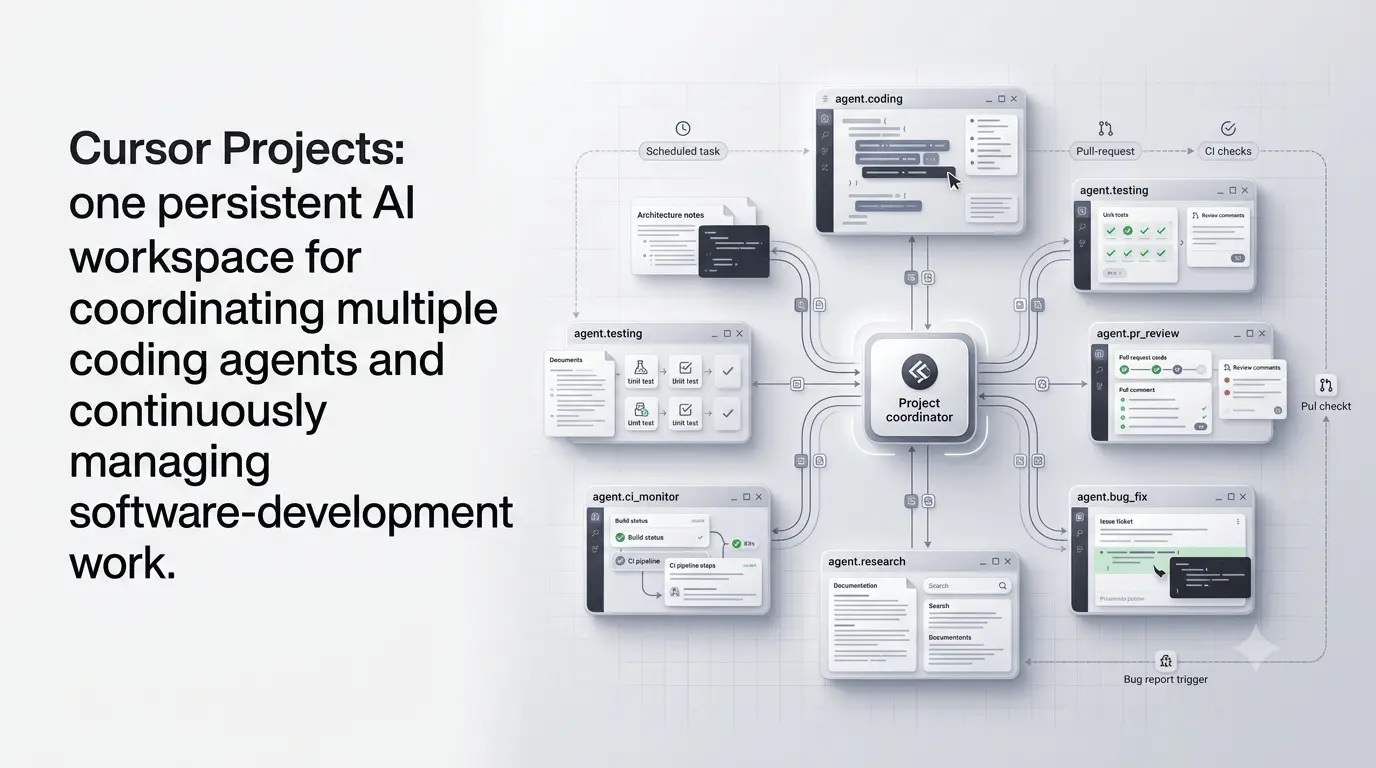
Cursor is launching Projects, an innovative way to oversee the long-running development of software through the coordination of an AI agent with several agents with specialized expertise. It was announced on 10 September 2026. Projects are designed to handle tasks that go beyond a single code session, with features that are large, including migrations, complete applications, and continuous code maintenance.
Instead of launching another chat window for each job, developers can build an ongoing Project and connect with a coordinator. The coordinator organizes the work and delegates tasks to agents, and reports their findings to be reviewed.
Cursor claims that Projects can keep the context of months as well as delegate work to a multitude of subagents and complete repetitive jobs without waiting on a new prompt. The feature is currently in beta and is now making its way to users.
Quick Summary
- Cursor has launched Projects as a persistent workspace for long-running software development.
- Projects uses a coordinator agent to manage multiple specialized AI agents.
- Agents can work on coding, testing, research, pull requests and other development tasks.
- Projects can support scheduled and event-driven workflows, including development maintenance.
- Agents can share context, files and generated artifacts across the Project.
- The feature is aimed at moving AI coding beyond individual prompts toward ongoing agentic software development.
- Cursor announced Projects on September 10, 2026.
What Is Cursor Projects?
Cursor Projects is designed to transfer AI-assisted development away from specific programming tasks to larger areas of work.
A Project can be used to implement a feature that spans several pull requests, a framework migration, as well as entire application regular maintenance. Instead of having developers manually control every AI agent, an orchestrator handles the orchestration.
The coordinator does not create the code for implementation. It is responsible for planning the tasks and assigning particular tasks to agents who perform them. This architecture permits the coordinator to be flexible while several agents are working in parallel.
This is what makes Projects distinct from conventional AI chatbots, where the developer usually assigns an agent a specific task to complete and then patiently waits for the outcome before deciding what to do next.
Cursor Projects Uses a Coordinator to Manage AI Agents
The main element of Projects is the coordinator agent.
Developers work with the coordinator in an ongoing Project dialogue. The coordinator is able to research an existing codebase, design plans and assign various tasks to specialists.
For instance, a huge component could be broken down into implementation, research or testing assignments. Multiple agents could then tackle these tasks simultaneously before the outcomes are integrated into the Project.
Cursor has also developed Projects that support cloud-based and local execution. The Project is run on its own computer within the cloud, which allows the work to continue even if the developer shuts down their laptop. If a task has to be evaluated on the developer’s computer, the coordinator is able to start an agent locally for the task.
Shared Context Lets Projects Remember How Work Is Done
One of the most important features that is a part of Cursor Projects is its shared context system.
Each Project keeps a repository of files which can be synchronized between the cloud and the local machines used for its agent. The files could include research, created artifacts, and information regarding the codebase, as well as instructions that reflect how the developer wants the work to be done.
This means that agents who are working on different projects are not required to begin from the same blank space.
Cursor provides an example of an agent determining the best way to conduct a specific service to be evaluated. This information could be incorporated into the context shared by the Project and allow future agents to benefit from it instead of repeating the process for onboarding.
In time, Cursor says the shared context will increase as the Project discovers more about the structure and preferences for development.
Projects Can Run Scheduled and Event-Driven Work
Cursor Projects also extends AI programming agents to tasks that start with an immediate call.
Projects can be subscribed to events like Slack notifications, scheduled tasks, and pull requests. This lets the coordinator react to new work that is spotted.
For example, a developer team could connect to the Slack channel to receive bug reports. If a new issue is discovered, the Project will be able to detect the problem and delegate the work to agents.
Projects are also able to examine pull requests, deal with CI issues, and react to any new development activity. Cursor explains this as a method for agents to work on the signals instead of patiently waiting for developers to start each task.
This builds upon Cursor’s previous efforts to work with always-on cloud agents and workflows for development driven by events.
How Cursor Projects Can Be Used?
Cursor identifies three fundamental patterns for projects, including feature development, migrations, and continuous code maintenance.
Feature Development
In order to benefit from an important aspect, agents should start by researching the current system and documenting what they discover in a shared environment.
The coordinator is then able to create plans and assign test and implementation tasks to different agents. When the feature is complete and tested, a local agent could be used to test any changes on the development machine.
The identical Project will be available following launch to review the code and help to address any resulting issues.
Large-Scale Migrations
Projects are also a great option to facilitate migrations that require a lot of changes to the codebase.
Cursor states that it has utilized Projects for the adoption of frameworks and styling-system changes in a variety of pull requests. The coordinator is able to establish an approach and then implement it gradually, permitting developers to look over the initial changes carefully prior to reducing manual supervision as the process gets more stable.
Ongoing Code Maintenance
Another reason to consider work that is never truly finished.
A Project can track pull requests, monitor bugs or reports, or run on an agenda to detect regular maintenance tasks. Cursor refers to this as “gardening” — continuous work like monitoring code quality and identifying regressions.
In one instance, Cursor says a design-system Project can analyze the new requests for pulls, spot frequent mistakes, and then add the lint rule when it finds the same issue repeatedly. Cursor says that the Project is set to process between 20 and 100 pull requests each day, with an engineer paying attention to instances that require human supervision.
Cursor Says Projects Can Increase Developer Productivity
Cursor also released initial internal productivity figures prior to the announcement.
The company claims that new users of Projects combine 30 percent more pull requests, and those who use Projects primarily integrate six times more Pull requests. Cursor’s reported results are not independent benchmarks; therefore, they are measures of productivity reported by the company, not an overall benchmark for the industry.
The most important development is what happens to the software itself. Projects aims to create AI agents responsible for coordinating the entire software tasks instead of responding to code instructions.
Cursor Projects Builds on Its Push Toward Always-On AI Agents
Projects follow several previous Cursor innovations designed to make coding agents more self-sufficient.
This August, Cursor added additional cloud agent capabilities. These included events-triggered work schedule tasks, pull-request monitoring and long-running objectives. Additionally, it introduced isolated environments in which subagents are able to operate within themselves on their virtual computers.
Projects integrates these capabilities to form a more permanent structure layer.
The distinction is significant since the developer’s job shifts from direct management of each agent’s task to setting the goal, monitoring progress, and intervening when needed.
Availability
Cursor Projects is currently available in beta and is being released to users. Projects can be initiated using the left-hand navigation of Cursor, in which developers can specify the tasks they would like to be handled with the help of a coordinator.
Cursor positions Projects to work on projects that last longer than one chat, including features that require numerous pull requests, migrations, and regular maintenance tasks.
The announcement also marks an evolution in the development of software using AI. Instead of thinking of an AI programming agent as a tool that waits for the next command, developers are now able to create groups of agents with enduring objectives.
Also Read –
Cursor 2.4 Update: Subagents and Nano Banana Pro Features
Cursor Dynamic Context: Smarter AI Context With 47% Fewer Tokens
Cursor Visual Editor: AI-Driven Drag-and-Drop UI Design
Cursor Visual Editor: AI-Driven Drag-and-Drop UI Design