
xAI has expanded the scope of its Grok Bot Guide with a complete guide for creating and operating long-lasting AI agents that are able to utilize computers, communicate with other applications, and work after a single chat.
xAI’s Grok Bot 101 guide, released on September 11, gives an in-depth overview of Grok Bot. It provides instructions on how users can build agents, train them on workflows connecting external services, set up routine tasks, and integrate several bots. The overall Guides hub includes additional information on support, engineering and templates, mobile app creation, designing, go-to-market work, and product management.
Documentation offers a clearer understanding of the way xAI believes Grok Bot is part of the growing market for permanent AI agents. It is less a typical chatbot and more akin to a digital assistant capable of executing defined tasks over the course of.
Quick summary
- xAI has expanded its official Grok Bot Guides library, with Grok Bot 101 published September 11, 2026.
- Grok Bot operates through a persistent cloud computer with a desktop, filesystem, terminal and applications.
- Bots can run scheduled routines and event-triggered workflows.
- Grok Bot can connect to services including Gmail, Calendar, Drive, Slack and other tools.
- Multiple specialized bots can communicate and form multi-agent workflows.
- xAI is publishing guides covering engineering, support, GTM, design, product management and mobile development.
- The broader development shows xAI positioning Grok Bot as a persistent AI workforce/agent platform, not simply a conversational assistant.
What Is Grok Bot?
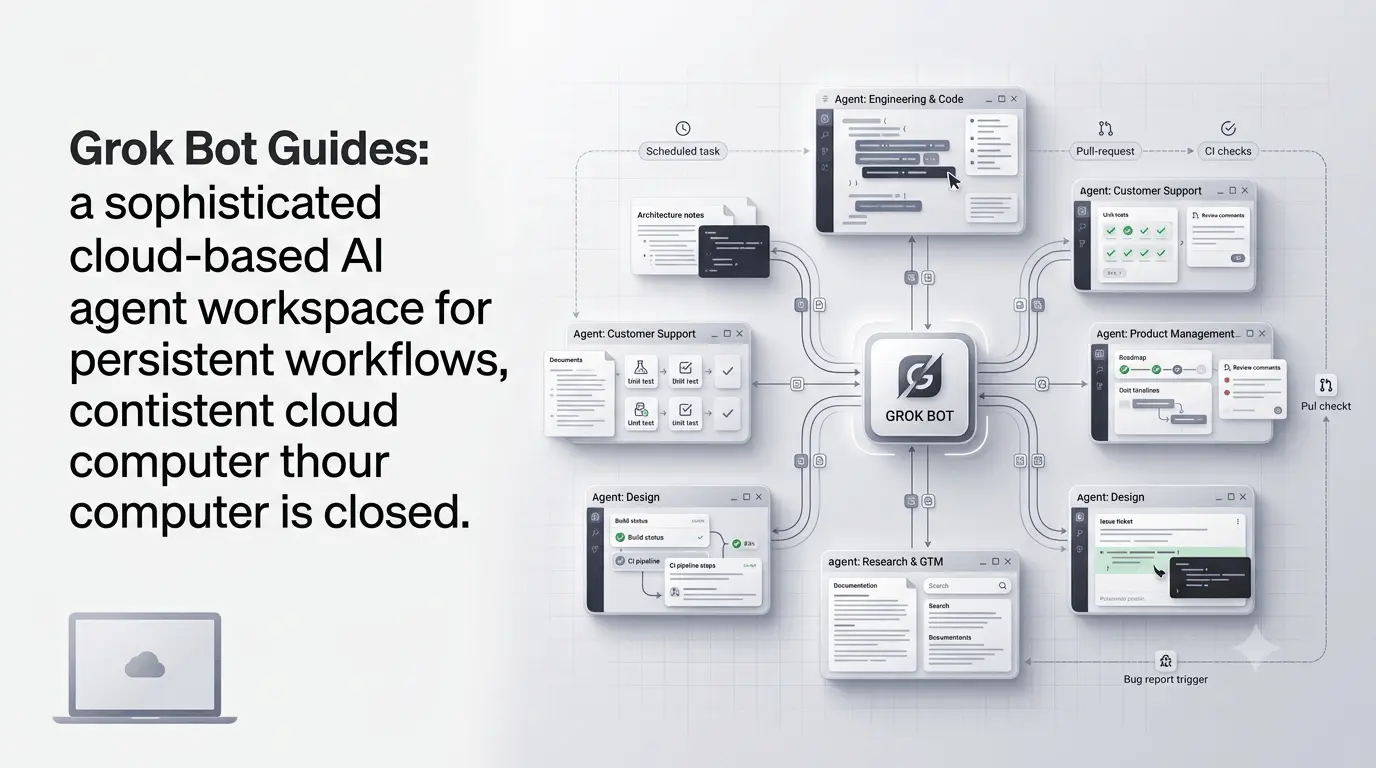
Grok Bot is an AI agent that operates through a computer environment hosted in the cloud. According to xAI’s Grok Bot 101 guide, the environment includes a desktop, filesystem, terminal and applications, allowing the bot to perform tasks in a way that resembles a person using a computer.
The persistent computer is central to the product. Instead of starting from a blank environment every time a conversation begins, a bot can retain its setup and continue working after the user closes their laptop.
Users can interact with the bot through chat, but xAI also describes routines and triggers that allow a bot to respond to scheduled events or activity in connected services.
That makes Grok Bot relevant to workflows that traditionally require repeated manual intervention.
Grok Bot Can Run Scheduled and Event-Driven Workflows
One of the more significant capabilities described in the new documentation is the ability to automate work without requiring a fresh prompt for every task.
xAI says Grok Bot supports three primary interaction patterns:
- Direct conversations with a bot
- Routines and triggers based on schedules or events
- Communication between multiple bots
A bot can, for example, monitor a Slack thread or GitHub pull request, run work on a schedule, or trigger another specialized bot when additional expertise is required.
This moves Grok Bot beyond the traditional question-and-answer model. The agent can become part of an ongoing workflow rather than simply responding when a user opens a chat.
Connected Apps Give Grok Bot Access to Real Workflows
Grok Bot can connect to services used for everyday knowledge work. The official guide specifically discusses integrations involving Gmail, Google Calendar, Google Drive and Slack, along with support for MCP servers, plugins and skills.
The model can therefore be configured to work across multiple information sources instead of operating entirely within its own conversation.
xAI’s documentation describes examples where a bot can gather information from services such as Slack, Notion and GitHub before passing the resulting context to another specialized agent.
This architecture separates information gathering and decision support from task execution.
Multi-Bot Chains Let Specialized Agents Work Together
Another major theme in the Grok Bot Guides is the use of multiple specialized agents.
Rather than asking one general-purpose bot to perform every part of a complex workflow, users can create bots with different responsibilities and allow them to communicate with one another.
For example, xAI’s documentation describes a setup in which one bot monitors a marketplace, while another acts as a chief-of-staff-style agent that can provide additional judgment when required. Bots can also be placed into group conversations and trigger other bots as part of a workflow.
This is effectively a multi-agent AI architecture in which different agents handle different parts of a larger process.
The approach is also visible in xAI’s broader Grok Bot material. Its GTM guide describes a chief-of-staff bot coordinating specialized agents for tasks such as prospecting, customer research, forecasting and presentations.
Grok Bot Can Be Taught Workflows
The Grok Bot 101 guide also emphasizes a different approach to configuring agents.
Rather than requiring users to build conventional automation logic, xAI says users can describe a workflow through instructions or demonstrate how a task should be performed.
The bot’s configuration can then define the role, workflow and rules it should follow. xAI describes these instructions as a natural-language alternative to defining agent rules through code or JSON.
That could lower the technical barrier for users who want to automate repetitive computer-based tasks without building a traditional software integration.
Permissions Remain Important for Computer-Using Agents
Giving an AI agent access to a computer and external services also creates a different set of risks from those associated with ordinary chatbots.
xAI’s documentation acknowledges this directly. Its Grok Bot 101 guide explains that permissions, reviewers and allow/block lists are used to control what bots can do. A separate review agent can evaluate proposed actions and allow, block or escalate them to the user.
The guide also notes that users need to consider what happens when an agent has access to authenticated websites and connected accounts.
This makes permission design an important part of deploying persistent AI agents, particularly when they can perform actions rather than merely generate information.
Grok Bot Is Being Positioned for More Than Coding
Although AI coding agents are an important part of the current agent ecosystem, xAI’s Grok Bot Guides show a much broader strategy.
The official guide library includes material for:
- Engineering
- Customer support
- Product management
- GTM and sales
- Design
- Mobile application development
- Multi-bot teams
- Workflow templates
The company’s earlier GTM guide similarly describes bots being used for meeting preparation, prospecting, customer research, forecasting, presentations and account monitoring.
That breadth suggests xAI is positioning Grok Bot as a general-purpose AI workforce platform, rather than limiting it to a single category such as coding assistance.
xAI Is Already Demonstrating Enterprise Workflows
The new documentation comes as xAI expands its public examples of Grok Bot in business environments.
In a September 4 example, xAI described using a procurement-focused bot called Haggle Bot to analyze vendor spending, contracts and usage data. The company said the bot identified more than $100,000 in direct savings.
xAI also described using the bot to identify unused SaaS seats, research alternative vendors and prepare procurement negotiations, while requiring human approval for actions such as spending money or accepting contractual terms.
These examples reinforce the distinction between an AI assistant that provides information and an AI agent that can continue working across multiple systems.
Grok Bot Guides Make the Agent Strategy More Accessible
The significance of the new Grok Bot Guides is therefore less about documentation alone and more about making xAI’s agent architecture easier to reproduce.
The Grok Bot 101 guide provides a starting point for creating a bot in roughly 10 to 15 minutes, according to the guide’s author, and then demonstrates how that bot can be connected to applications, given persistent workflows and combined with other agents.
For developers and businesses evaluating AI agents, the documentation also provides a practical look at how xAI expects persistent agents to operate: with their own computing environment, access to external tools, defined permissions, reusable skills and the ability to delegate work to other agents.
That puts Grok Bot firmly within the broader shift toward agentic AI, where the value of an AI system increasingly comes from completing multi-step tasks rather than simply generating responses.
Also Read –
Grok Bot: What Is It? And How It Works?