
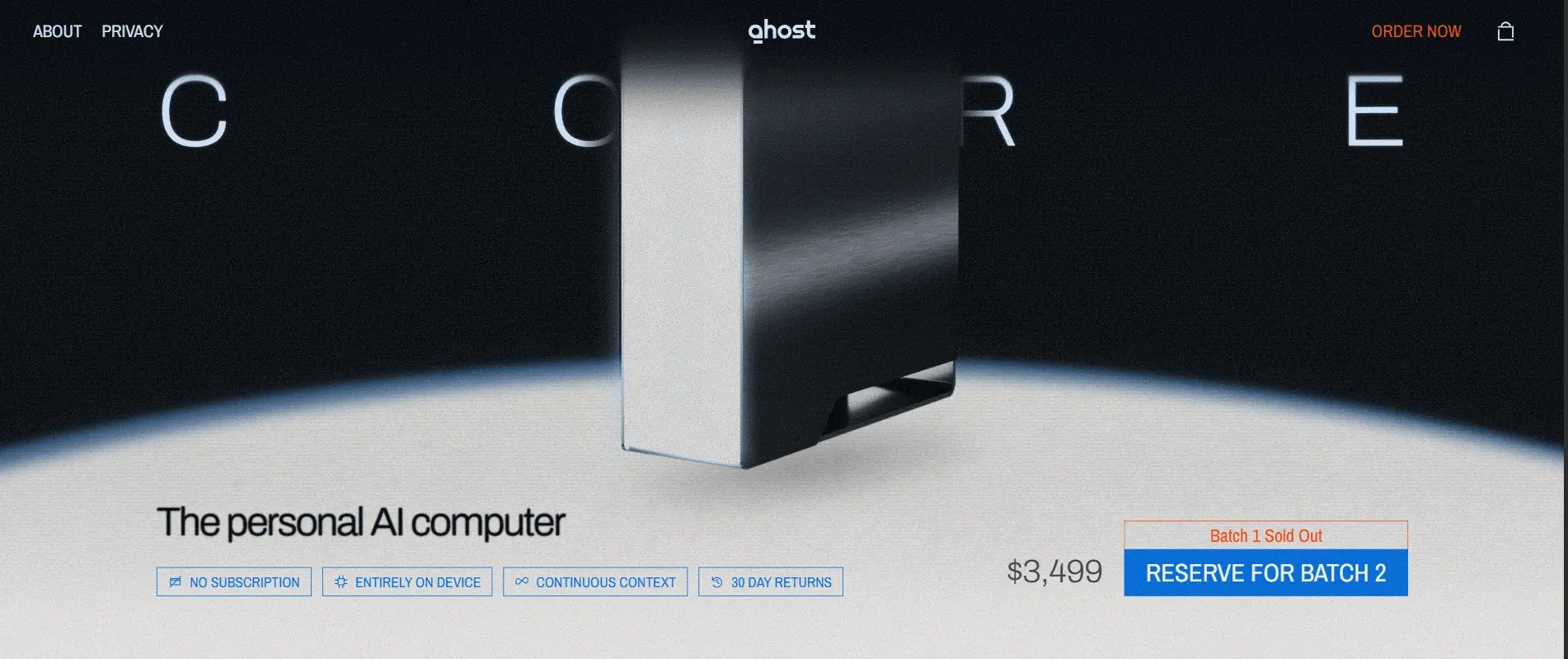
Ghost has launched Core, a dedicated personal AI computer designed to run AI models and agents locally while continuously building context from a user’s apps, files and connected devices. The screenless machine costs $3,499 and is designed to remain running continuously rather than functioning like a conventional desktop PC.
Ghost says Core processes its AI workloads on-device and is designed around the idea of keeping a user’s personal AI and its accumulated context on dedicated hardware. The company lists an NVIDIA RTX PRO 4000 Blackwell SFF Edition GPU, 64GB of DDR5 memory, 1TB of NVMe storage and an AMD Ryzen 5 7600 processor.
The first Core batch is scheduled to ship on October 31, according to Ghost’s product page.
What Is Ghost Core?
Core is positioned by Ghost as a personal AI computer, rather than a traditional computer that happens to run AI software.
The device has no conventional display. Instead, users interact with Core through connected devices and the company’s software, while the hardware remains dedicated to running AI models and managing the context associated with the user’s digital life.
Ghost says Core can connect to applications, files, devices and other sources of information. Its product materials reference email, calendars, finances, files, recordings, browsers, smart-home devices, cameras and health-related devices including Whoop, Oura and Eight Sleep.
The underlying concept is continuous context. Rather than requiring a user to provide the same information during every interaction, Core is designed to build a persistent understanding of information it is allowed to access.
Ghost gives examples involving routines, activity and connected data, with Core intended to identify patterns and surface suggestions proactively rather than waiting for a conventional prompt.
Ghost Core Hardware and AI Models
The hardware is a major part of Ghost’s approach because the company is building Core specifically around local AI inference.
Ghost lists the following specifications:
| Component | Core specification |
|---|---|
| GPU | NVIDIA RTX PRO 4000 Blackwell SFF Edition |
| GPU memory | 24GB GDDR7 ECC |
| CPU | AMD Ryzen 5 7600 |
| CPU configuration | 6 cores, 12 threads |
| RAM | 64GB DDR5 |
| Storage | 1TB NVMe SSD |
| Memory bandwidth | 432GB/s |
| AI performance rating | 770 AI TOPS |
Ghost also lists four models for Core: Qwen 3.8-Next, Qwen 3.8-27B, Gemma 4-31B and Muse-Glimmer-30B.
The supplied social posts also cited specific token-generation speeds for Qwen models. Those figures were not visible on the current official Core product page, so they are not treated here as independently verified performance measurements.
Ghost’s product positioning also extends beyond its preinstalled models. TechCrunch reported that founder Zain Javaid said users would be able to install other models from Hugging Face or load their own trained models.
Core Is Designed to Keep AI Processing Local
Local processing is one of the central differences between Core and conventional cloud-based AI assistants.
Ghost says Core runs models entirely on the device and that conversations, files, connected-app information and memories are stored and processed locally. Its privacy policy states that Core does not use a remote AI model as a fallback for its local conversational AI or memory processing.
That does not mean every internet-dependent operation happens without external services.
Ghost’s privacy documentation explains that features such as web search and phone calls can use online services. In those cases, task information can be sent to third-party providers through Ghost’s managed-service gateway. Ghost says its gateway does not retain the forwarded request and response content, while third-party providers may have their own retention policies.
This distinction is important: Core’s AI and memory are designed to run locally, but some actions can still require internet-connected services.
A Personal AI Agent With Access to Your Digital Context
Ghost is also positioning Core around AI agents rather than simple conversational assistance.
The product is designed to access information from connected applications and devices, understand the context around that information and take actions on a user’s behalf. Ghost describes Core as a proactive system that can identify what is happening in a user’s life and determine when an action or suggestion may be useful.
That approach makes Core different from a conventional chatbot. A chatbot generally waits for an instruction and works from the information supplied in the conversation. Core is being designed around a persistent environment in which an AI agent can maintain context across different sources.
For example, information from a calendar, wearable device, files or email can become part of the context available to the system, subject to the connections and permissions a user enables.
Ghost’s setup documentation says users select models, connect apps and upload data during setup, after which Core builds its memory on the device.
Core Is Also Built for AI Development
Ghost is not positioning Core solely as a consumer assistant.
The product page includes a specific FAQ about using Core for inference in personal applications and AI development tools such as OpenCode and OpenClaw. This makes the hardware relevant to developers who want a dedicated local machine for AI inference rather than relying exclusively on cloud APIs.
That could make Core useful in two overlapping roles: as a personal AI system that interacts with a user’s digital environment and as local infrastructure for running AI models and agent workloads.
The combination of dedicated GPU hardware, substantial memory and local model execution is central to that proposition.
Price, Availability and What Ghost Is Selling
Ghost lists Core at $3,499, with no subscription required for the device itself. The product page currently says the first batch ships October 31 and includes a one-year warranty and a 30-day return period.
The price places Core firmly in the premium personal-computing category. Its value proposition therefore depends less on replacing an ordinary desktop and more on whether users want dedicated hardware for persistent local AI, agent workloads and private personal context.
TechCrunch reported that Ghost emerged from stealth alongside an $11 million seed round led by Andreessen Horowitz. The publication also reported that Core was designed specifically for AI agents and that its first batch was scheduled to ship toward the end of October.
Core represents a broader shift in how personal AI hardware could be designed: instead of adding an AI assistant to an existing computer, the computer itself is being built around the AI system.
Whether that approach proves useful at a $3,499 price will ultimately depend on real-world performance, reliability, privacy behavior and the quality of the agents and integrations available to users. For now, Ghost’s Core is one of the more direct attempts to turn local AI inference and persistent personal context into a dedicated consumer hardware product.
Also Read –
Googlebook: Gemini AI Laptop From $899