
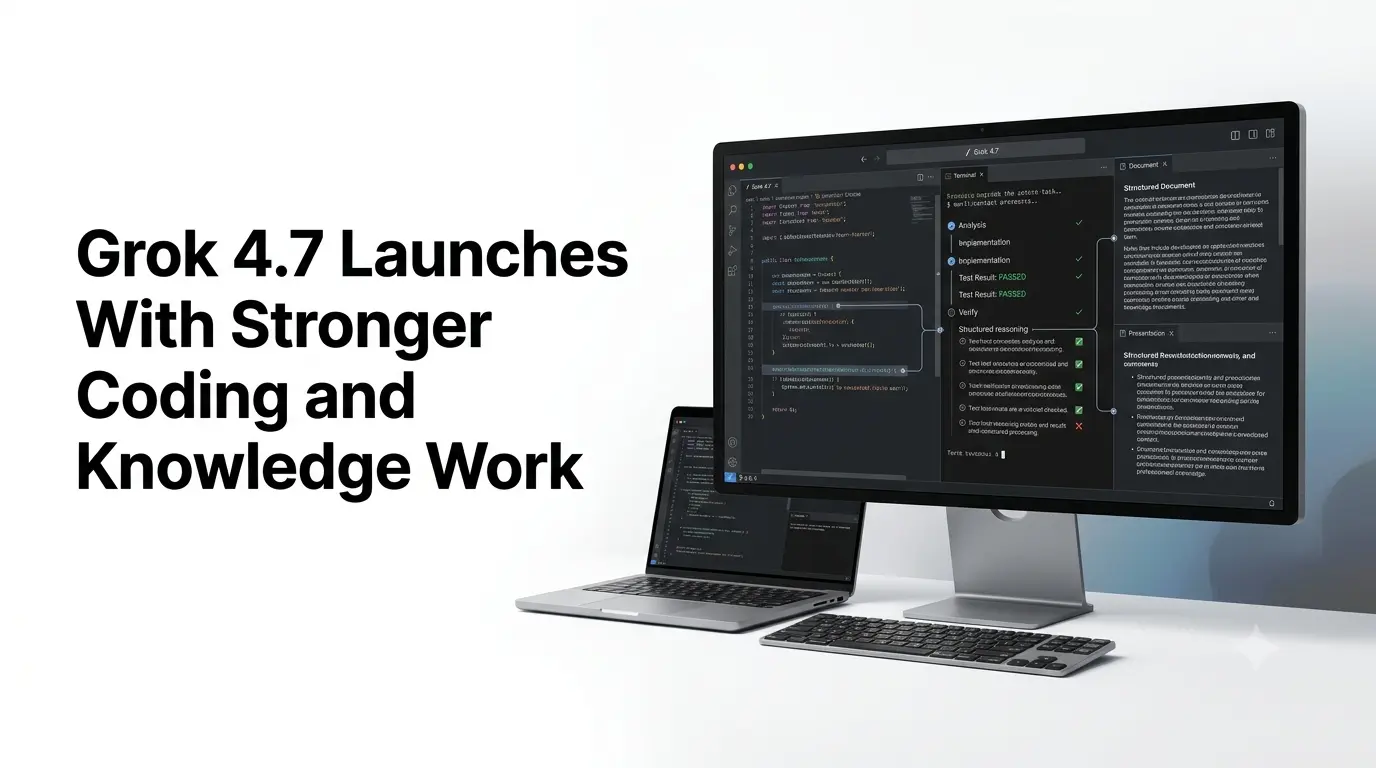
SpaceXAI has released Grok 4.7, a new AI model designed for coding and knowledge work that the company says can work longer on difficult tasks, manage more context and verify its own output more carefully. Released on September 21, 2026, Grok 4.7 keeps the same standard API pricing as Grok 4.6 while introducing a new base model, longer reinforcement-learning training and a redesigned safeguard stack.
The release moves Grok beyond the incremental model updates that have characterized the recent 4.x series. SpaceXAI says Grok 4.7 was trained on a harder mixture of tasks weighted toward problems that can take hours to complete, with particular attention to software engineering, professional knowledge work and multi-step reasoning.
Grok 4.7 is available through the Grok API, Cursor, Grok Build, third-party coding harnesses, model routers and cloud platforms.
Quick Summary
- Grok 4.7 is SpaceXAI’s new AI model for coding and knowledge work.
- It uses a new, larger base model and longer training on difficult tasks.
- The model focuses on long-running coding and multi-step workflows.
- SpaceXAI reports improvements over Grok 4.6 across its listed benchmarks.
- Grok 4.7 adds stronger self-verification and long-context performance.
- Standard API pricing remains $2 per million input tokens and $6 per million output tokens.
- It is available through the Grok API, Cursor, Grok Build and other development platforms.
What Grok 4.7 Changes?
The main technical change is a new and larger base model compared with Grok 4.6. SpaceXAI also extended the reinforcement-learning training run and shifted the training mix toward more difficult, long-running tasks.
That approach is intended to improve the model’s ability to maintain context across extended workflows rather than simply solve isolated prompts. SpaceXAI specifically highlights better self-verification and longer-context management as improvements in Grok 4.7.
The model was also trained to understand the Grok Bot harness natively. This gives Grok 4.7 a broader role in conversational and knowledge-work environments in addition to coding.
The company says the model is better at producing documents and presentations, extending its intended use beyond software development.
Grok 4.7 Benchmark Results
SpaceXAI reports improvements over Grok 4.6 across the benchmarks highlighted in its announcement.
| Benchmark | Grok 4.7 | Grok 4.6 |
|---|---|---|
| CursorBench 4.0 | 46.3% | 40.4% |
| DeepSWE v1.1 | 71.0%* | 65.2% |
| EEBench | 64.0% | 53.0% |
| AA Briefcase v1.1 | 1,657 | 1,546 |
| Terminal-Bench 4.0 | 38.0% | 20.3% |
| Harvey Legal Agent Benchmark | 19.6% | 15.8% |
| HealthBench Professional | 56.7% | 48.5% |
SpaceXAI marks the 71.0% DeepSWE v1.1 result as a high-effort score.
The largest improvement among these figures appears on Terminal-Bench 4.0, where Grok 4.7 reaches 38.0%, compared with 20.3% for Grok 4.6. CursorBench 4.0 also rises from 40.4% to 46.3%.
These results should be read as SpaceXAI-reported benchmark results, rather than as an independent overall ranking of AI models. Benchmark configurations, effort levels and evaluation harnesses can affect results.
SpaceXAI’s comparison table also places Grok 4.7 alongside GPT-5.6 Sol and Fable 5.1 on several evaluations. Grok 4.7 scores higher than both on the reported Harvey Legal Agent Benchmark and EEBench results, although it does not lead across the entire table. For example, Fable 5.1 records a higher score on CursorBench 4.0 and AA Briefcase v1.1.
Focus on Long-Running Coding Tasks
Grok 4.7’s coding improvements are particularly visible on evaluations designed around longer-running software tasks.
CursorBench 4.0 measures coding-agent workflows, while DeepSWE v1.1 and Terminal-Bench 4.0 evaluate different aspects of software engineering and terminal-based work. SpaceXAI says the model’s longer reinforcement-learning training was deliberately weighted toward tasks that can require many hours to complete.
That training philosophy is significant because coding agents increasingly need to maintain state across multiple steps: examining a repository, modifying files, running tests, diagnosing failures and revising their implementation.
Rather than treating each response as an isolated completion, Grok 4.7 is designed to spend more time working through these extended processes.
Grok 4.7 Adds a New Safety Stack
SpaceXAI has also emphasized safety as part of the Grok 4.7 release.
The company says the model uses an entirely new safeguard stack intended to improve refusal behavior and resistance to jailbreak attempts while preserving utility for legitimate security and research work.
On LatchBio’s biosafety benchmark, SpaceXAI reports a score of 62.4%. On HackerBench v0.3, which the company describes as an evaluation of risky and malicious cybersecurity tasks, it says only 3.3% of risky dual-use prompts were allowed through.
SpaceXAI also says selected cybersecurity partners are receiving invite-only access for red-team testing.
These figures are company-reported safety evaluations, so they should not be interpreted as a universal measurement of Grok 4.7’s safety across every possible use case.
Grok 4.7 Pricing and Availability
The standard Grok 4.7 API price starts at $2 per million input tokens and $6 per million output tokens, matching the base pricing SpaceXAI lists for Grok 4.6.
The company is also offering a faster version with twice the output speed at twice the price.
Grok 4.7 is available through several development environments and distribution channels, including:
- Grok API
- Cursor
- Grok Build
- Third-party coding harnesses
- Model routers
- Cloud platforms
Grok Build also provides a way to try the model for free, according to SpaceXAI’s announcement.
What Grok 4.7 Means for AI Coding
The Grok 4.7 release is notable less for a single headline benchmark than for the direction of the model’s development.
SpaceXAI is positioning the model around long-running coding and knowledge-work tasks, rather than only conventional question answering. Its training changes, self-verification improvements, Grok Bot integration and emphasis on documents and presentations all point toward broader agentic workflows.
For developers, the unchanged base API price means Grok 4.7 can be adopted without the standard token-price increase that often accompanies a new flagship model. The reported benchmark improvements over Grok 4.6 provide the performance case for the upgrade, while the separate fast variant gives developers another option when response speed is more important.
Grok 4.7 therefore becomes the latest step in SpaceXAI’s rapid Grok 4.x development cycle, following Grok 4.5 and Grok 4.6 with a stronger emphasis on sustained work, coding agents and professional knowledge tasks.
Also Read –
Grok Bot Guides: How xAI Is Building Persistent AI Agent Workflows?
Source
SpaceXAI – Introducing Grok 4.7
SpaceXAI – Introducing Grok 4.6
SpaceXAI – Introducing Grok 4.5