
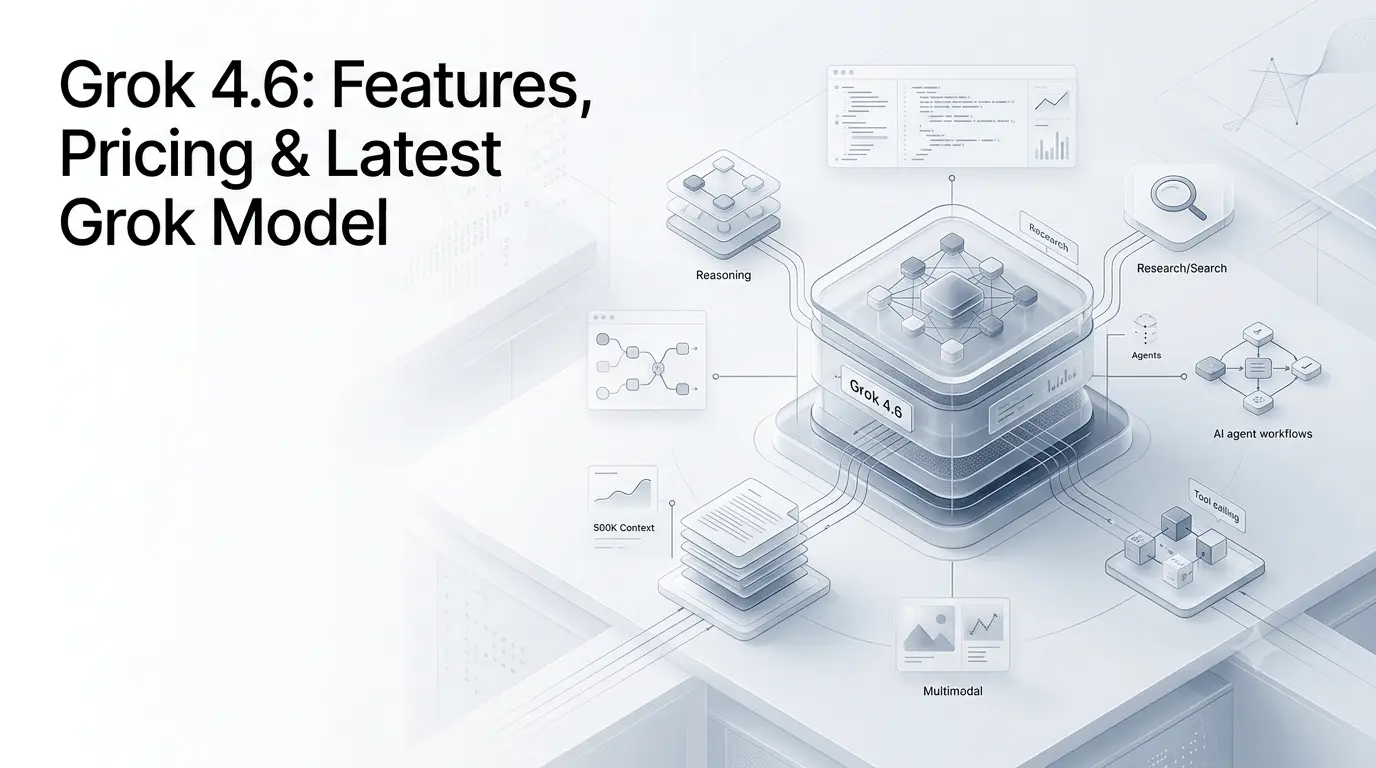
Grok 4.6 is the latest flagship Grok model from xAI, designed for coding, agentic tasks, research, knowledge work, and longer-running workflows. Released on August 12, 2026, it combines a 500,000-token context window, configurable reasoning, image input, tool calling, structured outputs, and support for web, X, and code-execution tools through the API.
Unlike a simple chatbot upgrade, Grok 4.6 is designed to stay useful across multi-step tasks. xAI specifically positions it around long-running agents, software engineering, research, information analysis, and turning ideas into working applications or other artifacts.
This guide covers what Grok 4.6 is, its capabilities, context window, reasoning modes, pricing, availability, use cases, limitations, and how it compares with earlier Grok models.
Quick Summary –
- Grok 4.6 is xAI’s latest flagship model for coding, reasoning, research, and agentic tasks.
- It offers a 500K-token context window with text and image input.
- Key capabilities include configurable reasoning, tool calling, coding, and structured outputs.
- Grok 4.6 is designed for long-running AI agents and complex multi-step workflows.
- API pricing starts at $2/1M input tokens and $6/1M output tokens.
- It can be accessed through the xAI API and platforms such as Cursor, GitHub Copilot, and Amazon Bedrock.
- Grok 4.6 is positioned as a strong choice for developers, researchers, businesses, and advanced AI workflows.
What Is Grok 4.6?
Grok 4.6 is xAI’s flagship AI model for coding, agentic tasks, and knowledge work. It accepts text and image inputs and produces text output, with support for function calling, structured outputs, and configurable reasoning. Its context window is 500,000 tokens.
The model was released on August 12, 2026, as the successor to Grok 4.5. xAI says the new model received additional training focused on reasoning, technical concepts, engineering, coding, and agentic environments.
The main idea behind Grok 4.6 is not simply generating better individual answers. It is designed to handle longer sequences of work, such as:
- Researching an unfamiliar topic
- Working through a large codebase
- Building an application from an idea
- Analyzing information across multiple steps
- Using external tools
- Testing and refining its own work
- Completing knowledge-work tasks with less step-by-step supervision
For developers, Grok 4.6 is available through the xAI API and is also integrated into platforms including Cursor, GitHub Copilot, Amazon Bedrock, Microsoft Foundry, Gemini Enterprise Agent Platform, OpenRouter, Vercel, and Cloudflare.
When Was Grok 4.6 Released?
Grok 4.6 was officially introduced on August 12, 2026.
The release followed Grok 4.5, which xAI introduced in July 2026 for coding, agentic tasks, and knowledge work. Grok 4.6 builds on that foundation with additional training and a stronger emphasis on long-running agent workflows and interactive projects.
A simplified timeline is:
| Model | Major focus |
|---|---|
| Grok 4 | Reasoning, tool use and real-time information |
| Grok 4.5 | Coding, agentic tasks and knowledge work |
| Grok 4.6 | Long-running agents, coding, research and interactive work |
The progression shows a shift from primarily answering questions toward models that can participate in more complete workflows.
What Are the Main Grok 4.6 Features?
Grok 4.6 combines several capabilities that are particularly useful for developers, researchers and advanced users.
1. 500K Context Window
Grok 4.6 has a 500,000-token context window.
A large context window allows a model to work with substantially more information in a single interaction. For practical applications, this can be useful when working with:
- Large codebases
- Long technical documents
- Research material
- Extensive project specifications
- Multiple related files
- Long-running conversations
- Large collections of instructions and tool results
However, context size should not be confused with model intelligence. A larger context window gives the model more room to work with information; it does not automatically guarantee better reasoning.
2. Configurable Reasoning
Grok 4.6 supports four reasoning levels:
- Low
- Medium
- High
- xHigh
The default is High.
This gives developers control over the trade-off between response speed, computational effort and reasoning depth.
For example:
- Low reasoning can be appropriate for relatively straightforward tasks where speed matters.
- High or xHigh reasoning can make more sense for difficult coding, research, planning or multi-step analytical problems.
This flexibility is particularly important for agentic applications because not every task needs the same amount of reasoning.
3. Agentic Tool Calling
One of the biggest differences between a conventional chatbot and Grok 4.6 is its ability to work with external tools.
The model supports function calling, allowing developers to connect it to software systems and external functions. The official model documentation also lists support for web search, X search and code execution.
That means an application can potentially allow Grok 4.6 to:
- Understand a user’s request.
- Decide which tool is necessary.
- Call the tool.
- Analyze the returned information.
- Continue reasoning.
- Produce a final result.
This architecture is useful for AI agents that need to do more than generate text.
4. Coding and Software Engineering
Coding is one of Grok 4.6’s central use cases.
xAI describes the model as a frontier model for coding and agentic tasks, while its launch announcement highlights work across software engineering, web development and other technical environments.
Grok 4.6 can be used for tasks such as:
- Generating code
- Debugging
- Refactoring
- Understanding unfamiliar code
- Planning software architecture
- Working through large projects
- Building web applications
- Reviewing technical implementations
- Iterating on applications
xAI also says its testing showed improvements in longer trajectories, including more self-testing and verification before moving forward.
That matters because real software development rarely consists of a single prompt followed by a finished program.
How Does Grok 4.6 Handle Long-Running Tasks?
Grok 4.6 was specifically developed with longer-running agentic work in mind.
Instead of:
Prompt → answer → stop
the intended workflow can look more like:
Goal → research → plan → execute → inspect → test → refine → deliver
For example, imagine asking an AI coding agent to create a small SaaS dashboard.
Grok 4.6 could potentially:
- Understand the requirements.
- Research unfamiliar technical concepts.
- Structure the application.
- Write the initial implementation.
- Inspect the result.
- Identify problems.
- Make changes.
- Continue iterating.
xAI says Grok 4.6 showed stronger first passes on visual and interactive projects than Grok 4.5 and was tested on tasks requiring it to sustain work over many steps.
This is one of the most important aspects of the model: the focus is increasingly on completing a task rather than simply producing a response.
Grok 4.6 for Research and Knowledge Work
Grok 4.6 is also designed for knowledge-intensive work.
Possible applications include:
- Research assistance
- Information analysis
- Technical research
- Document analysis
- Competitive research
- Data interpretation
- Report preparation
- Research-driven coding
- Structured decision support
When connected to tools, the model can become more useful for tasks requiring external information rather than relying only on information already available within the model.
For example, a research workflow could combine web search, reasoning and structured output to turn a broad question into a more organized research report.
Developers should still verify important claims, particularly when using AI for legal, medical, financial or other high-stakes decisions.
Grok 4.6 and Grok Build
Grok 4.6 is closely connected with Grok Build, xAI’s environment for creating websites, applications, games and interactive projects.
Grok Build became available across web and mobile plans in August 2026. Users can describe an application or other project and have Grok create a working version directly through the interface.
This makes Grok 4.6 particularly relevant to the growing category of AI-assisted software development.
Instead of starting with a blank code editor, a user can begin with a product idea and use the model to create an initial implementation, then refine it through additional instructions.
For developers, this can speed up prototyping. For non-developers, it can lower the barrier to experimenting with software ideas.
Does Grok 4.6 Support Images?
Yes. Grok 4.6 accepts text and image input, while its model output is text.
This allows the model to analyze visual information alongside written instructions.
Potential applications include:
- Screenshot analysis
- UI review
- Image-based debugging
- Diagram interpretation
- Visual research
- Understanding charts and documents
- Combining visual references with coding tasks
It is important to distinguish this from xAI’s dedicated Grok Imagine models. Grok 4.6 is a multimodal reasoning and knowledge-work model, while the Imagine API is designed specifically for image and video generation.
Grok 4.6 vs Grok 4.5
Grok 4.6 is an evolution of Grok 4.5 rather than an entirely separate product direction.
| Feature | Grok 4.5 | Grok 4.6 |
|---|---|---|
| Release | July 2026 | August 2026 |
| Context window | 500K | 500K |
| Text input | Yes | Yes |
| Image input | Yes | Yes |
| Reasoning | Yes | Yes |
| Function calling | Yes | Yes |
| Structured outputs | Yes | Yes |
| Main focus | Coding, agents, knowledge work | Coding, agents, long-running work, interactive projects |
| API pricing | $2 input / $6 output | $2 input / $6 output* |
Short-context API pricing below 200K prompt tokens; long-context pricing is higher.
The important distinction is not simply the context window or base price. xAI’s Grok 4.6 announcement emphasizes improvements from additional training, agentic reinforcement learning and longer trajectories, including stronger self-testing and work on interactive applications.
Grok 4.6 vs Grok 4.20
Grok 4.20 is another important model in the current xAI lineup, particularly for applications requiring a 1-million-token context window.
| Feature | Grok 4.6 | Grok 4.20 |
|---|---|---|
| Context | 500K | 1M |
| Input | Text + image | Text + image |
| Reasoning | Yes | Available in reasoning variant |
| Function calling | Yes | Yes |
| Structured outputs | Yes | Yes |
| Short-context input price | $2 / 1M | $1.25 / 1M |
| Short-context output price | $6 / 1M | $2.50 / 1M |
| Best suited to | Flagship coding and general agentic work | Large-context and cost-sensitive workloads |
The current xAI pricing documentation lists Grok 4.20 reasoning and multi-agent variants at $1.25 per million input tokens and $2.50 per million output tokens for short-context requests.
So Grok 4.6 is not automatically the best model for every API workload. Developers should select the model based on context requirements, reasoning needs, latency, tool use and budget.
Grok 4.6 Pricing
The Grok 4.6 API is priced at:
| Usage | Price per 1M tokens |
|---|---|
| Input | $2.00 |
| Cached input | $0.50 |
| Output | $6.00 |
For long-context requests of 200K tokens or more, pricing increases to:
| Usage | Long-context price |
|---|---|
| Input | $4.00 / 1M tokens |
| Cached input | $1.00 / 1M tokens |
| Output | $12.00 / 1M tokens |
These are xAI API prices and should not be confused with consumer Grok subscription pricing.
The official Grok 4.6 model page also confirms that the model itself has a 500K context window and is billed according to tokens used.
Does Grok 4.6 Have a Consumer Subscription Price?
There is an important distinction here.
Grok 4.6 API pricing is usage-based. It does not represent the price of a consumer SuperGrok subscription.
Consumer access to Grok depends on the applicable Grok or X plan and availability. API users pay according to their API usage, while consumer users access Grok through the relevant product plans.
Therefore, “$2 per million tokens” should not be described as the price of using Grok 4.6 on Grok.com.
Where Can You Use Grok 4.6?
Grok 4.6 is available through several developer platforms.
Current availability includes:
- xAI API
- Grok Build
- Cursor
- GitHub Copilot
- Amazon Bedrock
- Microsoft Foundry
- Gemini Enterprise Agent Platform
- OpenRouter
- Vercel
- Cloudflare
xAI announced integrations with GitHub Copilot shortly after launch, followed by Amazon Bedrock, Gemini Enterprise Agent Platform and Microsoft Foundry.
Availability can vary by platform, account, region and product tier, so developers should check the specific provider before planning a production deployment.
What Can You Build With Grok 4.6?
The model’s capabilities make it suitable for a broad range of applications.
For Developers
Grok 4.6 can help with:
- Coding agents
- Debugging assistants
- Software development
- Code review
- Documentation
- Application prototyping
- Engineering workflows
For Researchers
It can support:
- Multi-step research
- Information analysis
- Technical investigations
- Document-heavy workflows
- Research automation
For Businesses
Potential applications include:
- Internal knowledge assistants
- Workflow automation
- Enterprise research
- Customer-support systems
- Data-processing agents
- Business intelligence workflows
For Creators and General Users
Grok 4.6 can also help with:
- Writing
- Brainstorming
- Research
- Visual analysis
- Project planning
- Building simple applications through Grok Build
The key difference is that Grok 4.6 can be incorporated into workflows where the model needs to reason, use tools and continue working rather than simply respond once.
Grok 4.6 Benchmarks: How Good Is It?
xAI’s launch evaluation showed Grok 4.6 performing strongly across several coding, agentic and knowledge-work benchmarks. The company reported a score of 61 on the Artificial Analysis Intelligence Index, matching the listed score for GPT-5.6 Sol in its comparison.
xAI also reported results across evaluations including:
- GDPVal-AA v2
- CursorBench v3.2
- DeepSWE v1.1
- FrontierCode v1.1
- APEX-Agents
- Terminal-Bench v3.0
- APEX-SWE
- AA-Briefcase
These figures come from xAI’s own launch evaluation and should be interpreted in the context of each benchmark’s methodology. Benchmark scores are useful for comparison, but they do not necessarily predict how a model will perform on every real-world workload.
For production decisions, testing Grok 4.6 against the actual tasks and data your application uses is more meaningful than relying on a single benchmark.
What Are the Limitations of Grok 4.6?
Grok 4.6 is powerful, but it is not a replacement for human verification.
1. AI-generated information can still be wrong
Even with improved reasoning and tool use, the model can produce incorrect conclusions or misunderstand information.
2. API costs can increase with long contexts
The long-context pricing tier is significantly more expensive than standard pricing. Developers handling large prompts should monitor token consumption carefully.
3. Tool use introduces additional complexity
An agent that can call external systems is more capable, but it also introduces additional considerations around permissions, tool reliability, security and error handling.
4. Benchmarks do not guarantee production performance
A model can perform extremely well on a benchmark and still require substantial testing for a specific application.
5. High-stakes decisions need oversight
Grok 4.6 should not be treated as an autonomous authority for medical, legal, financial or safety-critical decisions.
For production applications, developers should combine the model with appropriate validation, permissions, monitoring and human oversight.
Is Grok 4.6 the Best Grok Model?
For many general-purpose API and coding workloads, Grok 4.6 is the flagship choice, and xAI currently describes it as its model for code and general tasks with agentic tool calling and configurable reasoning.
But “best” depends on the workload.
Choose Grok 4.6 when you need:
- Strong general-purpose performance
- Coding and software engineering
- Agentic workflows
- Long-running tasks
- Multimodal input
- Configurable reasoning
Consider other models when you need:
- 1M-token context: Grok 4.3 or Grok 4.20 variants
- Lower API pricing: Grok 4.20 or Grok 4.3
- Image generation: Grok Imagine Image 2.0
- Video generation: Grok Imagine Video 1.5
- Voice applications: Grok Voice API
The current model lineup is increasingly specialized, so the highest-numbered model is not necessarily the most economical option for every task.
Grok 4.6 Model Aliases and Versioning
Developers should also understand how xAI handles model names.
The current documentation explains that:
grok-4.6generally points to the latest stable version.grok-4.6-latesttracks the latest version.- Date-specific model identifiers are fixed and do not automatically update.
For applications where reproducibility is important, a versioned model identifier can be preferable. For applications where receiving the latest stable improvements matters more, aliases can be more convenient.
This distinction becomes increasingly important as AI models are updated frequently.
Who Should Use Grok 4.6?
Grok 4.6 is particularly relevant to:
- Developers: for coding agents, software development and tool-driven workflows.
- Researchers: for information-heavy, multi-step research tasks.
- Businesses: for internal automation, knowledge workflows and agentic applications.
- Creators: for writing, brainstorming, visual analysis and application prototyping.
- AI developers: for applications that require reasoning, function calling and external tools.
For someone who only needs occasional basic text generation, a less expensive model may be sufficient.
Final Verdict: Is Grok 4.6 Worth Using?
Grok 4.6 represents a shift toward more capable AI agents rather than simply a faster chatbot. Its 500K context window, configurable reasoning, tool calling, multimodal input and focus on longer-running tasks make it particularly relevant for coding, research, knowledge work and application development.
Its API pricing of $2 per million input tokens and $6 per million output tokens places it in a premium tier, although other Grok models can be more economical for workloads that do not require its full capabilities.
For developers building sophisticated AI applications, Grok 4.6 is one of the most important models in the current Grok lineup. For everyday users, its value depends more on the tools and plan through which they access it than on the API token price.
Tthe clearest reason to choose Grok 4.6 is its combination of coding, reasoning, multimodal understanding and agentic execution—particularly when the task requires the model to keep working across multiple steps rather than simply provide a single answer.
Frequently Asked Questions About Grok 4.6
1. What is Grok 4.6?
Grok 4.6 is xAI’s flagship model for coding, agentic tasks and knowledge work. It has a 500K-token context window, supports text and image input, configurable reasoning, function calling and structured outputs.
2. When was Grok 4.6 released?
Grok 4.6 was released on August 12, 2026. xAI introduced it as an evolution of Grok 4.5 focused on longer-running agents and interactive and visual work.
3. How much does Grok 4.6 cost?
The standard xAI API price is $2 per million input tokens and $6 per million output tokens, with cached input priced at $0.50 per million tokens. Long-context requests of 200K tokens or more cost $4 input and $12 output per million tokens.
4. Does Grok 4.6 have a 1 million token context window?
No. Grok 4.6 has a 500,000-token context window. Some other current Grok models, including Grok 4.20 variants and Grok 4.3, provide 1M-token context windows.
5. Is Grok 4.6 available in GitHub Copilot?
Yes. xAI announced Grok 4.6 in GitHub Copilot on August 14, 2026, making it available through supported Copilot experiences including VS Code and Copilot’s other developer products.
6. Is Grok 4.6 better than Grok 4.5?
Grok 4.6 is designed as an improvement over Grok 4.5, particularly for long-running agentic work, coding, research and interactive projects. However, which model performs better depends on the specific workload, and xAI’s benchmark results should not be treated as a guarantee for every use case.
Also Read –
Grok AI Models: Complete Guide to Grok Models & Capabilities
Grok API: Pricing, Models, Features & How to Use?