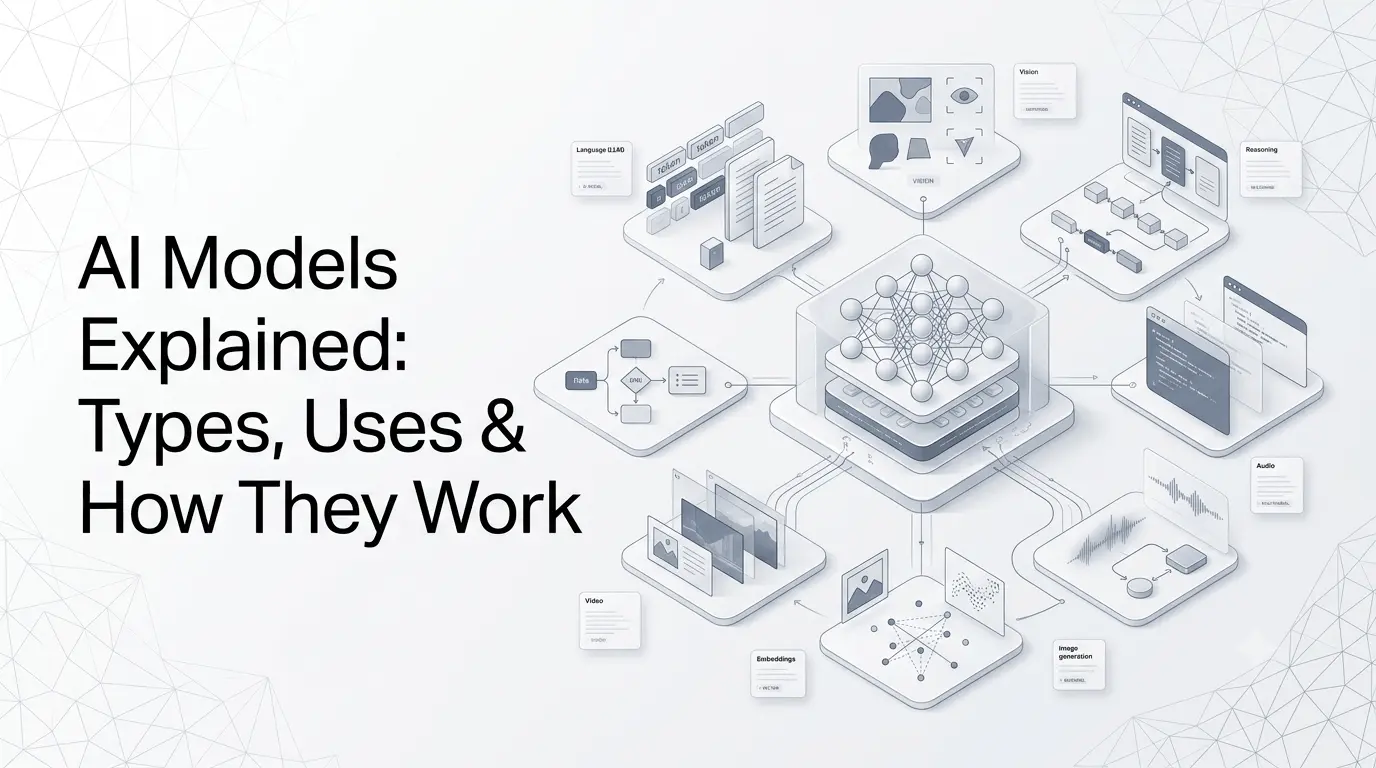
AI models are computational systems trained to recognize patterns in data and use those patterns to perform tasks such as generating text, understanding images, writing code, analyzing documents, making predictions, or producing audio and video.
Modern AI models range from relatively specialized systems, such as speech-recognition and embedding models, to general-purpose foundation models such as GPT, Gemini, and Claude. They can also differ significantly in architecture, training methods, input and output types, reasoning capabilities, context length, speed, cost, and intended use.
Understanding these differences is important because an AI model designed for image generation is not necessarily suitable for coding, while a small language model optimized for fast classification may be a better choice for a high-volume application than a larger reasoning model.
This guide explains what AI models are, how they work, the major types, how they are trained, what they can do, how models differ, and how to choose the right one.
What is an AI Model?
An AI model is a mathematical and computational system that learns patterns from data so it can produce predictions, classifications, decisions, or generated outputs when given new inputs.
For example, a language model learns statistical relationships between words, tokens, concepts, and other information during training. When given a prompt, it uses what it learned to generate an appropriate sequence of tokens.
An AI model can be designed for many different tasks, including:
- Text generation
- Image understanding
- Image generation
- Speech recognition
- Speech generation
- Video understanding
- Video generation
- Translation
- Classification
- Prediction
- Recommendation
- Search and retrieval
- Code generation
- Reasoning
- Tool use and agentic tasks
The term AI model is therefore much broader than “chatbot.”
A chatbot is an application or interface. The model underneath it is the computational system responsible for processing information and generating or predicting outputs.
How Do AI Models Work?
At a high level, most modern AI models follow a simple pattern:
Input → Model processing → Output
The complexity lies inside the model.
For a generative language model, the input might be:
Explain quantum computing to a beginner.
The model processes the input and predicts a sequence of tokens that forms the response.
For an image model, the input might be a text prompt describing an image.
For a classification model, the input could be an email, document, transaction, or photograph, and the output might be a category or probability.
A Simplified AI Model Workflow
Most modern AI systems involve several stages:
- Collect data
- Prepare and process the data
- Train the model
- Evaluate its performance
- Post-train or align the model
- Deploy it
- Monitor and improve it
OpenAI describes foundation-model development as involving data preparation, pre-training, post-training, evaluation, deployment, and ongoing improvement. The exact process varies between organizations and model types.
What Happens During AI Model Training?
Training is the process through which an AI model adjusts its internal parameters to learn patterns from data.
Consider a simplified language-model example.
The training system might provide:
“The capital of France is ___”
The model predicts a likely next token. If the prediction is incorrect, an optimization process adjusts the model’s parameters.
This happens repeatedly across enormous quantities of training examples.
Parameters
Parameters are numerical values inside a model that are adjusted during training.
The number of parameters can be useful for understanding model scale, but it does not tell you everything about model quality.
A larger parameter count does not automatically mean:
- Better reasoning
- Better accuracy
- Lower cost
- Faster responses
- Better coding
- Better multimodal performance
Training techniques, data quality, architecture, post-training, inference methods, and tool use also matter.
What Is a Foundation Model?
A foundation model is a model trained on broad data at large scale and designed to support many downstream tasks.
Instead of creating a separate model from scratch for every individual application, developers can build applications on top of a foundation model.
Examples include models used for:
- General language understanding
- Reasoning
- Coding
- Image understanding
- Multimodal interaction
- Content generation
- Document analysis
Foundation models can then be adapted through prompting, fine-tuning, retrieval, tool use, or other techniques.
OpenAI describes the models powering ChatGPT as foundation models developed through stages including pre-training and post-training.
What Are the Main Types of AI Models?
There is no single universally accepted classification of AI models.
A model can be classified according to its learning method, architecture, modality, purpose, or deployment characteristics.
The most useful categories include:
- Machine-learning models
- Deep-learning models
- Language models
- Large language models
- Multimodal models
- Generative AI models
- Computer-vision models
- Speech and audio models
- Embedding models
- Reasoning models
- Specialized task models
- Agent-oriented models
These categories can overlap.
For example, a multimodal reasoning model may also be a foundation model and a generative AI model.
1. Machine Learning Models
Machine learning models learn patterns from data rather than relying entirely on manually written rules.
Common examples include:
- Linear regression
- Logistic regression
- Decision trees
- Random forests
- Support vector machines
- Clustering algorithms
- Neural networks
These models are widely used for prediction, classification, recommendation, fraud detection, forecasting, and other tasks.
Not every AI system needs a massive neural network.
For some structured business problems, a smaller classical machine-learning model may be faster, cheaper, easier to interpret, and more appropriate.
2. Deep Learning Models
Deep learning is a subset of machine learning based primarily on neural networks with multiple computational layers.
Deep-learning models are especially important for:
- Computer vision
- Natural language processing
- Speech recognition
- Generative AI
- Multimodal AI
- Autonomous systems
Modern foundation models generally depend on large-scale deep-learning architectures.
3. Language Models
Language models are trained to model relationships between language elements.
They can be used for:
- Text prediction
- Translation
- Summarization
- Question answering
- Text classification
- Writing assistance
- Information extraction
Modern language models generally operate on tokens, rather than directly processing entire sentences as indivisible units.
A token may represent a word, part of a word, punctuation, or another piece of information depending on the tokenizer.
4. Large Language Models
A large language model (LLM) is a language model trained at substantial scale and capable of handling a broad range of language tasks.
Examples of major LLM families include:
- GPT
- Gemini
- Claude
- Llama
However, the exact capabilities and model lineups change frequently.
OpenAI’s API model catalog includes multiple GPT-5.6 variants and GPT-6 Astra, while Google’s Gemini ecosystem includes Gemini 3.1 Pro and newer Gemini 3.x models. Anthropic’s current model documentation includes Claude Opus 5, Sonnet 5, Fable 5, and other Claude generations.
This illustrates an important point: AI model names and versions change quickly, so older model comparisons can become outdated.
5. Multimodal AI Models
Multimodal models can process more than one type of input or output.
A model might accept:
- Text
- Images
- Audio
- Video
- PDFs
- Code
A multimodal model can therefore analyze an image while considering a written question about it, or process a document containing both text and visual information.
Google’s Gemini 3.1 Pro, for example, supports text, image, video, audio and PDF inputs, with tool capabilities including function calling, code execution, search grounding and structured outputs.
Multimodality is increasingly becoming a core characteristic of advanced general-purpose AI models.
6. Generative AI Models
Generative AI models create new content rather than simply classifying existing information.
They can generate:
- Text
- Images
- Audio
- Video
- Code
- Music
- Synthetic data
Examples include language models that generate text, image models that create or edit images, and speech models that generate audio.
Generative models can be specialized or general-purpose.
For example, an image-generation model is optimized for visual generation, while a general multimodal model may understand images without necessarily being designed primarily as an image generator.
7. Computer Vision Models
Computer-vision models process visual information.
Typical tasks include:
- Image classification
- Object detection
- Image segmentation
- Optical character recognition
- Facial analysis
- Visual search
- Image understanding
Modern multimodal foundation models can perform some of these tasks alongside language, but specialized vision models remain useful for applications requiring specific performance, latency, or deployment characteristics.
8. Speech and Audio Models
Audio models are designed to process or generate sound.
Examples include:
- Speech-to-text models
- Text-to-speech models
- Speaker recognition systems
- Audio classification models
- Music-generation models
- Real-time voice models
OpenAI’s current model catalog, for example, separates models for realtime, speech, transcription, translation and audio workflows from its general-purpose text and reasoning models.
9. Embedding Models
Embedding models convert information such as text, images, audio, or documents into numerical representations called embeddings.
These representations allow systems to compare semantic relationships between pieces of information.
Embeddings are commonly used for:
- Semantic search
- Recommendation systems
- Retrieval-augmented generation
- Document similarity
- Classification
- Clustering
- Knowledge retrieval
For example, a search system can convert a user’s query and documents into embeddings and compare their positions in a vector space.
Google’s current Gemini API catalog includes Gemini Embedding 2, a multimodal embedding model designed to map text, images, video, audio and PDFs into a unified embedding space.
10. Reasoning Models
Reasoning models are designed to spend additional computational effort on difficult problems.
They can be particularly useful for:
- Mathematics
- Programming
- Scientific reasoning
- Complex analysis
- Planning
- Multi-step problem solving
The distinction between ordinary and reasoning models is becoming less clear as model providers increasingly integrate reasoning into general-purpose systems.
OpenAI’s GPT-5 introduced a unified system with models or modes capable of different levels of reasoning, while newer OpenAI model families continue to expose different reasoning and performance profiles.
Google similarly describes Gemini 3.1 Pro as a reasoning model designed for complex tasks, coding, multimodal understanding, and agentic workflows.
11. Specialized AI Models
Not every AI model is designed to be a general-purpose assistant.
Some models are built for a narrow task.
Examples include:
- Fraud detection models
- Recommendation models
- Medical-imaging models
- Forecasting models
- OCR models
- Spam classifiers
- Search-ranking models
- Speech recognition models
- Code-generation models
- Robotics models
Specialized models can offer advantages in cost, speed, reliability, or deployment requirements.
12. Agentic AI Models
A newer category of AI development involves models designed to operate within agentic systems.
An agentic system can combine a model with:
- Tools
- APIs
- Memory
- Browsing
- Code execution
- Files
- External applications
- Planning mechanisms
Instead of simply answering a question, an agent may break a task into steps and use tools to complete those steps.
Google’s current Gemini ecosystem explicitly lists agentic capabilities and specialized models for tasks such as computer use and autonomous research.
The important distinction is that an AI model is not necessarily an AI agent.
An agent is usually a larger system built around one or more models.
How Are AI Models Different From AI Systems?
The terms are often used interchangeably, but there is an important distinction.
An AI model is the trained computational component.
An AI system may include:
- One or more models
- Prompting logic
- Retrieval
- Databases
- Tools
- APIs
- Memory
- Safety controls
- User interface
- Monitoring infrastructure
For example, a research assistant might use:
Language model + web search + document retrieval + citation system + user interface
Calling the entire application simply “the AI model” can therefore be technically misleading.
What Is the Difference Between Training and Inference?
Two concepts are fundamental to understanding AI models.
Training
Training is when the model learns from data and adjusts its parameters.
Inference
Inference is when the trained model processes new input and produces an output.
A simplified example:
- Training: Millions or billions of examples → model learns patterns
- Inference: Your prompt → trained model → response
Training is usually computationally expensive and may require large clusters of accelerators.
Inference happens whenever a deployed model processes a user’s request.
What Is Pre-Training?
Pre-training is the large-scale initial training stage used by many foundation models.
The model learns broad patterns from large datasets.
For language models, this can involve learning:
- Syntax
- Vocabulary
- Relationships between concepts
- Programming patterns
- General world knowledge present in the training data
- Statistical relationships between tokens
Pre-training gives a model broad capabilities, but it does not necessarily make the model behave like a useful assistant.
That is where post-training becomes important.
What Is Post-Training?
Post-training refers to additional training and optimization performed after the initial pre-training stage.
Depending on the model, it can improve:
- Instruction following
- Reasoning
- Safety
- Helpfulness
- Formatting
- Tool use
- Conversational behavior
Methods can include supervised fine-tuning, reinforcement-learning approaches, preference optimization, synthetic data, and other techniques.
The exact methods vary between model developers.
What Is Fine-Tuning?
Fine-tuning adapts an existing trained model to a narrower task, style, domain, or behavior.
For example, a company might fine-tune a model for:
- Customer-support conversations
- Internal terminology
- Document classification
- Specialized code
- Industry-specific workflows
Fine-tuning is different from training a foundation model from scratch because it starts with an already trained model.
What Is RAG and How Is It Different From Training?
Retrieval-augmented generation (RAG) gives a model relevant external information at inference time.
A simplified RAG workflow is:
User question → Search/retrieval → Relevant documents → AI model → Answer
This allows an AI application to use information that may not have been part of the model’s original training data.
RAG is particularly useful for:
- Company knowledge bases
- Product documentation
- Internal files
- Frequently changing information
- Search systems
- Research applications
RAG does not fundamentally retrain the underlying model.
What Are Context Windows and Tokens?
A context window is the amount of information a model can process within a particular interaction or request, subject to the model’s limits.
Tokens are the smaller units used by language models to represent text.
A context window can include:
- User prompts
- Previous conversation
- Documents
- Tool results
- Retrieved information
- Other model inputs
Larger context windows can make it easier to work with long documents and complex projects, but context size alone does not guarantee better reasoning or accuracy.
For example, Google lists a 1,048,576-token input limit and 65,536-token output limit for Gemini 3.1 Pro Preview.
What Capabilities Can Modern AI Models Have?
Advanced AI models can combine many capabilities within one system.
| Capability | What it means |
|---|---|
| Text generation | Producing natural-language responses |
| Reasoning | Handling complex multi-step problems |
| Coding | Generating, explaining and debugging software |
| Vision | Understanding images and visual information |
| Audio | Processing or generating speech and sound |
| Video | Understanding or generating video content |
| Long context | Processing large amounts of information |
| Tool use | Calling external functions or services |
| Structured output | Producing predictable machine-readable responses |
| Retrieval | Using external information sources |
| Agentic behavior | Performing multi-step tasks using tools |
Not every model supports every capability.
How Do AI Models Compare?
Comparing AI models requires more than asking which one has the highest benchmark score.
Important factors include:
- Reasoning quality
- Coding performance
- Multimodal capabilities
- Context window
- Speed
- Cost
- Reliability
- Tool use
- Structured outputs
- Fine-tuning availability
- Privacy requirements
- Deployment options
- API availability
- Rate limits
A model that is excellent for complex coding may not be the most economical choice for millions of simple classification requests.
GPT vs Gemini vs Claude
GPT, Gemini, and Claude represent major families of general-purpose AI models, but their exact capabilities and model versions change frequently.
| Model family | Developer | Typical strengths | Important consideration |
|---|---|---|---|
| GPT | OpenAI | General reasoning, coding, multimodal and tool-based workflows | Model lineup changes frequently |
| Gemini | Google DeepMind | Multimodal understanding, reasoning, long context and agentic workflows | Multiple Pro, Flash and specialized models |
| Claude | Anthropic | Reasoning, coding, writing and knowledge work | Multiple Opus, Sonnet and other model tiers |
| Llama | Meta | Open-weight ecosystem and developer customization | Specific capabilities vary by release |
This table should be treated as a high-level overview rather than a permanent ranking.
For example, OpenAI’s current API catalog includes GPT-6 Astra alongside GPT-5.6 models, Google’s current Gemini lineup includes 3.1 Pro and newer 3.x models, and Anthropic’s documentation lists Claude 5 and Claude 4.x generations.
Large AI Models vs Small AI Models
Bigger is not always better.
Large models
Often provide:
- More complex reasoning
- Broader capabilities
- Stronger performance across varied tasks
- Better handling of difficult instructions
But they may require:
- More compute
- More memory
- Higher inference costs
- Higher latency
Small models
Often provide:
- Lower cost
- Faster responses
- Easier local deployment
- Lower hardware requirements
They can be particularly useful for:
- Classification
- Extraction
- Simple assistants
- High-volume processing
- Edge devices
- Private/local applications
The right model depends on the workload rather than model size alone.
Open-Weight vs Closed AI Models
Another important distinction is how model weights and development access are distributed.
Closed models
The model provider controls access to the underlying model weights.
Users generally interact through:
- APIs
- Applications
- Cloud platforms
Open-weight models
Model weights are made available under a particular license, allowing developers to download and potentially run or modify the model depending on the license terms.
“Open-weight” and “open-source” are not necessarily identical terms.
A model may provide downloadable weights without releasing every component involved in training, such as complete training datasets or infrastructure.
What Are AI Models Used For?
AI models are now used across many industries.
Business
- Customer support
- Document processing
- Sales assistance
- Data analysis
- Marketing automation
Software Development
- Code generation
- Debugging
- Code review
- Documentation
- Testing
- Software agents
Healthcare
- Medical-image analysis
- Research assistance
- Clinical documentation
- Drug-discovery research
Applications in healthcare require additional safeguards because model outputs can affect high-stakes decisions.
Finance
- Fraud detection
- Risk analysis
- Document processing
- Customer support
- Research
Education
- Tutoring
- Personalized explanations
- Summarization
- Practice generation
- Language learning
Creative Work
- Writing
- Image generation
- Video creation
- Music and audio
- Design assistance
What Are the Limitations of AI Models?
AI models have become highly capable, but they still have important limitations.
Hallucinations
A model can produce information that sounds convincing but is incorrect.
This is particularly important when using AI for:
- Research
- Legal information
- Medical information
- Financial decisions
- Technical documentation
AI output should therefore be verified when accuracy matters.
Knowledge Limitations
A model may have a knowledge cutoff, incomplete information, or no access to current information.
Tools such as search, retrieval and APIs can help address this limitation.
Context Limitations
Even models with very large context windows can struggle to identify the most important information within massive inputs.
More context does not automatically mean better understanding.
Bias
Models can reproduce biases present in training data, human feedback, or system design.
Cost and Latency
Larger and more computationally intensive models can cost more and take longer to run.
Security
AI systems connected to tools, files or external services introduce additional risks, including prompt injection, data leakage and unauthorized actions.
How Do You Choose the Right AI Model?
Instead of starting with the model name, start with the task.
Step 1: Define the workload
Ask:
- What do I need the model to do?
- How frequently will it run?
- How much data will it process?
- Does it need current information?
Step 2: Identify required capabilities
Determine whether you need:
- Text
- Vision
- Audio
- Video
- Coding
- Reasoning
- Tool use
- Structured output
- Long context
Step 3: Consider performance
Test candidate models using examples that resemble your real workload.
Public benchmarks can provide useful context, but your own evaluation is often more informative.
Step 4: Consider cost
Calculate the expected cost based on your actual input and output volume.
Step 5: Consider latency
For interactive applications, response time may be more important than achieving the highest possible benchmark score.
Step 6: Check deployment requirements
Consider:
- API availability
- Cloud requirements
- Local deployment
- Data privacy
- Licensing
- Hardware requirements
- Regional availability
Step 7: Evaluate reliability
Measure how often the model produces incorrect or unusable results.
For production applications, reliability can matter more than a small difference in benchmark performance.
Are AI Models Getting Better?
AI model development is progressing in several directions at once.
The industry is moving beyond simply increasing model size.
Current development increasingly emphasizes:
- Reasoning
- Multimodal understanding
- Tool use
- Agentic workflows
- Coding
- Long-context processing
- Efficiency
- Smaller specialized models
- Real-time interaction
- Better reliability
- Better safety
Google’s current Gemini ecosystem, for example, includes general-purpose Pro and Flash models as well as specialized systems for computer use, deep research, embeddings and robotics.
OpenAI’s current research similarly spans frontier models, reasoning, multimodal systems, visual generation, audio and agent-oriented capabilities.
Anthropic’s current model documentation also shows a broad progression across Opus, Sonnet, Haiku and newer model families rather than a single model optimized for every workload.
This suggests that the future AI model landscape is likely to contain many specialized and general-purpose models working together, rather than one model serving every possible task.
What Is the Future of AI Models?
The next generation of AI models is likely to become increasingly capable of combining multiple forms of intelligence and interaction.
Important areas include:
Multimodal reasoning
Models will increasingly process text, images, audio, video and other information together.
Agentic systems
Models will increasingly operate tools and complete multi-step tasks rather than simply generating responses.
Specialized models
Smaller models optimized for specific tasks can complement large frontier models.
Real-time AI
Speech, vision and interactive systems are moving toward lower-latency experiences.
AI model ecosystems
Applications may use different models for different stages of a workflow.
For example:
Small model → classification → reasoning model → specialist model → tool call → final response
This approach can potentially reduce cost while improving overall system performance.
AI Models vs AI Applications
One final distinction is especially important for beginners.
- AI model: The underlying trained computational system.
- AI application: A product built using one or more models.
For example, an application can combine:
Model + system instructions + retrieval + tools + interface + safety controls
This means products such as AI assistants should not automatically be treated as identical to the underlying model powering them.
The same model can also appear in multiple products and services with different interfaces, tools, limits, and system behavior.
Conclusion
AI models are the foundation of modern artificial intelligence, but there is no single type of model that is best for every task.
Language models, multimodal systems, reasoning models, embedding models, computer-vision systems, audio models and specialized AI models each solve different problems. Modern AI development is also moving toward systems where several models, tools and external data sources work together.
The major model families are evolving rapidly. Current offerings from OpenAI, Google and Anthropic demonstrate how quickly the market is moving from traditional language models toward reasoning, multimodal, coding and agentic systems.
For users and developers, the most useful way to evaluate AI models is therefore not to ask which model is universally the best. The better question is:
Which model has the capabilities, reliability, speed, cost and deployment characteristics that match the problem I need to solve?
That shift from comparing model names to understanding model capabilities is essential for making informed decisions as the AI landscape continues to expand.
Frequently Asked Questions (FAQs)
1. What is an AI model?
An AI model is a computational system trained on data to recognize patterns and produce predictions, classifications, or generated outputs. Depending on its design, it can work with text, images, audio, video, code, structured data, or multiple modalities.
2. What are the main types of AI models?
Major categories include machine-learning models, deep-learning models, language models, large language models, multimodal models, generative models, computer-vision models, audio models, embedding models, reasoning models and specialized task models.
3. What is the difference between an AI model and an AI application?
An AI model is the trained computational component. An AI application is a larger product or system that may combine one or more models with prompts, retrieval, tools, databases, interfaces and safety controls.
4. What is the difference between an LLM and a multimodal AI model?
An LLM primarily focuses on language, while a multimodal model can process multiple information types such as text, images, audio or video. Modern models can overlap: a multimodal model may also contain a powerful language-model component.
5. Are bigger AI models always better?
No. Larger models can provide greater capability on some complex tasks, but smaller models can be faster, cheaper and easier to deploy. The best choice depends on the specific workload, required accuracy, latency, cost and deployment environment.
6. How do I choose the right AI model?
Start with the task rather than the model name. Identify the required modalities, reasoning level, context size, tool support, speed, cost, privacy and deployment requirements. Then test several models using representative examples from your actual workload.
Also Read –
Multiverse Computing Explained: AI Technology, Products & Use Cases
Grok AI: What Is It? Features, Models, Use Cases & More
What Is DeepSeek AI? A Complete Guide to Models & Features
Quantum AI: How Quantum Computing and Artificial Intelligence Work Together?
AI Model Compression: Techniques, Benefits, Challenges & Use Cases