
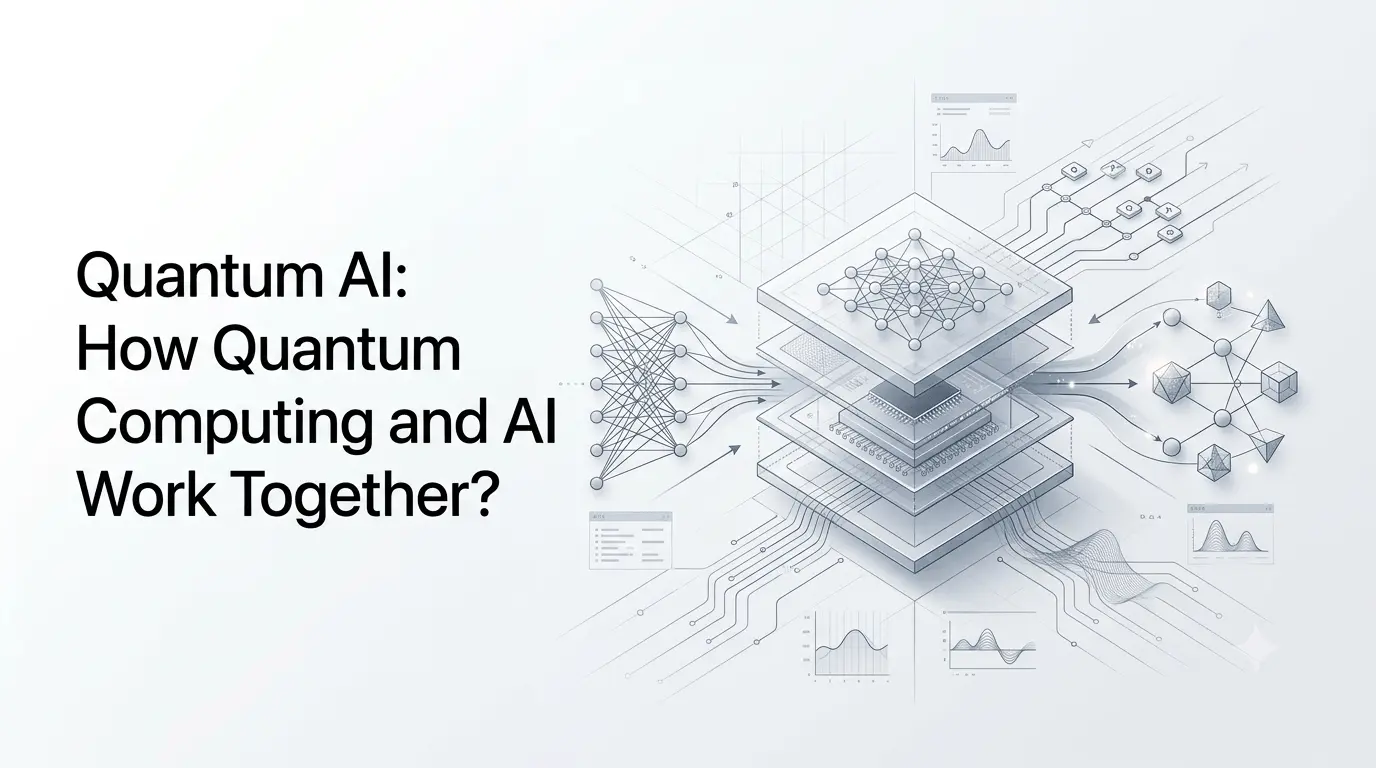
Quantum AI refers broadly to the intersection of quantum computing and artificial intelligence, where quantum processors, quantum algorithms, and AI techniques are developed to complement one another.
The relationship works in both directions. AI can help researchers design quantum circuits, calibrate hardware, detect errors, and optimize quantum systems. At the same time, future quantum computers could potentially accelerate specific machine-learning workloads through approaches known as quantum machine learning (QML).
However, Quantum AI does not mean that today’s quantum computers can simply replace GPUs for training large language models. Most practical systems remain hybrid, combining classical CPUs and GPUs with quantum processing units (QPUs). The field is still developing, and researchers are working to determine which AI problems can obtain a meaningful quantum advantage.
Quick Summary
- Quantum AI combines quantum computing with artificial intelligence and machine learning.
- It works in two directions: AI can improve quantum systems, while quantum computing may accelerate certain AI tasks.
- Quantum machine learning (QML) explores quantum algorithms for optimization, classification, kernels, and generative models.
- Current systems are mainly hybrid, combining CPUs, GPUs, and quantum processing units (QPUs).
- Potential applications include drug discovery, materials science, finance, logistics, and scientific research.
- Major challenges include quantum noise, error correction, scalability, and data-loading overhead.
- Quantum computers are not currently replacements for GPUs or conventional AI infrastructure.
- The long-term goal is to achieve useful quantum advantage for specific computational problems.
What Is Quantum AI?
Quantum AI is the application of quantum computing techniques to artificial intelligence, machine learning, and optimization, together with the use of AI to improve quantum computing itself.
The term therefore describes two closely connected areas:
- AI for quantum computing — using machine learning and AI to improve quantum hardware, software, algorithms, error correction, and control.
- Quantum computing for AI — using quantum processors or quantum algorithms to potentially accelerate selected machine-learning and optimization tasks.
This distinction is important because many current Quantum AI developments are actually about using conventional AI to make quantum computers more useful, rather than running AI models directly on quantum hardware.
How Do Quantum Computing and AI Work Together?
A practical Quantum AI system usually follows a hybrid architecture rather than sending an entire AI workload to a quantum computer.
A simplified workflow looks like this:
Classical data → AI model or optimizer → quantum circuit → QPU → measurements → classical processor → updated model
The classical computer handles tasks that conventional processors and GPUs already perform well. The quantum processor is used for a specific subproblem where a quantum algorithm may provide an advantage.
For example, a machine-learning system might use a classical optimizer to determine the parameters of a quantum circuit. The circuit runs on a QPU, measurements are returned to the classical computer, and the optimizer changes the parameters before the circuit is run again.
This creates a feedback loop between classical and quantum computation.
Why Hybrid Computing Matters?
Today’s quantum processors are limited by noise, error rates, connectivity, measurement overhead, and the number and quality of available qubits.
That makes it impractical to treat a QPU like a general-purpose replacement for a CPU or GPU.
Instead, quantum processors are being developed as specialized accelerators that work alongside classical computing infrastructure.
NVIDIA’s CUDA-Q, for example, is designed around hybrid programs that can use CPUs, GPUs, and QPUs within a single workflow. Microsoft similarly provides hybrid quantum-classical development capabilities through its quantum platform.
What Is Quantum Computing?
Quantum computing is a computing approach based on quantum-mechanical phenomena such as superposition, entanglement, and interference.
Traditional computers use bits that represent information as 0 or 1. Quantum computers use qubits, whose quantum states can represent combinations of basis states.
A quantum circuit manipulates these states using quantum gates and eventually measures the qubits to produce classical results.
The important point is that quantum computing is not simply “faster computing.”
Quantum algorithms have different computational properties from classical algorithms. For some specialized problems, that difference may eventually provide an advantage that grows dramatically with problem size.
But quantum computers are not automatically faster for every workload.
What Is Quantum Machine Learning?
Quantum machine learning is the area of research that combines quantum computing with machine-learning methods.
A QML system may use a quantum circuit as part of a machine-learning pipeline. Examples include:
- Quantum kernel methods
- Variational quantum circuits
- Quantum neural networks
- Quantum classifiers
- Quantum generative models
- Quantum optimization
- Hybrid quantum-classical learning
IBM’s Qiskit ecosystem, for example, includes tools for quantum machine learning based on techniques such as quantum kernels and neural networks.
The objective is not simply to make an algorithm “quantum.” Researchers are looking for situations where the quantum component provides a measurable computational benefit.
What Is AI for Quantum Computing?
AI for quantum computing is already an important research and engineering area.
Instead of asking how a quantum computer can accelerate AI, researchers can ask:
How can AI make quantum computers work better?
Machine learning can assist with tasks such as:
- Quantum error detection
- Error mitigation
- Hardware calibration
- Qubit control
- Noise characterization
- Quantum circuit optimization
- Algorithm discovery
- Device design
- Resource estimation
- Experimental data analysis
This direction is particularly relevant because quantum hardware produces complex measurements and must operate under extremely demanding physical conditions.
AI-Assisted Quantum Error Correction
Quantum systems are highly sensitive to environmental noise and operational imperfections.
Error correction attempts to protect logical quantum information by distributing it across physical qubits and detecting errors without directly destroying the encoded information.
AI can assist with interpreting error syndromes and identifying patterns in quantum-device behavior.
Google, for example, introduced AlphaQubit, an AI-based decoder designed to identify errors in quantum computations. Google reported that AlphaQubit reduced errors compared with certain tensor-network and correlated-matching approaches in its tests.
AI-based error correction remains an active research area, however, and should not be interpreted as a solved problem.
How Can AI Improve Quantum Algorithms?
Designing quantum circuits can be difficult because the number of possible circuit structures can become enormous.
AI can search through possible configurations and learn patterns that humans may not easily discover.
One example is AI-assisted circuit generation, where machine-learning systems can propose or optimize quantum circuits for a particular task.
NVIDIA’s CUDA-Q ecosystem includes research examples involving generative AI for quantum algorithm design, including work on generating quantum circuits for optimization problems.
This creates an interesting feedback loop:
AI designs quantum algorithm → quantum computer evaluates it → results return to AI → AI improves the algorithm
The same concept can potentially be applied to quantum hardware design and control.
How Could Quantum Computing Improve AI?
This is the more speculative side of Quantum AI.
Quantum machine learning researchers are investigating whether quantum processors could accelerate particular parts of machine-learning workflows.
Potential areas include:
1. Optimization
Many AI systems depend on optimization.
Training involves finding parameter values that minimize a loss function, while other AI applications involve scheduling, routing, portfolio optimization, or combinatorial search.
Quantum optimization algorithms such as the Quantum Approximate Optimization Algorithm (QAOA) are being investigated for problems of this type.
The important caveat is that practical quantum advantage has not been established broadly across ordinary AI optimization workloads.
2. Machine Learning Kernels
Quantum kernels map data into quantum feature spaces and can then be used with classical learning algorithms.
The idea is that a quantum feature mapping could represent relationships in a way that is difficult or inefficient for a classical method to reproduce.
IBM provides quantum-kernel training as one of its Qiskit machine-learning examples.
3. Generative Models
Researchers are also exploring quantum generative models.
In principle, quantum systems can represent complex probability distributions, creating research opportunities for quantum approaches to generative modeling.
However, this remains an active research field rather than a replacement for today’s large-scale generative AI infrastructure.
4. Scientific AI
Scientific computing may be one of the most interesting areas for Quantum AI.
AI is increasingly used to analyze scientific data and make predictions, while quantum computing is particularly suited to problems involving quantum-mechanical systems.
The combination could eventually support areas such as:
- Molecular simulation
- Drug discovery
- Materials science
- Chemistry
- Battery research
- Energy systems
- Physics simulations
Google’s Quantum Echoes work illustrates this broader direction. In October 2025, Google reported a verifiable quantum advantage using its Willow processor for an algorithm related to studying physical systems and demonstrated applications involving molecular structure.
Quantum AI vs Traditional AI
Quantum AI should not be viewed as a direct replacement for conventional artificial intelligence.
| Area | Traditional AI | Quantum AI |
|---|---|---|
| Main hardware | CPUs, GPUs, AI accelerators | CPUs, GPUs and QPUs |
| Core computation | Classical | Hybrid quantum-classical |
| Machine learning | Mature and widely deployed | Mostly research and early experimentation |
| Large language models | Widely deployed | Not currently trained primarily on QPUs |
| Data processing | Highly scalable | Quantum data-loading can be challenging |
| Optimization | Mature classical methods | Quantum optimization under investigation |
| Hardware availability | Broad | Limited |
| Error handling | Conventional numerical/system errors | Quantum noise and error correction |
| Current commercial maturity | High | Emerging |
The distinction is important because headlines about Quantum AI can sometimes imply that quantum computers are already accelerating mainstream AI models.
That is not the current state of the technology.
Quantum AI vs Quantum Machine Learning
The terms are related but not identical.
| Concept | Meaning |
|---|---|
| Quantum AI | Broad intersection of AI and quantum computing |
| Quantum machine learning | Machine-learning methods that use quantum computing |
| AI for quantum | AI techniques applied to quantum hardware and software |
| Quantum computing | Computing using quantum-mechanical systems |
| Classical AI | AI running on conventional computing infrastructure |
Quantum machine learning is therefore one part of the broader Quantum AI field.
AI for quantum computing is another.
What Are the Main Quantum AI Use Cases?
Quantum AI research currently spans several areas.
1. Drug Discovery
Quantum computers could eventually model molecular systems that are difficult to simulate classically.
AI can then help identify patterns, predict properties, prioritize candidates, and interpret experimental results.
The long-term vision is a hybrid workflow where AI narrows down promising candidates while quantum algorithms provide detailed simulations of selected molecular systems.
2. Materials Science
Materials researchers need to understand interactions between atoms and electrons.
Quantum computing may eventually provide more accurate simulations for certain classes of materials, while AI can help search through possible materials and predict their properties.
3. Financial Optimization
Finance contains many optimization problems involving portfolios, risk, scheduling, and scenario analysis.
Quantum optimization is being researched for these problems, although practical advantages over strong classical methods remain an important question.
4. Logistics
Routing vehicles, scheduling resources, and optimizing supply chains can involve enormous combinations.
Hybrid quantum-classical optimization approaches are being investigated for these problems.
5. Scientific Simulation
Quantum systems are naturally difficult to simulate using classical computers as their size increases.
Quantum computers may eventually become useful for simulating molecules, materials, and other physical systems.
AI can complement this process by helping interpret data and optimize calculations.
6. Quantum Hardware Development
This is one of the most immediate applications of AI.
Machine learning can help researchers:
- Calibrate quantum devices
- Detect anomalies
- Decode errors
- Optimize control parameters
- Analyze experimental measurements
- Design circuits
What Are the Benefits of Quantum AI?
The potential benefits come from combining the strengths of two very different computational approaches.
AI provides
- Pattern recognition
- Statistical learning
- Prediction
- Optimization
- Automation
- Data analysis
Quantum computing provides
- Quantum-state manipulation
- Specialized quantum algorithms
- Potential computational advantages for selected problems
- New approaches to simulation and optimization
Together, they could create hybrid systems in which each technology handles the part of a problem for which it is best suited.
What Are the Limitations of Quantum AI?
Quantum AI is promising, but several major obstacles remain.
1. Quantum Hardware Is Still Developing
Current quantum processors are much more difficult to operate than conventional computers.
Noise, gate errors, measurement errors, limited connectivity, and environmental sensitivity all affect performance.
Large-scale useful quantum computing requires substantial progress in error correction and hardware engineering.
2. Quantum Advantage Is Problem-Specific
A quantum computer does not automatically outperform a GPU simply because it uses qubits.
A useful quantum advantage requires:
- A suitable problem.
- A quantum algorithm that addresses it.
- Sufficiently capable quantum hardware.
- An implementation that accounts for data loading and measurement overhead.
- A meaningful comparison with the strongest classical alternatives.
This is why claims about quantum advantage need to be evaluated in the context of the specific benchmark.
3. AI Cannot Magically Solve Quantum Limitations
AI can improve calibration, decoding, optimization, and other processes, but it does not remove the fundamental physical requirements of quantum computing.
Recent research also highlights limitations in AI-based quantum error mitigation, including uncertainty around statistical guarantees and the difficulty of transferring models trained on synthetic noise to real quantum devices.
4. Data Loading Is a Challenge
Classical machine-learning systems generally operate on classical data.
Moving large classical datasets into quantum states can introduce substantial overhead.
A theoretical speedup can therefore disappear if preparing the quantum input takes too much time.
5. QML Still Needs Strong Classical Baselines
A quantum machine-learning method should not be considered successful merely because it works on a quantum processor.
Researchers must compare it against competitive classical methods.
The field is still determining which machine-learning problems have conditions under which quantum advantage is realistic.
Nature’s current research collection on quantum machine learning explicitly highlights that the conditions under which quantum advantage can be achieved remain an open research question.
What Is the Role of GPUs in Quantum AI?
GPUs are likely to remain important even as quantum computing advances.
Quantum computers do not eliminate classical computing infrastructure.
Instead, modern quantum architectures increasingly combine:
CPU + GPU + QPU
GPUs can be used for:
- Quantum circuit simulation
- AI model inference
- Error decoding
- Optimization
- Quantum-control workloads
- Scientific computing
- Large-scale data processing
NVIDIA’s CUDA-Q is specifically designed to coordinate CPU, GPU, and QPU resources in hybrid quantum-classical applications.
This means the future of Quantum AI may look less like “quantum versus classical” and more like quantum plus classical accelerated computing.
What Are the Major Quantum AI Platforms?
Several major technology companies are developing quantum-computing ecosystems.
a) Google Quantum AI
Google Quantum AI develops superconducting quantum processors and quantum algorithms.
Its Willow processor was introduced in December 2024 with 105 qubits, alongside reported advances in quantum error correction.
In October 2025, Google announced Quantum Echoes, which it described as the first verifiable quantum advantage demonstrated on hardware. The company reported that the algorithm ran 13,000 times faster than the classical algorithm used for its comparison. That result applies to the specific benchmark and should not be interpreted as a general 13,000× acceleration for AI.
b) IBM Quantum and Qiskit
IBM’s quantum ecosystem includes Qiskit, an open-source quantum software stack for developing and executing quantum workloads.
Qiskit also provides quantum machine-learning capabilities, including quantum kernels and related workflows.
IBM’s current Qiskit platform emphasizes quantum algorithms, optimization, simulation, quantum machine learning, and large-scale execution.
c) NVIDIA CUDA-Q
CUDA-Q focuses heavily on hybrid quantum-classical computing.
It allows developers to combine CPU, GPU, and QPU resources and provides tools for quantum simulation, algorithm development, error correction, and AI-assisted quantum workflows.
NVIDIA has also expanded CUDA-Q with tools aimed at fault-tolerant quantum computing and quantum-AI research.
d) Microsoft Azure Quantum
Azure Quantum provides cloud access to quantum hardware, quantum software, simulation capabilities, and resource-estimation tools.
Microsoft’s quantum development ecosystem supports Python and Q#, alongside hybrid quantum-classical workflows.
What Changed in Quantum AI Between Early Research and 2026?
The field has gradually shifted from demonstrating isolated quantum effects toward building complete computing systems around quantum processors.
Some of the major changes include:
| Period | Major development |
|---|---|
| Early quantum research | Fundamental algorithms and quantum information theory |
| NISQ era | Noisy intermediate-scale quantum hardware |
| 2023–2024 | Greater focus on error correction and logical qubits |
| 2024 | Google’s Willow demonstrated advances in error correction |
| 2025 | Google reported verifiable quantum advantage with Quantum Echoes |
| 2025–2026 | Greater emphasis on hybrid CPU-GPU-QPU systems and practical applications |
| Current direction | Fault-tolerant systems, quantum-AI workflows and real-world scientific applications |
The important trend is that the industry is increasingly focused on utility, not simply increasing the raw number of physical qubits.
Is Quantum AI Available Today?
Yes, but its availability depends on what you mean by Quantum AI.
Developers and researchers can already experiment with quantum machine learning and hybrid quantum-classical algorithms through cloud services and software frameworks.
However, mainstream consumers cannot currently use a quantum computer as a general-purpose AI accelerator in the same way they use a GPU-powered AI service.
Today’s practical Quantum AI work is concentrated largely in:
- Research institutions
- Universities
- Quantum computing companies
- Cloud platforms
- Pharmaceutical and chemical research
- Financial research
- High-performance computing
- AI and semiconductor companies
The technology is accessible for experimentation, but many proposed high-impact applications remain under development.
Can Quantum Computers Run ChatGPT-Style AI Models?
Not in the sense often suggested by popular headlines.
Large language models require enormous classical computational infrastructure for training and inference.
Current quantum processors do not replace the GPU clusters used to train frontier-scale language models.
Researchers may eventually explore quantum techniques for specific components of machine-learning systems, optimization, sampling, or scientific AI.
But there is currently no established approach in which a general-purpose quantum computer replaces the GPU infrastructure used to train a modern frontier LLM.
What Could Quantum AI Look Like in the Future?
A mature Quantum AI architecture could involve several layers.
AI layer
Handles prediction, planning, reasoning, data analysis and optimization.
↓
Classical computing layer
Runs CPUs, GPUs, memory, databases and conventional AI models.
↓
Quantum orchestration layer
Determines which subproblems should be sent to a QPU.
↓
Quantum layer
Executes specialized quantum algorithms.
↓
Measurement and feedback
Results return to classical systems, where AI models analyze them and optimize the next quantum computation.
This architecture could be particularly powerful in scientific applications.
For example, an AI system could search millions of possible molecular structures, select a smaller set of candidates, use a quantum processor to investigate difficult molecular interactions, and then feed the results back into the AI model.
That is a much more realistic vision of Quantum AI than the idea of a quantum computer simply becoming a faster version of a conventional AI server.
How Should Developers Start Learning Quantum AI?
Developers interested in Quantum AI do not need to start by building a quantum computer.
A practical learning path is:
Step 1: Learn classical machine learning
Understand:
- Linear algebra
- Probability
- Optimization
- Neural networks
- Machine-learning evaluation
Step 2: Learn quantum fundamentals
Focus on:
- Qubits
- Superposition
- Entanglement
- Quantum gates
- Measurement
- Quantum circuits
Step 3: Learn a quantum SDK
Qiskit, CUDA-Q and Microsoft’s quantum development tools provide practical ways to experiment with quantum algorithms.
Step 4: Study hybrid algorithms
Learn how classical optimizers interact with parameterized quantum circuits.
Step 5: Experiment with QML
Explore:
- Quantum kernels
- Variational circuits
- Quantum classifiers
- QAOA
- Quantum neural networks
Step 6: Compare against classical methods
This is essential.
A useful experiment should compare a quantum approach with a strong classical baseline rather than assuming the quantum method is automatically better.
Conclusion
Quantum AI is best understood as a hybrid field rather than a single technology.
Artificial intelligence can help quantum computing become more reliable and useful by improving calibration, error correction, circuit design and optimization. At the same time, quantum computing may eventually provide new computational tools for selected machine-learning and scientific problems.
The technology is still developing. Current evidence does not support the idea that quantum computers will broadly replace GPUs or conventional AI systems. Instead, the near-term direction is increasingly centered on hybrid architectures that combine classical computing, accelerated AI infrastructure and quantum processors.
As quantum hardware becomes more reliable and fault-tolerant, the most important developments will likely come from applications where quantum algorithms solve a specific computational problem that classical systems cannot handle efficiently.
For now, Quantum AI is less about replacing today’s AI and more about exploring what becomes possible when AI and quantum computing are designed to work together.
Frequently Asked Questions (FAQs)
1. What is Quantum AI?
Quantum AI is the intersection of artificial intelligence and quantum computing. It includes both using AI to improve quantum computers and researching quantum computing techniques that could improve selected AI and machine-learning workloads.
2. Is Quantum AI the same as quantum machine learning?
No. Quantum machine learning is a subset of the broader Quantum AI field. QML specifically focuses on applying quantum computing to machine-learning tasks, while Quantum AI can also include AI-assisted quantum hardware control, error correction, circuit optimization and quantum algorithm design.
3. Can quantum computers make AI faster?
Potentially, but not for every AI workload. Researchers are investigating quantum algorithms for optimization, kernels, sampling and other machine-learning tasks. Broad practical quantum acceleration of mainstream AI has not yet been established.
4. Is Quantum AI available today?
Quantum AI technologies are available for research and development through quantum-computing platforms and cloud services. Developers can experiment with quantum machine learning and hybrid algorithms, but current quantum hardware is not a general-purpose replacement for classical AI infrastructure.
5. Will quantum computers replace GPUs for AI?
There is no evidence that quantum computers will simply replace GPUs. A more realistic long-term architecture is hybrid, with CPUs, GPUs and QPUs performing different parts of a workload.
6. What are the biggest challenges for Quantum AI?
Major challenges include quantum noise, error correction, hardware scalability, data-loading overhead, limited quantum resources and proving meaningful advantages over strong classical algorithms.
Also Read –
AI Model Compression: Techniques, Benefits, Challenges & Use Cases
Multiverse Computing Explained: AI Technology, Products & Use Cases