

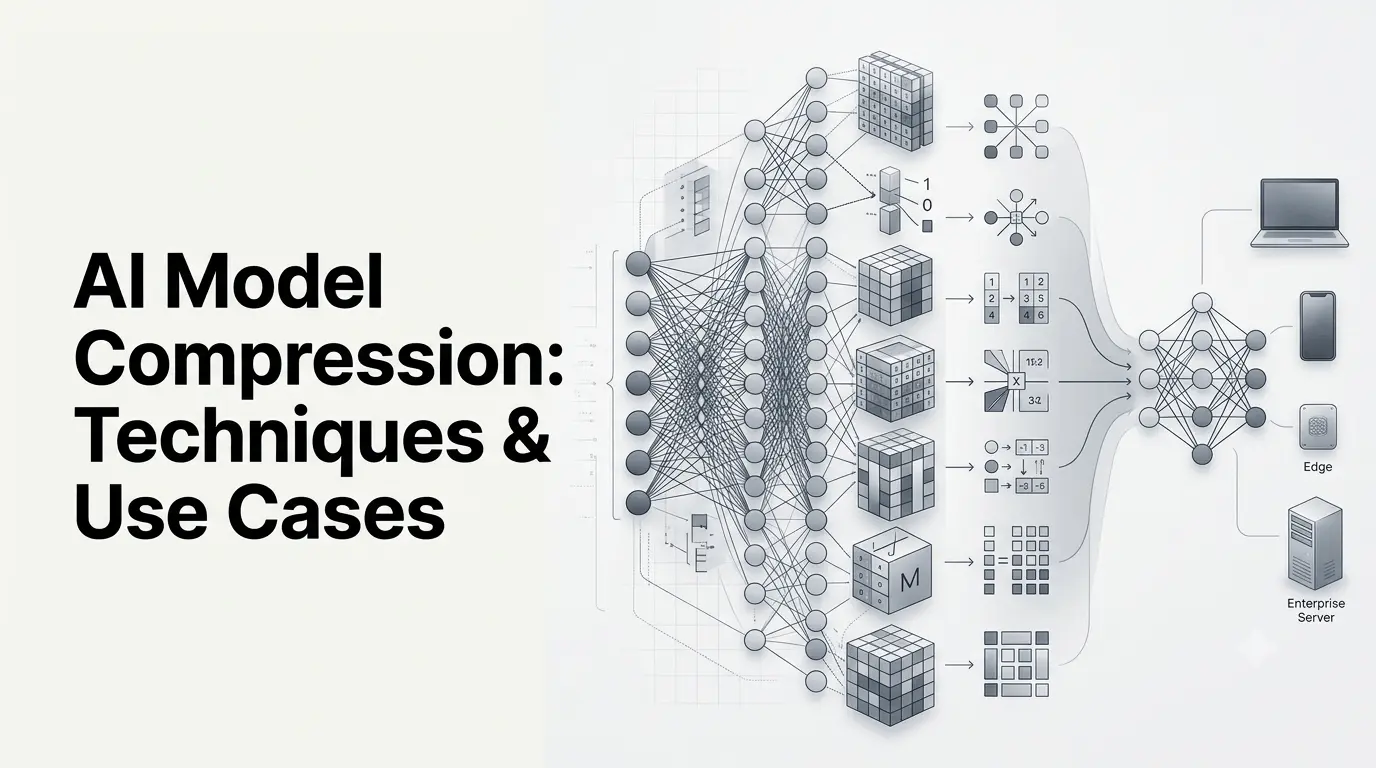
AI model compression is the process of reducing a machine learning model’s size, memory requirements, computational workload, or inference cost while preserving as much of its original performance as possible.
The main techniques include quantization, pruning, knowledge distillation, low-rank approximation, tensor decomposition, and weight sharing or clustering. These approaches can make AI models faster and cheaper to run, while also making them practical for devices with limited memory and computing power.
For large language models (LLMs), model compression has become particularly important as increasingly capable models require substantial hardware resources for inference and deployment. Modern tooling supports techniques ranging from 8-bit and 4-bit quantization to structured sparsity and more specialized compression methods.
Quick Summary –
- AI model compression makes AI models smaller and more efficient while preserving performance.
- Key techniques include quantization, pruning, knowledge distillation, and tensor decomposition.
- Compression can reduce memory usage, inference costs, latency, and energy consumption.
- It helps enable AI on smartphones, edge devices, PCs, robotics, and enterprise systems.
- Compressed LLMs can make local and private AI deployment more practical.
- Main challenges include accuracy loss, hardware compatibility, and additional engineering requirements.
- The goal is to achieve the right balance between AI capability, speed, cost, and resource usage.
What is AI Model Compression?
AI model compression refers to techniques that reduce the computational or storage footprint of a trained machine learning model.
A model can be compressed in several ways:
- Quantization reduces the numerical precision used to represent weights and activations.
- Pruning removes parameters or connections that contribute relatively little to the model.
- Knowledge distillation trains a smaller student model using information from a larger teacher model.
- Low-rank approximation represents large matrices using smaller mathematical components.
- Tensor decomposition restructures model parameters into more compact representations.
- Weight sharing or clustering reduces the number of unique parameter values.
The goal isn’t simply to make a model smaller. A useful compressed model should ideally require less memory and compute while retaining enough accuracy, reasoning ability, or task performance for its intended workload.
This distinction is important because reducing parameters does not automatically guarantee faster inference. The hardware and software stack must be able to take advantage of the compressed representation.
Why Does AI Model Compression Matter?
Large AI models can require significant memory, compute capacity and energy during inference. These requirements become particularly challenging when models need to run at high scale or on resource-constrained hardware.
TensorFlow’s Model Optimization Toolkit identifies model size, latency, memory utilization and power consumption as important deployment considerations, particularly for mobile and IoT devices.
Compression can help address several practical problems:
Lower memory requirements
A lower-precision or structurally smaller model can require substantially less memory.
For example, Hugging Face’s Transformers documentation notes that quantization can reduce memory requirements by representing weights and activations with lower-precision data types such as int8.
Lower inference costs
Smaller models generally require fewer resources to store and serve. For businesses operating AI workloads at scale, this can translate into lower infrastructure requirements.
The actual savings depend on the model, hardware, compression technique and inference workload.
Faster inference
Compression can reduce the amount of computation or memory movement required during inference. However, the speed improvement is hardware-dependent.
A compressed model that uses a representation unsupported by a particular accelerator may not become faster, even if its file size is substantially smaller.
Edge and on-device AI
Compression is particularly useful when AI must run on:
- Smartphones
- PCs
- Embedded systems
- IoT devices
- Cameras
- Automotive hardware
- Industrial equipment
- Robotics systems
These environments often have stricter limits on memory, power and compute than cloud data centers.
Greater deployment flexibility
A smaller model can make it possible to deploy AI in environments where the original model would be impractical, including private infrastructure and disconnected or intermittently connected systems.
How Does AI Model Compression Work?
The basic process usually looks like this:
Original Model → Compression → Validation → Fine-Tuning or Recovery → Deployment
A practical workflow can include:
- Select a trained model
- Measure baseline performance
- Choose a compression technique
- Compress the model
- Evaluate accuracy and task performance
- Fine-tune or retrain if necessary
- Benchmark memory, latency and throughput
- Deploy the optimized model
The most important step is benchmarking the compressed model against the original model on the workload that actually matters.
A model can score well on a general benchmark while behaving differently on a company’s production data or a specific application.
Main AI Model Compression Techniques
1. Quantization
Quantization reduces the numerical precision used to store or process model parameters.
A model might originally use 32-bit floating-point values and be converted to lower-precision formats such as FP16, INT8 or INT4.
Hugging Face currently documents numerous quantization approaches, including AWQ, GPTQ, bitsandbytes, FP8 and other methods.
Post-training quantization
Post-training quantization, or PTQ, is applied after a model has already been trained.
It is attractive because it can often be performed without retraining the entire model.
TensorFlow describes post-training quantization as a way to reduce model size, latency, processing requirements and power consumption while aiming to preserve model accuracy.
Quantization-aware training
Quantization-aware training, or QAT, incorporates the effects of quantization during training so the model can adapt to the reduced precision.
This can be particularly useful when aggressive quantization would otherwise cause unacceptable accuracy loss. TensorFlow notes that QAT can often provide better accuracy than straightforward post-training quantization.
4-bit quantization
Four-bit quantization has become particularly relevant for LLM deployment because it can substantially reduce memory requirements.
Methods such as AWQ and GPTQ are designed for low-bit LLM quantization. Hugging Face describes AWQ as preserving a small fraction of particularly important weights while enabling 4-bit compression.
However, 4-bit does not automatically mean that every model will run faster or retain identical quality. Hardware support, kernels, calibration and workload all matter.
2. Pruning
Pruning removes parameters or connections considered less important to the model.
In weight pruning, many values are converted to zero, creating a sparse model.
TensorFlow describes magnitude-based pruning as gradually zeroing model weights during training to create sparsity.
There are two broad approaches:
Unstructured pruning
Individual weights are removed regardless of their position.
This can produce high sparsity, but specialized hardware or software may be needed to convert that sparsity into meaningful speed improvements.
Structured pruning
Entire groups or structured patterns of parameters are removed.
Structured sparsity can be easier for compatible hardware to accelerate. TensorFlow’s documentation notes that specific structural sparsity patterns can improve inference time on supported hardware.
Pruning can also be combined with quantization for additional compression.
3. Knowledge Distillation
Knowledge distillation transfers useful behavior from a larger teacher model into a smaller student model.
Instead of simply deleting parameters from an existing model, the smaller model learns to reproduce useful information from the larger model.
A simplified workflow is:
Large Teacher Model → Training Signals → Smaller Student Model
PyTorch describes knowledge distillation as a technique for transferring knowledge from computationally expensive models to smaller models so they can run on less powerful hardware.
Distillation is particularly useful when an organization wants a smaller model designed around a specific task rather than a compressed copy of a general-purpose model.
For example, a company could use a large language model as a teacher while training a smaller model specifically for customer-support classification.
4. Low-Rank Approximation
Large neural networks contain matrices with millions or billions of numerical values.
Low-rank approximation attempts to represent these matrices using smaller matrices.
Instead of storing one very large matrix directly, the system can approximate it through smaller components.
This can reduce:
- Parameter count
- Memory usage
- Computational requirements
The trade-off is that excessive approximation can remove information that the model needs.
5. Tensor Decomposition
Tensor decomposition restructures high-dimensional model parameters into more compact mathematical representations.
It can be used as an alternative or complement to techniques such as quantization and pruning.
One notable example is CompactifAI from Multiverse Computing, which uses quantum-inspired tensor networks to compress AI models. The company’s published research describes applying tensor-network techniques to LLM layers and combining them with other compression methods.
In one published Llama 2 7B experiment, Multiverse reported reducing the model to around 30% of its original size in float16 while retaining about 90% of the original accuracy after retraining for its evaluated summarization tasks. These are specific research results rather than a universal compression guarantee.
6. Weight Sharing and Clustering
Weight sharing reduces the number of unique numerical values used by a model.
Instead of storing every parameter independently, multiple parameters can reference the same value or a smaller set of representative values.
This can reduce storage requirements and can work alongside other optimization methods.
TensorFlow’s Model Optimization Toolkit includes clustering alongside quantization and pruning as model-optimization techniques.
AI Model Compression Techniques Compared
| Technique | Main idea | Primary benefit | Main trade-off |
|---|---|---|---|
| Quantization | Reduce numerical precision | Lower memory and compute | Possible quality loss |
| Pruning | Remove less important parameters | Smaller/sparser models | Hardware support can matter |
| Distillation | Train a smaller model from a larger teacher | Compact specialized models | Requires additional training |
| Low-rank approximation | Factorize large matrices | Fewer parameters | Approximation error |
| Tensor decomposition | Represent parameters compactly | Model-size reduction | More complex implementation |
| Weight clustering | Share parameter values | Lower storage | May affect accuracy |
No single technique is universally best. The appropriate method depends on the model architecture, target hardware, quality requirements and deployment environment.
What Are the Benefits of AI Model Compression?
1. Lower memory consumption
Compressed models can fit into hardware that cannot accommodate the original model.
This is one of the main reasons quantized LLMs are widely used for local inference.
2. Reduced infrastructure costs
When a model requires fewer resources per inference, organizations may be able to serve more requests using the same infrastructure.
The financial impact depends on utilization, hardware pricing, traffic volume and the actual speedup achieved.
3. Lower latency
Compression can reduce computation and memory movement, potentially improving response times.
However, a smaller file size should not automatically be interpreted as lower latency.
4. More efficient edge deployment
Compression can make AI more practical for devices with limited compute, storage or power.
This is especially relevant for:
- Industrial sensors
- Mobile applications
- Autonomous systems
- Security cameras
- Healthcare devices
- Robotics
- Consumer electronics
5. Better energy efficiency
Reducing the amount of computation and hardware required can reduce energy consumption.
The amount saved varies substantially by model, hardware and workload.
6. Greater privacy and deployment control
Running a smaller model locally can reduce the need to send sensitive information to a remote AI service.
This can be useful in healthcare, manufacturing, finance and other environments where organizations have strict data-governance requirements.
What Are the Challenges of AI Model Compression?
Compression is not free. Most techniques introduce trade-offs that need to be measured.
1. Accuracy loss
Aggressive compression can remove information that contributes to model quality.
The impact may be small on one benchmark and significant on another.
This is particularly important for:
- Reasoning
- Mathematical tasks
- Coding
- Multilingual workloads
- Long-context applications
- Specialized enterprise data
2. Hardware compatibility
A compressed representation only delivers its full benefits when the deployment stack supports it.
For example, a particular 4-bit format may have excellent memory characteristics but limited acceleration on a particular CPU or GPU.
Hugging Face’s current quantization documentation lists different methods and hardware support, illustrating why compression decisions need to be made together with the target deployment environment.
3. Compression does not always mean faster inference
This is one of the most common misconceptions.
A smaller model may consume less storage but still deliver little or no latency improvement if the inference engine cannot efficiently exploit its compressed structure.
Pruning provides a good example: sparse weights can reduce model size, but meaningful inference acceleration depends on appropriate software and hardware support.
4. Additional engineering work
Production compression can require:
- Calibration datasets
- Fine-tuning
- Hardware-specific kernels
- Benchmarking
- Accuracy testing
- Model conversion
- Deployment changes
- Monitoring
The engineering effort can outweigh the benefits for small or low-volume applications.
5. Quality can change unevenly
Compression may preserve average benchmark performance while hurting specific capabilities.
A model could maintain general language performance but lose quality on coding, mathematical reasoning or a company’s specialized terminology.
That is why evaluation should include the tasks the model will actually perform.
AI Model Compression for Large Language Models
LLMs are a major application for model compression because their parameter counts can make local deployment difficult.
Modern LLM compression commonly involves:
- 8-bit quantization
- 4-bit quantization
- FP8
- Weight-only quantization
- AWQ
- GPTQ
- Pruning
- Knowledge distillation
- Tensor-based compression
- Combinations of multiple techniques
Hugging Face’s current Transformers documentation supports multiple quantization backends and methods, including AWQ, GPTQ, bitsandbytes and others.
For developers, the choice should be based on the target hardware and workload rather than simply selecting the smallest available model.
Real-World Use Cases for AI Model Compression
AI on smartphones and PCs
Compressed models can make local AI features more practical without requiring every request to be processed in the cloud.
Potential applications include:
- Writing assistants
- Image classification
- Speech recognition
- Translation
- Personal assistants
- Document processing
Edge AI
Factories, vehicles and IoT devices often operate with limited compute and connectivity.
Compression can help models fit within these constraints while reducing communication with cloud infrastructure.
Healthcare AI
Medical applications may require models to operate within controlled environments because of privacy and regulatory considerations.
Smaller models can make private or on-premises deployment more practical, although compression does not itself solve compliance requirements.
Financial services
Banks and financial institutions can use optimized models for fraud detection, document analysis, customer-service systems and other workloads where latency and infrastructure efficiency matter.
Robotics
Robots need to make decisions with limited onboard computing resources.
A compressed vision or language model can reduce the hardware requirements for local inference.
Autonomous and industrial systems
Manufacturing systems, cameras and industrial equipment can benefit from models that operate locally with lower latency.
Enterprise AI
Businesses can compress models to reduce infrastructure requirements or deploy them within private environments.
This is particularly relevant when organizations want greater control over data and inference infrastructure.
AI Model Compression vs Model Distillation
These concepts are related but not identical.
| Aspect | Model Compression | Knowledge Distillation |
|---|---|---|
| Definition | Broad family of optimization techniques | Specific model-training technique |
| Main approach | Quantization, pruning, decomposition and more | Teacher transfers knowledge to student |
| Requires original model? | Usually | Yes, as teacher |
| Can reduce precision? | Yes | Not necessarily |
| Can remove parameters? | Yes | Student architecture can be smaller |
| Best suited for | Efficient deployment | Building smaller task-specific models |
Knowledge distillation is therefore one approach within the broader model-efficiency landscape, rather than a synonym for every form of compression.
AI Model Compression vs Quantization
Quantization is a type of AI model compression.
AI model compression is the broader category.
Quantization specifically reduces numerical precision.
For example:
Compression → Quantization → INT8 / INT4
But compression can also involve pruning, distillation, low-rank approximation, tensor decomposition or combinations of these techniques.
Can Multiple Compression Techniques Be Combined?
Yes.
In many practical workflows, combining techniques can produce better results than relying on one method.
For example:
Pruning + Quantization
or
Distillation + Quantization
or
Tensor Decomposition + Quantization
TensorFlow’s optimization tooling explicitly supports combining different optimization approaches, while Multiverse Computing’s research describes combining tensor-network compression with quantization.
The important consideration is cumulative quality loss. Applying several aggressive techniques without intermediate evaluation can make debugging difficult.
How to Choose an AI Model Compression Technique?
Start with the deployment problem rather than the compression method.
If memory is the biggest constraint
Consider quantization, particularly lower-precision formats supported by your hardware.
If the model contains significant redundancy
Consider pruning or structured sparsity.
If you need a smaller specialized model
Consider knowledge distillation.
If matrix operations dominate the model
Investigate low-rank approximation or tensor decomposition.
If you need maximum efficiency
Benchmark a combination of techniques instead of assuming one method will be optimal.
A practical decision process is:
- Measure the original model.
- Define an acceptable accuracy threshold.
- Identify target hardware.
- Test several compression methods.
- Measure model size.
- Measure memory consumption.
- Measure latency and throughput.
- Test production-like workloads.
- Select the configuration that meets the required quality and efficiency targets.
Role of Quantum-Inspired Compression
Quantum-inspired techniques are another area of research and commercial development in AI model compression.
Multiverse Computing’s CompactifAI uses quantum-inspired tensor networks to reduce the size of AI models. Its research describes tensorization as a way of targeting correlations within neural-network parameters rather than relying solely on conventional parameter reduction.
The company’s more recent work has expanded this approach beyond language models. In 2026, Multiverse reported a computer-vision model reduced from 258 MB to 8 MB in a specific experiment while preserving accuracy. This result is a company-reported research result and should not be treated as a general compression ratio for all AI models.
The broader significance is that model compression is evolving beyond simple weight reduction toward methods that attempt to understand and preserve the most useful structure within a model.
What is the Future of AI Model Compression?
As AI models become more capable, compression is likely to remain an important part of deployment engineering.
Several directions are particularly relevant:
- More efficient low-bit quantization
- Hardware-aware compression
- Structured sparsity
- Smaller specialized language models
- Better knowledge distillation
- Automated compression pipelines
- Compression for multimodal models
- On-device generative AI
- Private and sovereign AI deployments
- Combining multiple optimization techniques
The focus is also shifting from simply asking “How small can this model become?” to a more practical question:
“How much capability can we deliver for a given amount of compute, memory, energy and latency?”
That distinction matters because the smallest model is not necessarily the most useful model.
Conclusion
AI model compression is becoming an important part of modern AI deployment because model capability is increasing faster than the practical availability of compute, memory and energy.
Quantization, pruning, knowledge distillation, low-rank approximation and tensor decomposition provide different ways to reduce a model’s computational footprint. Each comes with trade-offs, and the best approach depends on the model and deployment environment.
For developers and organizations, the objective should not simply be the smallest possible model. The better target is a model that delivers the required quality while using an acceptable amount of memory, compute, latency and energy.
As generative AI moves increasingly toward edge devices, private infrastructure and cost-sensitive production systems, efficient models will become an increasingly important part of the AI stack.
Frequently Asked Questions (FAQs)
1. What is AI model compression?
AI model compression is a collection of techniques used to reduce a machine learning model’s size, memory requirements, computational workload or inference cost while attempting to preserve its useful performance.
2. What is the most common AI model compression technique?
Quantization is one of the most widely used approaches, particularly for LLM inference. It reduces the numerical precision used to represent model parameters, such as converting weights to 8-bit or 4-bit representations.
3. Does model compression reduce AI accuracy?
It can. The effect depends on the model, compression method, compression level and workload. Proper calibration, fine-tuning or retraining can help reduce quality degradation.
4. Is quantization the same as model compression?
No. Quantization is one type of model compression. Other approaches include pruning, knowledge distillation, low-rank approximation and tensor decomposition.
5. Can compressed AI models run on phones?
Yes, depending on the model architecture, compression level and available hardware. Model optimization is commonly used to enable AI inference on mobile, IoT and other resource-constrained devices.
6. Does a smaller AI model always run faster?
No. Speed depends on the inference engine, hardware, memory bandwidth, kernels and whether the deployment environment can exploit the compressed representation.
Also Read –
Multiverse Computing Explained: AI Technology, Products & Use Cases
Quasar 1.1 438B Uses Quantum-Generated Data
Quantum AI: How Quantum Computing and Artificial Intelligence Work Together?
AI Models Explained: Types, Capabilities, How They Work & More