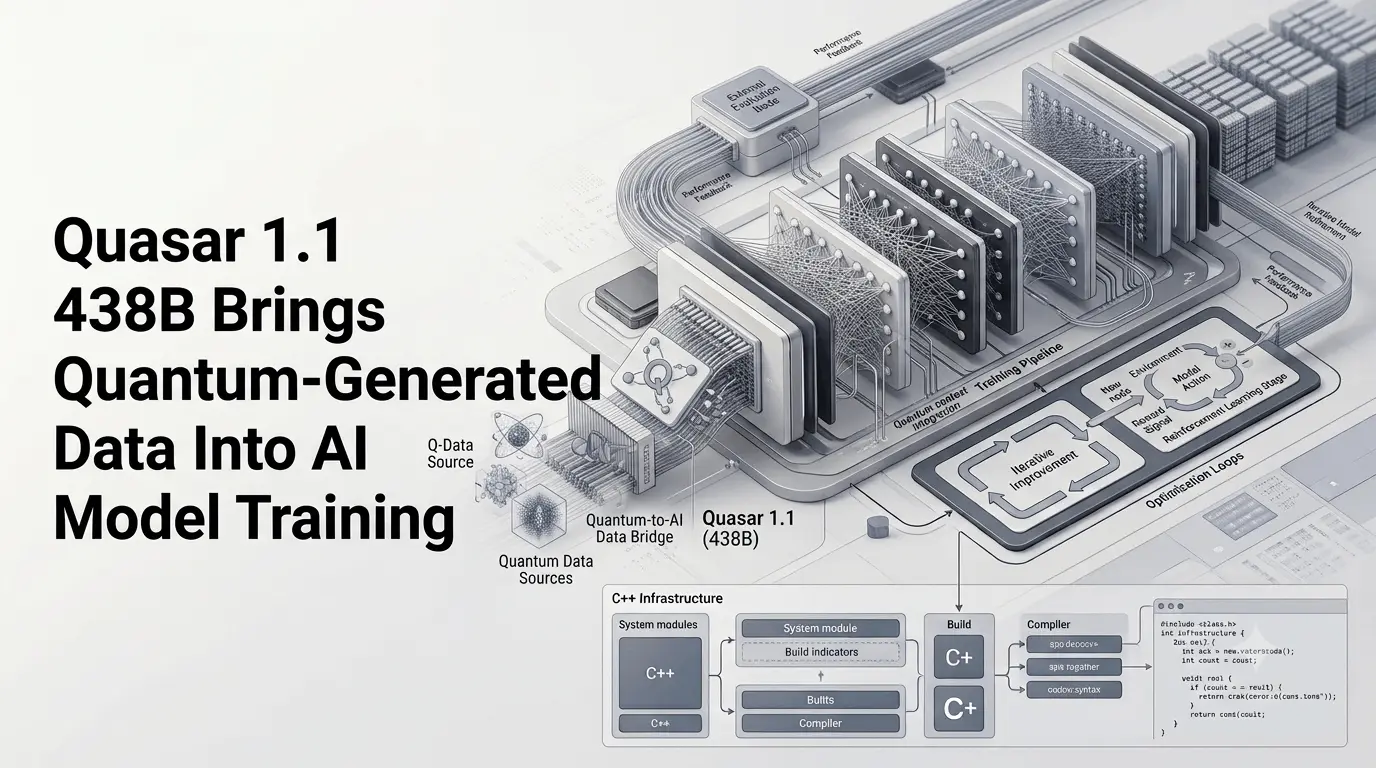
Multiverse Computing has released Quasar 1.1 438B, an updated version of its coding and agentic AI model that incorporates data generated with the help of quantum computing. The company says part of the model’s healing dataset was produced by a hybrid quantum language model running circuits on IBM Quantum System Two in Donostia-San Sebastián, using a 156-qubit IBM Heron processor.
The release is notable because the quantum component was used as part of the model-building process rather than simply being referenced as an inspiration for classical AI techniques. Multiverse Computing describes it as the first time quantum-generated data has entered its CompactifAI model-compression and optimization pipeline.
Quasar 1.1 438B is available through the CompactifAI API. The company says the model is designed for coding, tool use and agentic workloads, with the update focused on improving benchmark performance while reducing the amount of text the model generates.
Quick Summary
- Quasar 1.1 438B has been released by Multiverse Computing.
- The model incorporates quantum-generated data into its development pipeline.
- The data was generated using a hybrid quantum language model running on an IBM 156-qubit Heron processor.
- Multiverse reports improvements across several benchmarks compared with Quasar 1.0.
- The company reports 37.6% fewer output tokens, potentially improving inference efficiency.
- Quasar 1.1 is designed particularly for coding and agentic AI workloads.
- The quantum hardware was used for data generation, not for conventional model inference.
- The reported benchmark and safety results are company-reported, rather than independent validation.
- The release connects three increasingly important areas: quantum computing, large language models, and AI agents.
What Changed in Quasar 1.1?
The new release is a rebuilt version of Quasar 438B rather than a model trained entirely from scratch. Multiverse Computing says Quasar 1.1 starts from GLM-5.2, an open-weights model from Z.ai, and is transformed through the company’s CompactifAI pipeline.
That process includes expert pruning, additional training or “healing,” output-length tuning and quantization-aware optimization. In Quasar 1.1, Multiverse says the expert count is reduced from 256 to 148 per layer while retaining capabilities targeted at coding and agentic tasks.
The company reports that the new healing stage used a broader dataset containing reasoning traces, tool-call sequences and general knowledge. According to Multiverse’s reported evaluations, Quasar 1.1 improved over Quasar 1.0 by 6.2 points on Humanity’s Last Exam, 6.4 points on LCR, 4.6 points on IFBench and 4.3 points on GPQA.
These figures are company-reported results and should not be interpreted as independent benchmark validation.
Quantum-Generated Data Enters the Pipeline
The most distinctive change is the use of quantum-generated synthetic data.
Multiverse Computing says part of the healing dataset was generated by a hybrid quantum large language model in which one-sixth of the layers of a Qwen3-30B-A3B model were replaced with a quantum neural network. Circuits were then run on IBM Quantum System Two in San Sebastián using a 156-qubit IBM Heron processor, along with a noise model calibrated from that hardware.
This distinction is important. Quasar 1.1 is not a quantum-native chatbot that requires a quantum processor every time it generates an answer. Instead, quantum hardware contributed to the generation of data used during the model-development process.
The resulting model can still be accessed through a conventional API. Multiverse’s approach therefore represents an experiment in using quantum-generated information to influence the development of a classical large language model.
Quasar 1.1 Also Produces Shorter Responses
Another major focus of the update is efficiency.
Multiverse Computing says average output length fell from 3,322.9 tokens in Quasar 1.0 to 2,074.3 tokens in Quasar 1.1 across SciCode, HumanEval, GSM8K, TriviaQA and BBH. That represents a reported 37.6% reduction in output tokens.
For agentic applications, shorter responses can matter because an AI agent may make many model calls while completing a task. Reducing unnecessary output can potentially lower token consumption and associated serving costs, although the actual savings will depend on API pricing, workload and how the model is deployed.
Multiverse says the model was specifically tuned to stop when the work is complete rather than producing unnecessary additional text.
Changes to Refusal Behavior
Quasar 1.1 also changes how the model handles certain politically sensitive prompts.
Multiverse reports that its refusal rate on politically sensitive prompts fell to 41.00%, compared with 63.75% for Quasar 1.0. The company attributes the change to removal of topic-level restrictions inherited from the underlying model.
At the same time, the company says its refusal rate on harmful prompts remained at 93.00% on JailbreakBench, compared with 92.00% for Quasar 1.0.
Multiverse describes this as changing unwanted refusal behavior without removing its standard safety protections. The company says it used a refusal-steering technique involving an LLM-based judge and a steering vector to modify refusal behavior.
These safety figures are also reported by Multiverse Computing and should be distinguished from independent safety testing.
Built for AI Agents and European Deployment
Quasar 1.1 is being positioned primarily as an AI model for agentic workloads, rather than as a general-purpose conversational assistant.
Multiverse says the development process focused on capabilities such as tool calling, maintaining coherence across multi-step tasks and generating code that can be executed as part of an agent workflow. The company says its healing, verbosity tuning and quantization choices were optimized around this use case.
The model also fits Multiverse Computing’s broader focus on efficient and sovereign AI deployment. The company says Quasar 1.1 is served by a European company incorporated under EU law and developed with European regulatory requirements in mind, including transparency expectations associated with the EU AI Act.
That positioning could make the model relevant to organizations looking for AI infrastructure operated under European legal and deployment requirements, although regulatory compliance claims should ultimately be assessed according to the specific deployment and applicable obligations.
What the Quantum Element Actually Means?
The Quasar 1.1 release does not demonstrate that quantum computers have replaced conventional AI training infrastructure.
Instead, it provides an example of a hybrid approach in which quantum hardware contributes synthetic data to a classical AI development pipeline. The model itself is derived from an existing open-weights foundation model and processed through Multiverse Computing’s CompactifAI technology.
That makes the experiment significant primarily because it moves quantum computing one step closer to the data-generation and model-development side of AI, rather than limiting quantum techniques to theoretical research or quantum-inspired classical algorithms.
Multiverse’s earlier technical documentation describes CompactifAI as a compression pipeline that uses quantum-inspired expert selection, targeted healing and quantization-aware techniques to transform large models for more efficient deployment.
Quasar 1.1 extends that approach by adding actual quantum-generated data to the pipeline.
Quasar 1.1 438B at a Glance
| Feature | Quasar 1.1 438B |
|---|---|
| Developer | Multiverse Computing |
| Base model | GLM-5.2 from Z.ai |
| Main focus | Coding and agentic workloads |
| Model update | CompactifAI rebuild and healing |
| Quantum component | Quantum-generated healing data |
| Quantum hardware | IBM Quantum System Two |
| Processor | 156-qubit IBM Heron |
| Output reduction | 37.6% reported reduction |
| API access | CompactifAI API |
| Availability | Released September 15, 2026 |
What Comes Next for Quasar?
Multiverse Computing says more Quasar updates are planned, including larger and specialized models. The company is also inviting users to test Quasar 1.1 through a challenge designed to identify and report model flaws.
For now, the most important distinction is between the model’s quantum-assisted development process and quantum-native inference. Quasar 1.1 438B remains an AI model deployed through conventional infrastructure, but its development pipeline now includes data generated using quantum hardware.
That makes Quasar 1.1 an interesting development at the intersection of quantum computing, large language models and agentic AI, while the reported benchmark gains and the specific contribution of quantum-generated data remain areas that will benefit from broader independent evaluation.
Also read –
Grok 4.7 Delayed: Release Update, Expectations & What’s Next
Multiverse Computing Explained: AI Technology, Products & Use Cases