
Elon Musk has provided a new look at the Grok model roadmap, outlining the expected progression from Grok 4.7 through Grok 4.8, Grok 4.9 and eventually Grok 5. The update is notable because Grok 4.7 has not yet been publicly released, while Musk says the next model, Grok 4.8, is already approaching the end of its training phase.
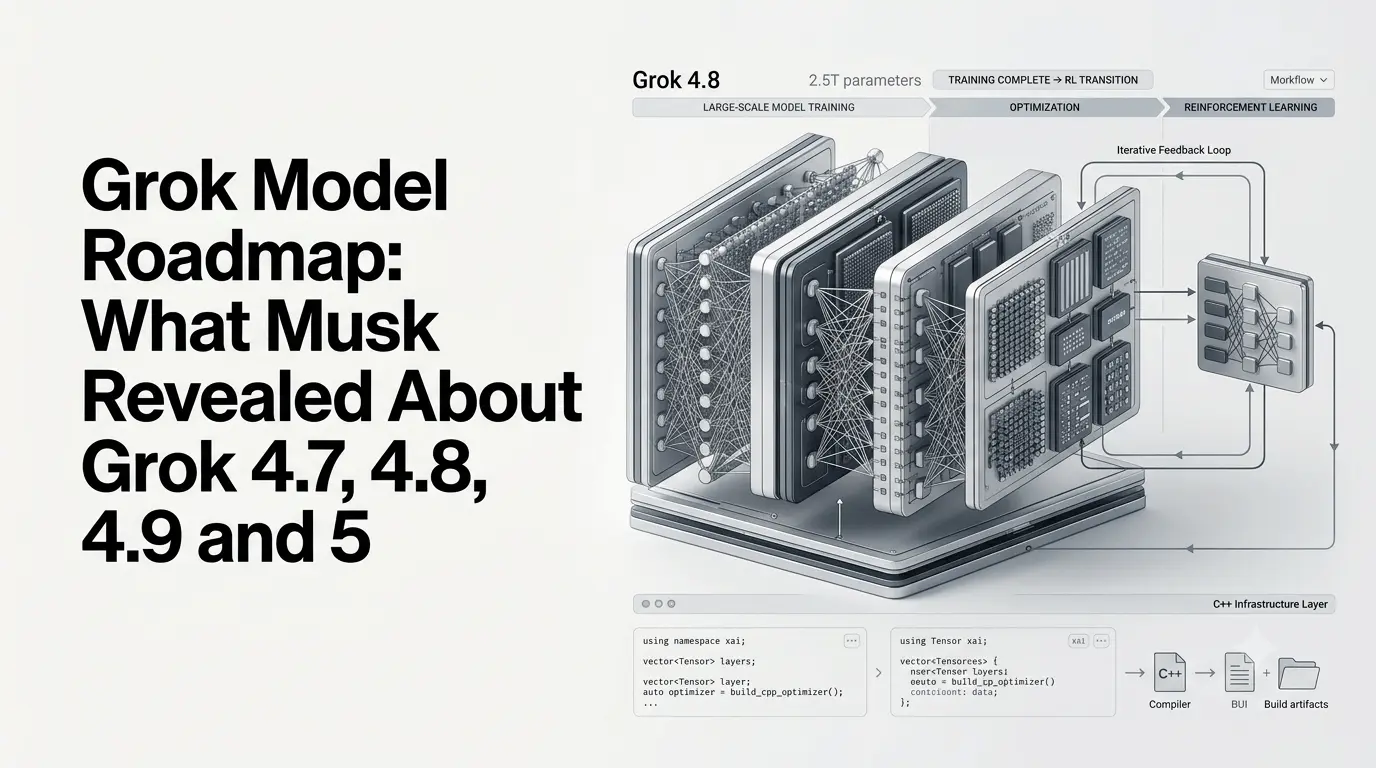
According to Musk, Grok 4.8 is a 2.5-trillion-parameter model trained using a new C++ software stack. He said the model would finish training during the week of September 14 and then move into reinforcement learning. Musk also described Grok 4.8 as a noticeable improvement over Grok 4.7, while placing Grok 4.9 and Grok 5 further along the roadmap.
The statements are roadmap guidance rather than a formal model launch. xAI’s latest publicly announced model remains Grok 4.6, which was released in August and is available through products including Grok Build and the API.
Musk Updates the Grok Model Roadmap
The latest Grok model roadmap covers four model generations and gives the clearest indication yet of how quickly xAI is progressing its next series of models.
Musk said Grok 4.7 should be roughly comparable with Anthropic’s Opus 5.0 rather than the newer Opus 5.1, while acknowledging that it is expected to be better in some areas and worse in others. He specifically identified multimodal performance as an area that still needs improvement.
The roadmap then moves quickly to Grok 4.8. Musk said the model will represent a noticeable improvement over 4.7 and is already nearing the end of its main training phase.
Beyond 4.8, Musk described Grok 4.9 as probably being in the class of models he referred to as Astra/Fable, while saying Grok 5 could potentially outperform everything currently available. Those descriptions are forward-looking statements rather than independently verified performance results.
Grok 4.7 Remains Unreleased
Grok 4.7 occupies an unusual position in the roadmap because the model discussed as the immediate predecessor to Grok 4.8 has not yet been publicly released.
Musk’s latest comments indicate that xAI is still working on the model’s performance, particularly its multimodal capabilities. He characterized Grok 4.7 as roughly on par with Opus 5.0 rather than Opus 5.1 and said it was better in some areas and worse in others.
That assessment should not be treated as an independent benchmark comparison. Grok 4.7 has not yet been released with a public model card or a complete set of independently reproducible benchmark results.
This distinction is important because the roadmap contains several future-looking performance claims that cannot yet be tested against publicly available versions of the models.
Grok 4.8 Is the Next Major Step
The most detailed part of Musk’s update concerns Grok 4.8.
Musk said Grok 4.8 is a 2.5-trillion-parameter model trained using xAI’s new C++ software stack. He also said its training would finish during the week of September 14 before the model moves directly into reinforcement learning.
If the timeline holds, the development would mark a significant transition in the model’s training process. Reinforcement learning is typically used after earlier training stages to optimize model behavior through feedback and targeted tasks.
However, the specific details of Grok 4.8’s architecture, training data, compute requirements, benchmark performance and eventual product availability have not been published by xAI in a formal technical announcement.
The 2.5-trillion-parameter figure and the C++ software-stack description should therefore be treated as claims from Musk rather than independently verified specifications.
Grok 4.9 and Grok 5 Are Already on the Roadmap
Musk’s roadmap extends beyond Grok 4.8.
He said Grok 4.9 is probably in the “Astra/Fable” class, using those names as reference points for future frontier-model capabilities. He then described Grok 5 as potentially being “better than anything,” while adding uncertainty about how it will ultimately perform.
There are currently no public release dates, model cards or benchmark results establishing those future capabilities.
As a result, Grok 4.9 and Grok 5 should be viewed as roadmap targets rather than products with confirmed specifications. The statements nevertheless show that xAI is already publicly discussing multiple generations beyond Grok 4.7.
Why the Speed of the Grok Roadmap Matters?
The most notable part of the update may be the pace of development implied by the sequence.
Grok 4.7 has not yet reached public release, while Musk says Grok 4.8 is already completing its main training run. At the same time, the company is publicly discussing Grok 4.9 and Grok 5 as subsequent generations.
That creates an unusually compressed-looking development sequence, although the actual release timing could differ substantially from the roadmap described by Musk.
The progression also highlights how xAI is focusing not only on model capability but on the infrastructure used to train increasingly large systems. Musk’s description of a new C++ software stack for Grok 4.8 suggests that changes to the underlying training infrastructure are part of xAI’s strategy for the next generation of models.
How the Roadmap Fits With Grok 4.6?
The current public baseline is still Grok 4.6.
xAI officially released Grok 4.6 on August 12, describing it as an upgrade focused on long-running agents, interactive work and visual tasks. The company reported results across several coding, knowledge-work and agentic benchmarks and made the model available through Grok Build, Cursor, its API and other partners.
That makes the gap between the public product and Musk’s future roadmap particularly important. Grok 4.7, 4.8, 4.9 and 5 represent future stages of the model family, while Grok 4.6 remains the version with publicly documented capabilities and benchmarks.
For users and developers, the practical question is therefore not yet how Grok 4.8 performs, but when xAI will provide a public release and enough technical information to evaluate it.
What Is Confirmed About the Grok Model Roadmap?
The current roadmap should be separated into publicly released information and Musk’s forward-looking statements.
| Model | Current status | Information available |
|---|---|---|
| Grok 4.6 | Publicly released | Official specifications, capabilities and benchmarks available |
| Grok 4.7 | Not publicly released | Musk has discussed expected positioning and remaining multimodal work |
| Grok 4.8 | In development, according to Musk | Reported 2.5T parameters, new C++ training stack and upcoming RL stage |
| Grok 4.9 | Future roadmap | Musk says it could be Astra/Fable class |
| Grok 5 | Future roadmap | Musk says it could potentially outperform everything |
The distinction matters because the later models have not yet been independently evaluated. Until xAI publishes formal documentation, release information or benchmark results, claims about their capabilities should remain attributed to Musk.
For now, the Grok model roadmap points toward a rapid sequence of new generations, with Grok 4.8 emerging as the next major technical milestone after the still-unreleased Grok 4.7. The next important confirmation will be whether Grok 4.8 completes training and enters reinforcement learning on the timeline Musk described.
Also Read –
Grok 4.7 Delayed: Release Update, Expectations & What’s Next
Grok 4.6: Inside the Latest Grok Model, Features & Pricing
Grok AI Models: Complete Guide to Grok Models & Capabilities