
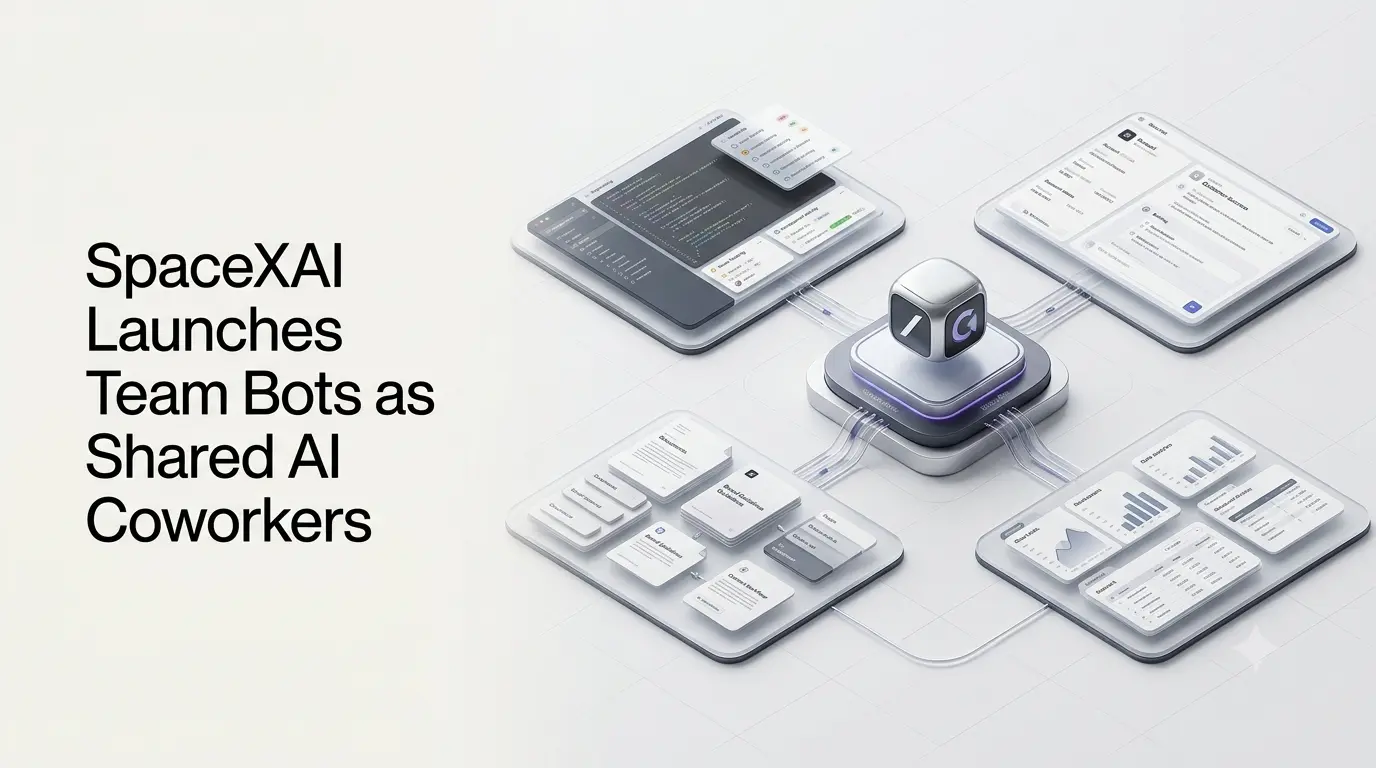
SpaceXAI has launched Team Bots, a new capability that lets teams share Grok Bots equipped with common files, tools, skills and memories. The feature launched on September 28, 2026, and is now available in public beta for Teams and Enterprise plans.
Unlike a conventional chatbot that starts each interaction largely from an individual user’s context, Team Bots are designed around a shared role or workflow. Multiple employees can use the same Bot while benefiting from common expertise and skills accumulated for that team’s work.
SpaceXAI says it is already using Team Bots internally for account briefings, engineering coordination and company-wide data questions. The company also provides examples spanning sales, product development, marketing and data analytics.
Quick Summary
- SpaceXAI launched Team Bots on September 28, 2026.
- Team Bots are shared Grok Bots designed for team workflows.
- They can use shared skills, context, plugins, credentials and memory.
- Individual conversations remain private while shared Bot knowledge can benefit the team.
- Team Bots can operate through Slack and Grok Bot.
- SpaceXAI highlights use cases across sales, engineering, marketing and data analytics.
- The feature is currently in public beta for Teams and Enterprise.
- The development moves Grok further toward persistent AI agents for organizational workflows.
How Team Bots work?
A Team Bot combines four core components: context, plugins, credentials and memory.
Context can include files, instructions and skills relevant to a team’s work, such as internal documentation or brand guidelines. Plugins allow the Bot to work with applications including Salesforce, Notion and GitHub, while credentials can provide access to third-party APIs that do not have a dedicated plugin.
Memory is the component that allows the Bot to retain information about its role and improve its usefulness over time. According to SpaceXAI, corrections and decisions made while teams work with a Bot can become part of the Bot’s accumulated knowledge.
The shared nature of the Bot does not mean every employee sees everyone else’s conversations. SpaceXAI says individual conversations remain private, with separate context and memories maintained for each user while shared skills remain available across the team.
Team Bots can also be used through Slack. Each Bot receives its own handle, allowing employees to invite it into a channel where team members can ask questions, provide additional context and see its responses.
Team Bots are already being used across different functions
SpaceXAI has outlined several internal and customer-facing examples to demonstrate how the system can operate across different business workflows.
1. Sales and customer success
The company says each major sales account at SpaceXAI has a dedicated Team Bot shared by account executives, customer success managers, solutions architects and sales leaders.
The Bot reviews information such as company news, Gong calls, Notion documents and relevant Slack discussions. It then prepares a morning briefing describing changes and recommended next steps for different members of the account team.
SpaceXAI also says the Bot can retain decisions made by the team, helping maintain context as employees move onto or off an account.
2. Product and engineering
For engineering work, SpaceXAI’s Team Bot connects project information across tools including Slack, Notion, Linear, Hex, Datadog and Cursor.
The company says its Engineering Team Bot can follow product decisions, triage bugs, create tickets and launch Cloud Agents for well-defined fixes. It can also coordinate work across tools and agents before reporting progress and blockers back to the team.
SpaceXAI says this setup was also used during the development of Team Bots itself. According to the company, a five-person team used a Cursor Project that orchestrated hundreds of Cloud Agents and helped the team ship more than 100 pull requests per day while developing the product. This is a company-reported result rather than an independently audited benchmark.
3. Marketing
Team Bots can also be configured for marketing workflows.
SpaceXAI says its Marketing Bot has access to brand guidelines, blog posts and social content. It can review drafts against the team’s current messaging and, for approved website and SEO changes, carry the workflow from review to preview and final sign-off.
This approach turns the Bot from a general-purpose assistant into a shared operational system with a specific team’s rules and processes.
4. Data analytics
SpaceXAI’s Data Bot is designed to answer internal data questions without requiring every employee to obtain direct warehouse access.
The company says the Bot uses shared, read-only credentials to query approved Databricks tables and can also connect to Datadog, Hex and Statsig. Its analytics team has supplied the Bot with a library of skills covering more than 45,000 tables, including instructions for finding data, analyzing feature usage and following internal chart standards.
The Bot can also remember corrections to queries, allowing information learned from one interaction to improve later responses for the team.
Team Bots availability
Team Bots is currently available in public beta on Teams and Enterprise plans. SpaceXAI is also offering pre-built Team Bots for sales, product management, marketing and data analytics as starting points for organizations.
The broader Grok Bot documentation shows that team deployments include administrative and security controls. Grok Bot operates as a computer-use agent capable of working with applications, browsers and development environments, while team administrators can control access, connectors, network settings and approval policies depending on the plan.
For Enterprise deployments, administrators can enforce Auto-review rules and configure additional controls around network access, team setup, secrets and computer management.
What Team Bots change for workplace AI?
The significance of Team Bots is less about adding another chatbot interface and more about changing how AI assistants can operate inside organizations.
Traditional AI assistants are often centered on an individual user’s conversation history, preferences and files. Team Bots instead give organizations a way to build a persistent AI worker around a shared business process, while maintaining individual user conversations separately.
That makes the system particularly relevant to workflows where the same information, tools and operating procedures need to be applied repeatedly by different employees. Sales accounts, engineering projects, marketing operations and recurring analytics requests are examples SpaceXAI has already identified.
Team Bots therefore represents a broader move toward AI agents that function as persistent members of a team rather than one-off assistants. Its public-beta availability gives Teams and Enterprise customers an opportunity to test that model in real business workflows, although the effectiveness and reliability of those deployments will depend on how organizations configure permissions, data access, tools and approval controls.
FAQs
1. What are Team Bots?
Team Bots are shared Grok Bots designed around a team’s role or workflow. They can use common context, skills, plugins, credentials and memories while maintaining separate conversations for individual users.
2. Are Team Bots available now?
Yes. SpaceXAI says Team Bots are available in public beta for Teams and Enterprise plans as of September 28, 2026.
3. Can Team Bots work in Slack?
Yes. SpaceXAI says each Team Bot has its own Slack handle and can be invited into channels for collaborative work.
4. What can Team Bots do?
SpaceXAI’s examples include preparing sales briefings, coordinating engineering work, reviewing marketing content, handling website and SEO workflows, and answering data analytics questions.
5. Do users see each other’s Team Bot conversations?
No. SpaceXAI says individual conversations remain private, with each user’s context and memories kept separate while shared skills are available to the team.
Also Read –
Grok AI Models: Complete Guide to Grok Models & Capabilities
Grok Bot Guides: How xAI Is Building Persistent AI Agent Workflows?
Grok Bot: What Is It? And How It Works?
Source
Team Bots: AI coworkers that learn from your team
Grok Bot for Teams and Enterprises documentation