
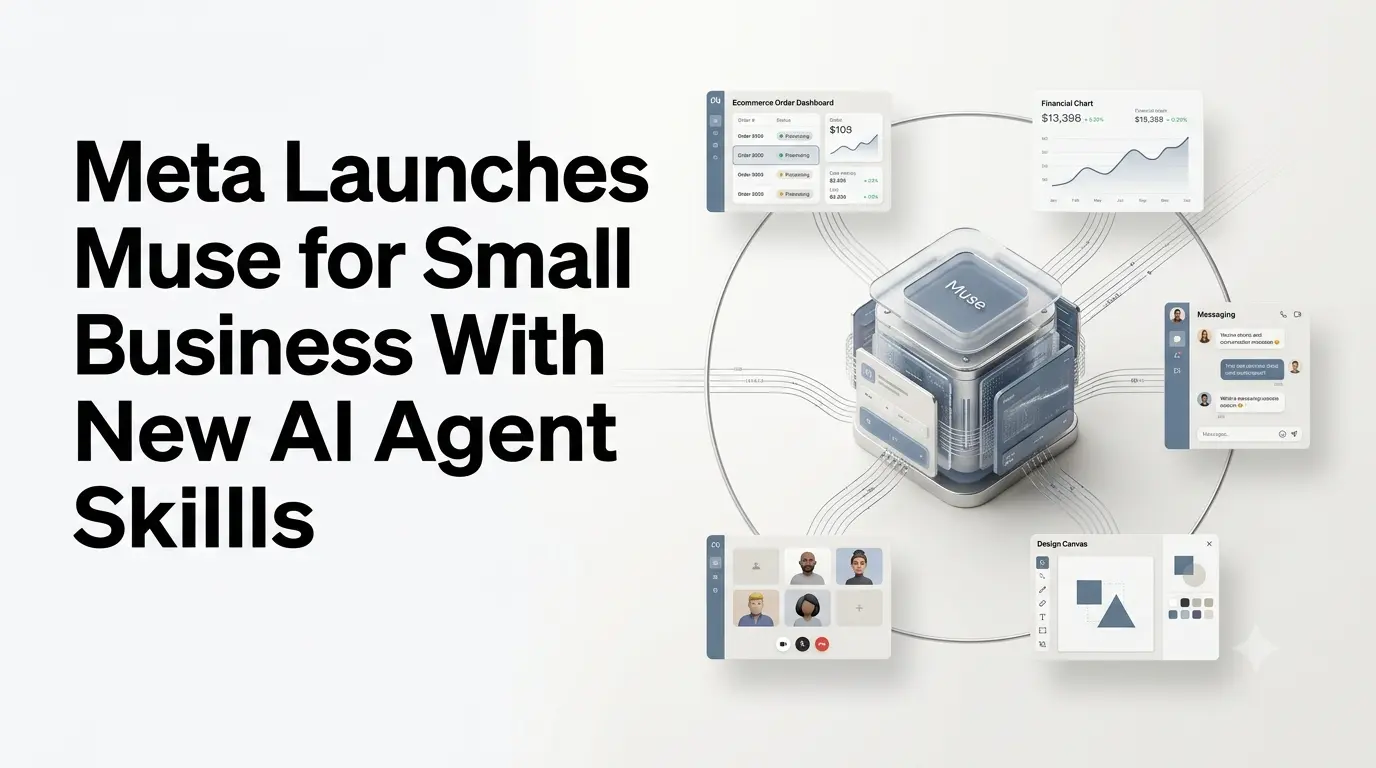
Meta has expanded its Muse personal AI agent into small-business workflows with the launch of Muse for Small Business, announced September 29, 2026. The update adds business-focused skills and connectors that allow Muse to work with services such as Shopify, QuickBooks, Slack, Canva, Notion and Zoom, while also connecting to Facebook and Instagram business accounts.
The move extends Muse beyond personal tasks and into areas such as marketing, sales, financial analysis, customer management and day-to-day business operations. Meta says users can give Muse broader goals, such as running parts of a business or finding new customers, and the agent can work across connected services to help accomplish those goals.
Muse was originally introduced by Meta earlier in September as a personal AI agent designed to carry out tasks rather than simply answer questions. The small-business update gives that agent access to a broader set of business context and software tools.
Quick Summary
- Meta launched Muse for Small Business on September 29, 2026.
- Muse is Meta’s personal AI agent expanded for business workflows.
- It can connect with tools including Shopify, QuickBooks, Slack, Canva, Notion, Stripe and Zoom.
- Muse can work with business information across connected services rather than operating only as a standalone chatbot.
- Meta says the agent can assist with marketing, sales, financial analysis and daily business operations.
- Users retain approval control over sensitive actions such as sending communications or spending money.
- The update expands Meta’s broader push toward AI agents that can perform tasks across multiple applications.
What Is Muse for Small Business?
Muse for Small Business is not presented as a separate standalone AI model. Instead, Meta is expanding its existing Muse agent with new skills and integrations designed around the software and information small businesses already use.
According to Meta, Muse can connect to a business’s Instagram professional account analytics, Facebook Pages and Meta advertising accounts. It can also work with third-party services through connectors, giving it access to information about areas such as storefronts, finances, marketing and customer activity.
The available connectors listed by Meta include:
- Asana
- Box
- Canva
- Dropbox
- Figma
- Granola
- HighLevel
- Intuit QuickBooks
- Klaviyo
- Lovable
- Notion
- Shopify
- Slack
- Stripe
- Zoom
Meta also says Muse supports custom connectors, allowing businesses to connect services that are not yet supported through its standard integrations.
This gives Muse a broader operating context than a conventional chatbot. Instead of asking an AI to generate a marketing idea without business information, for example, a connected Muse can work with the company’s existing data, accounts and tools.
How Muse Can Help Small Businesses?
Meta is positioning the AI agent around goals rather than isolated prompts.
A business owner could ask Muse to analyze sales, marketing campaigns and social activity and develop a growth plan. Other examples published by Meta include asking the agent to identify important items across email, calendars and other information, analyze advertising and content performance, or review business financial performance for unusual expenses.
Muse can also proactively identify tasks that may require attention. Meta says the agent can flag emails that need responses and prepare initial drafts, while its Ideas tab provides additional suggestions for ways to use the agent.
The practical difference is that Muse can potentially work across several connected systems instead of requiring the business owner to move information manually between individual AI conversations and business applications.
Muse Starts With Business Context
One of the more important changes in the small-business version is the amount of context Muse can use.
Meta says that after connecting relevant business accounts and tools, Muse can start with an understanding of what the business sells, its brand style and the questions customers frequently ask.
That context can then be combined with information from connected services. For example, connecting Canva allows Muse to work with a company’s existing templates and tools, while integrations with commerce, accounting or productivity platforms can provide additional business information.
Meta’s approach reflects a broader shift in AI agents from responding to individual prompts toward working with persistent context and external software.
Approval Controls Remain in Place
Despite giving Muse access to business systems, Meta says the agent does not automatically publish, send or spend money without user approval.
The company states that users remain in control of connected services and permissions. This is consistent with the security model Meta described when it introduced Muse earlier in September, where the agent can perform work on a user’s behalf but requires approval for sensitive actions such as sending an email or making a purchase.
Meta also previously described Muse as operating inside a dedicated Muse Secure VM, with connected credentials stored securely and controls governing what the agent can access and do.
For small businesses, these controls are particularly relevant because connecting an AI agent to accounting, advertising, commerce or communication systems can give the agent access to operationally important information.
Availability and Pricing
Meta says Muse for Small Business is available starting September 29, 2026. The company says Muse is free for most of what people need, while subscription plans are available for users who want more. Meta’s announcement does not specify individual subscription prices in the announcement itself.
The initial availability of Muse itself had been limited to the United States and Canada when Meta introduced the personal AI agent on September 8. Meta’s small-business announcement does not provide a separate global availability list for the new business capabilities, so availability should not be assumed beyond what Meta explicitly confirms.
Why Muse for Small Business Matters?
The significance of the update is less about adding another chatbot and more about giving an AI agent access to the operational systems a business already uses.
A small business owner may have separate tools for accounting, ecommerce, social media, advertising, project management, design and communication. Muse is designed to operate across those systems with a common understanding of the business.
That makes AI agents potentially more useful for recurring business workflows than conventional assistants that primarily generate text or answer questions. The agent can analyze information, prepare work and coordinate tasks across connected applications, while the owner remains responsible for approving sensitive actions.
The announcement also arrives as Meta expands its broader business AI strategy. On September 28, Meta introduced its Meta Enterprise Platform, which it says will bring technologies including Muse, Meta Business Agent, Muse API and Muse Code to businesses and developers.
Muse for Small Business therefore represents one part of Meta’s broader effort to extend agentic AI from consumer tasks into business operations.
For small businesses, the immediate change is straightforward: Muse can now be connected to many of the tools they already use, giving the AI agent more business context and more opportunities to perform useful work across their daily operations.
Also Read –
Meta Opens Muse Connector Platform to Developers
Muse AI Music Composition: AI Agent for Modern Music Creation
Source
Muse for Small Business announcement
Introducing Muse personal AI agent
Meta expands Muse to small businesses