
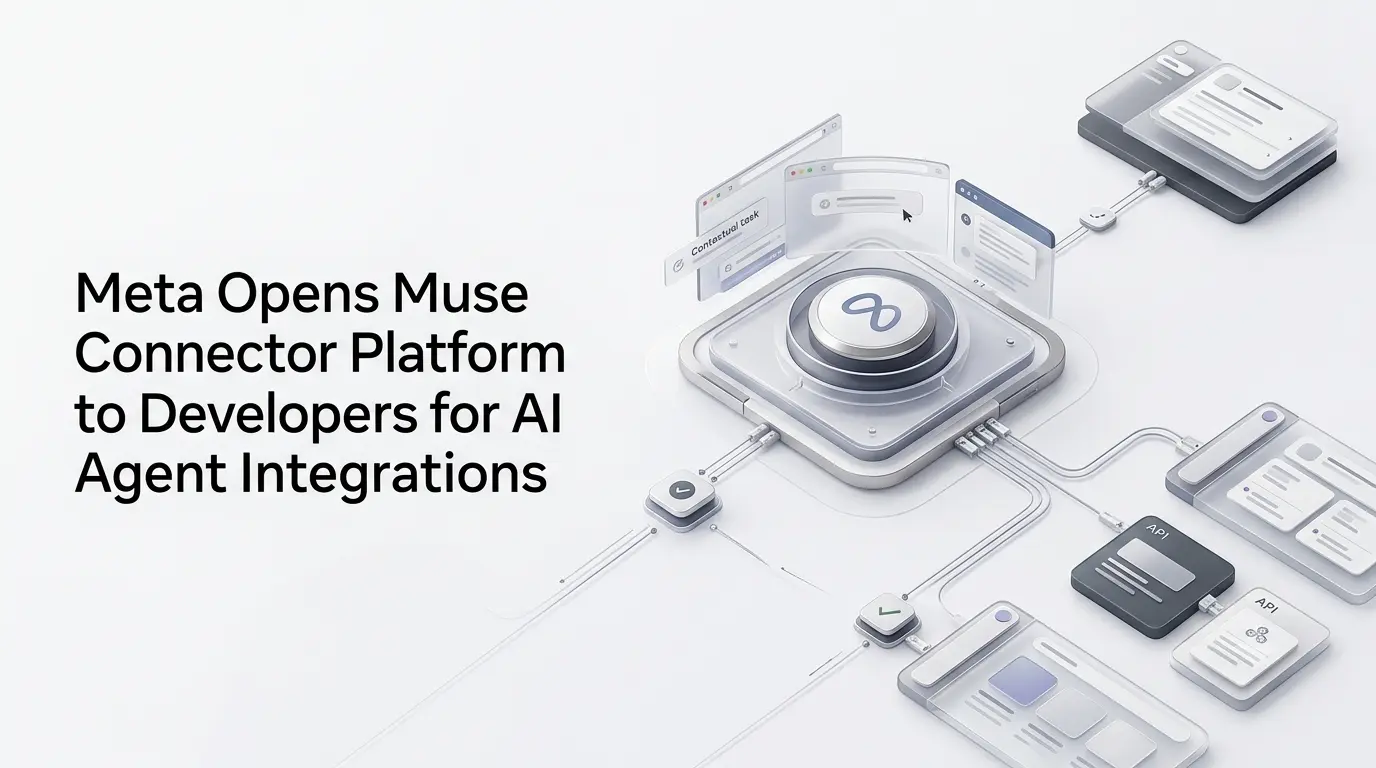
Meta has opened its Muse Connector Platform to developers, giving businesses a way to connect their own services to Muse, the company’s personal AI agent. The new platform allows a connector to bring an external service into the tasks users ask Muse to complete, while Meta provides the agent, browser and surrounding user context.
The developer opening was announced on September 18, 2026, shortly after Muse launched publicly. Meta’s platform now provides a submission process through which businesses can describe their products, submit connectors for review and, once approved, have them listed in Muse’s connector directory.
This moves Muse beyond a collection of integrations controlled solely by Meta and gives outside developers a formal route to make their services available through an AI agent.
Quick Summary
- Meta has opened the Muse Connector Platform to developers.
- Developers can submit connectors that allow their services to work with Meta’s Muse AI agent.
- Meta provides the agent, browser and contextual layer, while developers provide the service integration.
- Submitted connectors undergo functional, security, legal and end-to-end testing.
- Approved connectors can be listed in the Muse connector directory.
- Notion and Granola are among the early connectors associated with the rollout.
- Meta has also partnered with Stripe to support payments through Stripe Link.
- The development expands Muse from an AI agent into a broader platform for third-party services.
- Public information currently does not establish comprehensive connector pricing, revenue-sharing terms or review timelines.
How the Muse Connector Platform Works?
Meta’s developer process is currently presented as a three-step workflow.
First, developers describe what their product does and how people would use the connector. The submission is then reviewed by Meta for functional, security and legal requirements, followed by end-to-end testing.
Approved connectors can subsequently appear in the Muse directory, where users can discover them. Meta also says its editors will review connectors for potential featured placement.
The platform is therefore structured more like a curated integration directory than an unrestricted mechanism for publishing arbitrary APIs.
Meta has not publicly detailed a full developer SDK, connector pricing structure, revenue-sharing terms or a guaranteed review timeline on the platform page. Those details should not be assumed until the company publishes them.
What Connectors Add to Muse?
The purpose of the connector system is to allow Muse to interact with external services as part of a user’s requested task.
Meta describes Muse as a personal AI agent rather than a conventional chatbot. The system can browse the web, work across connected applications, execute multi-step tasks and continue working in the background after a user has assigned a goal.
Connectors extend that capability by giving Muse access to additional services. Instead of requiring users to open a separate application and manually perform an operation, the service can become part of an agent-driven workflow.
For example, a connector could allow Muse to retrieve information from a connected service or use that service as one step in a larger task. The precise actions available depend on what each connector exposes and what permissions the user grants.
This distinction is important because the connector does not replace the underlying service. The developer supplies the service or API integration, while Muse provides the agent interface through which users can request an action.
Notion and Granola Connectors Go Live
The developer rollout coincides with new connectors for Notion and Granola, according to posts from Meta and its executives.
The Notion integration is positioned around documents, while Granola provides access to meeting notes. These integrations give Muse additional sources of information and functionality that can be incorporated into user requests.
The launch is also an example of how an AI agent can become a layer between users and specialized software. Rather than requiring a user to understand which application should handle a task, the agent can determine which connected capability is appropriate within the context of the request.
However, the initial connector rollout should not be interpreted as evidence that every third-party service can immediately connect to Muse. Developers still have to submit connectors and pass Meta’s review and testing process.
Muse Provides the Agent and Browser Layer
The connector announcement builds on the architecture Meta introduced with Muse when it launched on September 8, 2026.
Muse operates with a dedicated secure virtual machine and browser that allow it to navigate websites, fill out forms and complete certain transactions. Meta also built approval controls for consequential actions such as sending messages and making purchases.
That architecture is significant for connectors because the third-party service is not necessarily responsible for creating the complete conversational agent experience. Muse provides the agent layer through which the user communicates, while the connector gives the agent access to an external service.
Meta’s platform therefore creates a separation between service capability and agent interaction: developers provide the service integration, while Muse handles the user-facing agent workflow.
Stripe Partnership Adds a Payments Layer
The Muse Connector Platform also includes a payments component.
Meta says it has partnered with Stripe to make accepting payments easier through Stripe Link. The platform page presents this as part of the connector ecosystem for businesses looking to reach customers through Muse.
Payments are particularly relevant to an agent-based interface because some tasks do not end with retrieving information. An agent may eventually need to complete a purchase or another transaction on the user’s behalf.
Meta’s existing Muse architecture already includes approval mechanisms for consequential actions. Its product documentation says Muse asks for permission before certain activities, including purchases, sending messages or sharing information with connected applications.
The Stripe integration consequently provides an infrastructure component for businesses whose services involve transactions, although the connector platform’s public page does not currently provide detailed commercial terms.
Why Muse Connectors Matter for AI Agents?
The Muse Connector Platform reflects a broader shift in how users can interact with software.
Traditional software generally requires people to identify the application they need, open it and operate its interface. An AI agent reverses that sequence: the user describes the desired outcome, and the agent determines which capabilities and services can help accomplish it.
Muse is designed around that model. Meta describes a personal AI agent that can connect applications, browse the web, perform multi-step tasks and continue working toward goals with user oversight.
Opening connectors to outside developers potentially expands the number of services Muse can incorporate into these workflows. For developers, it provides another distribution path in which users can discover and interact with a service through an AI agent rather than through the service’s traditional application interface.
The practical importance will depend on how widely the connector ecosystem grows, what functionality Meta ultimately allows developers to expose and what commercial and technical terms it publishes.
Developer Access Is Still Structured Around Review
Meta’s decision to require review is an important part of the initial rollout.
The company says every submitted connector is checked for functional, security and legal requirements and undergoes end-to-end testing before being approved for the directory.
That means the Muse Connector Platform is not simply an open API marketplace where developers can immediately publish an integration. Meta retains control over which connectors enter the directory and can determine which approved connectors receive featured placement.
For users, this review process could provide a layer of quality and security screening. For developers, it also means connector availability depends on Meta’s approval process.
As of September 19, 2026, Meta’s public platform page describes the submission and review workflow but does not provide comprehensive public documentation covering connector fees, revenue sharing, review times or a detailed connector SDK. Those areas will be important as the platform develops.
The launch nevertheless gives Muse a new developer-facing integration layer: businesses can now submit services to be used within an agent that already has browser access, persistent context and the ability to execute multi-step tasks.
Also Read –
Perplexity Computer Effort Controls for AI Tasks