
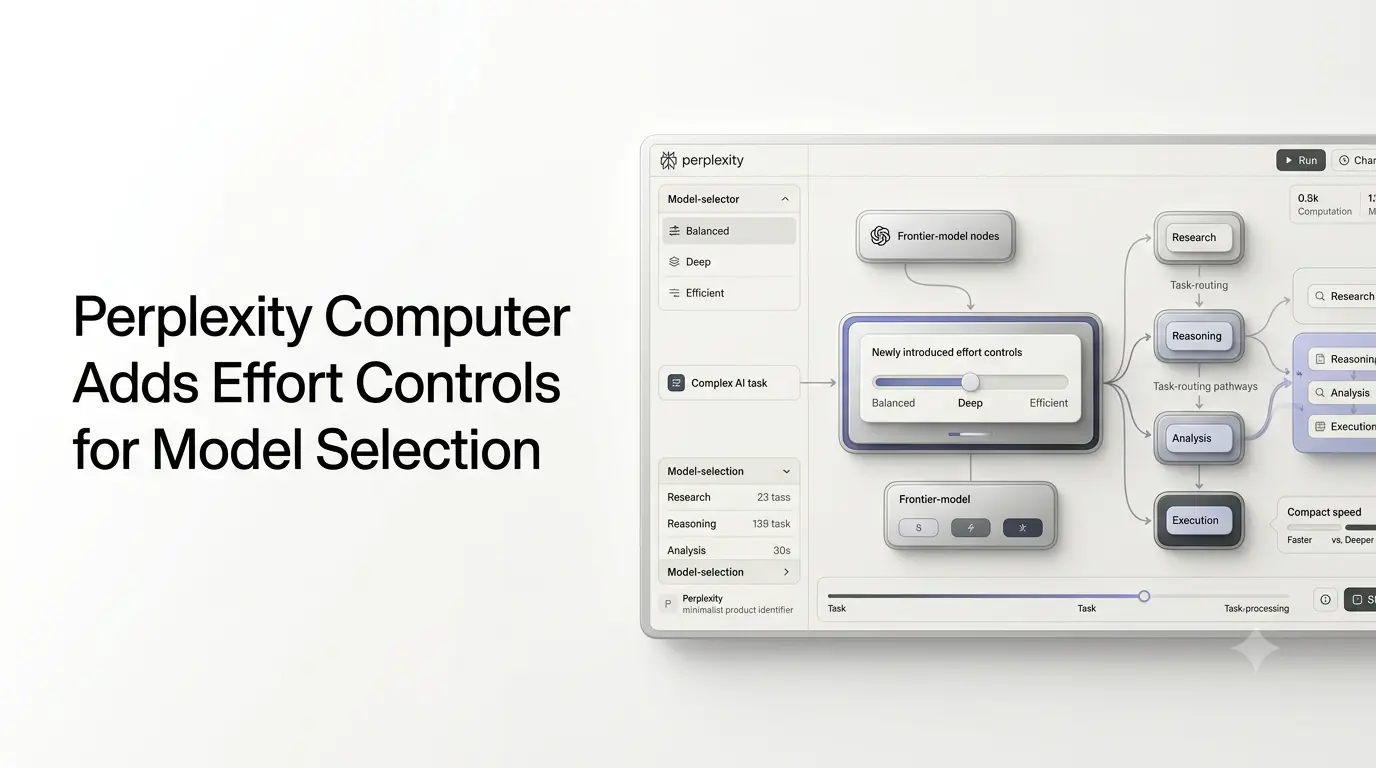
Perplexity is rolling out new effort controls for Computer, giving users more direct control over how the AI agent selects models and determines how deeply it reasons through a task.
The new controls combine the underlying model used by Computer’s orchestrator with a selected level of reasoning depth. Perplexity says the presets are designed to control how deeply and efficiently Computer works through different tasks.
The feature is currently rolling out on the web, with mobile and desktop availability planned for later.
Quick Summary
- Perplexity Computer is adding effort controls for its model selector.
- Effort presets combine the orchestrator model and reasoning depth.
- Users can control how deeply Computer works through a task.
- Advanced users can customize model selection, reasoning level and speed settings.
- The feature is currently rolling out on web.
- Perplexity says mobile and desktop support is coming.
- The update builds on Computer’s multi-model orchestration approach.
- The objective is to balance intelligence, efficiency and resource usage across AI workflows.
Perplexity Computer Adds Configurable Effort Levels
Computer is designed differently from a conventional chatbot. Rather than relying on a single AI model for an entire workflow, it uses multi-model orchestration to assign different parts of a task to models suited to those jobs.
Perplexity has previously described Computer as a system that orchestrates more than 20 frontier models across files and connected tools. Its approach allows a task to be divided among multiple agents and models rather than requiring one model to handle every stage.
The new effort controls add another layer to that system by allowing users to influence how Computer approaches the task.
According to Perplexity’s announcement, effort presets combine two variables: the orchestrator model and the reasoning depth used during execution.
This effectively creates different operating levels for Computer, allowing users to choose between approaches that prioritize different combinations of intelligence, reasoning depth and efficiency.
Users Can Customize Model and Reasoning Settings
Perplexity is also providing more granular controls for users who want to go beyond the predefined effort presets.
The company says users can customize:
- Model selection
- Reasoning level
- Available speed settings
This gives experienced users more control over the underlying behavior of Computer rather than relying entirely on Perplexity’s default orchestration decisions.
The distinction is important because Computer’s objective is not simply to use the most capable model for every task. Perplexity describes the product as aiming for high intelligence while controlling the cost and resources required to complete a workflow.
How Computer Uses Multi-Model Orchestration?
The effort update builds on Computer’s existing multi-model architecture.
Perplexity says Computer can coordinate different frontier models and agents depending on what a task requires. Its official research on real-world Computer usage describes workflows involving research, analysis, coding, editing and connected applications, with different parts of a task routed through the orchestration system.
That architecture means model selection can affect more than the quality of an individual response. The model and reasoning configuration can influence how a larger workflow is executed.
For example, a relatively straightforward task may not require the same reasoning depth or model capability as a complex research, coding or analysis workflow. Effort controls give users a mechanism for making that tradeoff more explicit.
Why Effort Controls Matter for AI Agents?
The update reflects a broader design challenge for AI agents: balancing capability, reasoning depth, speed and cost.
Using a highly capable model with extensive reasoning for every operation can provide more computational capacity than a task requires. Conversely, aggressively optimizing for speed or cost can limit the resources available for complicated tasks.
An orchestration system can potentially address that problem by matching resources to the requirements of individual tasks.
Perplexity’s broader Computer research provides some context for this approach. The company says Computer uses multiple models so that different stages of a workflow can be handled by models suited to those steps rather than forcing one model to perform everything.
The new effort controls put some of that configuration into the user’s hands.
Perplexity Plans More Control Across Devices
The effort controls are currently available on Perplexity Computer’s web experience, according to the company’s announcement.
Perplexity says the feature will also come to mobile and desktop, although the supplied announcement does not provide a specific release date for those platforms.
The company also says it plans to continue refining the model-agnostic infrastructure behind Computer. That includes adjusting the combinations of orchestrator and subagent models as newer frontier models become available.
This is particularly relevant to a multi-model system because the optimal model configuration can change as AI models improve.
Computer’s Model-Agnostic Approach
Perplexity’s strategy with Computer differs from products built around a single proprietary model.
Computer is intended to operate as an orchestration layer capable of combining different models and agents. Perplexity’s own description of the product emphasizes that users provide an objective while Computer handles much of the execution through coordinated agents and connected tools.
Effort controls therefore give users an additional interface for managing that orchestration layer.
Rather than selecting only a model from a conventional model picker, users can increasingly control how much computational effort Computer should apply to a task.
That could make the distinction between simple and complex workflows more explicit while retaining Computer’s underlying multi-model architecture.
What the Update Changes for Computer Users?
The main change is not the introduction of a new AI model. Instead, Perplexity is adding a control layer for Computer’s existing orchestration system.
The update gives users three increasingly granular levels of control:
- Effort presets for simpler configuration.
- Model selection and reasoning controls for more advanced customization.
- Speed settings for additional control over execution behavior.
The approach allows Computer to remain a multi-model agent while giving users more influence over the tradeoffs involved in completing a task.
For users who simply want Computer to determine the appropriate configuration, the presets provide a simpler option. More advanced users can adjust individual parameters themselves.
The effort controls are therefore an incremental but significant interface change for Perplexity Computer, moving some of the system’s model-orchestration decisions closer to the user while retaining the underlying multi-model architecture.
Also Read –
Perplexity Computer for Enterprise: AI Workflow Automation
Perplexity Computer Skills Introduces Reusable AI Task Automation
Perplexity AI Guide: Features, Search & How It Works?
Sources
- Perplexity — Computer Adds Effort Mode for Model Selection
- Perplexity — How Computer Is Reshaping Knowledge Work