

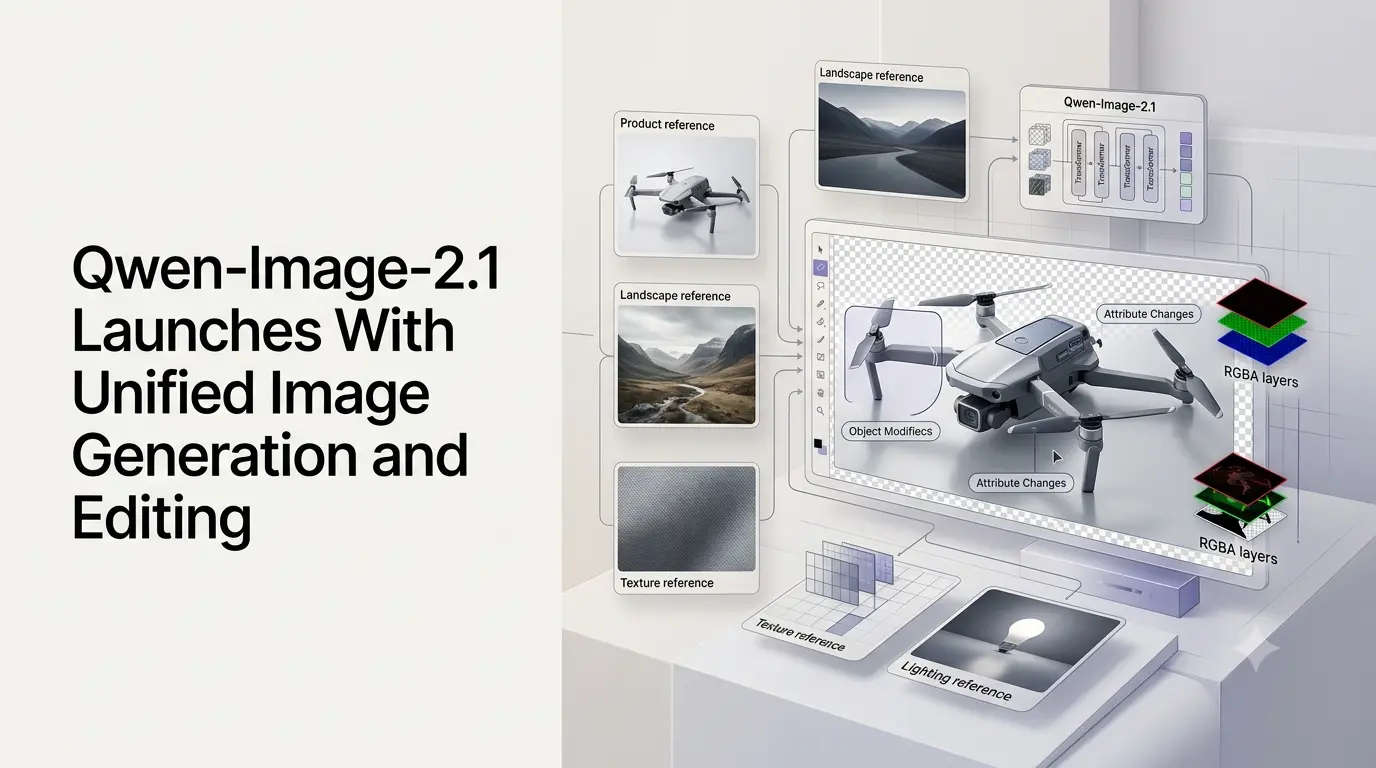
Alibaba’s Qwen team has released Qwen-Image-2.1, a new open-weight image generation and editing model that combines text-to-image generation, reference-image conditioning and localized editing in a single pipeline.
The release expands the Qwen-Image series with a model designed around more flexible image workflows rather than generation alone. Qwen highlights native transparent-image generation and editing, support for multiple reference images, localized edits and improvements to typography and portrait rendering.
The model is also now integrated into the Hugging Face Diffusers ecosystem. Its documented pipeline accepts text prompts alone or text together with one or more condition images, allowing generation and image editing to be handled through the same model interface.
Quick Summary
- Qwen-Image-2.1 is Qwen’s new open-weight image generation and editing model.
- It combines generation and editing in a unified workflow.
- The model supports multiple reference images, including workflows using up to 10 references.
- It introduces native transparent/RGBA image generation and editing.
- Users can perform localized edits to specific areas of an image.
- Qwen is positioning the model around improvements in image quality, typography and portraits.
- The model is also being integrated into the Hugging Face Diffusers ecosystem.
What Qwen-Image-2.1 Adds?
The central change in Qwen-Image-2.1 is the combination of image generation and editing with richer visual conditioning.
Instead of treating a generated image and an edited image as separate workflows, the model can take a prompt and reference images as part of the same generation process. Diffusers documentation shows that multiple condition images can be passed to the pipeline, with each image represented as a separate block in the model’s joint sequence.
This allows workflows in which a user can provide several visual references and instruct the model to combine information from them. For example, one reference can provide an object while another supplies a scene, with the prompt describing how the two should be combined.
Qwen also highlights support for more precise localized editing, allowing users to identify specific regions of an image and request multiple changes within the same editing task.
That makes the model relevant to workflows such as product-image modification, character consistency, visual design, storyboarding and other tasks where preserving parts of an existing image matters as much as generating new content.
Qwen-Image-2.1 Adds Native Transparency
One of the most notable additions is native support for transparent images.
Qwen says Qwen-Image-2.1 can generate and edit RGBA content, allowing transparency to be part of the image-generation and editing workflow rather than something that has to be created as a separate post-processing step. The release examples specifically demonstrate transparent-image creation and editing.
This is particularly relevant to compositing workflows.
A designer creating a product asset, character element or isolated visual object can work with transparency directly, making it easier to reuse the generated element in another composition.
The capability also extends to editing transparent images, according to Qwen’s release material. That potentially reduces the number of separate masking and background-removal steps required in some workflows.
Multiple Reference Images and Local Editing
Qwen-Image-2.1 supports up to 10 reference images, according to the Qwen release announcement.
The model’s architecture is designed to process multiple condition images alongside the text prompt. Hugging Face’s implementation documentation confirms that a list of images can be passed to the pipeline and that the images are incorporated into the joint sequence in the order supplied.
This is different from a simple single-image editing workflow.
Multiple references can provide additional information about the subject, environment, composition or desired result. The approach can therefore be useful when one image is not sufficient to communicate the complete visual target.
Qwen’s examples also demonstrate localized editing in which different regions of an image receive different instructions. This includes workflows where several objects or visual attributes are changed during the same editing operation.
Model Uses a Unified Generation and Editing Pipeline
Under the hood, Qwen-Image-2.1 uses a Qwen3-VL-based encoder to process the prompt and condition images, followed by a single-stream block-causal transformer for image denoising. Hugging Face’s implementation identifies the main components as a Qwen3-VL text/vision encoder, processor, Qwen-Image 2.1 transformer and a dedicated VAE.
The transformer uses block-causal attention. Text and image latents share a sequence, while the condition-image information is incorporated into that sequence before the target image tokens.
The implementation also supports key-value caching for the condition information. Hugging Face notes that the relevant prefix activations can be cached across denoising steps, providing an engineering optimization for inference.
Qwen positions the model as a relatively lightweight image system. The release describes it as a 7B-class architecture, a substantial reduction from the original Qwen-Image model’s 20B-scale architecture. However, model-size figures should not be interpreted as equivalent to the total memory required by the complete generation pipeline, since the system also includes components such as the vision-language encoder and VAE.
Qwen-Image-2.1 Focuses on Text and Portrait Quality
The release also emphasizes improvements in text rendering and portrait aesthetics compared with earlier Qwen-Image versions.
Text rendering has been a major focus of the Qwen-Image family, particularly for images such as posters, infographics and other designs where generated text needs to remain visually coherent.
Qwen-Image-2.0 already introduced a lighter 7B architecture alongside improvements to typography, image generation and unified generation-editing workflows. Qwen-Image-2.1 continues that direction while expanding reference-image and editing capabilities.
The new model is therefore not simply a text-to-image upgrade. Much of the release is centered on controlling and modifying visual content after or alongside the initial generation.
Qwen-Image-2.1 Is Already Supported by Diffusers
Developers can access Qwen-Image-2.1 through the current Hugging Face Diffusers implementation.
The documented pipeline is called QwenImage21Pipeline and supports text-to-image generation as well as image-conditioned editing. The default configuration uses 40 denoising steps and does not enable classifier-free guidance unless explicitly configured.
The implementation also provides a faster flex_attention path when the model is compiled. Hugging Face says this implementation expresses the same attention mask through a single flex_attention call and can be faster after compilation.
This early framework support is significant for developers because it means Qwen-Image-2.1 can be incorporated into existing image-generation workflows rather than requiring an entirely separate inference stack.
What Qwen-Image-2.1 Could Be Used For?
The model’s capabilities make it suitable for several image-generation and editing workflows:
- Product visualization: Modify product appearance while preserving important visual characteristics.
- Creative compositing: Generate transparent assets that can be reused in other designs.
- Character workflows: Use multiple references to maintain visual information across generated scenes.
- Storyboarding: Combine character and scene references into sequential visual concepts.
- Infographics: Generate images where typography and layout are important.
- Virtual try-on concepts: Modify clothing and other visual attributes using reference imagery.
- Localized image editing: Make several targeted changes without regenerating the entire concept.
These applications follow directly from the model’s documented generation, multiple-image conditioning and editing capabilities rather than requiring assumptions about future features.
Important Release Details Still Need Careful Interpretation
The release should not be treated as proof that Qwen-Image-2.1 universally outperforms every competing image model.
Qwen’s announcement makes strong performance claims, but those claims should be distinguished from independently reproduced benchmarks. The available Diffusers documentation establishes the architecture and supported workflows, not a comprehensive comparison against all commercial image-generation systems.
Hardware requirements also need to be treated carefully. A 7B model designation does not by itself establish a specific VRAM requirement for the complete pipeline. The current implementation includes multiple components, including the Qwen3-VL encoder and VAE, and actual memory consumption will depend on precision, resolution, caching and other inference settings.
Licensing is another area where reporting should remain precise. The original Qwen-Image model is listed under Apache-2.0, but that does not automatically establish the same license for Qwen-Image-2.1. The 2.1 model’s specific licensing terms should be checked against its current model card before making commercial-use claims.
Qwen-Image-2.1 nevertheless represents a notable expansion of the Qwen image-generation stack. By combining generation, editing, multiple reference images and native transparency within a single workflow, the model is aimed at a broader class of practical image-creation tasks than simple text-to-image generation.
For developers, the combination of open weights and growing ecosystem support makes Qwen-Image-2.1 particularly relevant to local and customized image-generation workflows, while its actual advantages over competing models will need to be established through broader independent testing.
Also Read –
Qwen3.8-LiveTranslate Launches for Real-Time Translation
Qwen3-Coder-Next: Agent-Centric Coding Model for Developers
Source
Qwen official Qwen-Image-2.1 announcement
Hugging Face Diffusers – Qwen-Image 2.1
Hugging Face – QwenImage21 Transformer documentation
Hugging Face – QwenImage21 VAE documentation
Qwen-Image official GitHub repository