
Manus has introduced Manus Flex, a new way for users to bring their own API keys and connect external AI models to the Manus agent environment. The feature separates the choice of underlying model provider from Manus’s agent infrastructure, giving users more control over which models power their workflows.
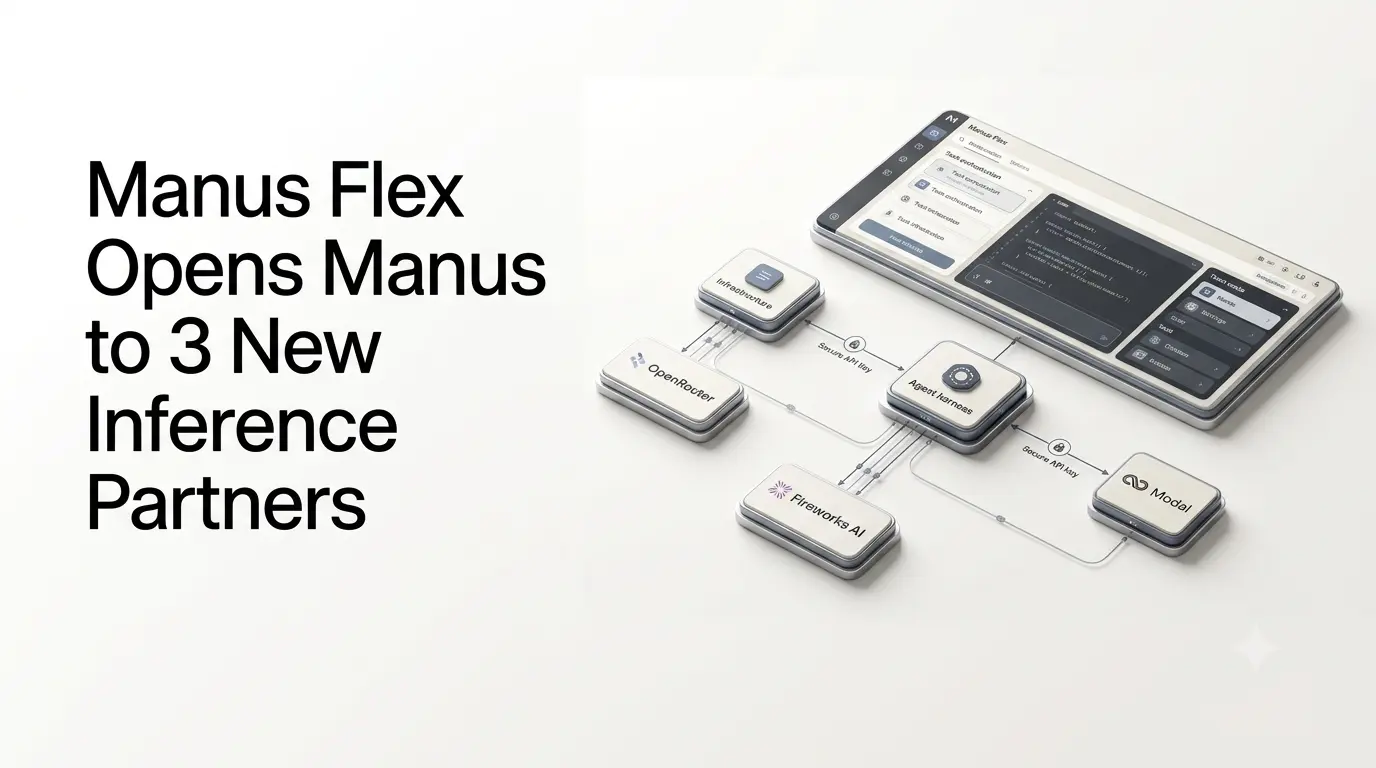
The initial Manus Flex inference partner program includes OpenRouter, Fireworks AI and Modal. According to Manus, the three providers give Flex users access to a broader selection of models while retaining the Manus agent harness, tools and execution environments.
The announcement comes shortly after Manus introduced Manus 2.0, which added its Cascade agent harness, Cloud Computer, Automations, Manus Studio and the Cue personal-agent application. The Flex launch extends that agent infrastructure in another direction by allowing users to bring their own model access into the system.
Quick Summary
- Manus Flex introduces a bring-your-own-API-key approach for Manus.
- Users can connect supported external inference providers to the Manus agent environment.
- OpenRouter, Fireworks AI and Modal are the initial inference partners.
- Manus continues to provide the agent harness, tools and execution environments.
- The feature gives users greater flexibility over the underlying inference layer.
- The development fits into Manus’s broader expansion toward configurable AI-agent infrastructure.
What Manus Flex Changes?
The central idea behind Manus Flex is BYO API key users can supply credentials from supported AI providers instead of relying exclusively on the model access bundled into Manus.
That gives the Manus agent environment a different role. Rather than being tied to a single underlying model source, Flex can act as an execution layer in which the user chooses a supported inference provider and model.
The distinction is important because an AI agent is not simply a language model. Manus provides the surrounding infrastructure needed to execute tasks, including its agent harness, tools and execution environments. Flex is designed to let the underlying inference provider change without removing that broader agent framework.
An independent report published around the launch says the Flex beta supports users bringing their own API keys and models, and reports that using a personal API key does not consume Manus credits. It also notes that Manus’s mobile application supports the feature.
Manus has not, however, publicly established through the material available for verification here that every provider, model or workflow will behave identically. The independent report also notes a warning that third-party model performance can vary.
OpenRouter, Fireworks and Modal Join Flex
Manus is launching its inference partner program with three providers:
| Inference partner | Role in Manus Flex |
|---|---|
| OpenRouter | Provides access to a broad selection of AI models through a unified inference layer |
| Fireworks AI | Provides model inference infrastructure and access to supported models |
| Modal | Provides cloud infrastructure for running AI workloads |
The three companies are being introduced as initial inference partners, rather than as replacements for the Manus agent platform.
OpenRouter is particularly relevant to the Flex model because its platform provides access to hundreds of models from multiple providers through a unified interface. Its current platform lists more than 500 models across more than 80 providers.
That means a user choosing OpenRouter can potentially access models from different AI companies without changing the broader Manus workflow. The exact models available through Flex can depend on Manus’s supported integrations and the provider configuration available to the user.
Why the BYO API Model Matters for AI Agents?
AI agent systems increasingly consist of several layers rather than a single model.
At the bottom is the inference model that performs reasoning or generates responses. Above that can sit an agent harness responsible for planning, tool calls, state management and execution. Additional infrastructure can then provide browsers, computers, code execution, external applications and other tools.
Manus Flex is focused on separating those layers.
For developers and advanced users, this can make model selection more flexible. A user may want one model for reasoning-heavy tasks, another for coding or a lower-cost model for routine workloads, while continuing to use the same agent environment.
This approach also makes inference providers more important to agent platforms. Instead of competing only on their own models, agent companies can increasingly compete on the quality of their orchestration, tools and execution environment while allowing users to choose where inference comes from.
Manus Is Expanding Its Agent Infrastructure
Flex arrives as Manus is broadening the architecture around its agents.
On September 28, Manus announced Manus 2.0, describing the release as an expansion of its agent platform. The update introduced the Cascade agent harness alongside Cloud Computer and Automations, Manus Studio for professional creation, and Cue for personal agents.
That context helps explain where Flex fits.
The company is not presenting Flex simply as another AI model. Instead, it extends the infrastructure surrounding Manus agents by giving users greater control over the inference layer.
This could be particularly relevant for developers and organizations that already maintain relationships with specific AI providers or want more direct control over model selection and API usage.
What Users Should Know About Manus Flex?
The feature is being introduced as a flexible way to connect external inference to Manus, but there are still practical considerations.
First, model availability is provider-dependent. Connecting an API provider does not necessarily mean that every model from that provider will automatically be available inside Manus.
Second, performance can vary between models. The independent reporting around the Flex rollout says Manus warns users that third-party model performance may differ and that Manus does not guarantee those results.
Third, the detailed billing rules deserve attention. Current reporting indicates that using a user’s own API key can avoid Manus credit consumption, but the complete Flex billing structure and whether that applies universally across every task and provider should be checked against Manus’s current documentation before users assume that all usage is free of Manus credits.
Manus Flex Availability and Partner Program
Manus Flex is being introduced as a beta capability, with the initial inference partner group consisting of OpenRouter, Fireworks AI and Modal.
The broader significance is less about adding three provider names and more about the architecture Manus is moving toward: an agent platform where the execution environment and underlying model infrastructure can be separated.
For users who want more control over AI models, API credentials and inference providers, Manus Flex provides a new route to use Manus’s agent tooling without being limited to a single model source.
As Manus continues developing the agent infrastructure introduced with Manus 2.0, Flex represents another step toward making the model layer more configurable while keeping the agent harness and execution environment intact.
Also Read –
Manus 2.0 Launches With New AI Agent Architecture, Studio and Cue
Manus Agents on Telegram: Features and Use Cases
Manus AI Always-On Agent: Features, Architecture and Use Cases
Manus Agent Selection for Scheduled Tasks Explained