
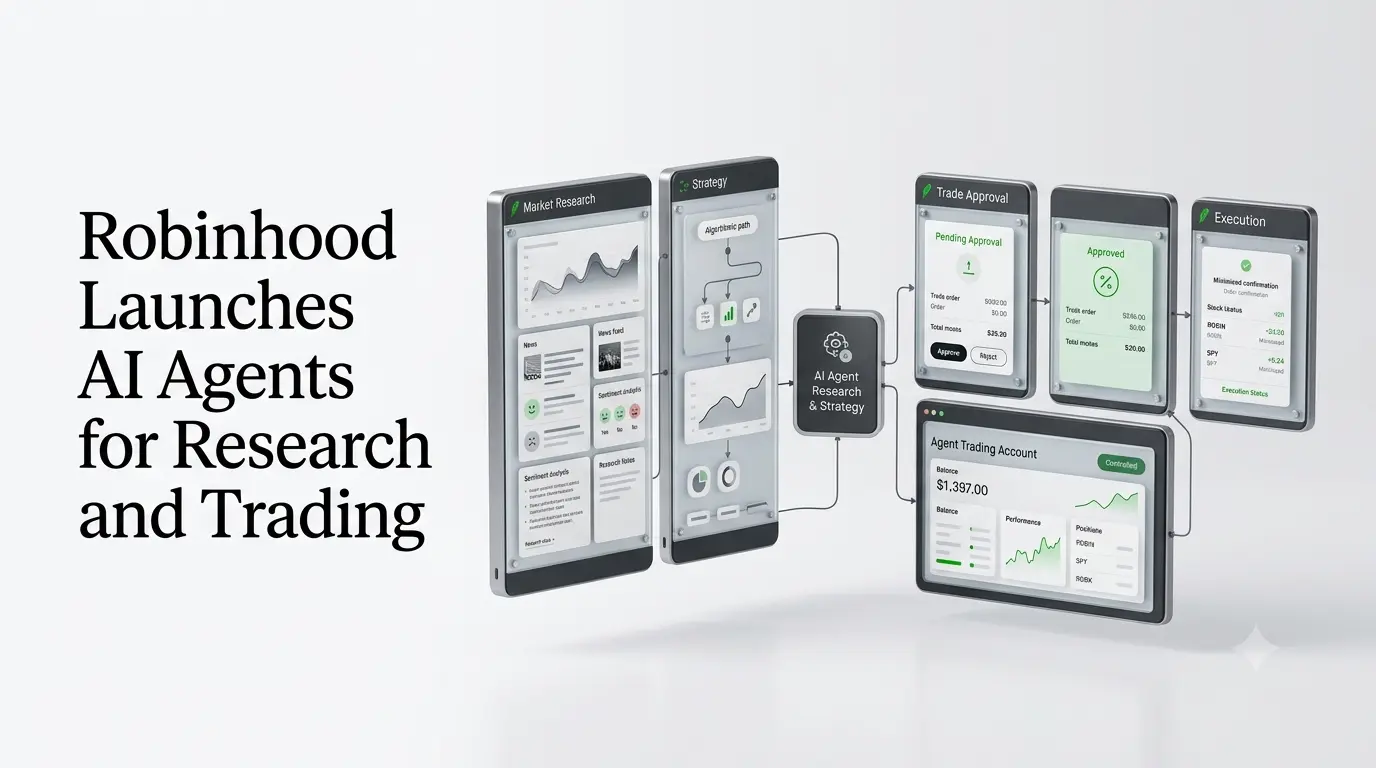
Robinhood has introduced Robinhood Agents, an AI-powered feature that lets users build and operate their own trading agents directly inside the Robinhood app. The company announced the product on September 29, 2026, at its HOOD Summit 2026, positioning it as a new way for users to research markets, develop strategies and execute trades without connecting a separate AI platform.
The rollout builds on Robinhood’s earlier Agentic Trading product, which launched in May and allowed customers to connect third-party AI agents to dedicated Robinhood accounts. With Robinhood Agents, the agent-building experience is moved directly into the brokerage app, removing the need for users to separately configure and connect an external agent.
Quick Summary
- Robinhood Agents brings AI agent creation directly into the Robinhood app.
- Users can create agents to research markets, analyze information, develop strategies and execute trades.
- Robinhood uses dedicated accounts for agentic trading.
- Users can configure trade approvals and other controls.
- Agent Apps can provide additional data and tools from third-party providers.
- Loops will eventually allow agents to repeatedly execute user-defined strategies.
- Robinhood Agents are beginning to roll out to eligible U.S. customers.
- The development expands Robinhood’s earlier Agentic Trading and Trading MCP infrastructure.
What Robinhood Agents Can Do?
Robinhood Agents are designed to combine AI reasoning with access to Robinhood’s market and portfolio tools.
Users can create an agent, give it instructions and set limits for how it operates. Robinhood says agents can research markets, analyze holdings, develop strategies and place trades based on those instructions.
The setup also allows users to select an AI model from several leading AI labs. Robinhood’s announcement specifically says OpenAI is among the supported model providers, although the company does not describe the feature as being tied to a single AI model.
The basic workflow is therefore different from a conventional chatbot. Instead of simply asking an AI system for information, users can give an agent instructions that connect analysis with actions inside a trading account.
Robinhood’s documentation says agents connected through its trading infrastructure can access information such as portfolio values, buying power, positions, transactions and watchlists. Agents can then use available tools to perform supported trading actions.
Dedicated Accounts and Trade Approvals
A central part of Robinhood Agents is the use of a dedicated agentic trading account.
Robinhood says an agent can only access the funds in its dedicated account rather than the user’s other Robinhood accounts. This creates a separate pool of capital for agent-driven activity.
Users can also configure trade approvals. With approvals enabled, the agent cannot place an order until the user confirms it. Robinhood says this setting is enabled by default during setup but can be changed later.
The system can also be configured to allow automated execution without individual confirmation. That means the degree of human involvement depends on the controls selected by the user.
Robinhood’s disclosures emphasize that users remain responsible for trades made by their AI agents and that AI systems can make errors, misinterpret instructions or behave unexpectedly.
Loops Will Add Continuous AI Trading
One of the more significant capabilities announced alongside Robinhood Agents is Loops, although it is not yet available.
Robinhood says Loops will allow users to turn a strategy into a standing instruction that an agent can execute repeatedly. For example, an agent could be instructed to check the market at a specified time and act when defined conditions are met.
The company says Loops can operate continuously in the background, including when the user is not actively using the app.
That makes Loops different from a one-time interaction with an AI assistant. Once activated, a Loop could continue executing the rules configured by the user and may place, modify or cancel trades automatically. Robinhood warns that automated trading carries investment risk and that users are responsible for monitoring the automation they configure.
For now, Robinhood lists Loops as coming soon, rather than as part of the initial Robinhood Agents rollout.
Robinhood Agents Builds on Agentic Trading
Robinhood Agents is not the company’s first attempt to connect AI agents with its financial platform.
In May 2026, Robinhood launched Agentic Trading, allowing customers to connect third-party AI agents through Robinhood’s Model Context Protocol, or MCP, infrastructure. The initial product was designed around dedicated accounts and controls for autonomous trading.
The newer Robinhood Agents product changes the user experience by putting the agent itself inside the Robinhood application.
Robinhood says customers no longer need to link an external agent when using the embedded Agents experience. The company’s existing Trading MCP remains available for customers who want to connect their own third-party agents.
This creates two related approaches: users can either build an agent within Robinhood or connect an external AI agent to Robinhood’s trading infrastructure.
Agent Apps Add External Data and Tools
Robinhood is also introducing Agent Apps, which extend Robinhood Agents with additional data sources and specialized tools.
The company says Agents have access by default to market data sources available through the Robinhood Trading MCP, along with portfolio information. Agent Apps can add premium data and tools from third-party providers. Robinhood announced 11 participating companies for launch or subsequent availability, with individual subscriptions carrying their own prices and a one-month free trial.
The announced integrations cover areas including options activity, investor sentiment, crypto fundamentals, weather-related analysis, satellite intelligence and stock-market signals.
This gives Robinhood Agents a broader information layer beyond the brokerage’s basic market and portfolio data.
What Is Available Now?
Robinhood’s official HOOD Summit support page categorizes Robinhood Agents as rolling out now, although access is being introduced progressively to eligible customers.
The company says Robinhood Agents and Agent Apps are intended for eligible customers in the United States. Availability can therefore depend on account eligibility and the rollout schedule.
Loops, meanwhile, remains a future feature.
Robinhood also says usage of OpenAI’s GPT-Luna model with Robinhood Agents will be free through the end of 2026, although this applies to model usage and does not make trading itself free.
| Feature | Status |
|---|---|
| Robinhood Agents | Beginning to roll out |
| Build an AI agent inside Robinhood | Beginning to roll out |
| Dedicated agentic trading account | Available as part of the Agents experience |
| Trade approvals | Available |
| External third-party agents through Trading MCP | Available |
| Agent Apps | Beginning to roll out |
| Loops | Coming soon |
The Risks of AI-Powered Trading
The introduction of Robinhood Agents also highlights a broader challenge with AI agents in financial applications: giving an AI system the ability to take actions with real money introduces risks beyond those associated with ordinary AI assistants.
Robinhood explicitly warns that AI agents can make mistakes, interpret instructions incorrectly, rely on incomplete or outdated information, or behave unexpectedly. The company also states that it does not control, supervise, monitor, recommend or audit agents.
The dedicated-account structure and configurable trade approvals are therefore important parts of the product rather than merely interface features. They define how much access an agent receives and whether a human must approve individual transactions.
Robinhood’s disclosures also make clear that users assume responsibility for trades executed by their agents and that automated strategies can result in losses.
Robinhood Agents represents the company’s shift from simply allowing external AI agents to access its brokerage infrastructure toward putting the agent-building experience directly inside the trading application. The initial rollout gives eligible U.S. customers a way to create AI agents, configure their instructions and use them for market research and trading, while features such as Loops extend the platform toward continuous automated execution.
Also Read –
Robinhood Cortex Digests: AI Market Insights for Traders
Sources
HOOD Summit 2026 product announcements
Robinhood is Now Open to Agents