
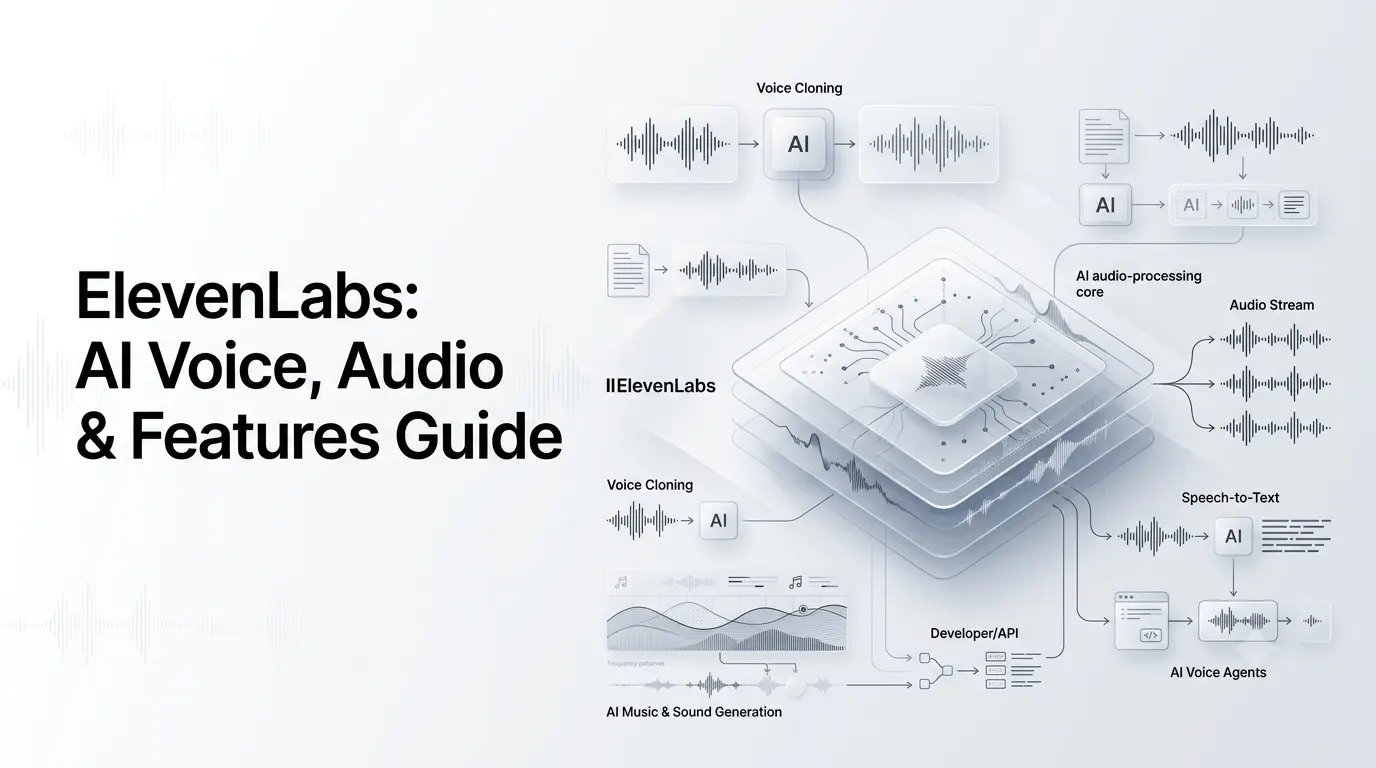
ElevenLabs is an AI audio platform that provides tools for text-to-speech, voice cloning, speech-to-text, voice changing, dubbing, music generation, sound effects, and conversational voice agents.
The platform has evolved significantly beyond basic AI voice generation. Its current ecosystem includes the expressive Eleven v3 speech model, Scribe v2 for transcription, Eleven Music v2.5, voice design and cloning tools, automatic dubbing, and ElevenAgents for building interactive voice applications.
ElevenLabs is best understood as a broader AI audio and voice infrastructure platform, serving creators, developers, media companies, marketers, enterprises, and businesses building voice-based applications.
Quick Summary
- ElevenLabs is an AI audio platform for voice, speech, music, dubbing, and audio generation.
- Key tools include Eleven v3, text-to-speech, voice cloning, Voice Design, speech-to-text, dubbing, and Voice Changer.
- Scribe provides AI transcription, while Eleven Music generates music from natural-language prompts.
- ElevenAgents enables real-time AI voice agents with speech recognition, reasoning, tools, and voice responses.
- ElevenLabs also provides APIs and SDKs for developers and businesses.
- Main use cases include content creation, podcasts, video localization, customer support, media production, and AI applications.
- Voice cloning requires appropriate consent and rights, and generated audio should be reviewed for accuracy.
What Is ElevenLabs?
ElevenLabs is an AI platform for creating, transforming, and processing speech and other types of audio.
Its most recognizable capability is AI text-to-speech, which converts written text into spoken audio using synthetic voices designed to sound natural and expressive.
However, the platform now covers a much wider range of audio workflows, including:
- Text-to-speech
- Speech-to-text
- Voice cloning
- Voice design
- Voice changer
- Voice isolation
- Dubbing
- Sound effects
- AI music generation
- Conversational voice agents
- Audio and video generation
- Developer APIs and SDKs
ElevenLabs also provides tools for deploying voice technology inside websites, applications, games, media products, customer-support systems, and other software.
Its current documentation lists Eleven v3 as its most advanced general speech synthesis model, while separate models are optimized for real-time conversations, transcription, music, and other specialized tasks.
What Can ElevenLabs Do?
At a high level, ElevenLabs covers the complete audio pipeline:
Create a voice → Generate speech → Edit or transform audio → Translate/dub → Transcribe → Build an interactive voice application
The main capabilities include:
| Capability | What it does |
|---|---|
| Text to Speech | Converts text into spoken audio |
| Voice Design | Creates voices from text descriptions |
| Voice Cloning | Creates a synthetic version of a person’s voice |
| Speech to Text | Converts spoken audio into text |
| Voice Changer | Converts one voice into another while preserving delivery |
| Dubbing | Localizes audio and video into other languages |
| Music | Generates songs and instrumental music |
| Sound Effects | Generates effects from text prompts |
| Voice Isolation | Separates voice from background audio |
| ElevenAgents | Builds interactive conversational voice agents |
| API | Adds ElevenLabs capabilities to applications |
This breadth is one of the main reasons ElevenLabs has become more than a conventional text-to-speech service.
How Does ElevenLabs Text-to-Speech Work?
The basic text-to-speech workflow is straightforward:
Text → AI speech model → Voice characteristics → Generated audio
A user provides a script and selects a voice or creates one. The model then generates spoken audio based on the text, voice characteristics, language, pronunciation, and delivery instructions.
With Eleven v3, the system can also respond to audio tags that influence delivery, such as emotional states, whispers, shouts, laughter, and other non-verbal reactions.
This makes the system considerably more expressive than a simple text reader.
For example, a script can contain contextual instructions such as:
[whispers] I don't think we're alone.or:
[laughs] That was not supposed to happen.Eleven v3 supports audio tags and multi-speaker dialogue, with support for more than 70 languages.
What Is Eleven v3?
Eleven v3 is ElevenLabs’ latest general-purpose expressive text-to-speech model.
It became generally available in February 2026 after its earlier alpha period. ElevenLabs describes it as its most expressive speech model, designed for natural delivery, emotional range, contextual understanding, and multi-speaker dialogue.
The model is particularly suited to:
- Audiobooks
- Character dialogue
- Video narration
- Podcasts
- Storytelling
- Dramatic content
- Multilingual content
- Audio experiences with multiple speakers
Eleven v3 supports more than 70 languages and can generate natural multi-speaker dialogue through the Text to Dialogue API.
What Changed From Eleven v3 Alpha?
The original Eleven v3 alpha launched in June 2025 with an emphasis on expressive speech, audio tags, multi-speaker dialogue, and 70+ languages.
When Eleven v3 became generally available in February 2026, ElevenLabs reported improvements in stability and handling of numbers, symbols, and specialized notation. Its internal testing reported a reduction in errors across categories such as phone numbers, chemical formulas, URLs, and mathematical expressions.
The distinction matters because older articles may still describe Eleven v3 as an experimental alpha model.
It is no longer accurate to describe the standard Eleven v3 model as an alpha release.
ElevenLabs Models Explained
ElevenLabs now uses different models for different audio requirements rather than relying on one model for every task.
| Model | Primary purpose | Key characteristic |
|---|---|---|
| Eleven v3 | Expressive text-to-speech | Highest expressive quality and 70+ languages |
| Eleven v3 Conversational | Real-time voice | Expressive low-latency conversations |
| Eleven Flash v2.5 | Fast TTS | Low latency and lower-cost generation |
| Eleven Multilingual v2 | Long-form speech | Stable multilingual generation |
| Scribe v2 | Speech-to-text | Transcription in 90+ languages |
| Scribe v2 Realtime | Live transcription | Real-time speech recognition |
| Scribe v2 Medical | Clinical transcription | Medical/clinical speech recognition |
| Music v2.5 | Music generation | Latest music-generation model |
| Text-to-Sound v2 | Sound effects | Generates effects from text |
| Multilingual STS v2 | Voice changing | Speech-to-speech transformation |
ElevenLabs recommends choosing the model according to the application’s requirements rather than simply selecting the newest model. For example, v3 is aimed at expressive high-quality generation, while Flash models are designed for low latency.
Eleven v3 vs Eleven Flash vs Multilingual v2
One of the most important practical decisions is selecting the appropriate speech model.
| Feature | Eleven v3 | Eleven Flash v2.5 | Multilingual v2 |
|---|---|---|---|
| Primary focus | Expressive speech | Fast speech | Stable multilingual speech |
| Languages | 70+ | 32 | 29 |
| Expressiveness | Very high | High | High |
| Real-time focus | No | Yes | Not primarily |
| Long-form stability | Good, but not its main distinction | Fast generation | Strong |
| Multi-speaker dialogue | Yes | Not the primary focus | Not the primary focus |
| Best suited for | Narration, dialogue, creative content | Real-time applications | Long-form multilingual content |
ElevenLabs currently lists approximately 75 ms latency for Flash v2.5 and approximately 280 ms for Eleven v3 Conversational, excluding application and network latency.
This demonstrates why “newest” does not automatically mean “best for every application.”
What Is Eleven v3 Conversational?
Eleven v3 Conversational is a separate model designed for real-time expressive speech synthesis.
It is intended for applications such as:
- Customer-support agents
- AI assistants
- Interactive characters
- Voice applications
- Conversational interfaces
The model combines expressive delivery with lower latency than standard Eleven v3 and is accessed through ElevenLabs‘ real-time conversational infrastructure. ElevenLabs lists approximately 280 ms latency, excluding application and network latency.
For applications where response speed is more important than maximum expressive quality, ElevenLabs also recommends its Flash models.
What Is ElevenLabs Voice Cloning?
Voice cloning allows ElevenLabs to create a synthetic representation of a person’s voice that can then be used to generate new speech.
ElevenLabs provides two primary cloning options:
- Instant Voice Cloning
- Professional Voice Cloning
These are not simply two speeds of the same technology.
Instant Voice Cloning uses a short sample as a conditioning reference. Professional Voice Cloning creates a more extensively trained representation intended for higher consistency and quality.
ElevenLabs explains that a voice clone represents characteristics of the speaker rather than reproducing the original recording itself. Generated speech is newly synthesized by the model.
a) Instant Voice Cloning
Instant Voice Cloning is designed for fast experimentation.
It can work with relatively short samples and does not require a traditional model-training process for each voice.
However, the quality depends significantly on the quality and characteristics of the reference recording.
Background noise, compression, unusual recording conditions, and limited vocal variation can affect the result.
b) Professional Voice Cloning
Professional Voice Cloning is intended for higher-quality and more consistent voice reproduction.
It is more appropriate for professional applications where voice consistency matters across larger amounts of generated content.
Users should only clone voices when they have the appropriate authorization and rights to do so.
What Is ElevenLabs Voice Design?
Voice Design allows users to create a new synthetic voice from a text description.
Instead of selecting an existing voice, the user can describe characteristics such as:
- Accent
- Gender
- Age
- Tone
- Speaking style
- Pacing
- Character
- Delivery
The system then generates voice options that match the description.
ElevenLabs currently describes Voice Design as an experimental feature intended particularly for exploration and iteration. Its documentation recommends Professional Voice Clones when production consistency is the priority.
This makes Voice Design particularly useful for:
- Fictional characters
- YouTube channels
- Games
- Prototypes
- Narrators
- Creative experiments
- Temporary project voices
What Is ElevenLabs Speech-to-Text?
ElevenLabs also works in the opposite direction.
Instead of:
Text → Speech
Scribe converts:
Speech → Text
The company’s current Speech-to-Text system is built around Scribe v2, which supports more than 90 languages.
It provides features including:
- Word-level timestamps
- Speaker diarization
- Dynamic audio tagging
- Smart multilingual recognition
- Entity detection
- Keyterm prompting
- Support for up to 32 speakers
Scribe v2 also supports automatic language detection for multilingual audio.
Scribe v2 Medical
ElevenLabs also offers Scribe v2 Medical, a version specialized for clinical audio.
The company says it is fine-tuned for medical and clinical speech and reports 18% fewer transcription errors on clinical audio compared with Scribe v2.
Healthcare organizations should still review applicable privacy, security, and compliance requirements before deploying transcription systems with sensitive information.
ElevenLabs Voice Changer
Voice Changer, previously referred to as Speech to Speech, transforms a source recording into another target voice while attempting to preserve the original performance.
That means the system can retain characteristics such as:
- Timing
- Delivery
- Tone
- Performance
- Emotional expression
While changing the speaker’s voice.
ElevenLabs currently lists a maximum conversion length of five minutes for Voice Changer.
This is useful when a performer wants to retain their acting performance but change the resulting voice.
What Is ElevenLabs Dubbing?
ElevenLabs Dubbing is designed to translate audio and video into other languages while preserving aspects of the original speaker’s identity and performance.
The current dubbing system supports 90+ languages and can preserve:
- Speaker identity
- Emotion
- Timing
- Tone
- Background audio
It can also detect multiple speakers, including overlapping speech.
Dubbing v2
ElevenLabs’ newer Dubbing v2 system is designed for automated multilingual localization.
The platform currently supports uploading audio or video through the app or API, with different limits depending on the workflow.
One important distinction is that Dubbing Studio and Automatic Dubbing are not identical products. ElevenLabs says Dubbing Studio is currently in maintenance mode, while the newer Automatic Dubbing workflow uses Dubbing v2.
This is another example of why older ElevenLabs tutorials may not accurately represent the current product architecture.
ElevenLabs Music
ElevenLabs has expanded into AI-generated music through Eleven Music.
The current generation includes Music v2.5, which ElevenLabs describes as its most advanced music model.
Users can generate music through natural-language prompts and control aspects such as:
- Genre
- Mood
- Style
- Structure
- Instrumentation
- Vocals
- Lyrics
Music v2.5 also supports workflows involving composition plans, audio references, and inpainting.
What Can Eleven Music Be Used For?
Potential applications include:
- Podcast background music
- YouTube videos
- Advertising
- Games
- Film and video projects
- Social media
- Original songs
- Instrumental tracks
ElevenLabs says Eleven Music was created in collaboration with artists, labels, and publishers and is cleared for broad commercial use subject to its applicable music terms and plan restrictions.
ElevenLabs Sound Effects
The platform can also generate sound effects from natural-language descriptions.
For example, a developer could request an effect describing:
A wooden door creaking open followed by a soft slam.
This capability is useful for:
- Games
- Films
- Podcasts
- Videos
- Interactive experiences
- Prototyping
Sound-effect generation can also be incorporated into developer and agent workflows through ElevenLabs tooling.
ElevenLabs Voice Isolation
Voice isolation is designed to separate speech from unwanted background sound.
This can help with recordings containing:
- Background noise
- Environmental sounds
- Room ambience
- Other audio interference
The cleaned voice can then be used for transcription, editing, voice conversion, or other audio workflows.
What Is ElevenAgents?
ElevenAgents is ElevenLabs’ platform for building interactive voice agents.
An ElevenLabs voice agent combines several components:
Speech-to-Text → LLM → Text-to-Speech
The platform adds conversational infrastructure such as interruption handling, turn-taking, and knowledge bases.
Developers can configure agents, deploy them through web and mobile experiences or telephony systems, and monitor their performance.
ElevenLabs also provides visual workflow tools, testing, evaluation, analytics, APIs, CLI tooling, and an MCP server for agent management.
What Can ElevenAgents Do?
A voice agent can be configured with:
- A custom voice
- A system prompt
- An LLM
- A knowledge base
- RAG
- Custom tools
- Conversation workflows
ElevenLabs allows developers to choose from its hosted models, models from providers such as OpenAI, Anthropic, and Google, or their own LLM depending on the configuration.
This makes ElevenAgents different from simply adding text-to-speech to a chatbot.
ElevenLabs for Developers
Developers can access ElevenLabs through APIs and developer tools.
The platform provides APIs for:
- Text-to-speech
- Speech-to-text
- Voice design
- Voice cloning
- Voice changing
- Dubbing
- Music
- Sound effects
- Agents
- Other audio workflows
ElevenLabs also provides SDKs and integrations for developers building voice-enabled applications.
Its current platform is increasingly designed around programmable audio infrastructure, allowing developers to integrate voice generation and processing directly into products.
Real-World Use Cases for ElevenLabs
YouTube and Video Narration
Creators can generate narration for videos without recording every sentence manually.
A typical workflow is:
- Write the script.
- Choose or design a voice.
- Generate narration.
- Review pronunciation and delivery.
- Edit problematic sections.
- Add music and sound effects.
- Combine the audio with video.
Eleven v3 is particularly suited to expressive narration, while other models may be preferable when generation speed is the priority.
Audiobooks
Audiobook production is one of the natural applications for expressive synthetic voices.
Eleven v3 is specifically positioned for long-form narration and complex emotional delivery, although creators should test voice consistency and pronunciation across an entire project rather than evaluating only a short sample.
Podcasts
ElevenLabs can support multiple parts of a podcast workflow:
- Voice generation
- Transcription
- Voice transformation
- Dubbing
- Music
- Sound effects
Scribe can turn podcast recordings into searchable transcripts, while dubbing can help create localized versions.
Gaming
Game developers can use ElevenLabs for:
- Character voices
- NPC dialogue
- Prototyping
- Dynamic dialogue
- Sound effects
- Voice agents
Voice Design is particularly relevant when a project needs a fictional character that does not correspond to a real person.
Customer Support
ElevenAgents can power conversational support experiences.
A business can connect:
Customer → Voice Agent → Knowledge Base → Business Tools → Response
The agent can be deployed across supported web, mobile, and telephony environments.
Education
Educational applications can use AI voice for:
- Course narration
- Language learning
- Interactive tutors
- Accessibility
- Audio versions of written material
Speech-to-text can also turn lectures and educational recordings into searchable transcripts.
Localization
Dubbing provides a way to create multilingual versions of existing content without completely re-recording every language from scratch.
This can be useful for:
- YouTube channels
- Online courses
- Marketing campaigns
- Podcasts
- Training materials
- Entertainment
ElevenLabs’ dubbing system is designed to preserve the original speaker’s characteristics while translating into other languages.
ElevenLabs Pricing
ElevenLabs uses a credit-based subscription structure across its creative and audio products.
As of September 2026, the public pricing page lists:
| Plan | Monthly price | Credits |
|---|---|---|
| Free | $0 | 10,000 |
| Starter | $6 | 30,000 |
| Creator | $22 | 121,000 |
| Pro | $99 | 600,000 |
| Scale | $299 | 1.8 million |
| Business | $990 | 6 million |
| Enterprise | Custom | Custom |
The pricing page also identifies differences in features such as commercial licensing, voice cloning, audio quality, workspace seats, professional voice clones, and concurrency.
Prices can change, so the live ElevenLabs pricing page should be checked before purchasing.
Is ElevenLabs Free?
Yes.
ElevenLabs has a free plan with 10,000 credits per month according to its current pricing page.
However, the free tier does not provide the same commercial rights and capabilities as paid subscriptions. For example, commercial licensing begins with the Starter plan according to the current pricing table.
For professional or commercial publishing, users should review the current terms associated with their specific plan.
Which ElevenLabs Plan Should You Choose?
The appropriate plan depends mainly on usage and commercial requirements.
Free
Suitable for:
- Testing the platform
- Learning the interface
- Small personal projects
- Exploring voices and features
Starter
More appropriate when:
- Commercial use is required
- You need Instant Voice Cloning
- You want more credits
- You are producing regular content
Creator
Designed for heavier creator workflows and adds Professional Voice Cloning.
Pro
Better suited to high-volume professional production and higher-quality API audio requirements.
Scale and Business
These plans are aimed at teams and larger production workloads, with additional seats, professional voice clones, collaboration, and larger credit allocations.
ElevenLabs API
The ElevenLabs API allows developers to integrate voice and audio generation into applications instead of using the website manually.
For example:
User input → Application → ElevenLabs API → Generated speech → Application
Possible applications include:
- AI assistants
- Audiobook platforms
- Video applications
- Games
- Accessibility tools
- Customer-service systems
- Language-learning applications
- Voice-enabled SaaS products
The API is particularly useful when audio generation needs to happen automatically as part of a larger software workflow.
ElevenLabs and AI Agents
The combination of speech recognition, language models, voice synthesis, and agent infrastructure is becoming one of the more important directions for ElevenLabs.
An AI voice agent can combine:
Scribe / speech recognition → LLM reasoning → ElevenLabs speech synthesis
With additional components such as:
- Knowledge bases
- RAG
- Tools
- APIs
- Telephony
- Web interfaces
- Workflow logic
This means ElevenLabs is moving beyond the question of “How do I generate an AI voice?” toward a broader question:
How do I build an application that can listen, reason, and speak?
What Are the Limitations of ElevenLabs?
Despite the quality of its models, ElevenLabs is not a replacement for every professional audio workflow.
1. AI voices still require review
Pronunciation, emphasis, pacing, and emotional delivery can occasionally be incorrect.
This is especially important for:
- Names
- Technical terms
- Medical terminology
- Acronyms
- Numbers
- Brand names
- Multilingual scripts
2. Voice cloning raises consent and rights issues
Voice cloning can reproduce characteristics of a real speaker.
That creates legitimate questions around:
- Consent
- Identity
- Copyright
- Publicity rights
- Impersonation
- Commercial authorization
Users should only clone voices they are authorized to use.
3. Expressiveness can involve trade-offs
The most expressive model is not necessarily the best option for real-time applications.
ElevenLabs itself recommends Flash models for low-latency scenarios and Eleven v3 for maximum expressive quality.
4. Costs scale with usage
For occasional creators, a subscription may be sufficient.
Applications generating large volumes of speech, transcription, or audio need to calculate costs based on actual usage, model choice, concurrency, and API requirements.
5. Some features have different availability
Not every feature is available on every model or subscription tier.
For example, professional voice cloning, commercial licensing, API capabilities, audio quality, and workspace functionality vary by plan.
ElevenLabs vs Traditional Voice Recording
ElevenLabs and conventional voice recording solve different problems.
| Factor | Traditional recording | ElevenLabs |
|---|---|---|
| Human performer required | Yes | No for synthetic voices |
| Editing spoken lines | Requires re-recording or editing | Text can be regenerated |
| Voice consistency | Depends on recording conditions | Model-dependent |
| Real-time generation | No | Available with suitable models |
| Voice cloning | Not applicable | Available |
| Multilingual production | Requires language talent | AI-assisted |
| Emotional performance | Human-controlled | AI-controlled |
| Production workflow | Recording/editing | Prompt/script/generation/editing |
AI voice is therefore most useful when speed, scalability, localization, or programmatic generation is important.
Human voice actors remain important where authentic human performance, legal requirements, artistic direction, or highly specific emotional delivery is required.
How to Get Better Results From ElevenLabs?
A good output depends on more than simply choosing a high-end model.
Write for speech
Written prose does not always sound natural when spoken aloud.
Use:
- Shorter sentences
- Natural punctuation
- Clear paragraph breaks
- Conversational phrasing
- Explicit pronunciation guidance when needed
Choose the model based on the job
- Use Eleven v3 when expressive quality matters most.
- Use Flash models when low latency is important.
- Use Scribe v2 for transcription.
- Use Eleven v3 Conversational when building expressive real-time voice interactions.
This model-selection approach is more reliable than automatically choosing the newest model for every task.
Test difficult words
Before generating a 30-minute narration, test:
- Proper names
- Acronyms
- Numbers
- URLs
- Product names
- Technical terminology
This can reveal pronunciation problems early.
Review long-form output
Listen to long-form content in context.
A voice that sounds excellent for a 20-second demo may behave differently during a 30-minute audiobook or documentary.
Future of ElevenLabs
ElevenLabs’ development increasingly points toward a broader AI audio operating layer rather than a standalone text-to-speech product.
Several areas are particularly important:
- More expressive speech models
- Real-time voice agents
- Multilingual localization
- AI-generated music
- Programmable audio
- Developer APIs
- Agent integrations
- On-device and private deployment
- Multimodal creative workflows
The company’s current documentation already spans speech, music, sound effects, images, video, voice agents, dubbing, and developer infrastructure.
Its August 2026 developer updates also introduced asynchronous generation workflows and reusable media assets, indicating a broader move toward production-oriented AI media pipelines.
Conclusion
ElevenLabs has grown from an AI text-to-speech platform into a broader voice and audio technology ecosystem.
Its current capabilities cover expressive speech through Eleven v3, low-latency voice generation, voice cloning and design, transcription through Scribe v2, multilingual dubbing, voice transformation, music and sound-effect generation, and interactive voice agents through ElevenAgents.
For creators, the platform can reduce the friction involved in producing narration, podcasts, audiobooks, videos, and localized content. For developers, its APIs and agent infrastructure provide a way to integrate voice into software products.
The most important distinction is that ElevenLabs is no longer simply about making text sound human. Its current platform is increasingly about creating, understanding, transforming, localizing, and deploying audio through AI.
Frequently Asked Questions About ElevenLabs
1. What is ElevenLabs used for?
ElevenLabs is used for AI voice generation, voice cloning, text-to-speech, speech-to-text, dubbing, voice changing, music, sound effects, and conversational voice agents.
2. Is ElevenLabs free?
Yes. ElevenLabs currently offers a free plan with 10,000 credits per month. Paid plans provide additional credits and capabilities, including commercial licensing and more advanced voice features.
3. Which is the best ElevenLabs voice model?
There is no single model that is optimal for every use case. ElevenLabs currently recommends Eleven v3 for high-fidelity expressive speech, Flash models for low latency, and specialized models such as Scribe v2 for transcription.
4. Can ElevenLabs clone a real person’s voice?
Yes. ElevenLabs offers Instant Voice Cloning and Professional Voice Cloning. Voice cloning creates a synthetic representation of a speaker’s characteristics and should only be used when the necessary permission and rights have been obtained.
5. Does ElevenLabs support multiple languages?
Yes. Eleven v3 supports more than 70 languages, while Scribe v2 supports more than 90 languages for speech recognition. Dubbing also supports localization across 90+ languages.
6. Can developers use ElevenLabs through an API?
Yes. ElevenLabs provides APIs and developer tools for speech generation, transcription, voice design, dubbing, music, sound effects, agents, and other audio workflows.
Also Read –
ElevenLabs Reception Launches as AI Receptionist
ElevenLabs Music Finetunes: Train AI to Generate Music
ElevenCreative by ElevenLabs: AI Platform for Voice, Music and Video