
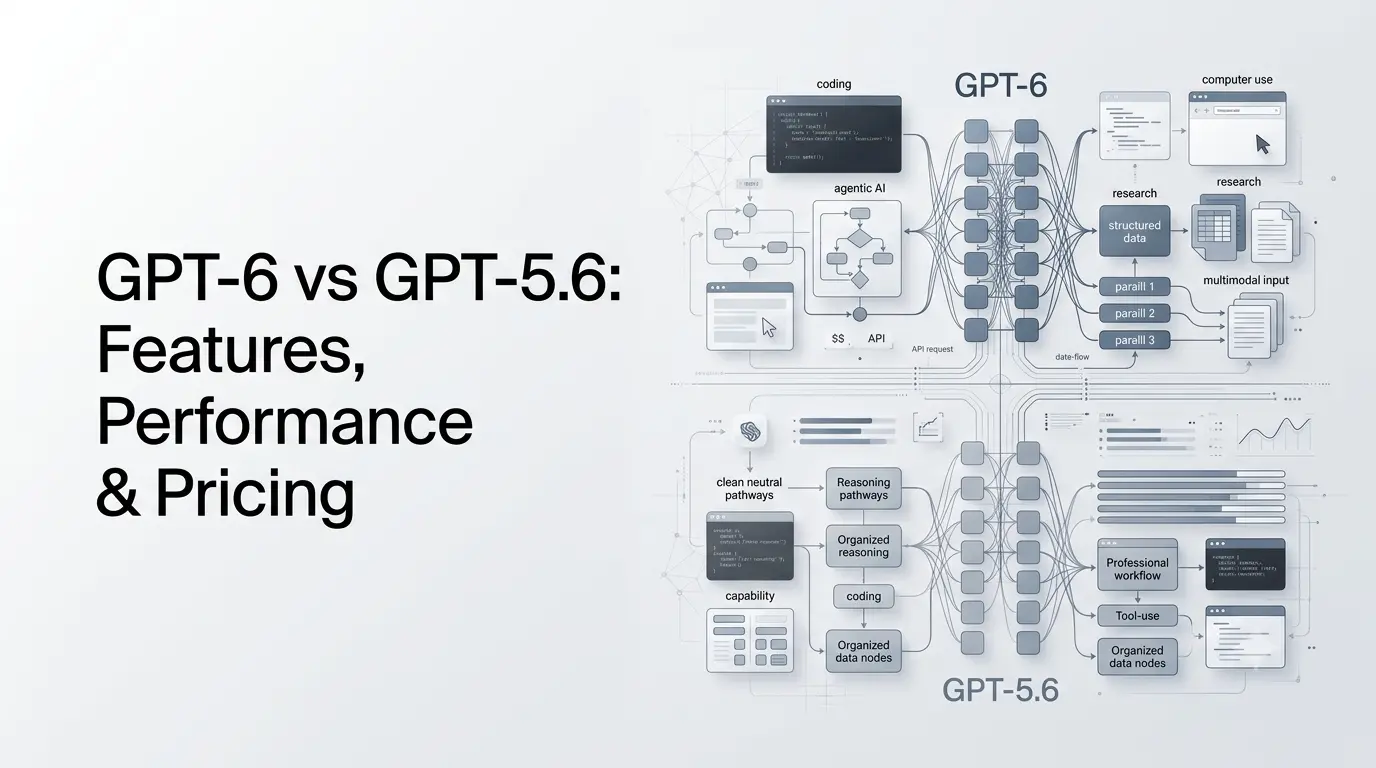
GPT-6 vs GPT-5.6 is not simply a comparison between two individual AI models. OpenAI now has two model generations with multiple tiers: GPT-6 Astra, GPT‑6 Sol and GPT‑6 Luna, alongside GPT-5.6 Sol, Terra, and Luna.
At the flagship level, GPT-6 Astra is positioned for the hardest end-to-end work, while GPT-5.6 Sol was designed for complex professional work with a strong emphasis on efficiency. Both support a 1.05-million-token context window, 128K maximum output, image input, reasoning, tool use, and computer-use capabilities. The more significant differences appear in areas such as computer use, agentic execution, coding performance, benchmark results, model architecture tiers, and pricing.
For developers, the choice is therefore less about whether GPT-6 can handle tasks that GPT-5.6 cannot. Instead, it is about how much capability, autonomy, performance, and cost efficiency a particular workload requires.
Quisk Summary
- GPT-6 vs GPT-5.6 compares the two AI model generations across capabilities, performance, context, and pricing.
- GPT-6 introduces a newer model architecture focused on advanced reasoning, coding, agents, and computer-use workflows.
- GPT-5.6 remains a highly capable model for coding, reasoning, professional tasks, and tool-based workflows.
- Both support long-context processing, image input, web search, file search, and computer use.
- GPT-6 expands capabilities around agentic execution and complex multi-step tasks.
- The article compares benchmark performance across coding, reasoning, computer use, and agent-related evaluations.
- API pricing differs between the GPT-6 and GPT-5.6 model tiers.
- The guide explains the key differences, use cases, limitations, and model-selection considerations.
GPT-6 vs GPT-5.6: Quick Comparison
| Feature | GPT-6 | GPT-5.6 |
|---|---|---|
| Current family | Astra, Sol, Luna | Sol, Terra, Luna |
| Flagship model | GPT-6 Astra | GPT-5.6 Sol |
| Primary focus | Hardest end-to-end work | Complex professional work |
| Context window | Up to 1.05M | Up to 1.05M |
| Maximum output | 128K tokens | 128K tokens |
| Image input | Yes | Yes |
| Reasoning | Yes | Yes |
| Computer use | Yes | Yes |
| Web search | Yes | Yes |
| File search | Yes | Yes |
| Coding | Advanced | Advanced |
| Agentic workflows | Major focus | Major focus |
| Standard flagship API input | $10/M | $4/M |
| Standard flagship API output | $50/M | $20/M |
The pricing comparison is particularly important: GPT-6 Astra currently costs more than GPT-5.6 Sol under Standard API pricing. However, OpenAI’s published evaluations also show Astra making substantial gains on several computer-use, professional, science, and cybersecurity benchmarks.
What Is the Difference Between GPT-6 and GPT-5.6?
The biggest difference is where OpenAI is pushing the models.
GPT-5.6 was introduced as a family focused on extracting more useful work from each token. OpenAI emphasized coding, professional knowledge work, computer use, cybersecurity, science, design, and multi-agent workflows. GPT-5.6 Sol also introduced an ultra capability setting that could coordinate multiple agents across parallel workstreams.
GPT-6 takes that direction further at the flagship level.
OpenAI describes GPT-6 Astra as its most capable model for the hardest end-to-end work, including:
- Complex reasoning
- Software engineering
- Computer use
- Research
- Scientific work
- Browsing
- Document creation
- Professional workflows
- Multi-step agentic tasks
The practical distinction is therefore not simply “GPT-6 is newer.” GPT-6 Astra is designed to perform more of the complete workflow itself, particularly when a task requires interacting with computers, navigating websites, manipulating applications, writing code, checking results, and continuing through multiple steps.
GPT-6 vs GPT-5.6 Models Compared
A useful way to understand the two generations is to compare their complete families.
GPT-6 family
| Model | Positioning | Standard input | Standard output |
|---|---|---|---|
| GPT-6 Astra | Hardest end-to-end work | $10/M | $50/M |
| GPT-6 Sol | Complex coding and agentic workflows | $2/M | $10/M |
| GPT-6 Luna | Focused, high-volume tasks | $0.10/M | $0.50/M |
GPT-5.6 family
| Model | Positioning | Standard input | Standard output |
|---|---|---|---|
| GPT-5.6 Sol | Complex professional work | $4/M | $20/M |
| GPT-5.6 Terra | Intelligence/cost balance | $2/M | $12/M |
| GPT-5.6 Luna | Cost-sensitive workloads | $0.20/M | $1.20/M |
All six models currently provide a 1.05-million-token context window and support up to 128K output tokens. The model tiers are differentiated primarily by capability, cost, and intended workload rather than context size.
GPT-6 Astra vs GPT-5.6 Sol
For a direct flagship comparison, GPT-6 Astra vs GPT-5.6 Sol is the most meaningful matchup.
GPT-5.6 Sol was OpenAI’s flagship model for complex professional work. It was built around coding, knowledge work, computer use, science, cybersecurity, design, and agentic workflows.
GPT-6 Astra moves the flagship position toward more demanding end-to-end execution.
OpenAI describes Astra as its most capable model and highlights computer use, browsing, software engineering, cybersecurity, science, and professional work.
Core specification comparison
| Specification | GPT-6 Astra | GPT-5.6 Sol |
|---|---|---|
| Model ID | gpt-6-astra | gpt-5.6-sol |
| Context window | 1.05M | 1.05M |
| Maximum output | 128K | 128K |
| Knowledge cutoff | Apr. 30, 2026 | Feb. 16, 2026 |
| Reasoning settings | Low, medium, high, xhigh, max | None, low, medium, high, xhigh, max |
| Image input | Yes | Yes |
| Web search | Yes | Yes |
| File search | Yes | Yes |
| Computer use | Yes | Yes |
| Standard input | $10/M | $4/M |
| Standard output | $50/M | $20/M |
The context window is therefore not the primary difference. Both models have the same 1.05M-token context capacity and 128K maximum output.
The more important distinction is capability at the frontier, particularly in computer-use and demanding end-to-end workflows.
GPT-6 vs GPT-5.6 Performance
Performance is where the comparison becomes more nuanced.
There is no single benchmark that can accurately summarize an AI model’s overall capability. OpenAI’s published evaluations show GPT-6 Astra ahead of GPT-5.6 Sol on many tests, but the size of the improvement varies considerably by task.
Computer-use performance
This is one of the clearest areas of differentiation.
OpenAI reports:
| Benchmark | GPT-6 Astra | GPT-5.6 Sol |
|---|---|---|
| Agents’ Last Exam | 59.3% | 53.6% |
| OSWorld 2.0 | 72.6% | 65.7% |
| ScreenSpot-Pro | 92.7% | 76.9% |
On OSWorld 2.0, OpenAI’s latency simulation reported Astra achieving its result in roughly 40 minutes per task, compared with roughly 75 minutes for GPT-5.6 Sol. OpenAI says that represents about 47% less time per task in that specific simulation.
That matters because computer-use agents can spend substantial time navigating interfaces, inspecting results, correcting mistakes, and completing multiple actions.
A model that completes a task with fewer or faster interactions can have a meaningful impact on the economics of an AI agent.
Coding Performance: GPT-6 vs GPT-5.6
Both generations are designed for serious software engineering.
GPT-5.6 Sol already showed strong coding-agent performance. OpenAI reported an Artificial Analysis Coding Agent Index score of 80, compared with 76.4 for GPT-5.5, along with 64.6% on SWE-Bench Pro, 72.7% on DeepSWE v1.1, and 88.8% on Terminal-Bench 2.1.
GPT-6 Astra was evaluated on newer and more demanding coding and engineering tests. OpenAI reports:
- 74.1% on DeepSWE v1.1
- 57.9% on Terminal-Bench 4.0
- 64.5% on FrontierCode 1.1 Extended
These evaluations use different benchmark versions in some cases, so they should not be treated as perfectly apples-to-apples comparisons.
The broader takeaway is that both generations are intended for coding agents, but Astra is positioned for more demanding end-to-end software engineering.
GPT-6 vs GPT-5.6 for Computer Use
Computer use is one of the most important practical differences.
GPT-5.6 already introduced stronger capabilities for interacting with computers, inspecting rendered results, refining interfaces, and executing multi-step workflows.
OpenAI reported a 62.6% OSWorld 2.0 score for GPT-5.6 Sol at launch, while Astra later achieved 72.6% on the same benchmark version cited in its launch material.
Astra is designed for tasks such as:
- Filling online forms
- Updating CRM systems
- Organizing calendars
- Conducting online research
- Creating websites
- Testing websites
- Analyzing scientific data
- Installing and testing software
- Troubleshooting on-screen problems
That makes the GPT-6 generation particularly relevant to computer-use agents that need to complete tasks instead of merely describing how users should perform them.
GPT-6 vs GPT-5.6 for Agents
Both generations support agentic workflows.
GPT-5.6 introduced several important mechanisms for agentic work, including Programmatic Tool Calling and multi-agent workflows through the Responses API. OpenAI’s ultra setting could coordinate four agents in parallel by default for demanding tasks.
GPT-6 continues this direction.
GPT-6 Sol is explicitly positioned for complex coding and agentic workflows, while Astra targets the most difficult end-to-end work.
This creates an important distinction for developers:
GPT-5.6: strong model plus tools and agent orchestration.
GPT-6: stronger emphasis on the model itself completing increasingly complex, multi-step work with tools and computer interaction.
The two approaches overlap, but the GPT-6 family pushes further toward autonomous execution.
GPT-6 vs GPT-5.6 Context Window
There is no major context-window advantage for GPT-6.
Both generations currently support:
1,050,000-token context window
and
128,000 maximum output tokens.
That means someone choosing GPT-6 purely because they need a larger context window would not gain an advantage over GPT-5.6 on this specification.
The difference is instead how effectively the models use long context as part of reasoning, tool use, and extended workflows.
For example, a large context can contain:
- A software repository
- Product documentation
- Research papers
- Customer records
- Long reports
- Large datasets
- Previous agent interactions
But a large context window does not guarantee perfect retrieval or reasoning over every piece of information. Developers still need sensible context management.
GPT-6 vs GPT-5.6 Pricing
Pricing is one area where GPT-5.6 can remain attractive.
Flagship API pricing
| Model | Input / 1M tokens | Cached input | Output / 1M tokens |
|---|---|---|---|
| GPT-6 Astra | $10 | $1 | $50 |
| GPT-5.6 Sol | $4 | $0.40 | $20 |
Under current Standard pricing, GPT-6 Astra therefore costs 2.5 times as much as GPT-5.6 Sol for both input and output tokens.
However, raw token price does not tell the whole story.
If Astra can complete a task with fewer tool calls, fewer retries, less human intervention, or substantially less wall-clock time, the effective cost of completing the task may be closer than the headline token prices suggest.
Conversely, a workload that does not need Astra’s additional capability may simply be more economical on GPT-5.6 Sol.
OpenAI also offers different pricing modes, including Batch, Flex, and Fast processing, so actual API costs depend on the processing configuration.
GPT-6 Sol vs GPT-5.6 Sol
An especially interesting comparison is not Astra versus Sol, but GPT-6 Sol vs GPT-5.6 Sol.
GPT-6 Sol is designed for complex coding and agentic workflows and currently costs:
- $2 per million input tokens
- $10 per million output tokens
GPT-5.6 Sol currently costs:
- $4 per million input tokens
- $20 per million output tokens
That means the newer GPT-6 Sol is currently priced at half the Standard input and output rates of GPT-5.6 Sol.
OpenAI’s September 22 announcement also described GPT-6 Sol and Luna as building on Astra’s advances while bringing them to faster and more affordable models for work at scale.
This is important because “GPT-6 is more expensive than GPT-5.6” is not universally true.
It depends on which GPT-6 and GPT-5.6 tiers are being compared.
GPT-6 Luna vs GPT-5.6 Luna
The same pattern appears at the lower-cost end.
| Model | Input / 1M | Output / 1M |
|---|---|---|
| GPT-6 Luna | $0.10 | $0.50 |
| GPT-5.6 Luna | $0.20 | $1.20 |
GPT-6 Luna is currently cheaper on both input and output under Standard API pricing. Its output rate is particularly different, at $0.50 compared with $1.20 for GPT-5.6 Luna.
Both are intended for cost-sensitive or high-volume workloads, but GPT-6 Luna belongs to the newer generation and benefits from the newer GPT-6 model stack.
GPT-6 vs GPT-5.6 for Developers
The right choice depends heavily on the application.
a) Choose GPT-6 Astra when:
- The task requires advanced computer use.
- The agent needs to complete complicated workflows autonomously.
- Software engineering is highly complex.
- Research requires extensive tool interaction.
- Accuracy and capability matter more than raw token cost.
- The application benefits from stronger end-to-end execution.
b) Choose GPT-6 Sol when:
- You need complex coding and agentic capabilities.
- You are processing workloads at scale.
- You want a lower-cost GPT-6 option.
- The task is demanding but does not require Astra’s highest capability tier.
c) Choose GPT-5.6 Sol when:
- Your application already performs well on GPT-5.6.
- You need strong professional-work capabilities at a lower price than Astra.
- You have an established GPT-5.6 workflow and do not need the latest frontier capabilities.
- Your application’s total economics favor its current performance/cost profile.
d) Choose GPT-5.6 Terra or Luna when:
- The workload does not require flagship reasoning.
- Cost is a major factor.
- You are processing large numbers of routine requests.
- A smaller model provides sufficient quality.
OpenAI’s current model-selection documentation similarly positions Astra for complex reasoning and coding, GPT-6 Sol for balancing intelligence and cost, and GPT-6 Luna for cost-sensitive high-volume workloads.
Is GPT-6 Better Than GPT-5.6?
The answer depends on what “better” means.
On several published benchmarks, GPT-6 Astra records higher scores than GPT-5.6 Sol, particularly in computer use and some professional, scientific, and cybersecurity evaluations. OpenAI’s Astra results include 72.6% on OSWorld 2.0 compared with 65.7% for GPT-5.6 Sol and 92.7% versus 76.9% on ScreenSpot-Pro.
But GPT-5.6 Sol remains a highly capable model and has a substantially lower standard API price than Astra.
So there are two separate questions:
- Capability: GPT-6 Astra introduces higher reported performance on many demanding evaluations.
- Economics: GPT-5.6 Sol can still make sense when its capabilities are sufficient for the task.
That distinction matters for production AI systems, where the goal is often not to maximize benchmark performance but to complete a real workload reliably at an acceptable cost.
What About GPT-6 Sol vs GPT-5.6 Sol?
This comparison is different from Astra versus GPT-5.6 Sol.
GPT-6 Sol is designed specifically for complex coding and agentic workflows and costs $2/$10 per million input/output tokens. GPT-5.6 Sol is positioned as the flagship of its generation for complex professional work and currently costs $4/$20 under Standard API pricing.
For developers evaluating a migration, GPT-6 Sol is therefore particularly relevant when:
- Coding is central to the application.
- Agents perform multi-step tasks.
- Lower token costs matter.
- You want a newer-generation model without moving all the way to Astra.
Actual migration decisions should still be validated against the application’s own prompts, tools, latency requirements, and evaluation set.
GPT-6 vs GPT-5.6: What Changed?
The transition from GPT-5.6 to GPT-6 is best understood as an evolution in agentic execution and end-to-end task capability, rather than a simple increase in context size.
GPT-5.6 already introduced:
- Strong coding
- Computer use
- Programmatic Tool Calling
- Multi-agent workflows
- Long-running professional work
- Advanced design and frontend generation
- Strong science and cybersecurity performance
GPT-6 extends the same direction with stronger emphasis on:
- More capable computer use
- End-to-end professional workflows
- Advanced software engineering
- Research and science
- Agentic execution
- More demanding tool-driven tasks
- Greater performance on selected frontier evaluations
OpenAI’s Astra announcement specifically describes the model as state-of-the-art across computer use, browsing, software engineering, cybersecurity, science, and professional work.
Limitations to Consider
Neither generation should be treated as infallible.
1. Benchmark results do not equal universal performance
A model can perform exceptionally on one benchmark while behaving differently on another task.
2. Agentic capability increases the need for safeguards
When a model can interact with websites, software, files, and external tools, errors can have consequences beyond an incorrect text answer.
Production systems should therefore use:
- Permission controls
- Sandboxing
- Human approval where appropriate
- Tool restrictions
- Logging
- Monitoring
- Application-level validation
3. Higher model capability can increase cost
GPT-6 Astra’s token pricing is substantially higher than GPT-5.6 Sol’s. The additional capability needs to justify the additional expense for the specific workload.
4. Long context is not the same as perfect memory
Both generations offer 1.05M-token context, but developers should still design retrieval and context-management strategies carefully.
GPT-6 vs GPT-5.6: Availability
The GPT-5.6 family is available through ChatGPT, Codex, and the OpenAI API. GPT-5.6 Sol, Terra, and Luna are available through the API, while availability in ChatGPT products depends on the user’s plan and product.
GPT-6 Astra is available through the OpenAI API and is rolling out across ChatGPT Plus, Pro, Business, and Enterprise, as well as through Microsoft Azure and AWS Bedrock. GPT-6 Sol and Luna are available through the API and have also rolled out in ChatGPT Work and Codex for eligible users.
Availability can change as OpenAI updates its product lineup, so developers should check the current model documentation before selecting a model for a production application.
Conclusion
The GPT-6 vs GPT-5.6 comparison is ultimately about more than generation numbers.
GPT-5.6 established a strong foundation for coding agents, professional knowledge work, computer interaction, programmatic tool use, and multi-agent workflows. GPT-6 builds on that foundation, with GPT-6 Astra pushing further into difficult end-to-end tasks, computer use, software engineering, research, science, and professional automation.
The context window is not the defining difference: both generations currently reach 1.05 million tokens. The more meaningful changes are in capability, execution, agentic workflows, computer use, and performance on demanding evaluations.
Pricing also complicates the picture. GPT-6 Astra is substantially more expensive than GPT-5.6 Sol, but GPT-6 Sol and Luna are currently priced below their GPT-5.6 counterparts under Standard API rates.
For developers, the practical approach is to match the model to the workload: use the highest-capability tier when the task genuinely requires it, and use lower-cost models when they can achieve the required result reliably.
As OpenAI continues to update both generations, model specifications, pricing, availability, and benchmark results can change. The current OpenAI model documentation should therefore be checked before making production decisions.
Frequently Asked Questions
1. What is the difference between GPT-6 and GPT-5.6?
GPT-6 is the newer OpenAI model generation and places greater emphasis on advanced computer use, agentic execution, coding, research, and difficult end-to-end workflows. GPT-5.6 already supports many of these capabilities, but GPT-6 extends them at the frontier.
2. Is GPT-6 faster than GPT-5.6?
Speed depends on the model, processing mode, workload, and tool usage. OpenAI reports that GPT-6 Astra completed OSWorld 2.0 tasks in roughly 40 minutes in its latency simulation versus roughly 75 minutes for GPT-5.6 Sol. That result applies to the specific evaluation setup rather than every workload.
3. Does GPT-6 have a larger context window than GPT-5.6?
No. Both GPT-6 and GPT-5.6 models currently support a 1.05-million-token context window and up to 128K output tokens.
4. Is GPT-6 more expensive than GPT-5.6?
It depends on the models being compared. GPT-6 Astra costs $10/$50 per million input/output tokens, while GPT-5.6 Sol costs $4/$20. However, GPT-6 Sol costs $2/$10 and GPT-6 Luna costs $0.10/$0.50, making those GPT-6 models cheaper than their corresponding GPT-5.6 tiers under current Standard pricing.
5. Which is better for coding, GPT-6 or GPT-5.6?
Both are designed for advanced coding. GPT-6 Astra targets the hardest software-engineering workloads, while GPT-6 Sol is specifically positioned for complex coding and agentic workflows. GPT-5.6 Sol also has strong published coding-agent results. The appropriate choice depends on the required capability and cost.
6. Should developers switch from GPT-5.6 to GPT-6?
There is no universal reason to migrate every application immediately. GPT-6 is particularly relevant when an application benefits from stronger computer use, advanced coding, agentic workflows, or difficult end-to-end execution. Existing GPT-5.6 applications should be evaluated against representative workloads before migration.
Also Read –
GPT-6 Explained: Everything to Know About OpenAI’s Next AI Model
GPT-6 Sol and Luna Launch With Lower API Costs
GPT-6 Models Guide: Compare Capabilities, Performance & Pricing
GPT-6 Astra: Features, Capabilities, Performance & What’s New?