
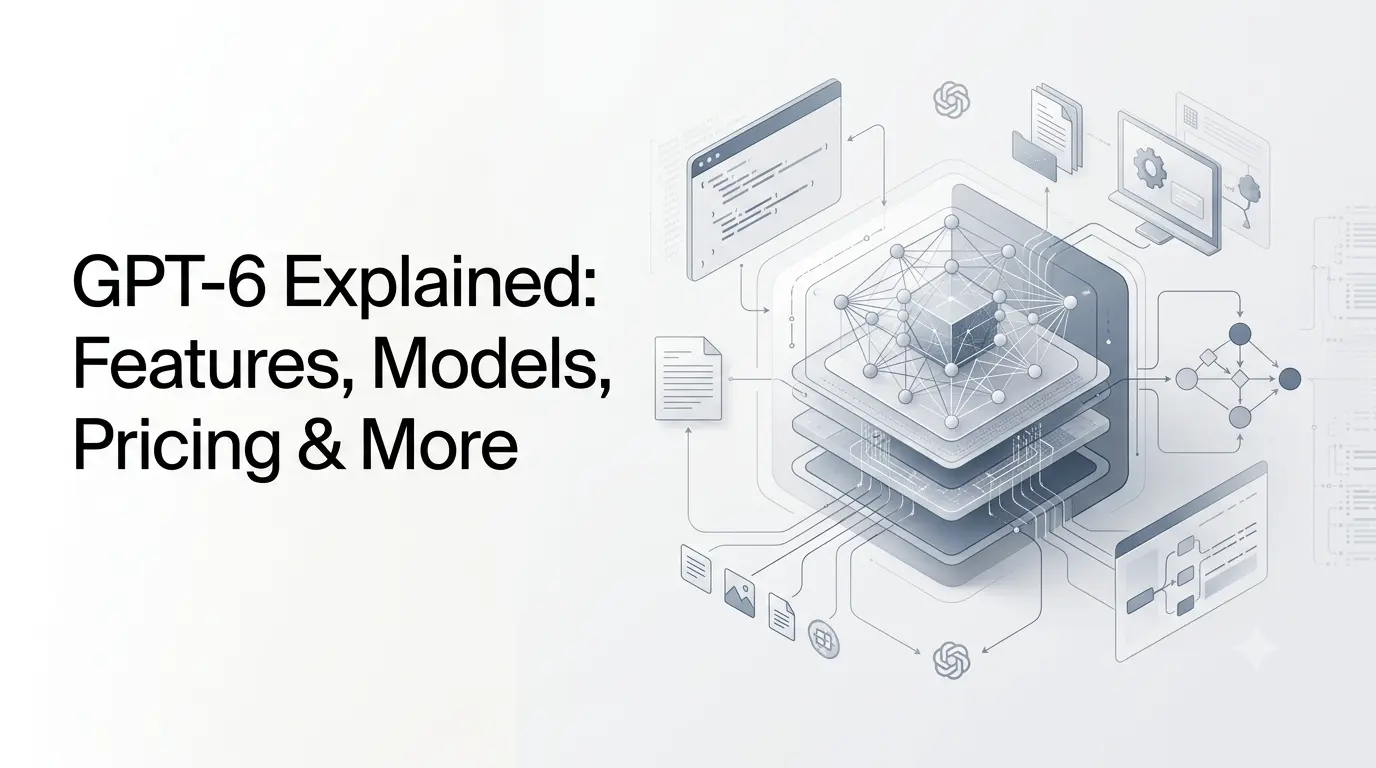
OpenAI’s GPT-6 generation has arrived, but it is not a single model. The GPT-6 family currently includes GPT-6 Astra, GPT-6 Sol and GPT-6 Luna, each designed for a different balance of capability, speed, and cost.
GPT-6 Astra is the flagship model for demanding end-to-end work, including computer use, software engineering, research, science, browsing, and professional workflows. GPT-6 Sol targets complex coding and agentic tasks at a lower cost, while GPT-6 Luna is designed for efficient, high-volume workloads.
The first GPT-6 model, Astra, was introduced in September 2026. OpenAI subsequently expanded the family with Sol and Luna on September 22. This means older descriptions of GPT-6 as an unreleased future model are now outdated.
Quick Summary
- GPT-6 is OpenAI’s latest AI model generation, with Astra, Sol, and Luna variants.
- GPT-6 Astra focuses on advanced reasoning, coding, research, and computer-use tasks.
- GPT-6 Sol targets coding and agentic workflows at a lower cost.
- GPT-6 Luna is designed for fast, high-volume AI workloads.
- The models support a 1.05-million-token context window and image input.
- GPT-6 emphasizes AI agents, tool use, coding, and multi-step task execution.
- API pricing varies significantly by model, from $0.10 to $10 per million input tokens.
- GPT-6 is available across OpenAI’s API, ChatGPT Work, and Codex, depending on the model and plan.
What Is GPT-6?
GPT-6 is OpenAI’s latest generation of general-purpose AI models, built around stronger reasoning, computer use, coding, tool interaction, long-context processing, and multi-step task execution.
Rather than treating GPT-6 simply as a larger chatbot, OpenAI positions the family around AI systems that can carry out work. The models can process text and images, use tools, interact with software, and support workflows that involve multiple steps.
The family currently consists of:
| Model | Primary focus | Context window | Max output | Standard API input | Standard API output |
|---|---|---|---|---|---|
| GPT-6 Astra | Hardest end-to-end work | 1.05M | 128K | $10/M | $50/M |
| GPT-6 Sol | Coding and agentic workflows | 1.05M | 128K | $2/M | $10/M |
| GPT-6 Luna | Efficient, high-volume tasks | 1.05M | 128K | $0.10/M | $0.50/M |
Pricing above refers to OpenAI’s current standard API rates for shorter-context requests; longer-context, cached-input, batch, and fast-processing rates differ.
When Was GPT-6 Released?
GPT-6 was introduced in stages rather than as one single launch.
GPT-6 Astra was introduced by OpenAI in September 2026. OpenAI described Astra as its most intelligent and aligned model and positioned it around computer use, browsing, software engineering, cybersecurity, science, and professional work.
On September 22, 2026, OpenAI expanded the family with GPT-6 Sol and GPT-6 Luna. The two models were made available through the OpenAI API, with Sol and Luna also introduced into ChatGPT Work and Codex.
This gives the GPT-6 generation a tiered structure instead of forcing every workload onto the most expensive model.
What Are the Main GPT-6 Models?
GPT-6 Astra
GPT-6 Astra is the highest-capability model in the GPT-6 family.
OpenAI designed it for difficult tasks requiring reasoning, software interaction, computer use, research, coding, and professional workflows. It can work with browsers and software, generate documents and spreadsheets, create websites, analyze scientific data, and carry out multi-step computer tasks.
Astra is also the model behind GPT-6 Pro in eligible ChatGPT plans. OpenAI’s current documentation lists GPT-6 Pro, powered by Astra, for Pro, Business, and Enterprise users, while Plus users receive Astra in ChatGPT Work and Codex. Availability can depend on the product and workspace configuration.
GPT-6 Sol
GPT-6 Sol is positioned between Astra and Luna.
OpenAI describes it as a model built for complex coding and agentic workflows. It supports reasoning levels from none through xhigh and has the same 1.05-million-token context window and 128,000-token maximum output listed for Astra.
Its much lower API price makes it relevant for developers who need substantial reasoning and tool use without using Astra for every request.
GPT-6 Luna
GPT-6 Luna is the efficiency-focused member of the family.
OpenAI describes Luna as its most efficient model for focused, high-volume tasks. It has the same published 1.05-million-token context window and 128,000-token maximum output as Sol and Astra, but its standard API pricing is substantially lower.
That makes Luna particularly relevant for applications that need to process large numbers of requests where the highest available reasoning capability is not always necessary.
What Makes GPT-6 Different From Earlier GPT Models?
The biggest change is not simply a higher benchmark score. GPT-6 is increasingly designed around execution.
Earlier generations could already generate code, analyze documents, search the web, and use tools. GPT-6 pushes further toward systems that can maintain a goal, interact with software, respond to changing requirements, and complete multi-step workflows.
OpenAI highlights several areas in particular.
1. Stronger Computer Use
Computer use is one of the clearest areas of emphasis for GPT-6 Astra.
The model can interact with software interfaces to perform tasks such as:
- Filling out online forms
- Updating CRM records
- Organizing information
- Conducting online research
- Working with documents
- Analyzing scientific data
- Creating websites
- Running frontend quality checks
- Installing and testing software
- Troubleshooting problems visible on a computer screen
OpenAI reports that Astra scored 72.6% on OSWorld 2.0 in its reported evaluation, compared with 65.7% for GPT-5.6 Sol. OpenAI also reported that Astra achieved the higher computer-use performance in roughly 47% less simulated task time in that comparison.
These figures come from OpenAI’s evaluations and should be interpreted in the context of their stated test setups rather than as universal measures of real-world performance.
2. Better Agentic Workflows
GPT-6 is built for workflows where the model does more than generate a single answer.
An agentic workflow might look like:
Goal → planning → tool calls → information gathering → execution → verification → final output
For example, instead of asking an AI to explain how to build a website, a computer-using model can potentially create the site, inspect it in a browser, test interactions, identify problems, and make corrections.
OpenAI specifically describes Astra as capable of carrying out multi-step workflows across code, browsers, and professional software.
3. Stronger Coding
Coding is another major GPT-6 focus.
OpenAI describes GPT-6 Astra as its strongest model for software engineering to date. The model can work with codebases, perform browser testing, use development tools, and preserve information across long-running tasks.
OpenAI reports a 57.9% Terminal-Bench 4.0 score for Astra compared with 37.3% for GPT-5.6 Sol in its published comparison. On DeepSWE v1.1, Astra scored 74.1% compared with 72.7% for GPT-5.6 Sol.
The practical significance is less about one benchmark and more about the direction of development: coding models are increasingly being used as agents that can inspect, modify, test, and iterate on software.
4. Long Context
The GPT-6 family has a published 1.05-million-token context window across Astra, Sol, and Luna. Maximum output is listed at 128,000 tokens.
A large context window can be useful when working with:
- Large codebases
- Long technical documents
- Multiple research papers
- Large collections of business files
- Extended agent sessions
- Complex project specifications
Astra also introduces a different approach to long-running coding work through Codex. OpenAI says earlier context windows can remain searchable, allowing the model to retrieve requirements and test results from previous context windows rather than relying only on a compressed summary.
How Does GPT-6 Handle Images and Other Inputs?
The current OpenAI model documentation says the latest GPT-6 models support text and image input and text output. They are also described as supporting multilingual capabilities and vision.
This means GPT-6 is not limited to traditional text prompts.
For example, a developer could build an application that sends an image to GPT-6 for analysis while also providing text instructions and additional contextual information.
The model can therefore participate in workflows involving both visual and textual information.
GPT-6 Reasoning and Tool Use
GPT-6 continues OpenAI’s move toward reasoning models that can spend different amounts of computational effort depending on the task.
Astra supports reasoning levels from low through max, while Sol and Luna support none through xhigh.
This distinction matters because not every task needs maximum reasoning.
A simple classification or transformation may benefit from a fast setting. A difficult software-engineering or research task can justify greater reasoning effort.
GPT-6 also adds capabilities aimed at more flexible tool workflows. OpenAI’s model guidance highlights asynchronous tool calling and mid-turn steering as new capabilities for the GPT-6 family.
With asynchronous tool calling, an application can allow the model to continue reasoning or work on other parts of a task while a tool operation is running.
Mid-turn steering allows additional user instructions to be sent while GPT-6 is working, which is useful when requirements change during a long-running task.
GPT-6 Benchmark Performance
OpenAI has published extensive GPT-6 Astra evaluations across computer use, coding, science, mathematics, long-context reasoning, and cybersecurity.
Some selected results are:
| Evaluation | GPT-6 Astra |
|---|---|
| OSWorld 2.0 | 72.6% |
| ScreenSpot-Pro | 92.7% |
| Terminal-Bench 4.0 | 57.9% |
| DeepSWE v1.1 | 74.1% |
| FrontierMath Tier 4 | 97.6% |
| GPQA Diamond | 96.0% |
| ARC-AGI-3 | 99.9% |
| MRCR v2, 8-needle, 256K–512K | 100.0% |
| MRCR v2, 8-needle, 512K–1M | 96.3% |
These are OpenAI-reported results, and the evaluation methodology, available tools, reasoning effort, and model configuration can affect results. OpenAI explicitly notes that some evaluations were run in research or API environments that can differ from production ChatGPT.
For that reason, benchmark numbers are most useful for understanding the capabilities OpenAI is targeting rather than predicting how the model will perform on every individual task.
GPT-6 vs GPT-5.6
GPT-6 is the next major generation after GPT-5.6, but the difference is best understood as a shift toward more capable task execution rather than simply better text generation.
| Feature | GPT-5.6 Sol | GPT-6 Astra | GPT-6 Sol | GPT-6 Luna |
|---|---|---|---|---|
| Primary role | Professional work | Hardest end-to-end work | Coding/agentic workflows | High-volume efficiency |
| Context | 1.05M | 1.05M | 1.05M | 1.05M |
| Max output | 128K | 128K | 128K | 128K |
| Image input | Yes | Yes | Yes | Yes |
| Computer use | Supported | Advanced | Supported | Supported |
| Web search | Supported | Supported | Supported | Supported |
| API standard input | $4/M* | $10/M | $2/M | $0.10/M |
| API standard output | $20/M* | $50/M | $10/M | $0.50/M |
GPT-5.6 Sol pricing shown here is from OpenAI’s current model documentation and can change with promotional or processing tiers. GPT-6 prices are the current standard rates.
The more important distinction is that Astra is designed for substantially more autonomous, computer-based and agentic work, while Sol and Luna extend the GPT-6 technology to different cost and workload requirements.
GPT-6 Pricing
GPT-6 does not have one universal price.
OpenAI currently lists the following standard API rates per 1 million tokens:
| Model | Input | Cached Input | Output |
|---|---|---|---|
| GPT-6 Astra | $10 | $1 | $50 |
| GPT-6 Sol | $2 | $0.20 | $10 |
| GPT-6 Luna | $0.10 | $0.01 | $0.50 |
For prompts exceeding the shorter context pricing threshold, OpenAI lists higher long-context rates. Fast processing, batch processing, and other pricing tiers also have separate rates.
For developers, this makes model selection an important part of application architecture. A high-volume classification or transformation workload may not need Astra, while an autonomous software-engineering agent may justify its higher cost.
Is GPT-6 Available in ChatGPT?
Yes, but availability depends on the GPT-6 model and the ChatGPT product.
GPT-6 Astra is available in ChatGPT as GPT-6 Pro for eligible Pro, Business, and Enterprise users, while Plus users have access to Astra in ChatGPT Work and Codex.
GPT-6 Sol and GPT-6 Luna were introduced into ChatGPT Work and Codex on September 22, 2026. OpenAI’s release notes specify that these models are separate from the models available in regular ChatGPT conversations.
Availability can therefore differ depending on whether you are using ChatGPT Chat, Work, Codex, the API, or a managed workspace.
Is GPT-6 Available Through the API?
Yes.
The current OpenAI API supports:
gpt-6-astragpt-6-solgpt-6-luna
The models can be used through OpenAI’s Responses API and supported Chat Completions workflows.
GPT-6 Sol and Luna are also available through Amazon Bedrock, while OpenAI lists GPT-6 models across its broader developer ecosystem.
What Can GPT-6 Be Used For?
The GPT-6 family is broad enough to support both everyday AI applications and complex professional workflows.
For Developers
Developers can use GPT-6 for:
- Code generation
- Debugging
- Refactoring
- Codebase analysis
- Software testing
- Agentic coding
- Web applications
- Tool-calling applications
- Structured data extraction
- Long-context applications
For Businesses
Potential workflows include:
- Research
- Data analysis
- Document processing
- Spreadsheet work
- Customer workflows
- CRM automation
- Internal knowledge systems
- Report generation
- Business process automation
Astra is particularly relevant when the workflow requires the model to interact with software rather than simply return text.
For Creators and Marketers
GPT-6 can support:
- Content research
- Content planning
- Data analysis
- Competitor research
- Drafting
- Editing
- Spreadsheet analysis
- Presentation creation
- Website development
The value for these users increasingly comes from connecting AI to the rest of the workflow rather than using it only as a writing assistant.
What Are GPT-6’s Limitations?
Despite the capabilities described by OpenAI, GPT-6 is not a replacement for human verification.
Several limitations remain important.
a) Model Errors Still Matter
A more capable model can still produce incorrect information. Better reasoning does not mean every answer is factually correct.
For high-stakes work, users should continue checking important claims, calculations, sources, and decisions.
b) Tool Access Changes Results
A model with web access, file search, computer use, or specialized tools can perform tasks that a model without those tools cannot.
This means comparisons between models need to account for the tools and harness used during testing.
c) Safety Systems Can Interrupt Tasks
OpenAI has introduced additional safeguards around GPT-6 Astra, particularly because of its stronger cybersecurity and computer-use capabilities.
OpenAI says Astra can reach a critical level of cybersecurity capability under its Preparedness Framework and has therefore strengthened monitoring, isolation, and safeguards.
These protections can sometimes interrupt legitimate workflows when a task triggers additional safety checks.
d) Cost Depends on the Workflow
Astra’s API pricing is considerably higher than Sol or Luna.
However, the cheapest model is not necessarily the cheapest option for an entire task. If a more capable model completes a workflow with fewer iterations, fewer tool calls, or fewer output tokens, its total cost can differ from its headline per-token price.
OpenAI specifically argues that Astra can sometimes achieve lower estimated cost per completed task despite having a higher per-token price because it uses fewer output tokens on some evaluations.
Which GPT-6 Model Should You Use?
There is no single GPT-6 model designed for every workload.
A practical starting point is:
- GPT-6 Astra: difficult research, complex coding, computer use, professional workflows and demanding agents.
- GPT-6 Sol: complex coding and agentic applications where cost matters.
- GPT-6 Luna: high-volume, repetitive, focused workloads where efficiency is important.
OpenAI itself recommends choosing between Astra, Sol, and Luna based on the reasoning requirements, latency, and cost of the task.
For developers, it is better to test representative workloads rather than selecting a model solely from benchmark rankings.
What Happened to GPT-5.6?
GPT-5.6 remains part of OpenAI’s model lineup, but GPT-6 introduces the next generation of models.
OpenAI’s current model catalog lists GPT-6 Astra, Sol, and Luna alongside GPT-5.6 Sol, Terra, and Luna.
This means developers do not necessarily need to migrate every application immediately. Existing applications can be evaluated against GPT-6 using representative tests before changing production models.
OpenAI’s GPT-6 guidance recommends setting the model explicitly and reviewing reasoning effort, tool calling, and prompt behavior during migration.
What Does GPT-6 Mean for AI Agents?
GPT-6’s development is closely tied to the broader move from chatbots toward agents.
A traditional chatbot generally follows a simple pattern:
Prompt → Response
An agentic system adds additional stages:
Goal → Planning → Tools → Actions → Verification → Iteration → Result
GPT-6 Astra is designed around this second pattern.
The distinction matters because many real business tasks are not single questions. They require opening software, gathering information, changing files, checking the result, responding to new information, and continuing until the task is complete.
GPT-6’s computer-use, tool-calling, long-context, and steering capabilities are designed to make these workflows more practical.
GPT-6 and the Future of AI Work
The most important aspect of GPT-6 may be the way it changes the role of the model.
The focus is moving from:
“Generate something for me.”
toward:
“Complete this task within these constraints.”
That difference affects software development, research, marketing, business operations, data analysis, and other knowledge-work workflows.
GPT-6 Astra’s ability to use computers, browse, work with documents, write software, test applications, and preserve information across long-running tasks illustrates this direction.
At the same time, users still need to decide what the AI is authorized to do, what information it can access, and where human review is required.
Conclusion
GPT-6 is not simply one replacement for GPT-5.6. OpenAI has built a three-model family around different levels of capability, cost, and workload requirements.
GPT-6 Astra targets the hardest end-to-end tasks, particularly computer use, software engineering, research, science, and professional workflows. GPT-6 Sol brings strong reasoning and agentic coding capabilities at a lower API price, while GPT-6 Luna is designed for efficient, high-volume work.
The larger story is the shift toward AI that can do more than answer questions. GPT-6 is designed to reason through tasks, use tools, interact with computers, work across long contexts, and continue through multi-step workflows.
For users, the practical question is therefore no longer simply whether GPT-6 is more capable. It is which GPT-6 model fits the task, how much autonomy should it have, and where should human verification remain part of the workflow?
Frequently Asked Questions About GPT-6
1. What is GPT-6?
GPT-6 is OpenAI’s current model generation, consisting of GPT-6 Astra, GPT-6 Sol, and GPT-6 Luna. The family focuses on reasoning, coding, computer use, agentic workflows, long-context tasks, and professional work.
2. When was GPT-6 released?
OpenAI introduced GPT-6 Astra in September 2026 and expanded the family with GPT-6 Sol and GPT-6 Luna on September 22, 2026.
3. Is GPT-6 available in ChatGPT?
Yes, but access depends on the model, ChatGPT product, plan, and workspace configuration. GPT-6 Astra is available through GPT-6 Pro and ChatGPT Work/Codex on eligible plans, while Sol and Luna are currently available in Work and Codex rather than regular ChatGPT conversations.
4. How much does GPT-6 cost?
API pricing varies by model. Current standard rates are $10/$50 per million input/output tokens for Astra, $2/$10 for Sol, and $0.10/$0.50 for Luna. Cached input and longer-context pricing are different.
5. What is the GPT-6 context window?
OpenAI currently lists a 1.05-million-token context window for GPT-6 Astra, Sol, and Luna, with a maximum output of 128,000 tokens.
6. Which GPT-6 model is best for coding?
GPT-6 Astra is OpenAI’s highest-capability option for demanding software-engineering work, while GPT-6 Sol is specifically positioned for complex coding and agentic workflows at a lower cost. The appropriate choice depends on the complexity, latency, and budget of the application.
Also Read –
GPT-6 Sol and Luna Launch With Lower API Costs
GPT-6 Models Guide: Compare Capabilities, Performance & Pricing
GPT-6 vs GPT-5.6: What’s the Difference? Features & Performance Compared