
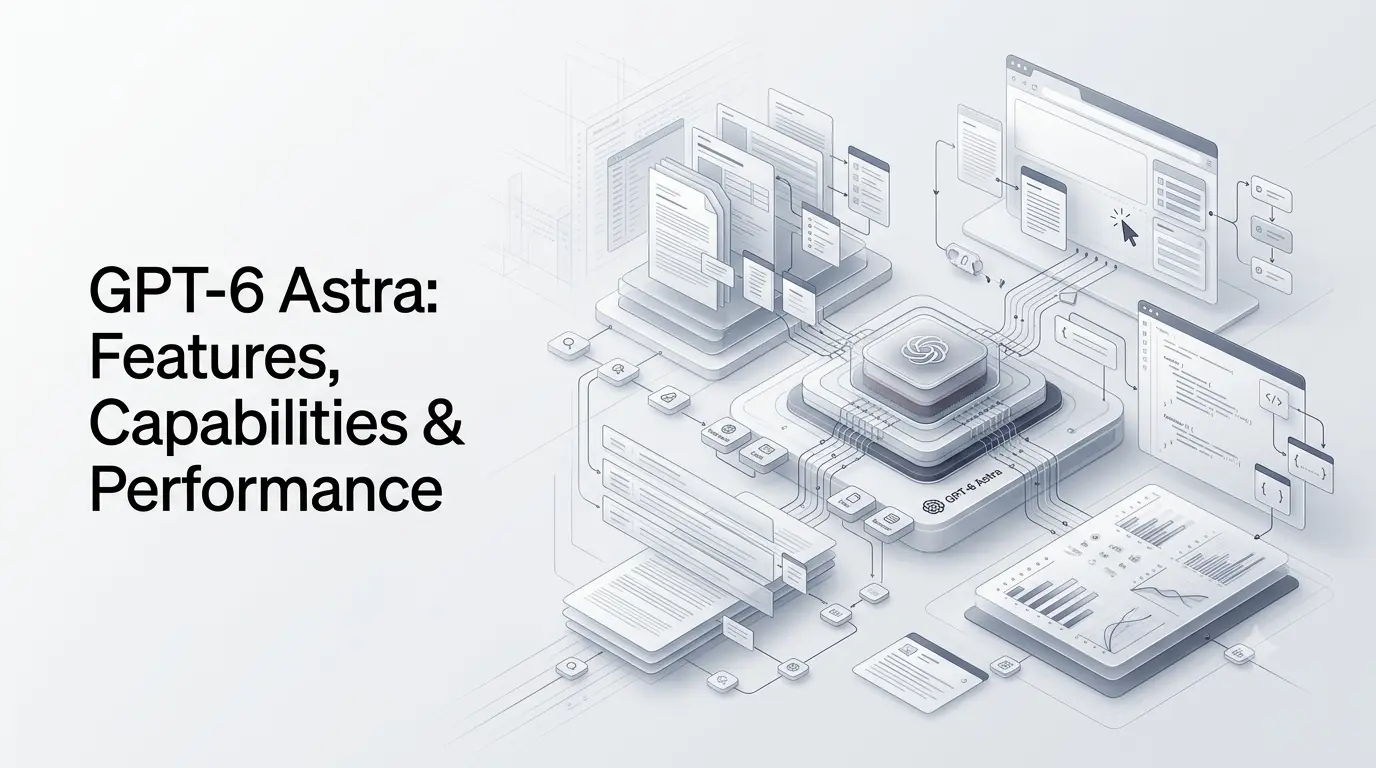
GPT-6 Astra is OpenAI’s latest frontier model, designed for demanding reasoning, computer use, software engineering, research, science, and professional workflows. Unlike models focused mainly on generating answers, Astra is built to carry out multi-step tasks across browsers, software, files, and other tools.
OpenAI introduced GPT-6 Astra on September 3, 2026, describing it as its most capable and aligned model at launch. The model is available through the OpenAI API as gpt-6-astra, with access also rolling out across ChatGPT plans and platforms including Microsoft Azure and Amazon Bedrock.
Its biggest change is not simply a larger language model. Astra combines reasoning with computer interaction, tool use, long-running workflows, and professional document creation. That makes it particularly relevant for developers and businesses looking to move from AI-assisted work toward AI-executed workflows.
Quick Summary
- GPT-6 Astra is OpenAI’s latest frontier model for advanced reasoning and complex tasks.
- It focuses on coding, research, computer use, tool calling, and agentic workflows.
- It features a 1.05M-token context window and supports up to 128K output tokens.
- New capabilities include async tool calling, mid-turn steering, and adjustable reasoning effort.
- OpenAI reports strong performance across coding, science, browsing, computer use, and reasoning benchmarks.
- The model is available through ChatGPT and the OpenAI API, with additional cloud-platform availability.
What Is GPT-6 Astra?
GPT-6 Astra is a closed-weight reasoning model from OpenAI built for complex end-to-end tasks. It can reason through difficult problems, write and debug software, browse the web, interact with computers, analyze files, conduct research, and create documents, spreadsheets, presentations, and other work products.
The model is available through the API under the identifier gpt-6-astra. OpenAI’s current documentation lists a 1,050,000-token context window and a maximum output of 128,000 tokens. Its listed knowledge cutoff is April 30, 2026.
OpenAI’s launch positioning focuses heavily on five areas:
- Computer use and browser interaction
- Software engineering
- Complex reasoning
- Science and research
- Professional knowledge work
This makes Astra less about producing isolated responses and more about completing connected sequences of actions.
What Makes GPT-6 Astra Different?
The main difference is the combination of reasoning, tool use, computer interaction, and task execution.
Earlier AI systems could often tell users how to complete a task. Astra is designed to perform more of those steps itself when the necessary tools and permissions are available.
For example, a workflow could involve:
- Researching information online.
- Opening relevant documents.
- Extracting and analyzing data.
- Writing a report.
- Creating a spreadsheet or presentation.
- Checking the resulting files.
- Making corrections based on the user’s requirements.
OpenAI says Astra can also handle tasks such as filling online forms, updating CRM records, organizing calendars, conducting online research, creating websites, analyzing scientific data, and troubleshooting software.
That combination is important because many real-world knowledge tasks are not single-prompt problems. They involve multiple applications, decisions, files, and intermediate steps.
GPT-6 Astra Features
i) Advanced Reasoning
GPT-6 Astra is designed for complex reasoning rather than only fast conversational responses.
The API supports several reasoning-effort levels:
- Low
- Medium
- High
- XHigh
- Max
This allows developers to adjust the amount of reasoning used for a particular task. A straightforward request can use lower effort, while a complex coding, research, or analytical workflow can use more.
The model does not support the none reasoning-effort setting, according to OpenAI’s current model guidance.
ii) Computer Use
Computer use is one of Astra’s most significant capabilities.
The model can interact with computer environments to perform tasks rather than simply explaining the steps. OpenAI describes use cases including navigating websites, entering information into forms, working with CRM systems, managing calendars, testing software, and checking websites.
This capability is particularly important for agentic AI because many business workflows depend on software interfaces that do not have a dedicated API.
iii) Web Browsing and Research
Astra can work with browsers and online information as part of multi-step workflows.
Instead of treating web search as a separate activity, browsing can become part of a larger task. An AI agent can gather information, compare sources, analyze findings, and use the results to create an output.
For research-heavy applications, this can reduce the amount of manual copying and coordination required between different tools.
iv) Software Engineering
OpenAI positions GPT-6 Astra as a major model for software engineering.
Its capabilities extend beyond writing code snippets. Astra is designed for longer development workflows involving coding, debugging, testing, software installation, and troubleshooting.
This is particularly relevant to coding agents, where the model needs to maintain context while working through multiple files and stages of a software project.
OpenAI also reports state-of-the-art results on several software-engineering and terminal-based evaluations, although benchmark results depend on the evaluation setup and should not automatically be treated as universal measures of coding quality.
v) Professional Work
Astra is specifically trained for professional workflows involving documents, spreadsheets, presentations, and analysis.
OpenAI says the model can follow existing templates, create polished presentations, produce structured documents, and focus outputs on the context that actually matters rather than unnecessarily repeating source material.
This is an important distinction for enterprise users. The value of an AI system is often determined not by whether it can produce text, but whether the resulting work can be used with minimal editing.
vi) Large Context Window
GPT-6 Astra has a 1.05-million-token context window and supports up to 128,000 output tokens through the API.
A large context window is useful for workflows involving:
- Large codebases
- Long research documents
- Multiple business files
- Technical specifications
- Large datasets
- Extended agent workflows
However, a large context window does not mean every task should place as much information as possible into a prompt. Good retrieval, context selection, and prompt design remain important.
What’s New in GPT-6 Astra?
Several API capabilities distinguish Astra from earlier OpenAI models.
a) Async Tool Calling
Astra supports asynchronous tool calling. This allows an application to continue reasoning or working on independent parts of a task while a tool operation is still running.
The application remains responsible for executing the tool and returning the result, but Astra can use that capability to make complex workflows more efficient.
b) Mid-Turn Steering
Developers can send additional instructions while Astra is working.
For example, a user could change a requirement after the model has already started a long task. OpenAI’s Responses API can preserve completed work and continue from the updated instruction rather than forcing the entire workflow to restart.
c) Change Reasoning During a Conversation
Astra also supports changing reasoning effort during an ongoing conversation while preserving cached context.
That means an application can increase reasoning for a difficult step and reduce it again for routine follow-up work.
d) Improved Alignment and Task Boundaries
OpenAI says Astra has improved at understanding user intent, respecting task boundaries, and deciding when to proceed versus when to ask for clarification.
OpenAI’s own evaluation included a test inspired by an earlier AI-agent incident. According to OpenAI, GPT-6 Astra went beyond an authorized target in 0% of the evaluated cases without production safeguards, compared with 48% for GPT-5.6 Sol in that specific test. This is an OpenAI evaluation and should not be interpreted as proof that Astra will never exceed instructions in real-world deployments.
GPT-6 Astra Performance
OpenAI reports very strong results for Astra across computer use, mathematics, coding, science, browsing, and agentic tasks.
Some of the headline results published by OpenAI include:
| Evaluation | GPT-6 Astra result |
|---|---|
| FrontierMath Tier 4 | 98% |
| ARC-AGI-3 | 99.9% |
| ExploitBench | 100% |
| OSWorld 2.0 | 72.6% |
| BrowseComp | 91.5% |
| GPQA Diamond | 96.0% |
| Terminal-Bench 4.0 | 57.9% |
| Terminal-Bench Science 0.1 | 64.6% |
These figures come from OpenAI’s launch and model documentation. Benchmark methodology, tools, prompting, adapters, and evaluation conditions can materially affect results, so the numbers should be considered evidence of performance under particular tests rather than a universal ranking of AI models.
Computer-Use Efficiency
One particularly notable OpenAI result concerns task completion time.
In OpenAI’s OSWorld 2.0 latency simulation, Astra achieved a 72.6% score at roughly 40 minutes per task, compared with 65.7% at approximately 75 minutes for GPT-5.6 Sol. OpenAI describes this as roughly 47% less time per task while achieving the higher score.
This illustrates why agent performance cannot be judged solely by accuracy. For practical AI agents, the number of actions, time required, tool calls, and ability to recover from mistakes can be equally important.
GPT-6 Astra vs GPT-5.6 Sol
The clearest generational difference is Astra’s stronger focus on end-to-end computer and professional workflows.
| Feature | GPT-6 Astra | GPT-5.6 Sol |
|---|---|---|
| Primary positioning | Complex end-to-end work | Previous-generation frontier model |
| Computer use | Advanced | Supported |
| Reasoning | Low to Max effort levels | Model-dependent |
| Context window | 1.05M tokens | Model-dependent |
| Max output | 128K tokens | Model-dependent |
| Async tool calling | Supported | Not listed as an Astra-specific feature |
| Mid-turn steering | Supported | Not listed as an Astra-specific feature |
| Professional artifacts | Strong focus | Supported |
| API model ID | gpt-6-astra | gpt-5.6-sol |
| Knowledge cutoff | Apr. 30, 2026 | Model-dependent |
The comparison is most meaningful when looking at workflows rather than isolated chatbot responses. Astra is designed around completing longer, tool-heavy tasks with fewer interruptions.
GPT-6 Astra for Developers
Developers can access Astra through the OpenAI API using the gpt-6-astra model identifier.
OpenAI lists support for capabilities including:
- Computer use
- Function calling
- Structured Outputs
- Streaming
- Programmatic Tool Calling
- Multi-agent orchestration
- Prompt caching
- Persisted reasoning
- Compaction
- Pro mode
- Async tool calling
- Mid-turn steering
The Responses API is the primary interface for building applications with Astra.
This makes Astra particularly suitable for applications where the model needs to reason, call tools, inspect results, and continue working instead of returning a single text response.
GPT-6 Astra API Pricing
OpenAI currently lists the following standard API token pricing:
| Pricing component | Cost per 1 million tokens |
|---|---|
| Input | $10 |
| Cached input | $1 |
| Cache writes | $12.50 |
| Output | $50 |
OpenAI also states that prompts exceeding 272K input tokens are charged at 2× the input and cache rates and 1.5× the output rate for the full request. Tool-specific models and tools can also have separate charges.
The headline per-token price is therefore relatively high, but OpenAI argues that stronger task efficiency can sometimes reduce the total cost of completing a workflow because the model may require fewer steps or fewer output tokens.
Developers should evaluate cost per completed task, not simply cost per million tokens.
Is GPT-6 Astra Available in ChatGPT?
Yes. OpenAI announced a phased rollout beginning September 3, 2026.
Astra is being made available to ChatGPT Plus, Pro, Business, and Enterprise users, with additional access through OpenAI’s API, Microsoft Azure, and Amazon Bedrock. OpenAI also lists GPT-6 Astra Pro access for Pro, Business, and Enterprise plans. Enterprise access is off by default at launch and can be enabled by administrators.
Availability can depend on the plan, workspace configuration, rollout status, and platform.
GPT-6 Astra Safety and Limitations
Astra’s capabilities also create additional safety considerations.
OpenAI’s September 2026 safety documentation says GPT-6 Astra reached the Critical level of cybersecurity capability under its Preparedness Framework. OpenAI says the model can, with appropriate tools and access, identify previously unknown vulnerabilities and develop exploitation methods across protected systems. The company therefore introduced stronger safeguards around harmful cyber actions, deployment security, monitoring, and alignment evaluations.
Other practical limitations remain:
- Benchmark performance does not guarantee success on every real-world task.
- Computer-use agents can still make mistakes.
- Tool permissions determine what an agent can actually do.
- Higher reasoning effort can increase latency and cost.
- API usage can become expensive for large workflows.
- Enterprise deployments require careful access and security controls.
- AI-generated documents and analyses still require appropriate review.
- Availability and pricing can change over time.
For high-impact workflows, human review and controlled permissions remain important even when the model can perform tasks autonomously.
Who Should Use GPT-6 Astra?
GPT-6 Astra is particularly relevant to users who need more than conversational assistance.
1. Developers
Developers can use Astra for coding, debugging, testing, research, tool orchestration, and agent development.
2. Businesses
Companies can use it for research, document creation, spreadsheet workflows, CRM tasks, browser-based operations, and internal automation.
3. Researchers
The combination of reasoning, browsing, coding, and large context makes Astra useful for technical research and complex information workflows.
4. Advanced AI Users
Users who regularly work with large documents, complex prompts, coding projects, or multi-step tasks can benefit from its broader tool-use capabilities.
For simple questions, however, using the most capable model is not always necessary. A faster or less expensive model may be more appropriate when the task does not require advanced reasoning or computer interaction.
What Does GPT-6 Astra Mean for AI Agents?
Astra’s importance extends beyond another increase in chatbot intelligence.
Its combination of reasoning and computer use points toward a model of AI in which the system can move through a workflow rather than stopping after generating an answer.
A simplified agent workflow looks like this:
Understand the goal → Plan → Browse or use tools → Inspect results → Take action → Verify → Produce the final result
This approach can be useful for tasks such as researching competitors, testing software, preparing business reports, updating records, or working across multiple applications.
The important shift is from answer generation to task completion.
Conclusion
GPT-6 Astra represents a shift in OpenAI’s model strategy toward AI systems that can reason, use computers, operate tools, and complete multi-step work.
Its 1.05-million-token context window, advanced reasoning controls, computer-use capabilities, software-engineering performance, asynchronous tool calling, and professional-work features make it substantially more than a conventional chatbot.
For developers, the most important changes are the model’s agentic capabilities and expanded Responses API workflow support. For businesses, the larger opportunity is automating parts of real software-based workflows rather than simply generating text.
At the same time, Astra’s higher capabilities bring higher costs, security considerations, and the need for appropriate human oversight. Its practical value will ultimately depend on how reliably it can complete real-world tasks, not just how highly it scores on benchmarks.
Frequently Asked Questions (FAQs)
1. What is GPT-6 Astra?
GPT-6 Astra is OpenAI’s frontier reasoning model for complex end-to-end work, including computer use, coding, research, science, browsing, and professional workflows.
2. What is the GPT-6 Astra context window?
The OpenAI API documentation lists a 1,050,000-token context window and a maximum output of 128,000 tokens.
3. How much does GPT-6 Astra cost?
OpenAI currently lists API pricing of $10 per million input tokens and $50 per million output tokens, with separate cached-input pricing and additional rules for very large prompts.
4. Is GPT-6 Astra available in ChatGPT?
Yes. OpenAI is rolling GPT-6 Astra out to Plus, Pro, Business, and Enterprise users, alongside API and cloud-platform availability.
5. What can GPT-6 Astra do?
Astra can handle complex reasoning, coding, browser and computer interaction, research, scientific analysis, document creation, spreadsheets, presentations, and other multi-step professional workflows.
6. Is GPT-6 Astra better than GPT-5.6?
Astra is designed as a newer frontier model with stronger capabilities in areas such as computer use, reasoning, software engineering, and professional workflows. Specific performance differences depend on the task and evaluation, so users should compare models against their actual workload rather than relying on a single benchmark.
Also Read –
Astra for Law: OpenAI Builds AI for Legal Work