
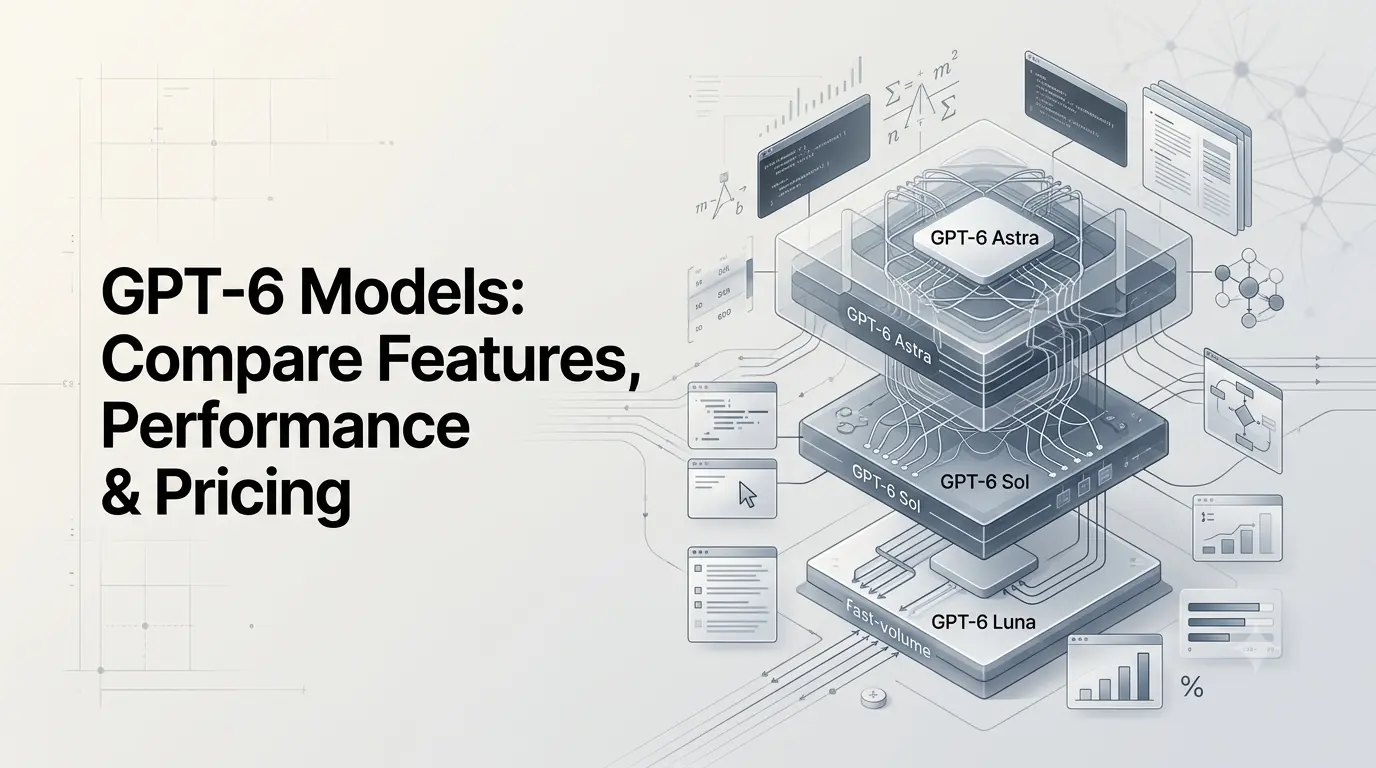
OpenAI’s GPT-6 family now consists of three models: GPT-6 Astra, GPT-6 Sol, and GPT-6 Luna. They share a 1.05-million-token context window and support text and image inputs, but they target different levels of reasoning, workload complexity, speed, and cost.
GPT-6 Astra is designed for the hardest end-to-end work, including complex reasoning, software engineering, computer use, research, and professional workflows. GPT-6 Sol is positioned for complex coding and agentic work at a lower price, while GPT-6 Luna focuses on efficient, high-volume workloads.
This GPT-6 models guide compares their capabilities, performance, context windows, API pricing, availability, and practical use cases so you can understand which model fits a particular workload.
GPT-6 Models at a Glance
| Model | Primary focus | Context window | Max output | Standard input price / 1M tokens | Standard output price / 1M tokens |
|---|---|---|---|---|---|
| GPT-6 Astra | Hardest reasoning and end-to-end work | 1.05M | 128K | $10 | $50 |
| GPT-6 Sol | Complex coding and agentic workflows | 1.05M | 128K | $2 | $10 |
| GPT-6 Luna | Efficient, high-volume tasks | 1.05M | 128K | $0.10 | $0.50 |
The pricing above refers to OpenAI API Standard processing and can differ for cached input, long-context requests, Fast mode, Batch, Flex, and other processing options.
The basic choice is straightforward: Astra targets maximum capability, Sol balances capability and cost, and Luna is designed for workloads where efficiency and volume matter most.
What Are the GPT-6 Models?
The GPT-6 models are OpenAI’s latest general-purpose reasoning models, with the family split into three tiers rather than using one model for every workload.
GPT-6 Astra
GPT-6 Astra is the flagship model in the family. OpenAI describes it as its most capable model for difficult end-to-end work.
It is designed for:
- Complex reasoning
- Software engineering
- Computer use
- Web and browser workflows
- Research
- Scientific work
- Professional document creation
- Spreadsheets and presentations
- Multi-step agentic tasks
- Advanced coding
Astra supports reasoning effort levels from low through maximum, giving developers more control over the amount of reasoning used for a task.
Its 1.05-million-token context window is particularly relevant for large codebases, long research projects, extensive documents, and workflows where information needs to remain available across many steps.
GPT-6 Sol
GPT-6 Sol is positioned below Astra for cost and is designed to bring much of the GPT-6 generation’s capability to more scalable workloads.
OpenAI specifically describes Sol as being built for complex coding and agentic workflows.
Typical applications include:
- Software development
- Code generation and debugging
- Coding agents
- Research workflows
- Tool-driven applications
- Business automation
- Multi-step reasoning
- Applications where cost matters alongside capability
Sol supports the same 1.05-million-token context window and 128K maximum output size as Astra, but its standard API pricing is substantially lower.
GPT-6 Luna
GPT-6 Luna is the efficiency-focused member of the GPT-6 family.
OpenAI describes it as its most efficient model for focused, high-volume tasks.
That makes Luna relevant to workloads such as:
- High-volume text processing
- Classification
- Summarization
- Content transformation
- Data extraction
- Routine reasoning
- Background automation
- Large-scale API applications
- Cost-sensitive agent workflows
Luna still supports a 1.05-million-token context window and 128K maximum output, meaning a lower price does not mean it is restricted to short-context applications.
GPT-6 Astra vs Sol vs Luna: What’s the Difference?
The biggest difference between the GPT-6 models is not their basic input/output format. It is the balance between capability, reasoning depth, workload complexity, and cost.
| Capability | GPT-6 Astra | GPT-6 Sol | GPT-6 Luna |
|---|---|---|---|
| Complex reasoning | Highest-end use cases | Strong | Designed for focused tasks |
| Coding | Advanced software engineering | Complex coding | High-volume coding tasks |
| Agentic workflows | Advanced | Strong focus | Efficient workflows |
| Computer use | Yes | Yes | Yes |
| Web search/tool use | Yes | Yes | Yes |
| File search | Yes | Yes | Yes |
| Image input | Yes | Yes | Yes |
| Context window | 1.05M | 1.05M | 1.05M |
| Max output | 128K | 128K | 128K |
| API cost | Highest | Mid-tier | Lowest |
| Best fit | Difficult end-to-end work | Capability/cost balance | High-volume workloads |
The table should not be interpreted as meaning that Luna or Sol cannot handle difficult tasks. The models overlap in capabilities. The intended distinction is the level of capability and cost OpenAI provides for different workloads.
GPT-6 Models Performance
Performance comparisons between GPT-6 models should be treated carefully because benchmark scores measure particular capabilities rather than general intelligence.
OpenAI’s published GPT-6 Astra evaluations show particularly strong results in computer use, coding, mathematics, scientific reasoning, and cybersecurity.
GPT-6 Astra benchmark results
Some of OpenAI’s reported results include:
| Benchmark | GPT-6 Astra result |
|---|---|
| Terminal-Bench 4.0 | 57.9% |
| DeepSWE v1.1 | 74.1% |
| FrontierCode 1.1 Extended | 64.5% |
| FrontierMath Tier 4 | 97.6% |
| GPQA Diamond | 96.0% |
| Terminal-Bench Science 0.1 | 64.6% |
| ARC-AGI-3 | 99.9% |
| ExploitBench | 100% |
These numbers come from different evaluation suites and should not be treated as one universal performance score.
OpenAI also reports that Astra scored 72.6% on OSWorld 2.0 in its published latency evaluation, compared with 65.7% for GPT-5.6 Sol, while completing tasks in approximately 40 minutes versus approximately 75 minutes in that particular simulation.
Benchmark results can also change as evaluation methods, model configurations, tools, and testing conditions change.
How Good Is GPT-6 Astra at Computer Use?
Computer use is one of the most significant areas of the GPT-6 generation.
Astra can perform tasks that require interacting with software rather than simply generating a response. OpenAI gives examples including:
- Filling out online forms
- Updating CRM records
- Organizing calendars
- Conducting online research
- Working in document editors
- Analyzing scientific data
- Creating websites
- Running frontend quality checks
- Installing and testing software
- Troubleshooting problems displayed on screen
This changes the role of the model from a system that primarily produces information into one that can participate in multi-step workflows.
For example, a traditional language-model workflow might be:
Prompt → explanation → user performs the task
A computer-use workflow can become:
Instruction → planning → computer interaction → verification → completed task
The distinction is important for developers building AI agents.
GPT-6 Models for Coding
Coding is another major focus of the GPT-6 family.
Astra is designed for complex software engineering and can work across larger development tasks. OpenAI reports strong results on Terminal-Bench, DeepSWE, FrontierCode, and internal database migration evaluations.
One notable Astra feature is its approach to long-running coding sessions.
OpenAI says Astra can preserve and retrieve information from earlier context windows in Codex. Rather than relying entirely on repeated summarization when a context window fills, earlier context can remain searchable.
That can matter during:
- Large refactors
- Long debugging sessions
- Multi-file projects
- Complex testing workflows
- Extended agentic coding sessions
Sol is positioned as a lower-cost option for complex coding and agentic workflows, making it relevant when the workload requires substantial reasoning but does not always justify using the highest-priced model.
Luna can be useful for more repetitive or high-volume coding-related operations where throughput and cost are major considerations.
GPT-6 Models and Long Context
All three GPT-6 models have a 1.05-million-token context window.
That is substantially larger than what many conventional AI workflows require.
A large context window can be useful when working with:
- Large repositories
- Long technical documentation
- Research collections
- Legal documents
- Product specifications
- Large datasets
- Extensive conversation histories
- Multi-file projects
However, a large context window does not automatically mean the model will perfectly understand every piece of information inside it.
Context capacity and context utilization are different concepts. A model may technically accept a very large input while still needing good retrieval, organization, prompting, and tool use to work effectively with that information.
GPT-6 Models and Multimodal Input
The current OpenAI model catalog lists GPT-6 Astra, Sol, and Luna as supporting text and image input with text output.
This allows applications to combine conventional language prompts with visual information.
Examples include:
- Analyzing screenshots
- Understanding diagrams
- Reviewing documents containing visual information
- Inspecting interfaces
- Working with charts
- Supporting computer-use workflows
- Combining images with written instructions
This capability is especially relevant to agents because the model can use visual information as part of a larger task rather than treating text as the only source of context.
GPT-6 Models Pricing
For developers, pricing is one of the clearest differences between the three GPT-6 models.
GPT-6 API pricing
OpenAI’s current Standard API pricing is:
| Model | Input / 1M tokens | Cached input / 1M | Cache writes / 1M | Output / 1M |
|---|---|---|---|---|
| GPT-6 Astra | $10.00 | $1.00 | $12.50 | $50.00 |
| GPT-6 Sol | $2.00 | $0.20 | $2.50 | $10.00 |
| GPT-6 Luna | $0.10 | $0.01 | $0.125 | $0.50 |
There is an important pricing detail for large prompts: OpenAI currently charges higher rates for requests exceeding 272K input tokens under Standard pricing.
For GPT-6 Astra, for example, prompts above that threshold are priced at twice the input and cache rates and 1.5 times the output rate for the full request.
OpenAI also offers different pricing structures for Batch, Flex, and Fast processing, so the Standard figures should not be treated as the only possible API cost.
How Much Cheaper Is GPT-6 Luna Than Astra?
At Standard API rates, the difference is substantial.
For one million input tokens:
- Astra: $10
- Sol: $2
- Luna: $0.10
For one million output tokens:
- Astra: $50
- Sol: $10
- Luna: $0.50
That means Luna’s standard input price is 100 times lower than Astra’s, while its output price is also 100 times lower.
However, price alone should not determine model selection. If a cheaper model requires substantially more retries, tool calls, human intervention, or downstream processing, the effective cost of completing a task can be different from the raw token price.
GPT-6 vs GPT-5.6
GPT-6 represents a shift toward models designed not only to answer questions but also to perform longer, tool-driven workflows.
| Area | GPT-6 | GPT-5.6 |
|---|---|---|
| Model family | Astra, Sol, Luna | Sol, Terra, Luna |
| Context | Up to 1.05M | Up to 1.05M |
| Max output | Up to 128K | Up to 128K |
| Computer use | Strong focus in GPT-6 | Supported |
| Agentic workflows | Major focus | Supported |
| Coding | Advanced | Advanced |
| Multimodal input | Text + image | Text + image |
| Long-running workflows | Stronger context-management focus | Supported |
| Pricing | Depends on model | Depends on model |
The most meaningful difference is therefore not simply context length.
GPT-6 Astra puts considerable emphasis on computer use, autonomous multi-step work, professional workflows, coding, scientific tasks, and agentic execution.
OpenAI’s published Astra results show significant gains over GPT-5.6 Sol on several evaluations, although benchmark results vary by task and configuration.
Which GPT-6 Model Should You Use?
Model selection depends on what the system needs to accomplish.
a) Choose GPT-6 Astra for complex end-to-end work
Astra makes sense when the task involves several demanding capabilities at once.
Examples include:
- Complex software engineering
- Advanced research
- Scientific analysis
- Long-running computer-use tasks
- Complex agent workflows
- Professional documents and presentations
- Difficult reasoning problems
- Large projects requiring substantial context
Astra is particularly relevant when model capability matters more than minimizing token cost.
b) Choose GPT-6 Sol for complex work at lower cost
Sol is designed for situations where substantial reasoning and agentic capability are required without using Astra for every request.
It can be considered for:
- Coding agents
- Software development
- Research assistants
- Business automation
- Tool-using applications
- Multi-step workflows
- Applications processing a significant number of requests
For many production systems, this middle tier can provide a useful balance between capability and API cost.
c) Choose GPT-6 Luna for high-volume workloads
Luna is designed around efficiency.
It is a natural candidate for:
- Classification
- Summarization
- Extraction
- Transformation
- Content processing
- Routine reasoning
- High-volume API calls
- Background automation
- Cost-sensitive applications
A practical architecture can also combine models instead of using only one.
For example:
Astra → difficult planning and final judgment
Sol → complex worker tasks
Luna → repetitive processing
This type of model routing can reduce unnecessary spending when every task does not require the same level of reasoning.
GPT-6 Models for AI Agents
GPT-6’s model lineup is closely connected to the broader movement toward AI agents.
An agent generally needs more than language generation. It may need to:
- Understand the objective
- Break the objective into steps
- Use tools
- Inspect results
- Correct mistakes
- Continue working
- Produce a final result
Astra is particularly designed for this type of end-to-end workflow.
Sol provides a lower-cost option for complex agentic work, while Luna can handle focused tasks inside larger systems.
This makes the GPT-6 family useful for architectures in which different models have different responsibilities.
What Are the Limitations of GPT-6 Models?
GPT-6 does not eliminate the fundamental limitations of AI systems.
i) Models can still make mistakes
A high benchmark score does not guarantee that every response or action will be correct.
Critical workflows should retain appropriate verification.
ii) More autonomy creates more risk
Computer-use and agentic systems can perform actions rather than merely describe them.
That makes permissions, sandboxing, human approval, monitoring, and tool restrictions important in production environments.
iii) Larger context is not perfect understanding
A 1.05-million-token context window provides capacity, but developers still need good retrieval and context-management strategies.
iv) API costs depend on usage
The headline per-million-token rate is only one part of the total cost.
Actual spending can also depend on:
- Input volume
- Output volume
- Cached tokens
- Long-context requests
- Tool calls
- Processing tier
- Number of agent iterations
- Retries
- External services
v) Benchmark scores are not universal rankings
Different evaluations test different capabilities.
Coding, scientific reasoning, computer use, and general language performance should not be reduced to one number.
GPT-6 Models Availability
GPT-6 Astra is available through the OpenAI API and is being made available across ChatGPT plans and enterprise offerings. OpenAI also lists Azure and Amazon Bedrock availability for Astra.
GPT-6 Sol and GPT-6 Luna are available through the API and have also rolled out in ChatGPT Work and Codex for eligible plans.
OpenAI’s current model catalog lists the three models with the following API identifiers:
gpt-6-astragpt-6-solgpt-6-luna
Availability can vary by product, subscription, region, and deployment channel, so developers should check OpenAI’s current documentation before building around a specific model.
Conclusion
The GPT-6 models are built around a tiered approach rather than a single model for every workload. Astra targets demanding reasoning, coding, computer use, research, and professional tasks; Sol brings substantial reasoning and agentic capability at a lower price; and Luna is optimized for efficient, high-volume workloads.
For developers, the practical difference is the trade-off between capability and cost. For users building AI agents, the more important change is GPT-6’s emphasis on tool use, computer interaction, long-running tasks, and end-to-end execution.
As OpenAI continues updating the GPT-6 family, pricing, availability, benchmark results, and model capabilities can change. Developers should therefore verify the current model documentation before making production decisions.
Frequently Asked Questions
1. What are the GPT-6 models?
The current GPT-6 family consists of GPT-6 Astra, GPT-6 Sol, and GPT-6 Luna. Astra targets the most difficult end-to-end work, Sol focuses on complex coding and agentic workflows, and Luna is designed for efficient high-volume tasks.
2. What is the difference between GPT-6 Astra, Sol, and Luna?
The primary difference is the balance between capability and cost. Astra is designed for the hardest workloads, Sol provides a lower-cost option for complex coding and agents, and Luna focuses on efficient high-volume processing.
3. How much does GPT-6 cost?
Standard OpenAI API pricing currently ranges from $0.10 per million input tokens for GPT-6 Luna to $10 per million input tokens for GPT-6 Astra. Output pricing ranges from $0.50 to $50 per million tokens, depending on the model.
4. Does GPT-6 have a 1-million-token context window?
Yes. GPT-6 Astra, Sol, and Luna currently have a 1.05-million-token context window according to OpenAI’s model documentation.
5. Which GPT-6 model is best for coding?
For the most demanding software-engineering and end-to-end coding work, OpenAI positions GPT-6 Astra as its most capable model. GPT-6 Sol is specifically designed for complex coding and agentic workflows at a lower price, while Luna can be useful for high-volume coding-related tasks.
6. Is GPT-6 available through the API?
Yes. The current API model identifiers are gpt-6-astra, gpt-6-sol, and gpt-6-luna. Availability and supported features can vary by API endpoint and processing configuration.
Also Read –
GPT-6 Explained: Everything to Know About OpenAI’s Next AI Model
GPT-6 Sol and Luna Launch With Lower API Costs
GPT-6 vs GPT-5.6: What’s the Difference? Features & Performance Compared