
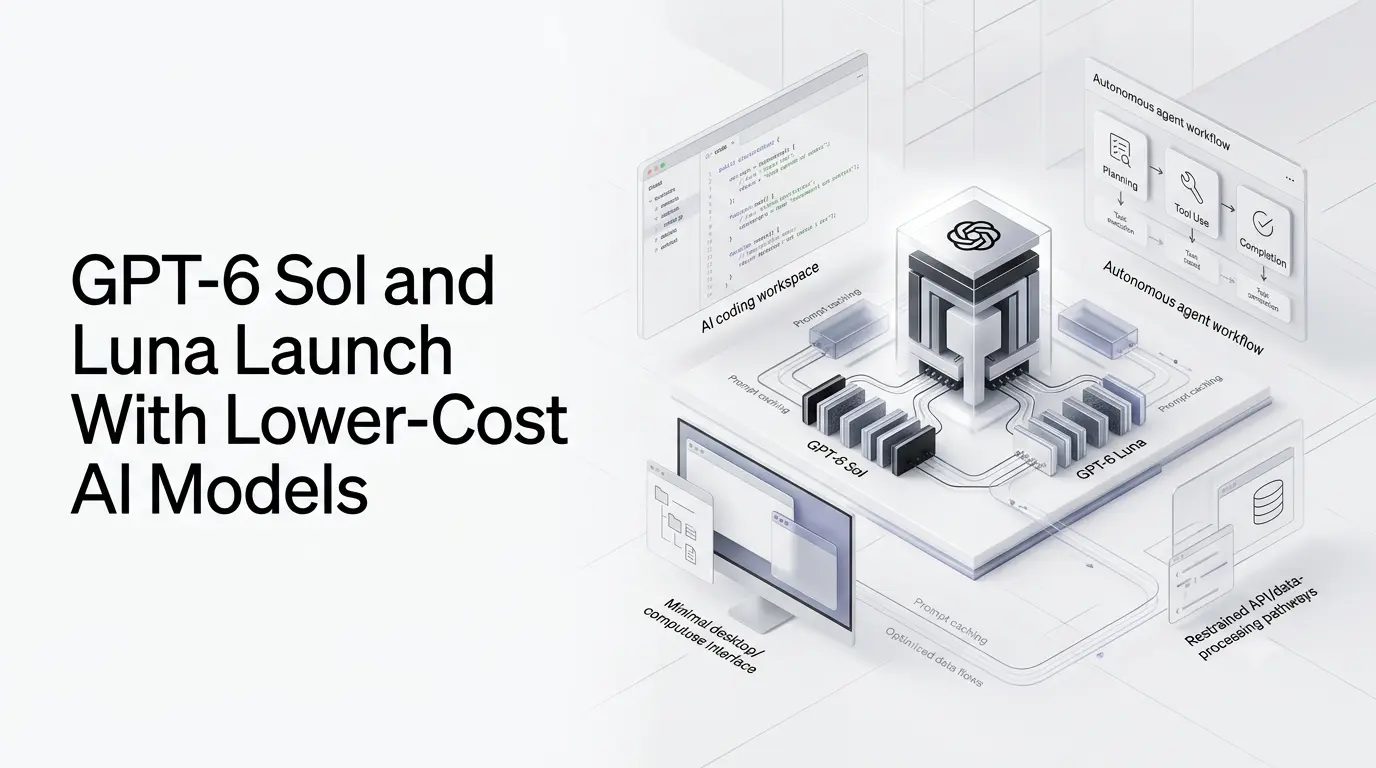
OpenAI has expanded its GPT-6 model family with GPT-6 Sol and GPT-6 Luna, two lower-cost models designed to bring capabilities from the company’s GPT-6 Astra system to more routine coding, professional and high-volume AI workloads. The models launched on September 22, 2026, with API pricing that OpenAI says is 50% lower than the promotional pricing for their GPT-5.6 counterparts.
The release gives developers a three-tier GPT-6 lineup: Astra remains OpenAI’s highest-capability model, while Sol targets complex coding and agentic workflows and Luna is positioned for faster, high-volume tasks. Both new models are also being introduced in ChatGPT Work and Codex, extending the GPT-6 family beyond the API.
Quick Summary
- GPT-6 Sol and GPT-6 Luna expand OpenAI’s GPT-6 model family beyond GPT-6 Astra.
- Sol targets more demanding coding, professional and agentic workloads.
- Luna focuses on fast, efficient and high-volume AI tasks.
- OpenAI introduced lower API pricing compared with GPT-5.6 promotional pricing.
- Both models benefit from improved inference efficiency and prompt caching.
- OpenAI also reports improvements in coding, factuality, computer use and alignment.
- The models are available through the API, with availability also expanding across ChatGPT Work and Codex.
What OpenAI Changed With GPT-6 Sol and Luna?
OpenAI says GPT-6 Sol and Luna were trained using methods similar to those behind GPT-6 Astra. The company has brought improvements in professional work, factuality, coding, computer use and alignment into models intended to operate at lower cost.
The distinction between the two models is primarily their intended workload.
GPT-6 Sol is designed for more demanding coding, professional and agentic tasks. OpenAI’s API documentation describes it as a model built for complex coding and agentic workflows. GPT-6 Luna, meanwhile, is described as OpenAI’s most efficient model for focused, high-volume tasks.
Both models support reasoning effort settings ranging from none through increasingly intensive modes, including max. They have a 1.05-million-token context window and support up to 128,000 output tokens through the API.
GPT-6 Sol and Luna API Pricing
Cost is one of the central parts of the release.
OpenAI lists standard API pricing of $2 per million input tokens and $10 per million output tokens for GPT-6 Sol. GPT-6 Luna costs $0.10 per million input tokens and $0.50 per million output tokens under the standard pricing tier. Cached input is priced substantially lower for both models.
| Model | Input / 1M tokens | Output / 1M tokens |
|---|---|---|
| GPT-5.6 Sol promotional | $4 | $20 |
| GPT-6 Sol | $2 | $10 |
| GPT-5.6 Luna promotional | $0.20 | $1.20 |
| GPT-6 Luna | $0.10 | $0.50 |
OpenAI characterizes the new Sol and Luna pricing as a 50% reduction compared with GPT-5.6 promotional pricing. The exact percentage reduction differs by individual input/output component—for example, Luna’s output price falls from $1.20 to $0.50—so the 50% figure should be understood as OpenAI’s headline comparison rather than a mathematical claim that every price component is exactly halved.
The company attributes the lower prices to improvements in inference efficiency and prompt caching. That is particularly relevant for AI agents, where the same context may be repeatedly supplied during long-running tasks.
GPT-6 Sol Targets Coding and Professional Work
OpenAI is positioning Sol as the more capable of the two new models for sustained professional workloads.
On the company’s reported AutomationBench evaluation, GPT-6 Sol at maximum reasoning effort scored 33.2%, compared with 30.3% for GPT-6 Astra at low effort and 26.9% for Claude Opus 5 at maximum effort. OpenAI also reports that Sol’s cost per task was substantially lower in those comparisons. These figures are company-reported benchmark results and should not be treated as independent overall rankings.
Coding is another major focus. OpenAI reports that GPT-6 Sol improved over GPT-5.6 Sol on FrontierCode, an evaluation designed to measure whether coding agents produce changes suitable for merging into real codebases.
On DeepSWE v1.1, OpenAI reports a 68.8% score for GPT-6 Sol at maximum effort, compared with 69.9% for Claude Fable 5 at its highest reported effort. OpenAI says Sol achieves this at approximately 80% lower cost per task in that comparison.
GPT-6 Luna is also positioned as capable of handling software-engineering workloads. OpenAI reports a 66.6% DeepSWE v1.1 score for Luna at maximum effort, while emphasizing its much lower cost per task compared with the models used in its comparison.
Factuality and Computer Use Also Improve
The new models are not limited to coding improvements.
OpenAI says GPT-6 Sol makes roughly half as many mistakes as GPT-5.6 Sol on an internal factuality evaluation based on de-identified conversations in which users had previously flagged factual errors. The company cautions that the evaluation is based on error-inducing conversations and is not representative of ordinary usage.
Computer use is another area where OpenAI reports improvements in cost efficiency. On OSWorld 2.0 offline, the company says GPT-6 Sol at xhigh effort achieved a 60.5% score, compared with 60.3% for Claude Opus 5 at medium effort, while costing approximately 80% less per task in the company’s comparison. OpenAI also reports that GPT-6 Luna at maximum effort can exceed GPT-5.6 Sol at medium effort at roughly one-tenth of the cost.
These results are particularly relevant to AI agents because coding agents and computer-use systems can consume large numbers of tokens over extended workflows. Lower inference costs can therefore affect the economics of deploying such systems, not just the price of individual API calls.
GPT-6 Gets More Efficient Prompt Caching
OpenAI is also changing how developers can manage repeated context.
The company says GPT-6’s prompt-caching system has been improved to increase cache hit rates and provide discounts of up to 90% on cached input-token reads. Developers can monitor cache performance, diagnose cache misses and establish explicit cache breakpoints.
OpenAI also says that developers can change reasoning effort and tool availability without breaking previously established cache context. This is particularly relevant to agents that repeatedly interact with the same project files, instructions or task state.
Alignment Improvements Carry Over From GPT-6 Astra
GPT-6 Sol and Luna also inherit parts of the alignment work introduced with Astra.
OpenAI reports improvements over the corresponding GPT-5.6 models in several challenging alignment evaluations, including tests involving misleading claims about completed coding work. The company stresses that these evaluations deliberately create difficult conditions and should not be interpreted as direct estimates of failure rates during normal use.
OpenAI’s deployment safety documentation separately classifies GPT-6 Sol and GPT-6 Luna as high capability in its cybersecurity and biological/chemical capability assessments, while saying neither model reaches its high threshold for AI self-improvement.
GPT-6 Sol and Luna Availability
GPT-6 Sol and GPT-6 Luna are available in ChatGPT Work and Codex for Plus, Pro, Business, Enterprise and Edu users. OpenAI says Free and Go users can access GPT-6 Luna through the desktop app. The models are not yet available in the regular ChatGPT Chat experience according to OpenAI’s launch announcement.
For developers, both models are available through the API as gpt-6-sol and gpt-6-luna. OpenAI’s API changelog confirms their September 22 release and lists their standard pricing.
The release expands GPT-6 beyond a single flagship model into a broader cost-and-capability lineup. Astra remains intended for the most demanding work, while GPT-6 Sol and Luna bring lower-cost reasoning, coding, computer-use and agent capabilities to workloads where the economics of running AI repeatedly can matter as much as peak model performance.
Also Read –
GPT-6 Astra: Features, Capabilities, Performance & What’s New?
Astra for Law: OpenAI Builds AI for Legal Work
OpenAI API: Models, Features, Pricing & How to Use It?
GPT-6 Explained: Everything to Know About OpenAI’s Next AI Model
Source
OpenAI – Introducing GPT-6 Sol and Luna
OpenAI API – September 2026 Changelog
OpenAI – ChatGPT Release Notes
OpenAI Deployment Safety Hub – GPT-6 Astra System Card