
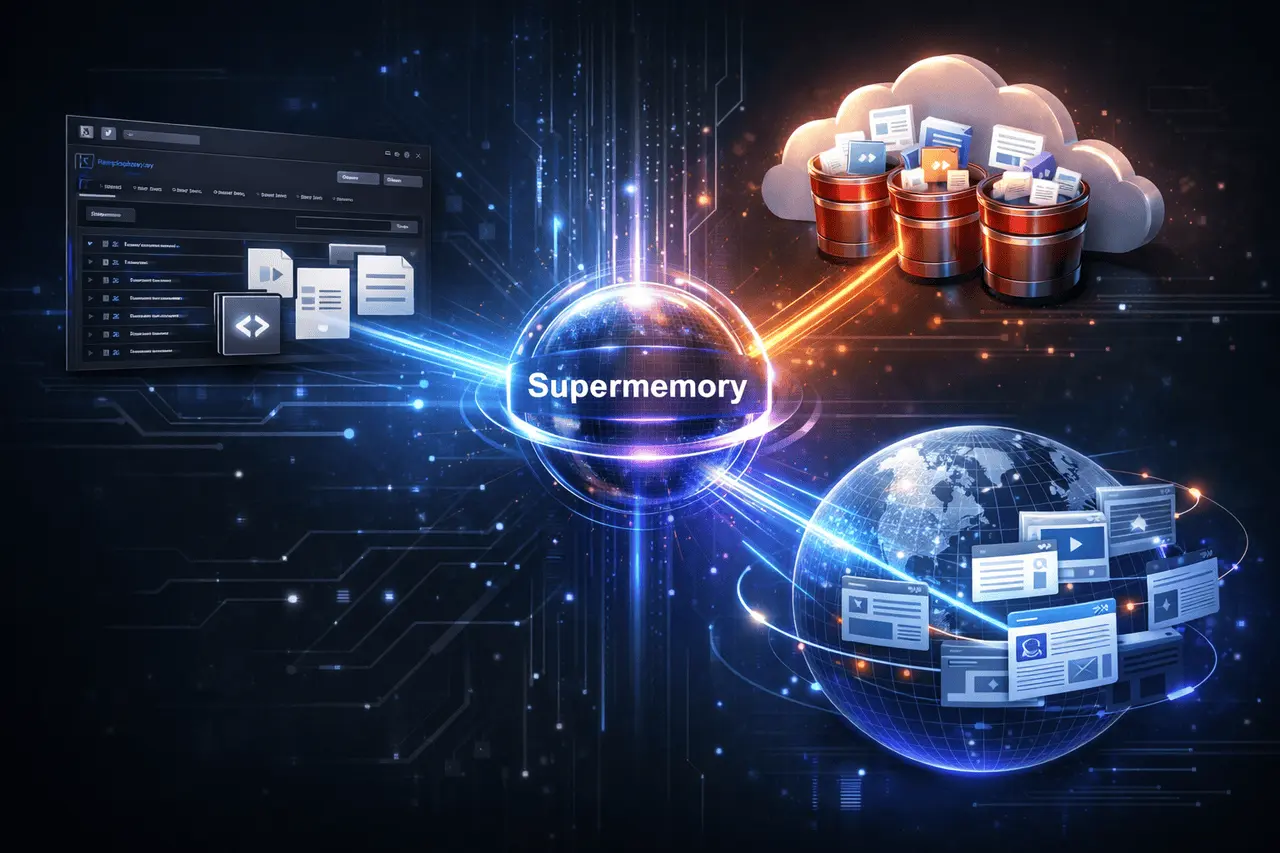
As companies increasingly depend on AI-powered assistants and unidirectional knowledge platforms, keeping information relevant, searchable and connected is vital. Supermemory, a memory API as well as a knowledge orchestration platform, has recently unveiled a collection of connectors that automatically transfer critical sources of data, such as GitHub repositories, AWS S3 buckets and complete websites, into the persistent layer of memory. These new connectors will help teams feed structured data into AI apps and databases, allowing quicker, more precise responses from chatbots as well as search interfaces.
This article describes SuperMemory Connectors, how each connector works, the reason this matters to AI, as well as enterprise workflows, and how integrating these connections can improve knowledge retrieval across various systems.
What Are Supermemory Connectors?
SuperMemory Connectors are the integrations that automatically import and synchronise data from other platforms to SuperMemory. Supermemory system. After connecting, the connectors will keep data up-to-date with no manual updates, making sure that memory graphs, a formatted depiction of knowledge stored, represent the latest versions of files, codes, websites, and other resources.
Connectors are particularly beneficial for experts, developers or AI-based system developers that require constant, reliable context linked to a variety of sources of data.
SuperMemory connectors: Key Features of the New Connectors
The most recent version of Supermemory introduces three necessary connectors:
1. GitHub Connector — Sync Repositories and Documentation
The GitHub connector is designed to connect Supermemory to at least one of the GitHub repositories. It can synchronise documents, files and other resources that are stored in the repositories and bring them into the Supermemory knowledge base.
How It Works:
- GitHub repositories are linked via OAuth and are monitored for any changes.
- If the documentation or updates to code are made, Supermemory captures the changes slowly.
- This real-time, or near-real-time sync will ensure that documentation, READMEs, design notes, and code comments are searchable and linked to the memory of the organisation.
Benefits:
- Documentation for internal use and engineering information is aligned with the production code.
- Helps to ensure continuity of knowledge for remote teams as well as onboarding and compliance workflows.
- Reduces manual document imports through automation of the synchronisation process.
It is especially beneficial for teams that structure technical information within the repository, such as developer guides, API documentation, or notes on architecture.
2. S3 Connector — Sync All Buckets in an S3 System
Supermemory’s S3 connector provides synchronisation features to storage objects such as AWS S3. Through this connector, all buckets in the S3 instance, which include assets, structured files, and unstructured content, are able to be integrated into the schema of Supermemory.
How It Works:
- Following authentication, Supermemory is able to access S3 buckets designated for it.
- The files within these buckets, including documents, images, logs, backups, and other data, are indexable and stored by memory object.
- Sync routines refresh the memory store when new objects are added or changed in the files. Are added to the.
Business Impact:
- Centralises enterprise data dispersed and stored in different S3 buckets.
- Allows AI assistants to refer to archives of documents, logs of operations, or rich media.
- Enhances the compliance of audit trail and metadata by keeping content in sync.
Cloud storage remains the primary repository for huge data assets within many companies. Through linking S3 with Supermemory, teams are able to unify the siloed data into a Knowledge graph that can be searched.
3. Web Crawler Connector, Index Websites for Instant Answers
The Web Crawler connects to the internet continuously and searches for specific websites and then ingests Web content into Supermemory’s searchable system. The crawler follows the standard indexing protocols and is created to keep the content of websites up-to-date for immediate retrieval.
How It Works:
- Users can specify a start URL or a list of URLs they want to crawl.
- The connector tracks links and indexes websites in accordance with guidelines for crawling as well as schedules.
- Content is processed and stored in memory graphs, which allows AI systems to address questions using the most recent internet data.
Benefits:
- Keeps corporate blogs up to date. Helps sites, documentation hubs and help hubs indexable.
- Improves AI chatbots by providing up-to-date and web-wide context.
- Allows for research tasks that require the web’s real-time knowledge.
The feature can be handy for applications for customer support and knowledge-based that rely on web resources to be up-to-date.
Why Syncing Data Matters for AI and Knowledge Platforms?
Modern AI systems are based on context and thoroughness. In the absence of timely updates and a wide coverage of data sources, AI responses can become outdated or incorrect. Connectors like these can solve one of the most significant architectural challenges:
- Automatic synchronisation: Removes manual export and import workflows that can be slow and error-prone.
- Relevance in real-time: Ensures that the most recent content is visible in search results or AI-based responses.
- Integration across platforms: Pulls different data sources, codes cloud storage websites, and other data sources into a central memory layer.
Through standardising the way data enters the AI memory graph, companies can use more competent assistants to develop more efficient internal search systems and ensure a single source of truth across all tools and departments.
Supermemory connectors: Practical Use Cases
Here are some scenarios in which Supermemory connectors provide tangible worth:
- Engineering Documentation: The team of developers makes use of GitHub to share code and specifications. Thanks to this GitHub connector being in place, the newest requirements and changelogs are kept in sync to allow AI-powered code reviews as well as internal chatbots for Q&A.
- Cloud Archive Search: Legal and compliance teams have to refer to archived documents and contracts that are stored on AWS S3. The S3 connector transforms that content into a single knowledge index.
- Knowledge Base of Customer Support: The support team utilises online resources and help articles. Web crawlers ensure that any changes to support websites are instantly reflected by AI-powered agents for support.
In every use case, the connectors will remove the need for manual uploads and make sure that users are searching with the most up-to-date, authoritative content.
Starting with Supermemory Connectors
The implementation of these connectors usually requires:
- Authorisation: Authorising Supermemory Access to other platforms using API keys or tokens secured.
- Modification: Selecting URLs, buckets, or repositories to consume.
- Monitoring and Maintenance: Monitoring sync logs and scheduling to ensure consistency in indexing.
Supermemory also offers API documentation for developers and developer documentation to help you set up connectors and automate health tests.
Final Thoughts
Supermemory’s launch to GitHub, S3, and Web Crawler connectors marks an essential step towards seamless knowledge synchronisation. Each connector tackles a specific data issue that is keeping documentation and code on the same page, unifying cloud-stored resources as well as maintaining current web content to provide instant responses.
Together, they decrease the manual effort, increase the reliability of data, and build the base that AI applications run on. For those working on AI-powered applications or internal knowledge bases and enterprise systems for search, connectors provide the ability to scale up and ensure that crucial information is always available and easily accessible. As AI adoption expands and data synchronisation is automated, solutions like this will soon become an essential feature rather than an option.
FAQs
1. What platforms can Supermemory connectors be synced with?
Supermemory connectors can be integrated with GitHub repositories, AWS S3 buckets and websites using crawlers. Other connectors (e.g., Google Drive, Notion) exist for more extensive sync needs.
2. When does the crawler refresh its indexed content?
A crawler will schedule periodic updates to ensure that the site’s content is up-to-date. The frequency of recrawls is determined by how the site is configured and also by how large the website is.
3. Are private repositories’ data supported?
Yes. If you have the correct OAuth tokens and authorisations, Private GitHub repositories can be synced to Supermemory.
4. Can I manually start a synchronisation?
Connectors generally allow manual sync commands as well as automated scheduling.
5. Do you think the S3 connector works with versions of objects?
The connector is able to ingest the most recent objects and handles version history, which is dependent on the S3 bucket configuration as well as Supermemory’s parsing requirements.
6. What is the security management process?
Connectors utilise authenticated APIs as well as tokens. Supermemory is a secure provider of data handling practices and permits limitations for every platform.
Also Read –
LFM2-2.6B-Exp: Strongest 3B AI Model Explained
Windsurf Wave 13 (Shipmas Edition): SWE-1.5 Free and Parallel AI Development