

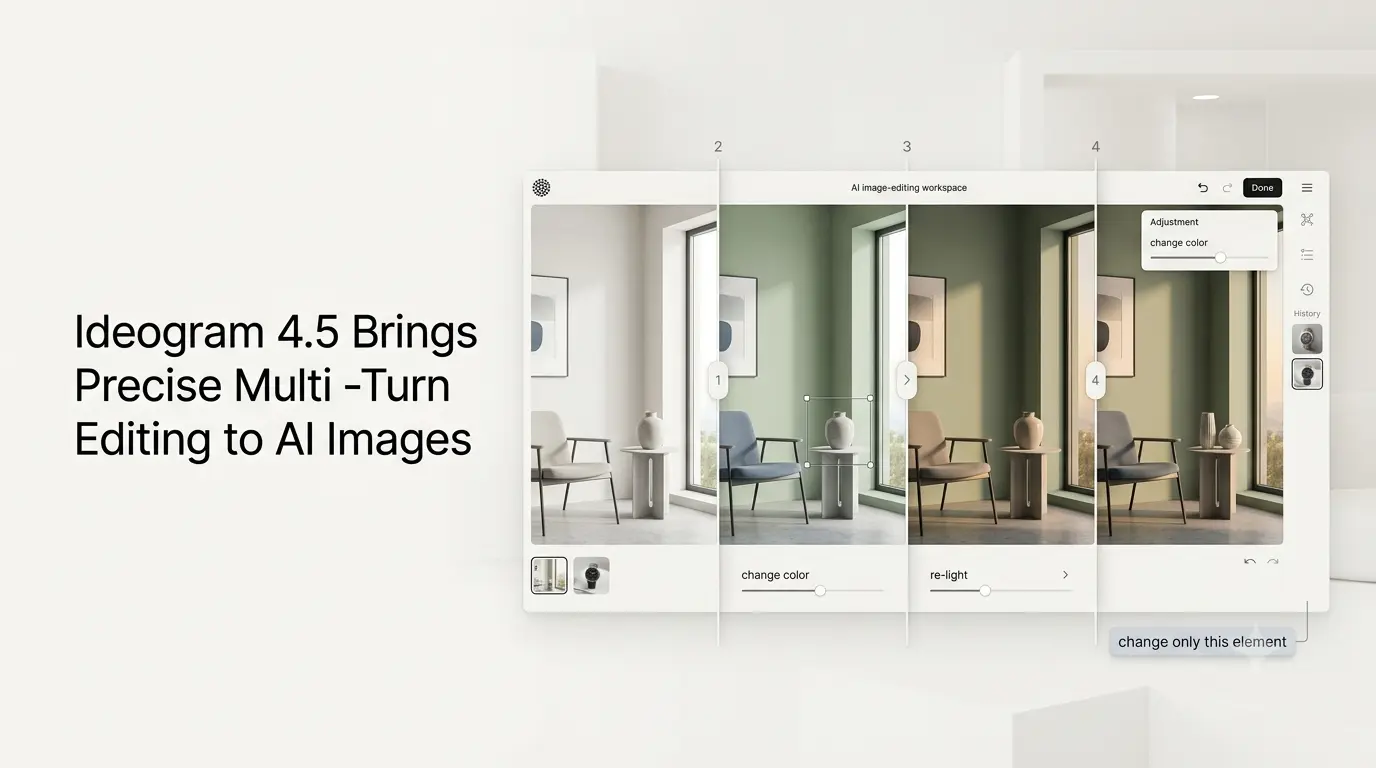
Ideogram has launched Ideogram 4.5, a new image-editing model designed to preserve an image’s existing details through repeated edits. The model is built around what Ideogram calls more precise editing, addressing a common problem in generative image workflows where successive changes can introduce pixel shifts, color changes and accumulating artifacts.
The model is now available through Ideogram and its API, with availability also extending to launch partners. Ideogram’s official model page positions 4.5 specifically around multi-turn editing, allowing users to make targeted changes while keeping the rest of an image stable.
That focus separates Ideogram 4.5 from a conventional text-to-image upgrade. Instead of primarily generating a new image from scratch, the model is designed for workflows in which an existing image is repeatedly refined.
Quick Summary
- Ideogram 4.5 is a new AI image-editing model focused on precise, multi-turn edits.
- It is designed to reduce visual drift and unwanted changes across successive edits.
- Users can modify colors, lighting, products, interiors, typography and restored photographs.
- The model supports editing at high resolutions while preserving image details.
- Its key differentiator is the ability to keep refining an image without progressively degrading the original composition.
- Ideogram also introduced editing workflows for more controlled image modifications through its platform and API.
What Is Ideogram 4.5?
Ideogram 4.5 is an AI image editing model focused on precision and consistency across multiple editing steps.
Ideogram says image models can introduce visual drift when an image is edited repeatedly. Details may shift, colors can change unintentionally and textures can accumulate artifacts. The company says 4.5 is designed to reduce that drift and preserve image details across multi-turn edits.
This makes the model particularly relevant to workflows where users need to change one part of an image without rebuilding the entire composition.
The official examples span several areas, including color and lighting adjustments, text modification, product photography, interior design, architecture, photo restoration, sketch-to-image conversion and style references.
Multi-Turn Editing Is the Main Focus
The central capability of Ideogram 4.5 is the ability to make a sequence of targeted changes while maintaining the underlying image.
For example, a user can change a product’s color, make another adjustment to its lighting and continue refining the image without intentionally changing unrelated elements.
Ideogram’s model page demonstrates this approach with colorway changes and lighting adjustments. The company says shadows, reflections and other surrounding details can be updated while the edited object and broader composition remain consistent.
This workflow is particularly relevant to commercial image creation, where maintaining the appearance of a product or a particular composition across multiple variations can be more important than simply generating a visually attractive image.
Product Images, Interiors and Architecture
Ideogram 4.5 is designed for more than general image retouching.
For product photography, Ideogram shows examples involving objects such as bags, kitchen equipment and other consumer products. The goal is to modify visual attributes while retaining the underlying product and composition.
The same approach extends to interior design. Users can start with a photograph of an existing room and modify furnishings, finishes or visual styles while preserving the architecture of the space.
Architecture is another featured use case. Ideogram’s examples show transformations of existing architectural imagery while retaining the underlying structure. This could make iterative visual exploration more practical than repeatedly generating an entirely new scene.
The distinction is important: the model is not simply being positioned as another image generator. Its core value is maintaining more of the source image while making controlled changes.
Text Editing and Translation
Ideogram has historically emphasized text rendering in generated images, and 4.5 extends that focus into image editing.
The model can modify stylized text within an existing design while preserving the surrounding visual composition. Ideogram’s examples also demonstrate translating text into another language while retaining the broader design.
This is particularly relevant for posters, signage, advertising layouts, packaging concepts and other graphics where text is an integral part of the image.
Instead of recreating the complete graphic after changing a phrase or language, the editing workflow is intended to allow the text itself to be modified.
Restoring Old Photos in Multiple Steps
Ideogram 4.5 also supports iterative restoration workflows.
The company’s examples include historical photographs that can be progressively repaired and enhanced. A restoration workflow can involve removing scratches or damage, adding color and then improving the image rather than asking the model to perform every transformation simultaneously.
This multi-step approach reflects the broader design goal behind 4.5: each edit can be treated as a separate operation instead of repeatedly regenerating the complete image.
For restoration work, that distinction can help users maintain greater control over the original image while progressively improving individual aspects.
Editing at High Resolution
Ideogram also highlights high-resolution editing as part of the 4.5 workflow.
The model’s official page shows an example involving a source image measuring 4,016 × 6,016 pixels, or 24.2 megapixels. Ideogram says 4.5 can edit high-resolution images without first downsizing them and can preserve the edges of an edited region so it can be integrated back into the original image.
That capability is particularly relevant to professional design and production workflows where the source image may eventually be used for large-format output rather than only viewed on a screen.
Ideogram 4.5 API and Availability
Ideogram 4.5 is available through the Ideogram platform and API, while the company has also announced availability through launch partners.
The launch material describes two primary editing workflows: Precise Edit, designed to preserve the source image outside the requested change, and Generate + Edit, which gives the model more freedom to reinterpret the image.
The precise-edit approach is particularly suited to chained modifications where maintaining the original image is important. Generate + Edit is intended for cases where the user wants more substantial transformation.
Ideogram’s current API pricing documentation separately confirms that its API supports image generation and editing, although the currently indexed general pricing page does not yet expose a dedicated Ideogram 4.5 pricing table.
Launch material from Ideogram lists four quality modes for 4.5, with pricing ranging from $0.008 to $0.22 per image and native 2K output. Because those figures are not currently displayed on the official 4.5 model page itself, they are best treated as launch pricing information and may change.
What Ideogram 4.5 Changes for AI Image Editing?
The significance of Ideogram 4.5 is less about generating another standalone image model and more about addressing a practical weakness in iterative AI image editing.
Generative image systems can produce strong individual outputs, but repeatedly modifying the same image can cause unwanted changes to elements that were not supposed to move. Ideogram is specifically targeting that problem with a model designed to preserve more of the existing image during successive edits.
That makes 4.5 particularly relevant to designers, marketers, product teams and creative professionals who need multiple controlled variations of an existing visual.
The launch also puts greater emphasis on image editing as an ongoing workflow rather than a single generation event. Users can start with an existing photograph, illustration or design and progressively modify it while attempting to preserve the elements they want to keep.
Ideogram has also said that open weights are coming, although the company has not yet published them on the official 4.5 model page at the time of publication.
For now, the defining feature of Ideogram 4.5 is its focus on precision: changing what the user asks to change while reducing unwanted changes elsewhere in the image. That makes multi-turn editing the central development behind this release, rather than simply another step in the progression of text-to-image generation.
Also Read –
Exa Agent Ultra Launches for Exhaustive Deep Research
Source
Ideogram 4.5: The most precise edit model