
AI agents need more than a powerful language model to operate effectively across multiple steps and interactions. They also need a way to retain relevant information, retrieve it when needed, and update what they know over time. This is where AI agent memory comes in.
AI agent memory is the collection of mechanisms that allow an agent to preserve and retrieve useful context from a current task or previous interactions. It can include conversation history, user preferences, past actions, successful workflows, instructions, facts, and lessons learned.
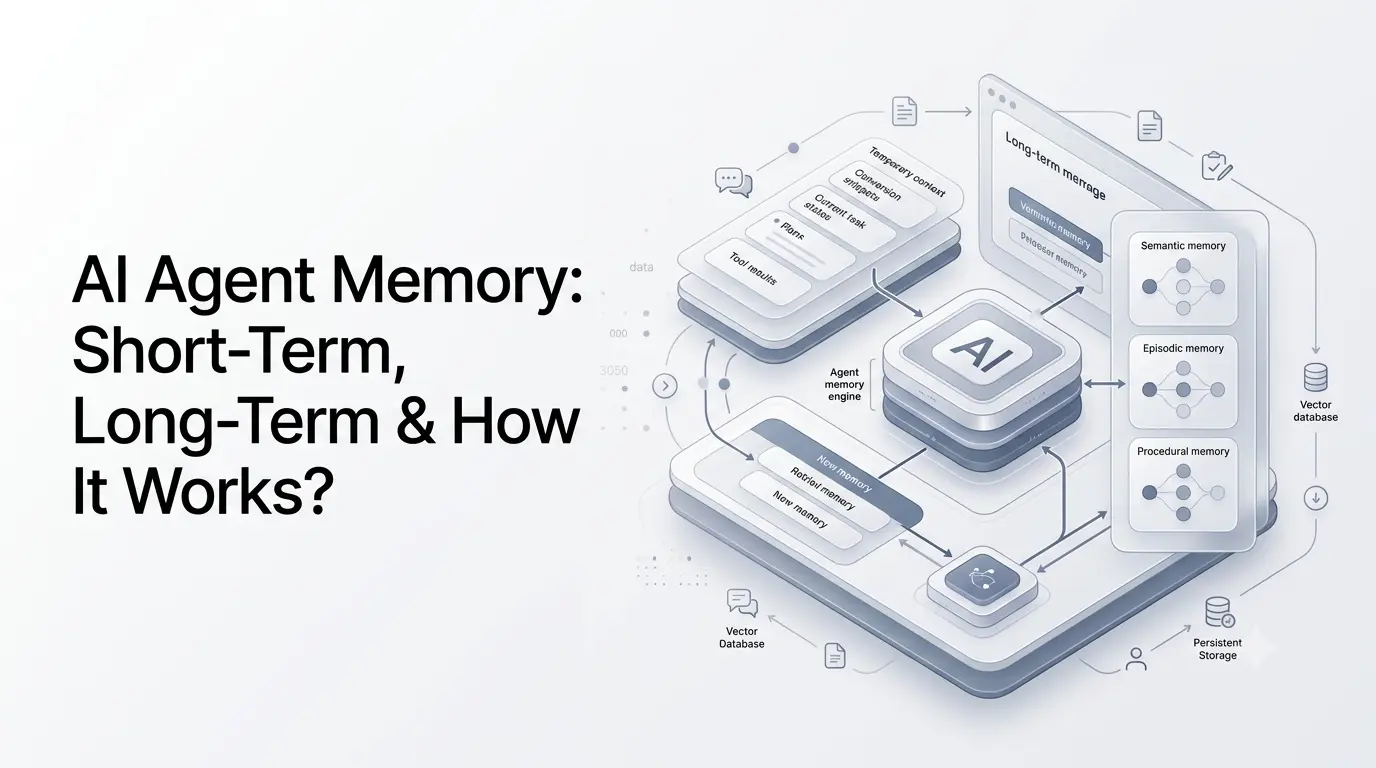
The simplest distinction is between short-term memory and long-term memory. Short-term memory manages the active task or conversation, while long-term memory preserves information that should remain useful across sessions. Modern agent architectures increasingly add more specialized forms of memory, including semantic, episodic, and procedural memory.
Quick Summary
- AI agent memory helps AI agents retain, retrieve, update, and use information across tasks and conversations.
- Short-term memory handles the current conversation, task state, plans, and temporary tool results.
- Long-term memory stores information across sessions, such as user preferences, facts, past experiences, and workflows.
- Long-term memory can be semantic, episodic, or procedural, depending on what the agent needs to remember.
- Context windows and memory are different: context is temporary model input, while memory provides persistent information when needed.
- Memory systems typically use databases, vector search, metadata, graphs, or hybrid storage for retrieval.
- Good memory architecture needs freshness, relevance, correction, privacy, security, and access control.
- AI agent memory can work alongside RAG, agent frameworks, and persistent sessions to support more capable and personalized agents.
What Is AI Agent Memory?
AI agent memory is the system that allows an AI agent to retain, retrieve, update, and use information beyond the immediate model response. It can maintain context during a task, remember information across conversations, and preserve useful lessons that influence future behavior.
A conventional LLM does not automatically have human-like memory. An application has to decide what information to retain, where to store it, when to retrieve it, and how much of it to place back into the model’s context.
A practical AI agent memory system typically contains several stages:
Experience → memory extraction → storage → retrieval → context assembly → agent action → new experience
For example, imagine a research agent that learns that a particular user prefers primary sources over third-party articles.
The agent could:
- Detect that preference during an interaction.
- Extract it as a potentially useful memory.
- Store it under the user’s memory namespace.
- Retrieve it during a future research task.
- Include it in the agent’s working context.
- Use primary sources more heavily in the new task.
This is different from simply saving the entire conversation transcript. A transcript is historical evidence; a memory is information that has been selected or transformed so the agent can use it later. LangChain makes this distinction explicitly: traces become memory when useful information is extracted into something the agent can retrieve and use on a later run.
Why Do AI Agents Need Memory?
Without memory, an agent may repeatedly rediscover the same information, forget user preferences, repeat mistakes, or lose progress between sessions.
Memory becomes particularly important when an agent performs tasks over long periods.
Common examples include:
- Personal AI assistants
- Coding agents
- Research agents
- Customer-support agents
- Sales agents
- Scheduling assistants
- Autonomous workflows
- Multi-agent systems
- Long-running enterprise agents
Consider a coding agent working with the same software project over several weeks.
Without persistent memory, it may repeatedly need to rediscover:
- Project conventions
- Preferred libraries
- Deployment procedures
- Previous fixes
- Known bugs
- User preferences
- Decisions made earlier
With an appropriate memory architecture, those lessons can become reusable context.
OpenAI’s current Agents SDK, for example, provides session-based memory for maintaining conversation history across agent runs, while its sandbox memory capabilities can preserve lessons from previous runs separately from conversational history.
How Does AI Agent Memory Work?
A typical memory architecture has two broad layers:
Short-term or working memory handles the current task.
Long-term memory stores information that should survive beyond the current interaction.
A simplified workflow looks like this:
User request
     ↓
Current task / working memory
     ↓
Agent reasoning + tools
     ↓
New information and outcomes
     ↓
Memory extraction
     ↓
Long-term memory store
     ↓
Future retrieval
     ↓
Working memory
The important point is that long-term memory does not usually mean putting the entire historical record into every prompt.
Instead, the system retrieves the information that is relevant to the current task.
Step 1: Capture experience
The agent generates a trace containing information such as:
- User messages
- Agent responses
- Tool calls
- Tool results
- Retrieved documents
- Actions
- Errors
- Outcomes
- User feedback
This trace becomes the raw material from which useful memories can be extracted.
Step 2: Decide what is worth remembering
Not everything should become memory.
A good system may identify:
- Stable user preferences
- Important facts
- Repeated instructions
- Successful strategies
- Failed approaches
- Project decisions
- Workflow rules
- Important relationships between entities
For example:
“The user prefers official documentation when researching AI products.”
could be useful long-term memory.
By contrast:
“The user asked about the weather on Tuesday.”
Usually has little value beyond that interaction.
Step 3: Store the memory
The extracted information can be stored in different forms.
Common storage options include:
- Relational databases
- Document stores
- Key-value stores
- Vector databases
- Graph databases
- Files
- Hybrid memory systems
There is no universal requirement to use a vector database. Vector retrieval is useful for semantic search, but graph or hybrid approaches can be better when relationships and temporal information matter.
Step 4: Retrieve relevant memories
When a new task arrives, the system searches its memory for information related to the current request.
Retrieval can use:
- Semantic similarity
- Keywords
- Metadata
- User ID
- Time
- Recency
- Task type
- Project
- Relationships
- Explicit memory categories
The result is a smaller collection of relevant information rather than the entire memory database.
Step 5: Inject memory into the agent’s context
The retrieved memories are then assembled into the context available to the model.
For example:
Current request:
"Research the latest AI search APIs."

Relevant memory:
- User prefers official sources.
- User wants concise technical comparisons.
- User is researching AI developer tools.
The model can now adapt its behavior without being given the entire history of every previous conversation.
Step 6: Update memory after the task
The task can produce new information.
The system can determine whether that information should:
- Create a new memory
- Update an existing memory
- Replace an outdated memory
- Merge with another memory
- Be discarded
- Remain only in the historical trace
This read-and-write cycle is central to persistent agent memory.
Short-Term vs Long-Term Memory in AI Agents
The distinction between short-term and long-term memory is one of the most important concepts in agent architecture.
| Feature | Short-Term Memory | Long-Term Memory |
|---|---|---|
| Scope | Current task or thread | Across sessions and tasks |
| Purpose | Maintain active context | Preserve reusable information |
| Typical data | Messages, tool results, plans | Preferences, facts, skills, past outcomes |
| Duration | Temporary or thread-scoped | Persistent |
| Retrieval | Usually automatically available | Usually selectively retrieved |
| Storage | Context/checkpoint/session | Database, files, vector store, memory service |
| Main challenge | Context size and relevance | Retrieval quality and stale information |
LangGraph similarly describes short-term memory as thread-scoped state and long-term memory as information that persists across conversations.
What Is Short-Term Memory in AI Agents?
Short-term memory, also called working memory, is the information an agent needs while completing the current task or conversation.
It can include:
- Recent messages
- Current instructions
- Tool results
- Current plan
- Intermediate outputs
- Retrieved documents
- Temporary files
- Current task state
- Previous actions in the same workflow
It is similar to the agent’s active workspace.
OpenAI’s Agents SDK provides session memory that automatically maintains conversation history for a specific session. LangGraph uses checkpointing to preserve state within an agent thread.
Example of short-term memory
Suppose an agent is asked:
“Find five AI search companies, compare their APIs, and summarize their pricing.”
During that task, its working memory might contain:
- The original request
- Companies already discovered
- Search results
- API documentation
- Pricing information
- Comparison criteria
- Intermediate findings
Once the task ends, most of this information may no longer need to persist.
What Is Long-Term Memory in AI Agents?
Long-term memory stores information that remains useful beyond the current conversation or task.
Examples include:
- User preferences
- Personal facts
- Project information
- Repeated instructions
- Successful workflows
- Past decisions
- Skills
- Policies
- Important historical events
LangGraph’s long-term memory implementation, for example, provides persistent storage that can be searched across conversation threads.
Mem0 similarly describes persistent memory as a layer that allows agents to retain information across sessions rather than relying solely on temporary context.
Example of long-term memory
An agent may learn:
“This user prefers official documentation as the primary source when researching AI companies.”
A month later, the user asks about a completely different AI company.
That preference can still influence the new research task.
Types of Long-Term Memory for AI Agents
Long-term memory is often divided into several categories.
One commonly used framework separates memory into semantic, episodic, and procedural forms. LangChain uses these categories when discussing modern agent memory architectures.
Semantic Memory
Semantic memory contains information the agent knows.
Examples:
- User preferences
- Facts
- Definitions
- Project information
- Stable relationships
- Domain knowledge
For example:
“The user’s website focuses on AI and technology.”
This is a factual memory that can be reused across tasks.
Episodic Memory
Episodic memory captures experiences.
It answers questions such as:
- What happened?
- What did the agent do?
- What worked?
- What failed?
- What happened in a previous task?
For example:
“The previous deployment failed because the environment variable was missing.”
That experience can help the agent avoid repeating the same mistake.
Procedural Memory
Procedural memory stores information about how the agent should behave or perform a task.
Examples:
- Workflow rules
- Tool-use instructions
- Formatting rules
- Policies
- Skills
- Preferred procedures
For example:
“When researching AI products, verify pricing against the official pricing page before publishing.”
Procedural memory can be particularly valuable because it changes how the agent performs future tasks. LangChain notes that many practical improvements in agent behavior come from procedural memory.
What Is Working Memory?
Working memory is sometimes used interchangeably with short-term memory, but the concept can be more specific.
It represents the information the agent is actively using to solve the current problem.
For a research agent, working memory might contain:
Goal
↓
Research plan
↓
Search results
↓
Important evidence
↓
Intermediate conclusions
↓
Next action
Working memory should generally remain relatively focused.
A common architectural mistake is treating the entire context window as memory. A context window is a capacity limit for information supplied to a model during a particular inference process. Memory is an application-level mechanism for deciding what information should persist and what should be retrieved later.
Mem0 makes this distinction explicitly: working memory is the active workspace, while long-term memory performs the cross-session storage and retrieval work.
AI Agent Memory vs Context Window
These concepts are related but not identical.
| Concept | Context Window | Agent Memory |
|---|---|---|
| What it is | Model input capacity | Persistence and retrieval system |
| Duration | Usually tied to a model request/session | Can span sessions |
| Stores everything? | Potentially whatever is supplied | Usually selected information |
| Retrieval | Context must be assembled | Memory system retrieves relevant data |
| Main limitation | Token capacity | Storage, retrieval and relevance |
| Primary role | Give model information now | Help agent remember information later |
A larger context window can reduce some memory-management problems, but it does not automatically create useful long-term memory.
An agent could have access to a million-token context window and still fail to remember a user’s important preference in a later conversation if that preference was never persisted and retrieved.
AI Agent Memory vs RAG
Agent memory and retrieval-augmented generation (RAG) can look similar because both retrieve information before an LLM generates an answer.
The difference is usually in where the information comes from and why it is being retrieved.
RAG commonly retrieves information from an external knowledge source such as:
- Company documents
- Manuals
- Websites
- PDFs
- Databases
- Knowledge bases
Agent memory typically captures information produced or learned through the agent’s interactions and activities.
LangChain describes this distinction in terms of how the information is acquired and what information is prioritized.
However, the boundaries are not absolute.
A production agent can combine both:
User
 ↓
Agent
 ├── Long-term memory
 ├── RAG knowledge base
 ├── Web search
 ├── Tools
 └── Current working memory
This combined approach is increasingly common in sophisticated agent systems.
How Is AI Agent Memory Stored?
There is no single storage technology that defines agent memory.
Vector Databases
Vector databases store embeddings and support semantic similarity searches.
They are useful when an agent needs to retrieve memories based on meaning rather than exact wording.
For example:
“The customer likes concise reports.”
can potentially be retrieved when the new request says:
“Keep the market analysis brief.”
Relational Databases
Traditional databases are useful for structured memory.
For example:
| User | Preference | Updated |
|---|---|---|
| User A | Concise responses | 2026-09-20 |
| User A | Primary sources | 2026-09-22 |
Relational storage can be especially useful when memory needs strong consistency, filtering, permissions, or structured updates.
Document and File-Based Memory
Some agents use files or documents as persistent memory.
OpenAI’s current sandbox memory system, for example, stores memory artifacts in a workspace and can progressively retrieve relevant information rather than injecting everything into every run.
LangChain has also explored file-based “wiki memory,” where raw source material is transformed into a compact, persistent knowledge layer that an agent can read.
Graph Memory
Graph-based systems represent relationships between entities.
For example:
User
 ├── works_on → Project A
 │                 ├── uses → Python
 │                 └── uses → PostgreSQL
 └── prefers → concise reports
This can be useful when relationships matter as much as individual facts.
What Is Memory Retrieval?
Memory retrieval is the process of finding the information most relevant to the current task.
A basic retrieval pipeline might look like:
Query → embedding → similarity search → metadata filtering → reranking → context assembly
More advanced systems can incorporate:
- Recency
- Importance
- Frequency
- User identity
- Task relevance
- Temporal validity
- Source reliability
- Memory type
The goal is not to retrieve the maximum number of memories.
The goal is to retrieve the right memories.
This becomes increasingly important as an agent’s memory grows.
Why Memory Retrieval Is Difficult?
More memory does not automatically mean a smarter agent.
A memory system can fail in several ways.
Too little memory
The agent forgets useful information.
Too much memory
The model receives unnecessary context and may lose focus.
Wrong memory
The retrieval system returns information that looks similar but is not relevant.
Outdated memory
The information was once correct but is no longer true.
Conflicting memory
Two memories contain different versions of the same fact.
Incorrect memory
The agent previously generated or extracted something that was wrong.
These problems make memory maintenance as important as memory storage.
Memory Decay and Stale Information
One of the emerging challenges in AI agent memory is memory freshness.
Suppose an agent remembers:
“The user works in Company A.”
Six months later, the user changes jobs.
If the memory system continues treating the old information as current, it can produce incorrect behavior.
Recent memory systems are therefore experimenting with techniques such as:
- Recency-aware retrieval
- Memory decay
- Temporal reasoning
- Superseding outdated facts
- Memory consolidation
- Background cleanup
Mem0 introduced memory decay in 2026 to give recently accessed memories a ranking boost while allowing older memories to remain retrievable when relevant.
It also introduced temporal reasoning so agents can distinguish between information that was true in the past and information that is currently true.
Memory Consolidation
Long-running agents can accumulate thousands or millions of events.
Storing everything separately can make retrieval noisy.
Memory consolidation attempts to transform many low-level experiences into more useful higher-level memories.
For example:
10 separate conversations
        ↓
Repeated observations
        ↓
Pattern detected
        ↓
One consolidated memory
An agent might initially record:
- User requested concise reports.
- User removed unnecessary background.
- User preferred tables.
- User asked for shorter introductions.
The system could consolidate those observations into:
“User prefers concise, information-dense reports with tables where useful.”
Mem0’s 2026 Dream system, for example, describes background memory consolidation that merges duplicates, marks outdated facts as superseded, and summarizes recurring behavior.
Memory Compaction
Another technique is compaction.
Instead of keeping every message and tool result indefinitely, the system can summarize older information into a smaller representation.
For example:
100 messages
      ↓
Conversation summary
      ↓
10,000 tokens → 1,000 tokens
The summary preserves important context while reducing the amount of information that must be supplied to the model.
OpenAI’s Agents SDK currently supports session compaction mechanisms for long conversations, while still allowing the underlying session history to be stored separately.
Compaction is especially useful when conversations become too large for efficient context processing.
How AI Agents Learn From Past Mistakes?
Memory becomes more useful when it captures lessons, not just events.
Consider an agent that repeatedly calls an API incorrectly.
A basic log might record:
API request failed.
A more useful memory could be:
“This API requires the
organization_idfield before authentication succeeds.”
The second representation can directly influence future behavior.
A memory-learning loop can therefore look like:
Action → outcome → evaluation → lesson → memory → future action
This is one reason procedural and episodic memory are important in agent systems.
AI Agent Memory in Multi-Agent Systems
Memory becomes more complicated when multiple agents collaborate.
Imagine a system containing:
- Research agent
- Coding agent
- Planning agent
- Review agent
They may need different memories.
A research agent may need research findings.
A coding agent may need project conventions.
A review agent may need quality rules.
Some memories can be shared globally, while others should remain private to a user, project, or agent.
This creates several possible scopes:
| Memory scope | Example |
|---|---|
| Agent-specific | Coding agent’s tool workflow |
| User-specific | User preferences |
| Project-specific | Project architecture |
| Team-specific | Company policies |
| Global | General operating rules |
LangMem, for example, uses namespaces to isolate memories by user, application route, team, or other scopes.
Privacy and Security in AI Agent Memory
Persistent memory introduces a major responsibility: the system is storing information about users and their interactions.
Potential risks include:
- Sensitive information being stored unnecessarily
- One user’s memory being exposed to another
- Incorrect information becoming persistent
- Prompt injection entering memory
- Unauthorized memory modification
- Data-retention problems
- Difficulty deleting information
- Cross-agent memory leakage
A production memory architecture should therefore consider:
- User and tenant isolation
- Access controls
- Encryption
- Retention periods
- Deletion mechanisms
- Audit logs
- Memory provenance
- Consent
- Sensitive-data filtering
- Memory-update authorization
OpenAI’s Agents SDK currently includes an encrypted-session option with encryption and TTL-based expiration, illustrating how persistence and security can be addressed together.
Popular AI Agent Memory Approaches
Several approaches are being used in current agent-development frameworks.
1. LangGraph
LangGraph separates thread-level short-term memory from long-term persistent memory and provides storage primitives for cross-thread retrieval.
2. OpenAI Agents SDK
OpenAI’s Agents SDK provides Sessions for conversation history and separate sandbox Memory functionality for reusable lessons across runs.
3. Mem0
Mem0 provides a dedicated memory layer for AI applications, including persistent memory, semantic retrieval, memory extraction, temporal reasoning, and memory-management features.
4. File-Based Memory
Agents can also maintain structured Markdown or other documents that summarize preferences, project information, procedures, and past work. LangChain’s recent work on wiki memory is an example of this approach.
No single approach is universally best. The appropriate design depends on the agent’s task, memory volume, privacy requirements, latency requirements, and retrieval patterns.
A Simple AI Agent Memory Architecture
A practical architecture for a personal AI assistant could look like this:
                    ┌─────────────────┐
                    │   User Request  │
                    └────────┬────────┘
                             ↓
                    ┌─────────────────┐
                    │  Agent / LLM    │
                    └────────┬────────┘
                             ↓
             ┌───────────────┴───────────────┐
             ↓                               ↓
     Working Memory                   Long-Term Memory
   Current conversation             Preferences / facts
   Current task                     Past experiences
   Tool results                     Procedures / skills
   Current plan                     Project information
             ↓                               ↑
             └──────────→ Retrieval ─────────┘
                             ↑
                             │
                     Memory Extraction
                             ↑
                         Past Trace
The key architectural principle is separation.
Working memory should handle what the agent needs now.
Long-term memory should preserve what the agent may need later.
Practical Example: AI Personal Assistant
Consider an AI assistant used every day by the same person.
First interaction
User:
“I prefer concise emails and don’t want unnecessary greetings.”
The system may extract:
Procedural/user preference memory: concise emails; minimal greetings.
Second interaction
The user asks:
“Draft an email to a client.”
The memory system retrieves the preference and provides it to the agent.
The agent generates a concise email without an unnecessary introduction.
Later interaction
The user says:
“Actually, for legal emails, use a more formal tone.”
The system should not simply add another contradictory memory.
It should update or scope the existing preference:
General email style:
Concise, minimal greetings

Legal email style:
More formal
This illustrates why memory needs scope, retrieval, and updating, not just storage.
Best Practices for Building AI Agent Memory
A reliable memory system should be designed around relevance rather than maximum retention.
1. Store selectively
Do not save every conversation message as permanent memory.
2. Separate temporary state from durable memory
Keep task-specific working state separate from cross-session information.
3. Give memories a scope
A memory may belong to:
- One user
- One project
- One organization
- One agent
- All agents
4. Track freshness
Time-sensitive information should carry timestamps or validity information.
5. Allow memory correction
Users and agents should be able to update or delete incorrect memories.
6. Retrieve selectively
More context is not necessarily better context.
7. Protect sensitive data
Memory stores can contain more sensitive information than ordinary application logs.
8. Evaluate memory separately
Test whether the agent:
- Remembers the right information
- Ignores irrelevant memories
- Updates outdated information
- Handles conflicting memories
- Respects memory boundaries
9. Preserve provenance where possible
Knowing where a memory came from makes it easier to evaluate and correct.
10. Avoid treating memory as truth
A stored memory is still data that can be wrong, outdated, or misunderstood.
What Is the Future of AI Agent Memory?
Agent memory is moving beyond the simple idea of “remember previous messages.”
Current research and product development are exploring:
- Automatic memory extraction
- Memory consolidation
- Temporal reasoning
- Memory decay
- Multimodal memory
- Cross-agent memory
- Procedural learning
- Personalized memory
- Memory evaluation benchmarks
- More efficient retrieval
- Background memory processing
- Knowledge synthesis
A recent survey of agent memory research argues that the traditional short-term/long-term distinction is no longer enough to describe modern systems. It proposes looking at memory through its forms, functions, and dynamics, including token-level, parametric, and latent memory as well as factual, experiential, and working memory.
This suggests that future agent systems may treat memory as a more fundamental architectural component rather than an optional database attached to a chatbot.
Conclusion
AI agent memory is the layer that turns an agent from a system that reacts to the current prompt into one that can preserve useful information across tasks and interactions.
Short-term memory keeps the agent focused on its current work. Long-term memory preserves information that remains useful later. Within long-term memory, semantic, episodic, and procedural approaches help distinguish facts, experiences, and behavioral rules.
The difficult part is not simply storing more information. A production-quality memory system must decide what to remember, when to retrieve it, how to update it, when information has become stale, and who is allowed to access it.
As agent systems become more persistent and autonomous, memory is becoming an important part of the underlying architecture. Current work across frameworks such as LangGraph, OpenAI Agents SDK, and dedicated memory platforms such as Mem0 shows that the field is moving toward more selective, structured, temporal, and efficient memory rather than simply retaining complete conversation histories.
Frequently Asked Questions
1. What is AI agent memory?
AI agent memory is the mechanism that allows an AI agent to retain, retrieve, update, and use information across tasks or conversations. It can include short-term working context, long-term facts, user preferences, past experiences, and procedural instructions.
2. What is the difference between short-term and long-term memory in AI agents?
Short-term memory contains information needed during the current conversation or task, such as messages, plans, and tool results. Long-term memory persists beyond the current session and can contain preferences, facts, experiences, workflows, and other reusable information.
3. Is a context window the same as AI agent memory?
No. A context window is the amount of information a model can process in a particular request. Agent memory is an application-level system that decides what information to preserve and retrieve for future tasks.
4. Does AI agent memory require a vector database?
No. Vector databases are common for semantic retrieval, but agent memory can also use relational databases, document stores, files, graph databases, or hybrid architectures. The appropriate choice depends on the type of information and retrieval requirements.
5. What are semantic, episodic and procedural memory?
Semantic memory stores facts and preferences, episodic memory stores experiences and outcomes, and procedural memory stores instructions, workflows, skills, and rules for how an agent should behave.
6. Can AI agent memory become outdated?
Yes. Persistent memory can become stale when circumstances change. Modern memory systems are therefore exploring techniques such as recency-aware retrieval, temporal reasoning, superseding outdated facts, and memory decay.
Also Read
Grok Bot Galaxy: xAI to Livestream Product Build With AI Agents
Qwen Intelligence Brings Three AI Agents to Smartphones