

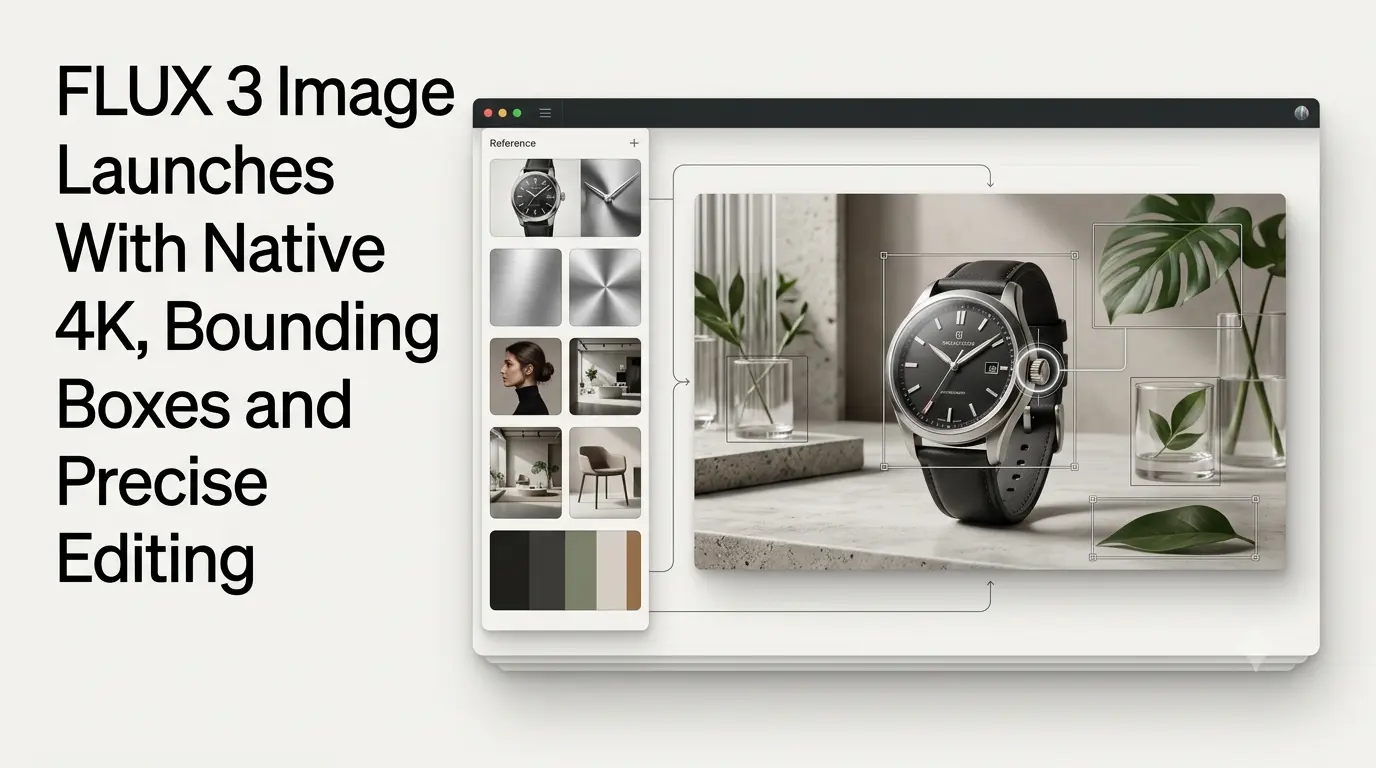
Black Forest Labs has launched FLUX 3 Image, an image-generation and editing model built on the company’s multimodal FLUX 3 foundation. The model combines text-to-image and image-to-image generation with native 2K and 4K output, bounding-box-based composition, multi-reference generation and targeted editing designed to preserve untouched parts of an image.
The release gives creators more direct control over image composition than conventional prompt-only generation. Users can define where individual elements should appear, provide as many as 10 reference images and make localized changes across successive editing passes.
Quick Summary
- Black Forest Labs launched FLUX 3 Image, adding a dedicated image-generation and editing model to the FLUX 3 family.
- The model supports native 2K and 4K image generation.
- Users can provide up to 10 reference images for generation and editing.
- Bounding-box controls provide more precise control over where elements appear in an image.
- FLUX 3 Image focuses heavily on localized, multi-step image editing while preserving other parts of the composition.
- Companies can access commercial weights for private deployment and fine-tuning.
- API access is currently promoted at 50% off through October 8, 2026, according to current launch reporting.
- An open-weight version is expected in the coming weeks, although a specific release date has not been established.
What Is FLUX 3 Image?
FLUX 3 Image is the image-focused component of Black Forest Labs’ broader FLUX 3 model family.
BFL introduced FLUX 3 in July 2026 as a multimodal foundation model designed to work across images, video, audio and action-related capabilities. FLUX 3 Image brings that foundation to image synthesis and editing.
The model is designed for both conventional text-to-image workflows and more structured production tasks where positioning, references and localized modifications matter.
Key capabilities include:
- Native 2K and 4K image generation
- Text-to-image generation
- Image-to-image generation and editing
- Bounding-box composition
- Up to 10 reference images
- Targeted, multi-turn image editing
- Detailed text rendering
- Commercial weights for eligible companies
FLUX 3 Image Adds Bounding-Box Control
One of the most distinctive features is the ability to use bounding boxes to control image composition.
Instead of describing an entire scene only through natural-language prompts, users can define boxes for individual elements. The model then generates those elements within their specified areas.
The system uses a coordinate grid from 0 to 1000 across the image. Users can describe what should appear inside each region while separately providing a description of the overall scene.
This approach is particularly useful for compositions where relative positioning matters.
Examples include:
- Product advertisements
- Editorial layouts
- Posters and graphic designs
- Character positioning
- Multi-object scenes
- Collages
- Images requiring reserved areas for text
The model can also work without manually drawing boxes. BFL says an agent can generate a layout plan from a simple request, producing the element descriptions and coordinates before generation.
FLUX 3 Image Supports Up to 10 References
FLUX 3 Image can combine up to 10 reference images into a single composition.
Rather than treating every reference as an independent generation, the system uses the references as elements of a larger visual composition. BFL’s interface assigns each reference an identifier, which can then be incorporated into the generation instructions.
This could be useful for workflows that require several visual sources to appear consistently within one scene.
For example, a creative team could provide separate references for clothing, products, locations, accessories or characters and ask the model to combine them into a single composition.
The approach is intended to reduce the amount of manual compositing required after generation.
Pixel-Precise Editing Is a Major Focus
FLUX 3 Image also emphasizes localized editing.
BFL describes a workflow in which users can modify a particular area while preserving the rest of the image. Multiple targeted changes can be performed across editing rounds without requiring the entire composition to be recreated from scratch.
This is important for professional image workflows because generative editing can otherwise introduce unwanted changes to areas that were already correct.
The model’s editing system is therefore designed around a simple principle: change the specified element while maintaining the surrounding composition.
That can be particularly valuable for product photography, advertising creatives, editorial graphics and other assets that require repeated revisions.
Native 4K Generation Preserves Fine Details
FLUX 3 Image supports native 2K and 4K generation.
Black Forest Labs showcases a 4K output measuring 5,456 × 3,072 pixels, equivalent to roughly 16.8 megapixels.
Native high-resolution generation can be useful when images need to retain small details during cropping, printing or close inspection.
BFL specifically highlights preservation of details such as textures, faces, colors and small elements at higher resolutions.
This makes the model relevant beyond social-media-sized images, particularly for professional creative workflows where source resolution matters.
How FLUX 3 Image Differs From Prompt-Only Image Generation?
Traditional text-to-image systems primarily depend on a natural-language prompt to determine the position and relationship of objects.
That approach can work well for general scenes but becomes less predictable when users need precise spatial arrangements.
FLUX 3 Image adds an explicit layout layer.
| Capability | Conventional prompt workflow | FLUX 3 Image |
|---|---|---|
| Text-to-image | Yes | Yes |
| Image editing | Available on many models | Yes |
| Spatial layout control | Primarily prompt-based | Bounding boxes |
| Reference images | Varies by model | Up to 10 |
| Native 4K | Varies | Yes |
| Localized editing | Varies | Core capability |
| Commercial weights | Model-dependent | Available under commercial license |
The difference is particularly relevant for production environments where an image needs to follow a predefined composition rather than simply look aesthetically similar to a prompt.
Commercial Weights Are Available
Black Forest Labs is also offering FLUX 3 Image commercial weights to companies running image generation at scale.
According to BFL, eligible organizations can fine-tune the model and deploy it on their own infrastructure under a commercial weights license.
That creates an alternative to relying exclusively on a hosted API.
For companies generating large volumes of images, self-hosted deployment can provide greater control over infrastructure and model customization, although the commercial licensing terms and operational requirements need to be evaluated separately.
BFL has also said that an open-weights version of FLUX 3 Image is planned for release in the coming weeks. The company has not provided a specific release date in the material currently available.
What FLUX 3 Image Could Be Used For?
The model’s combination of generation, layout control, references and editing makes it relevant to several professional applications.
1. Advertising and Marketing
Teams can use bounding boxes to establish where products, people and text-heavy design elements should appear.
2. Product Visualization
Multiple reference images can help combine product components or maintain visual details across generated scenes.
3. Editorial Design
Publishers can use structured layouts for covers, illustrations, magazine-style compositions and promotional graphics.
4. Creative Production
Designers can generate an initial composition and then make localized modifications rather than repeatedly regenerating the entire image.
5. AI Agent Workflows
BFL explicitly presents FLUX 3 Image as being designed for agents. An AI agent can generate a layout, assign elements to boxes and send the structured request to the model.
That could make the model useful as an image-generation component inside broader AI automation platforms.
Pricing and Availability
The launch material supplied for FLUX 3 Image states that API access is being offered at a 50% promotional discount through October 8, 2026.
Third-party API platforms currently list the same October 8 promotional period, although prices can vary by provider and resolution.
The Black Forest Labs model page confirms that FLUX 3 Image is available through the BFL API and Playground.
The commercial weights offering is separately positioned for companies that want to fine-tune and deploy the model on their own infrastructure.
Limitations and Open Questions
The most important limitation at launch is that some of the model’s capabilities are presented primarily as product functionality rather than independent benchmark results.
For example, BFL emphasizes precise editing and preservation of untouched image regions, but users should distinguish those product claims from independently measured performance.
The open-weights release also does not yet have a firm public launch date.
For developers and enterprises, licensing, infrastructure requirements, inference costs and performance on specific production workloads will therefore remain important factors when evaluating the model.
Why FLUX 3 Image Matters?
FLUX 3 Image expands the role of generative image models from prompt-driven creation toward structured visual production.
Bounding boxes, multiple references and localized editing give users more explicit control over composition and revisions, while native 4K output targets higher-resolution workflows.
The model also fits into BFL’s broader strategy of developing multimodal AI that can understand and generate across different forms of media.
As image-generation systems increasingly become components inside AI agents and creative automation platforms, controllable generation may become as important as raw visual quality.
Conclusion
FLUX 3 Image brings Black Forest Labs’ FLUX 3 foundation into a more controllable image-generation workflow, combining native 4K output with bounding-box composition, up to 10 references and targeted editing.
The most significant development is the emphasis on structured control rather than prompt-only generation. By giving users and AI agents a way to define layouts and make localized changes, FLUX 3 Image targets professional image-production workflows where precision matters.
With commercial weights already available and open weights planned, the model also extends beyond consumer image generation toward developer, enterprise and AI automation use cases.
FAQs
1. What is FLUX 3 Image?
FLUX 3 Image is Black Forest Labs’ image-generation and editing model within the broader FLUX 3 multimodal model family.
2. Can FLUX 3 Image generate 4K images?
Yes. Black Forest Labs says FLUX 3 Image supports native 2K and 4K generation, including a demonstrated 5,456 × 3,072-pixel output.
3. How many reference images can FLUX 3 Image use?
FLUX 3 Image can use up to 10 reference images in a single composition workflow.
4. What are bounding boxes in FLUX 3 Image?
Bounding boxes let users specify where individual elements should appear within an image. The model then generates those elements within the defined regions.
5. Can FLUX 3 Image edit specific parts of an image?
Yes. The model supports targeted editing designed to modify specified areas while preserving the rest of the composition.
6. Will FLUX 3 Image have open weights?
Black Forest Labs has announced plans for an open-weights version, but the current announcement does not provide a specific release date. Commercial weights are already available under a license for eligible companies.
Also Read –
Runway Ads Launches Autonomous AI Performance Marketing Platform
Source
Black Forest Labs FLUX 3 Image