
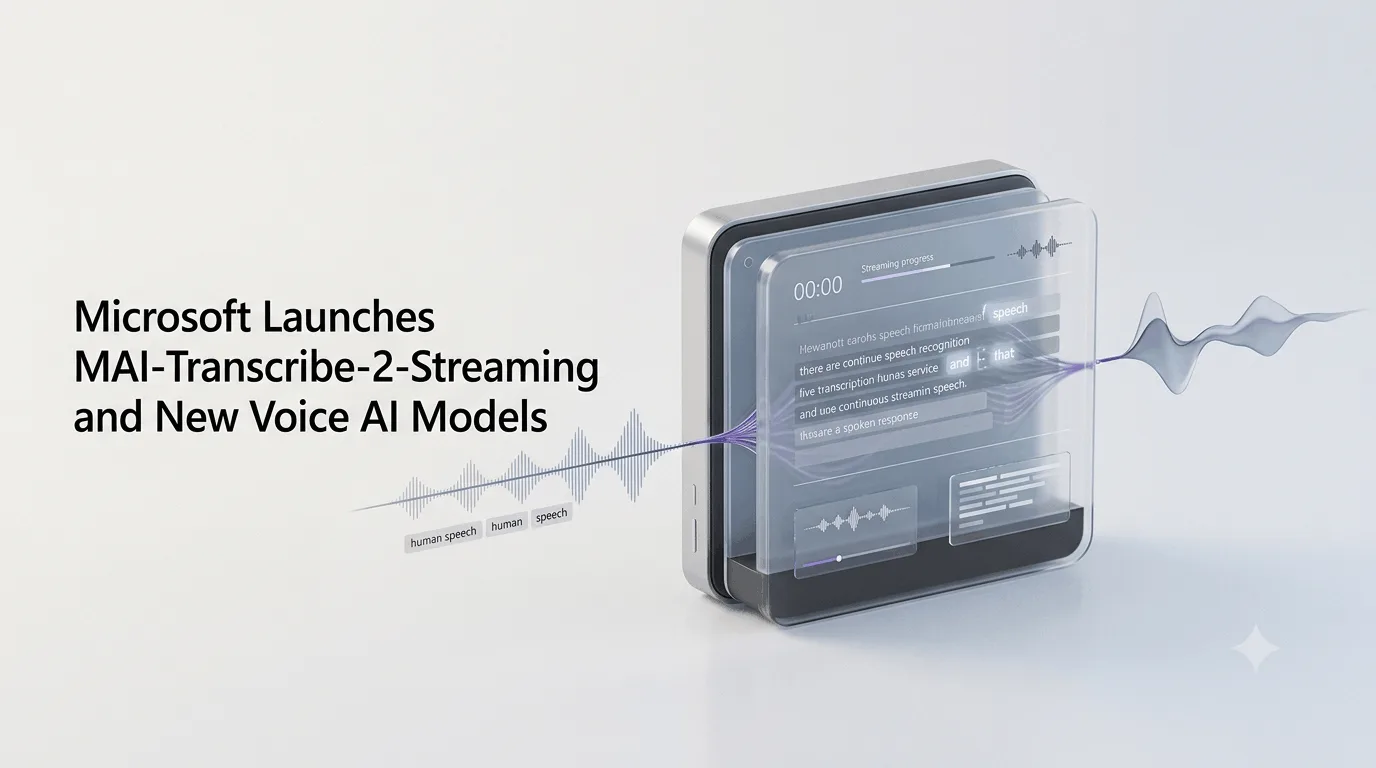
Microsoft has announced MAI-Transcribe-2-Streaming, its first streaming transcription model, alongside MAI-Voice-2.1 and MAI-Voice-2.1-Flash. The models are designed to help developers build faster, more natural AI voice agents that can transcribe speech continuously and respond with less delay.
The announcement was published on Microsoft AI’s website on October 1, 2026. Microsoft says MAI-Transcribe-2-Streaming debuted at number one on Artificial Analysis, while the company positions the three models as building blocks for conversational voice applications.
The claim is supported by the linked Microsoft AI source. However, the page does not provide enough independent benchmark detail in the available content to verify the ranking beyond Microsoft’s published statement.
Quick Summary
- Microsoft launched MAI-Transcribe-2-Streaming, its first streaming transcription model.
- The model converts speech into text continuously during live conversations.
- Microsoft also introduced MAI-Voice-2.1 for expressive speech generation.
- MAI-Voice-2.1-Flash is designed for faster, lower-latency voice responses.
- The models are intended for AI voice agents, customer support, accessibility tools and real-time automation.
- Microsoft says MAI-Transcribe-2-Streaming ranked first on Artificial Analysis.
- The official Microsoft page supports the announcement, but complete independent benchmark details should be checked before presenting the ranking as independently verified.microsoft
- Microsoft documentation says MAI-Transcribe-2 supports capabilities such as multilingual transcription, speaker diarization, timestamps and domain-specific audio processing.
What is MAI-Transcribe-2-Streaming?
MAI-Transcribe-2-Streaming is designed to convert spoken audio into text while the conversation is still taking place. Unlike conventional transcription systems that may process a recording after the speaker has finished, a streaming model continuously receives and interprets audio.
That capability is important for real-time applications, including:
- Customer-service voice agents.
- Meeting and interview transcription.
- Live captions.
- Voice-controlled software.
- Healthcare and field-service documentation.
- Contact-center automation.
For developers, the main benefit is reduced delay between speech, transcription and an AI-generated response. In a voice agent, even small pauses can make an interaction feel unnatural. Continuous transcription can help an assistant recognize when a user has finished speaking and prepare a response more quickly.
Microsoft describes its MAI-Transcribe models as capable of handling noisy audio and producing precise, domain-specific transcripts. The linked announcement also references accuracy results on FLEURS and Artificial Analysis, although it does not list the complete scores or test methodology in the accessible page text.
MAI-Voice-2.1 targets natural speech
Microsoft is also introducing MAI-Voice-2.1, a speech-generation model intended to produce expressive, low-latency audio. The company says the model is designed to maintain quality across longer generations.
That matters because voice assistants need more than correct words. They must also manage:
- Natural pacing.
- Consistent pronunciation.
- Expressive delivery.
- Appropriate pauses.
- Stable output during longer responses.
These qualities can affect whether users perceive an AI assistant as responsive and usable. Poor timing or unnatural speech can make even a technically accurate system difficult to use.
The model is aimed at conversational experiences in which an AI system listens, reasons and speaks in a continuous loop. This places it within the wider development of multimodal AI assistants and AI agents that can interact through voice instead of relying only on text interfaces.
Flash model prioritizes speed
The third model, MAI-Voice-2.1-Flash, is described as a faster variant of MAI-Voice-2.1. Its intended role is to reduce waiting time when an application needs rapid speech output.
A lower-latency voice model may be useful for:
- Interactive customer support.
- Voice search.
- Real-time translation interfaces.
- In-car assistants.
- Accessibility tools.
- Games and virtual characters.
The trade-off between speed, quality and operating cost is central to voice AI development. A highly expressive model may be suitable for premium experiences, while a faster variant may be more practical for applications handling large numbers of conversations.
Microsoft’s announcement presents the three models as a combined set: MAI-Transcribe-2-Streaming handles incoming speech, while MAI-Voice-2.1 and its Flash version generate spoken responses.
How the models fit together?
A typical voice agent built around these systems could follow this sequence:
| Stage | Model or component | Function |
|---|---|---|
| 1 | MAI-Transcribe-2-Streaming | Converts incoming speech into text continuously |
| 2 | Large language model or AI agent | Interprets the request and generates a response |
| 3 | MAI-Voice-2.1 | Produces expressive speech for longer or quality-focused interactions |
| 4 | MAI-Voice-2.1-Flash | Produces faster speech where latency is the priority |
This architecture does not mean the models alone create a complete AI agent. Developers still need to add orchestration, safety controls, authentication, business logic, memory, monitoring and integration with external systems.
Why the announcement matters?
The launch reflects a broader shift from text-based chatbots toward real-time AI agents. As businesses deploy assistants that handle calls, appointments, troubleshooting and internal workflows, users increasingly expect conversations to feel immediate and uninterrupted.
Streaming transcription is particularly important because voice systems must process information incrementally. Waiting for a complete recording before transcription can introduce delays, while processing partial audio allows the system to begin interpreting a request sooner.
The combination of transcription and speech generation also gives Microsoft a more complete voice AI offering. Rather than focusing on only speech recognition or text-to-speech, the company is presenting models for both sides of a spoken interaction.
Microsoft’s claim that MAI-Transcribe-2-Streaming ranked first on Artificial Analysis could increase attention from developers comparing speech models. Still, benchmark rankings should be evaluated alongside factors such as language coverage, pricing, latency, accuracy in specific industries and deployment requirements.
Potential limitations
The announcement does not disclose all technical details needed for a full independent assessment. The accessible page does not specify complete benchmark scores, supported languages, pricing, API limits or general availability terms.
Developers considering the models should therefore verify:
- Whether the models are available in their region.
- Supported languages and dialects.
- Streaming API requirements.
- Latency under production workloads.
- Data retention and privacy policies.
- Performance on domain-specific vocabulary.
- Cost at high audio volumes.
These factors may matter more than a single leaderboard position for enterprise deployments.
Practical applications
The models could support several categories of voice automation:
- Contact centers that transcribe calls and enable real-time agent assistance.
- Healthcare systems that convert clinician–patient conversations into structured notes.
- Education platforms offering live captions and spoken tutoring.
- Enterprise software with hands-free voice controls.
- Accessibility products for users who prefer spoken interaction.
- AI agents that complete tasks through natural conversation.
The strongest use cases are likely to be those where rapid turn-taking produces a clear operational benefit. For example, a support assistant that can transcribe a customer’s request while they are speaking may begin retrieving relevant account or product information before the conversation pauses.
FAQs
1. What is MAI-Transcribe-2-Streaming?
MAI-Transcribe-2-Streaming is Microsoft’s streaming speech-to-text model. It is designed to transcribe spoken audio continuously while a conversation is taking place.
2. What are MAI-Voice-2.1 and MAI-Voice-2.1-Flash?
MAI-Voice-2.1 is a speech-generation model focused on expressive, low-latency output. MAI-Voice-2.1-Flash is a faster variant intended for applications where response speed is especially important.
3. What can Microsoft’s new voice models be used for?
Potential applications include customer-service agents, live captions, meeting transcription, voice search, accessibility software, healthcare documentation and enterprise automation.
4. Did MAI-Transcribe-2-Streaming rank first on Artificial Analysis?
Microsoft’s official announcement says that MAI-Transcribe-2-Streaming debuted at number one on Artificial Analysis. The linked page, however, does not include the complete benchmark methodology or scores needed to independently assess the claim. citeturn0fetch0
5. Are these models a complete AI voice agent?
No. The models provide transcription and speech-generation capabilities, but a complete voice agent also requires an orchestration layer, a reasoning model, business logic, integrations, safety controls and monitoring.
6. Why is streaming transcription important?
Streaming transcription reduces the delay between a person speaking and an AI system understanding the request. That can make voice interactions feel more natural and improve real-time automation workflows.
Also Read –
Microsoft Copilot Cowork: AI Agent That Automates Work in Microsoft 365
Source
Microsoft AI: Our first streaming transcription model debuts at no. 1 on Artificial Analysis