
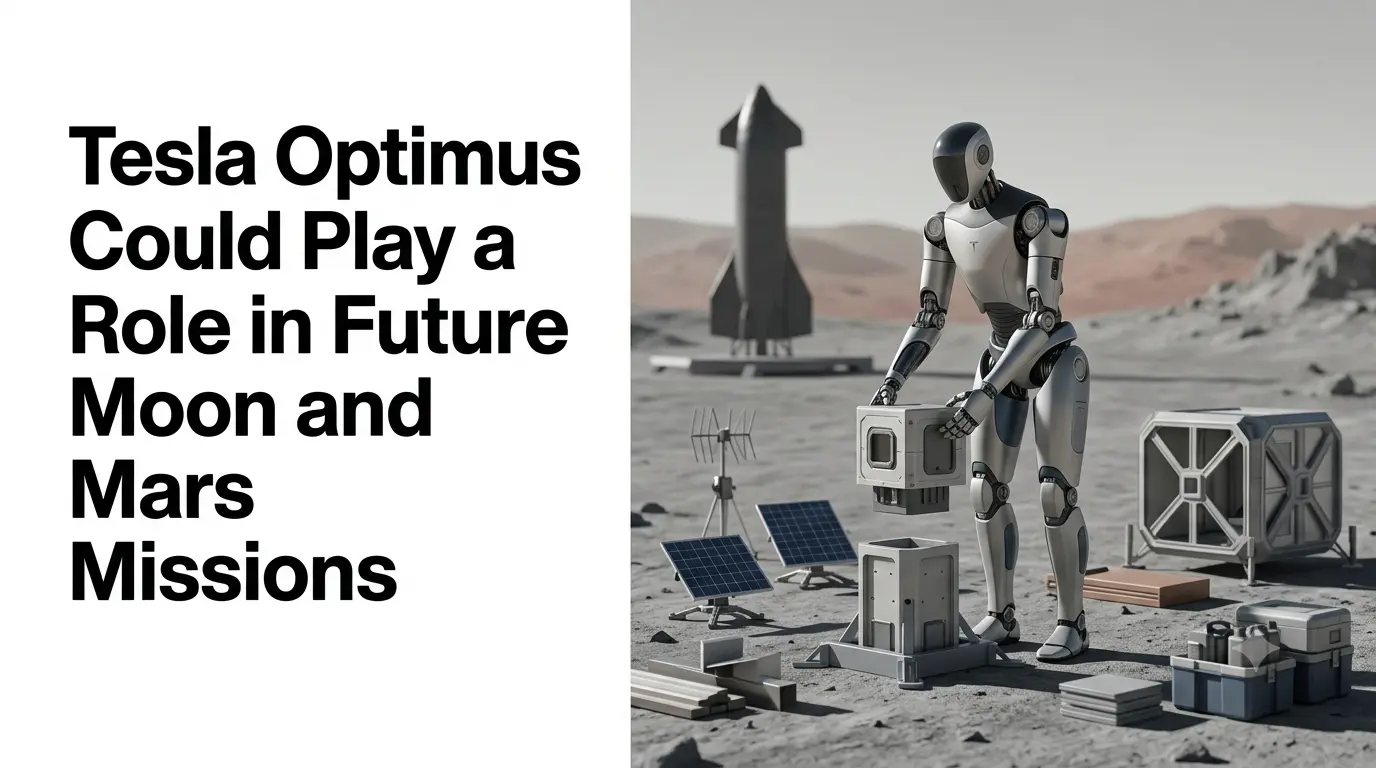
Tesla’s Optimus humanoid robot is increasingly tied to Elon Musk’s long-term plans for expanding human activity beyond Earth, with SpaceX envisioning robotic missions that could prepare infrastructure before people arrive. The strongest public evidence concerns Mars, where Musk has described sending Optimus robots on early uncrewed Starship missions to investigate resources and begin preparing infrastructure for future human missions.
The broader strategy now also includes the Moon. In February 2026, Musk said SpaceX had shifted its near-term focus toward building a self-growing lunar city, while continuing to target Mars development on a longer timeline. SpaceX’s own Starship material describes the vehicle as being designed to carry crew and cargo to Earth orbit, the Moon, Mars and beyond, including equipment needed to establish permanent surface infrastructure.
That makes the idea behind the tweet directionally consistent with Musk’s stated plans, but the specific claim that Optimus will build complete lunar and Martian systems such as roads, communications networks and power infrastructure should be treated as a projection rather than a confirmed deployment plan.
Quick Summary
- Tesla Optimus is being developed as a general-purpose humanoid robot for physical-world tasks. Tesla describes Optimus as part of its broader effort to bring AI into the physical world.
- Elon Musk has previously described using Optimus robots on uncrewed Starship missions to Mars.
- The broader concept involves robots potentially helping prepare infrastructure before human missions.
- SpaceX’s Starship plans cover transportation of cargo and equipment for future lunar and Martian activity.
- The specific claim that Optimus will build roads, power systems and communications networks on the Moon and Mars is not currently established as an operational plan.
- SpaceX’s current plans and Tesla’s Optimus development make the robot-first infrastructure concept a legitimate topic, but much of the deployment scenario remains future-facing.
- Tesla is continuing to develop Optimus’s AI, inference hardware, manufacturing and physical-world capabilities.
What Musk Has Actually Said About Optimus and Mars?
The clearest connection between Optimus and off-world construction comes from Musk’s May 2025 presentation on SpaceX’s Mars architecture.
Musk described early uncrewed Starship missions carrying Optimus robots to Mars. The robots would be used to explore the environment and help prepare for later human missions. The plan included developing power generation, mining, construction, propellant production, habitats and communications infrastructure.
Aerospace America also reported on the plan, describing a sequence in which uncrewed Starships would carry Optimus robots to Mars to help establish ground infrastructure and survey resources such as water ice before human missions.
This is important because it changes the role envisioned for humanoid robots. Rather than simply functioning as assistants after astronauts arrive, Optimus could eventually be used as part of the preparatory workforce sent ahead of them.
However, that remains a future mission concept. There is currently no operational Optimus deployment on Mars, and the robot still has to meet the considerably more demanding requirements of launch, deep-space travel, landing and autonomous operation on another planet.
SpaceX Has Shifted Its Near-Term Focus Toward the Moon
The Mars plan has also changed since Musk previously targeted an uncrewed Starship Mars mission for the end of 2026.
On February 8, 2026, Musk said SpaceX had shifted its focus toward building a “self-growing city” on the Moon. He argued that lunar missions offer much more frequent launch opportunities and shorter travel times than Mars missions. He said SpaceX would nevertheless continue toward a Mars city, with that work expected to begin in roughly five to seven years under his stated timeline.
That shift matters for the Optimus story because the Moon could become an earlier testing environment for technologies needed for larger off-world construction projects.
SpaceX’s current lunar plans already include delivering large cargo payloads, rovers, habitats and other equipment to the lunar surface. Its Starship lunar material says the system is intended to support the establishment of a permanent and sustainable lunar presence.
But SpaceX’s public lunar material does not currently establish that Optimus will be the robot responsible for building that infrastructure.
What Starship Is Designed to Do?
The transportation side of the strategy is much more clearly documented.
SpaceX describes Starship and Super Heavy as a fully reusable transportation system designed to carry both crew and cargo to Earth orbit, the Moon, Mars and beyond. The company says Starship is designed around a payload capacity of more than 100 metric tons to orbit.
SpaceX also describes Starship as a potential foundation for establishing lunar and Martian infrastructure. Its Mars material lists power generation, resource mining, propellant production, construction, communication and transportation among the technologies required to create a permanent presence on Mars.
The company currently lists Starship cargo flights to both the Moon and Mars as beginning no earlier than 2028 on its public vehicle information.
That is a significant distinction from saying Optimus will definitely arrive on either world on a particular date.
Why Humanoid Robots Could Be Useful in Space?
The logic behind using humanoid robots is relatively straightforward: infrastructure designed for humans often relies on tools, controls and physical environments built around human proportions.
Tesla describes Optimus as a general-purpose, bipedal autonomous humanoid intended to perform unsafe, repetitive or boring tasks. Tesla’s current AI and robotics materials also describe work on perception, navigation, interaction and physical-world intelligence for Optimus.
A robot with a human-like body could theoretically operate equipment and perform construction tasks without requiring every tool and workspace to be redesigned around a specialized machine.
That does not mean Optimus is currently capable of independently constructing a lunar or Martian settlement. Operating in space would introduce challenges that do not exist in a factory, including radiation, extreme temperatures, abrasive dust, limited communications and the need for high reliability with little or no immediate human assistance.
Moon and Mars Plans Are Still Development Programs
There is also an important distinction between SpaceX’s long-term architecture and demonstrated capability.
Starship’s twelfth flight test in May 2026 successfully completed the planned ascent and stage separation sequence, but the Super Heavy booster experienced problems during its attempted return and ended with a hard splashdown.
That illustrates why the transportation system remains a major part of the development challenge. Before robots can construct infrastructure on another world, Starship has to reliably transport them, their equipment and other cargo through launch, spaceflight and landing.
The robotics side has its own development path. Tesla is still working on the perception, foundation-model and embodied-intelligence systems required for Optimus to understand and interact with physical environments. A current Tesla job listing for Optimus specifically references vision and multimodal foundation models, navigation and world modeling.
Consequently, the robot-first concept should currently be understood as part of a long-term development strategy rather than an established operational capability.
What Is Confirmed and What Is Not?
The distinction is important when interpreting claims about Optimus and space.
Documented:
- Musk has described sending Optimus robots on early uncrewed Starship missions to Mars.
- Those missions have been described as scouting resources and beginning infrastructure preparation.
- SpaceX intends Starship to transport cargo and crew to the Moon and Mars.
- SpaceX has shifted its near-term strategic emphasis toward lunar development.
- SpaceX’s public Mars architecture includes power, mining, construction, propellant and communications infrastructure.
Not yet established:
- A confirmed Optimus lunar deployment date.
- A confirmed Optimus Moon construction program.
- An operational Optimus robot capable of independently constructing a lunar or Martian settlement.
- A demonstrated ability for Optimus to build complete roads, power grids or communications networks on another world.
- A confirmed date for humans arriving after Optimus has prepared a site.
The distinction matters because the tweet presents the entire sequence as though it were already an established mission architecture. The available evidence supports the broader concept, but not every specific operational claim.
For now, Tesla Optimus is best understood as a potential component of Musk’s longer-term robot-first approach to lunar and Martian development. SpaceX is developing Starship as the transportation system, while Tesla is developing Optimus as a general-purpose humanoid robot. Whether the two systems ultimately operate together on the Moon or Mars depends on substantial development and testing that has not yet been completed.
Also Read –
Tesla Terafab AI Chip Factory Launch for FSD, Dojo, Optimus
Source
Tesla – AI & Robotics / Optimus
Reuters – SpaceX prioritizes lunar self-growing city over Mars project
Aerospace America – A Closer Look at SpaceX’s Mars Plan