

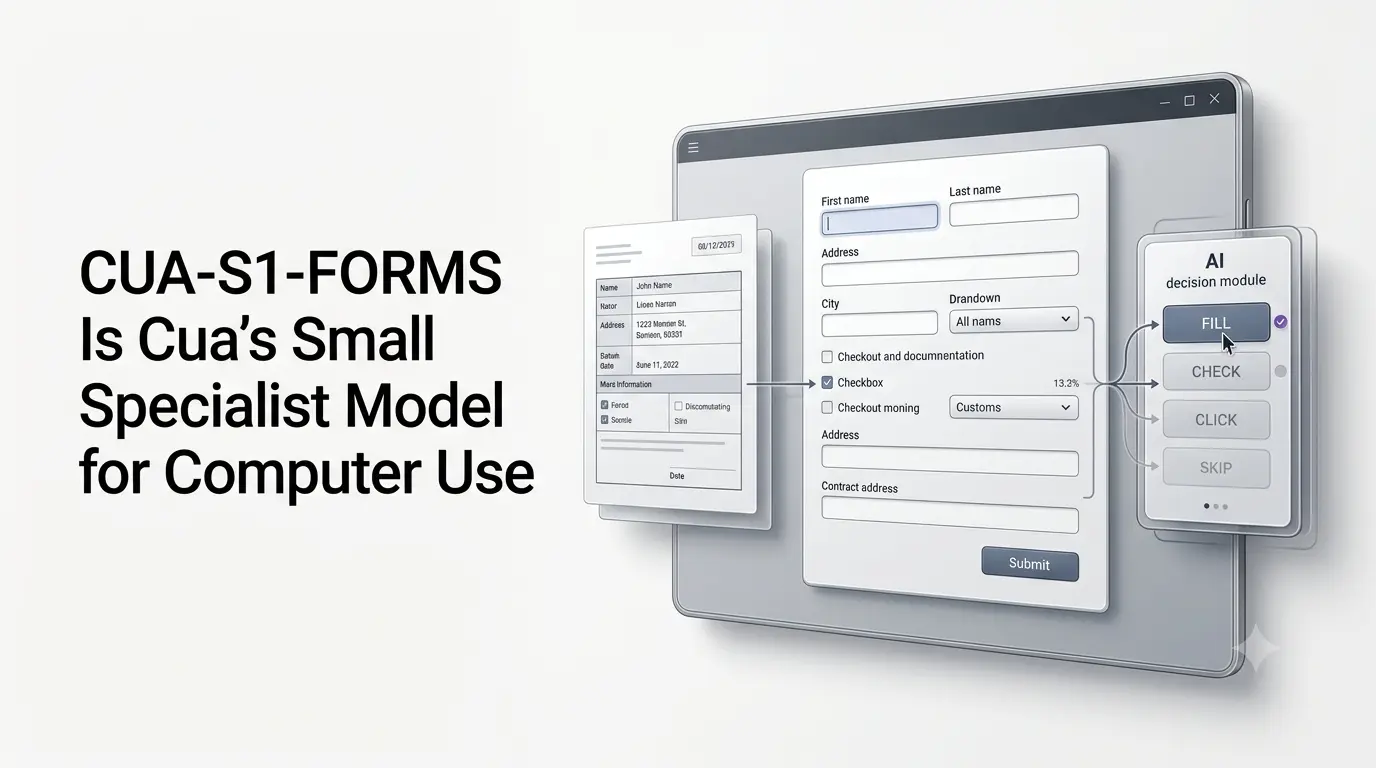
Cua has open-sourced CUA-S1-FORMS, a small specialized AI model designed to handle a narrow but common computer-use task: deciding how to fill out graphical user-interface forms from information contained in a document.
The model is the first release in Cua’s CUA-S1 family of “System One” models. Rather than generating text token by token like a conventional large language model, CUA-S1-FORMS scores a bounded set of possible actions in a single forward pass and passes the selected decision to Cua Driver for execution.
That design makes the model substantially smaller than the general-purpose models typically associated with computer-use agents. The released checkpoint contains 706,048 trainable parameters and is about 2.8 MB, according to the model card.
Quick Summary
- CUA-S1-FORMS is the first specialist model released in Cua’s CUA-S1 family.
- It is designed specifically for computer-use form-filling workflows.
- The model has only 706,048 parameters and is approximately 2.8 MB.
- It scores candidate actions such as filling, checking, clicking, or skipping.
- Cua Driver handles the actual computer interaction and execution.
- The model was trained primarily using synthetic form-filling data.
- Cua reports 99.95% top-1 accuracy on its synthetic test set.
- Cua also reports a smaller real-form evaluation, but the limited real-world evaluation should be kept in context.
- The release demonstrates an alternative to using large general-purpose LLMs for every step of a bounded computer-use workflow.
What CUA-S1-FORMS Does
CUA-S1-FORMS is designed around a constrained decision problem rather than open-ended computer interaction.
For each actionable form element, the model receives the UI context and a list of candidate options. Those options can include document-derived values to fill into a field as well as three fixed actions: check, click, and skip.
The model then produces a probability for each option in one forward pass. Every actionable element can be scored independently and in parallel, while the downstream application determines the execution order.
This distinction is important. CUA-S1-FORMS does not independently discover arbitrary information, generate a complete workflow, or control the computer from start to finish. The application must first extract document entities, describe the UI elements, construct candidate actions, and validate and order the resulting actions before sending them to Cua Driver.
How the CUA-S1 Model Works?
The model uses a compact Transformer-based architecture with byte-level embeddings and separate two-layer Transformer encoders for the form context and option text.
An attention mechanism then allows each candidate option to query the context before producing a score. The final probabilities are normalized across the available options.
The model operates on bounded inputs. The form context is truncated to 224 bytes, while each option is limited to 96 bytes. This constrained input format is part of the reason the system can remain small, but it also limits the range of tasks and information it can handle.
The released model is licensed under the MIT license, making the checkpoint available for developers to inspect, modify and integrate under that license.
CUA-S1-FORMS Uses a Specialist Rather Than a General LLM
The broader idea behind CUA-S1 is to use specialized models for bounded computer-use problems instead of relying on a large language model for every decision.
For form filling, the decision space is relatively constrained. A system generally needs to determine which document value corresponds to a particular field, whether a checkbox should be selected, whether a button should be clicked, or whether an element should be skipped.
CUA-S1-FORMS turns that problem into an option-selection task. This allows the model to focus on the decision layer while Cua Driver remains responsible for carrying out the corresponding computer actions.
The approach also differs from an autonomous agent that repeatedly reasons through a screen, generates actions, observes the result and then decides what to do next. CUA-S1-FORMS instead scores the available choices for individual form elements in parallel.
Reported CUA-S1-FORMS Results
Cua’s published evaluation reports strong results on its form-filling task.
On a synthetic test split containing roughly 15,000 decisions, the model achieved 99.95% top-1 accuracy. The training and test forms were separated by exact field signatures, meaning the test form field combinations did not appear in training according to the model card.
Cua also reports a smaller real-world evaluation using three real forms and three real PDFs. That evaluation contained 196 decisions, with the model achieving 100% on the reported task.
A separate head-to-head comparison against TypeSafe’s hosted jev-latest API reported 99.7% for CUA-S1-FORMS versus 83.6% for the hosted Jev API overall on Cua’s stated task. The model card also reports different Jev results when restricting the comparison to decisions requiring real judgment.
These figures are reported by Cua and should be interpreted within the scope of its evaluation. They do not establish that the model is more capable than general-purpose AI systems across computer-use tasks.
Training Data Is Built Around Form-Filling Decisions
The accompanying dataset is also publicly available through Hugging Face.
The dataset contains synthetic and real evaluation data for the form-filling option scorer. Its published training split contains 188,000 rows, with each example containing form context, candidate options and a label representing the selected option.
The model card says the training process used 10,000 synthetic episodes. The synthetic generator creates forms with different field combinations, document entities, distractors and deliberately confusing field pairs, such as phone versus emergency-contact phone or state versus university.
The training procedure used AdamW, a cosine learning-rate schedule with warmup, six epochs and a batch size of 128, with cross-entropy applied over the available options.
CUA-S1-FORMS Has Important Limitations
The narrow design that makes CUA-S1-FORMS lightweight also defines its limitations.
The model cannot invent a field value. It can only select among entities that a separate document extractor has already identified. It is also trained primarily on synthetic forms, with the real evaluation consisting of only 196 decisions across the reported demonstration forms and PDFs.
Cua also describes the model as English-centric and notes that arbitrary new forms and languages require their own evaluation. Its scores should not be treated as calibrated confidence guarantees.
That means the model is better understood as a specialized decision component for a bounded computer-use workflow, rather than a general-purpose replacement for a computer-use LLM.
Why Small Specialist Models Matter for Computer Use?
The release highlights a different design direction for AI agents: not every component of an agentic workflow necessarily needs to be powered by a large general-purpose model.
A computer-use system can divide its workload between components. A larger model or application can handle higher-level planning and interpretation, while a small specialist handles a repetitive decision problem such as matching form fields to document values.
For high-volume, repetitive workflows, that architecture could make it possible to dedicate a lightweight model to a narrowly defined task. But the published CUA-S1-FORMS results are still limited to the specific form-filling problem evaluated by Cua.
CUA’s model and dataset releases therefore provide both a working computer-use component and a reproducible example of how a specialist AI model can be designed around a constrained action space. The company says CUA-S1-FORMS is the first specialist in the CUA-S1 family, leaving the broader scope of future specialists to be determined by subsequent releases.
Also Read –
Meta Opens Muse Connector Platform to Developers
Qwen3.8-LiveTranslate Launches for Real-Time Translation
Sources
CUA-S1-FORMS model card on Hugging Face
CUA-S1-FORMS dataset on Hugging Face