
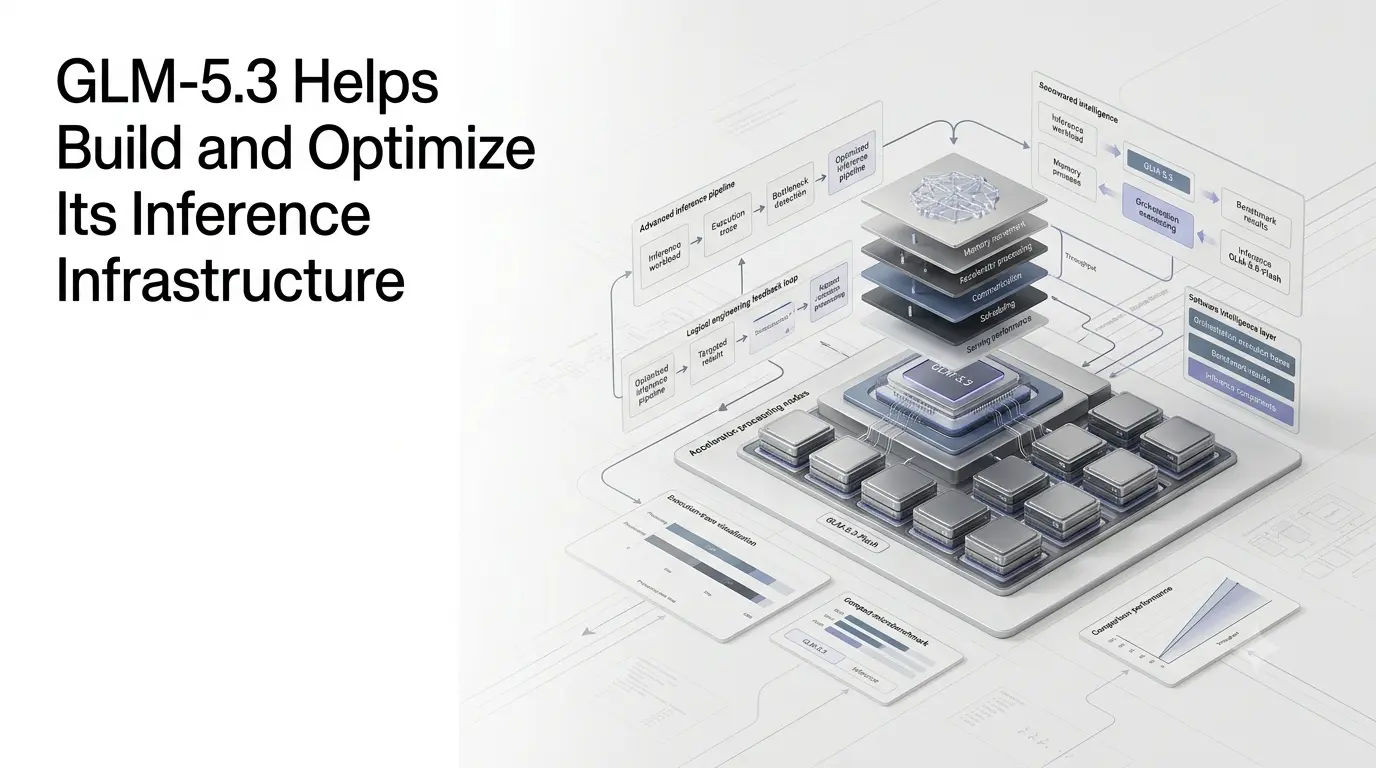
Z.ai says its GLM-5.3 model helped build and optimize the inference infrastructure used to serve GLM-5.3-Flash, completing the transition from an initial model run to production readiness in less than two weeks. The company reports that the resulting serving system achieved roughly three times the end-to-end throughput of its initial baseline on the same infrastructure.
The work is notable because the AI model was not used only to write isolated pieces of software. Z.ai says a GLM-5.3-powered Infra Agent participated in diagnosing numerical errors, analyzing execution traces, testing performance hypotheses and modifying the inference stack itself.
Z.ai describes the project as an early example of what it calls recursive self-improvement (RSI). However, the company explicitly says it has not reached full recursive self-improvement, with humans still responsible for setting objectives, defining system boundaries and reviewing high-risk changes.
Quick Summary
- Z.ai says GLM-5.3 helped build and optimize the inference infrastructure serving GLM-5.3-Flash.
- The production inference system was developed on a cluster of more than 100,000 Chinese-made AI accelerators.
- Z.ai reports that the system reached production readiness in less than two weeks.
- The optimized serving stack achieved roughly 3× end-to-end throughput compared with the initial baseline.
- An Infra Agent powered by GLM-5.3 helped investigate performance and correctness issues.
- The optimization process relied on dense feedback, including execution traces, local correctness tests, microbenchmarks and end-to-end measurements.
- Z.ai describes the work as an early example of recursive self-improvement, while explicitly noting that humans still define objectives, system boundaries and risk constraints.
How GLM-5.3 Helped Build the Inference System?
Serving a large AI model in production requires more than getting the model to run successfully. The inference infrastructure has to manage memory, parallelism, communication, numerical accuracy and serving performance under real workloads.
For GLM-5.3-Flash, Z.ai built a production-grade inference service from scratch on a cluster containing more than 100,000 Chinese-made AI accelerators. According to the company, the environment presented constraints around chip memory capacity and bandwidth while also needing to support the model’s architecture, a 1-million-token context window and multimodal requests.
Z.ai says the resulting system combines several inference optimizations, including intra-node tensor parallelism, ReplaySSM, W8A8 quantization, mixed-precision cache quantization using INT8, FP8 and BF16, Layer Split, and an Encode-Prefill-Decode architecture.
Together, those techniques produced approximately a 3× improvement in end-to-end serving performance compared with the initial baseline, according to Z.ai. The company’s separate GLM-5.3-Flash material confirms the threefold serving-performance improvement on the same hardware.
Dense Feedback Was Central to the Optimization Process
The key idea behind the project was not simply giving the model access to more logs.
Z.ai calls its approach “dense feedback”: a system in which an AI agent receives local, timely and objectively verifiable information that can help it test a specific engineering hypothesis.
The feedback environment combined several forms of testing and observation:
- Local correctness tests
- Runtime logs
- Execution traces
- Runtime events
- Microbenchmarks
- End-to-end performance measurements
This allowed the Infra Agent to investigate individual problems before waiting for a complete production-scale test.
For example, an end-to-end throughput reduction could indicate that something had gone wrong, but it would not necessarily explain whether the cause was a kernel, memory transfer, scheduling problem, communication bottleneck or another component.
By connecting performance measurements to lower-level execution data, Z.ai says the agent could progressively narrow its investigation.
Agent Helped Find a Numerical Accuracy Problem
One example involved the KDA kernel’s Context Parallelism path.
Z.ai used comparisons between partitioned and unpartitioned execution paths to identify numerical discrepancies. The investigation eventually traced the issue to the precision used by tl.dot operations during state transformation and merging.
The original implementation used TF32 computation in a situation where the accumulated numerical error became more pronounced with long contexts. Z.ai says the fix explicitly used input_precision="tf32x3" for the relevant operations.
The important part of the workflow was the connection between the system-level symptom and the kernel-level test. Rather than treating the entire inference system as a black box, the agent could use targeted tests to identify where the discrepancy originated.
Z.ai says the resulting numerical fixes were also merged upstream into Flash Linear Attention.
GLM-5.3 Also Helped Identify a KV Transfer Bottleneck
Another example involved performance rather than numerical correctness.
Z.ai had established separate test scenarios for Prefill, Prefill plus KV Transfer, and Decode. In some cases, the performance difference between Prefill plus KV Transfer and the Prefill-only baseline exceeded 20%.
The Infra Agent examined execution timelines and identified a concurrency problem involving KV Transfer and DeepEP. The investigation eventually reached the Python/C++ boundary, where Z.ai found that relevant DeepEP operations were not explicitly releasing Python’s Global Interpreter Lock.
The resulting scheduling behavior limited the ability of the KV Transfer process to overlap with subsequent computation.
After the relevant change, Z.ai reports that the performance gap between Prefill plus KV Transfer and the Prefill baseline fell below 1% under the same test conditions.
This example illustrates the role of the feedback system: an end-to-end performance discrepancy led to timeline analysis, which narrowed the problem to a concurrency interaction and ultimately to a specific implementation detail.
Inference Stack Reached Production in Less Than Two Weeks
Z.ai says the GLM-5.3-Flash inference system progressed from its first successful run to production readiness in under two weeks.
The company attributes this speed partly to the continuous optimization loop between engineers, the GLM-5.3-powered Infra Agent and the experimental environment.
Engineers defined the objectives and constraints, while the agent analyzed problems, proposed hypotheses, modified code and conducted experiments. The testing environment supplied the feedback needed to determine whether those changes were correct and whether they improved actual serving performance.
The resulting system was subsequently used to serve real-world GLM-5.3-Flash traffic. Z.ai says the model was tested anonymously as Ox-Alpha on OpenCode and OpenRouter, where it processed more than 62 trillion tokens over six days and became the most-used model on both platforms within its first week, according to the company’s report.
What This Means for AI-Assisted Infrastructure Engineering?
The development points to a broader use of coding-capable AI systems: not just generating application code, but participating in the optimization of the infrastructure that runs AI models.
That distinction matters because inference optimization involves several interacting layers. A change that improves an individual kernel may have little benefit at the system level, while a change that appears minor in code can improve overall throughput if it removes a scheduling or communication bottleneck.
Z.ai’s approach attempts to address this by making engineering feedback more granular and directly accessible to the agent.
The company says the Infra Agent also learned optimization techniques from existing kernels across projects such as SGLang, Flash Linear Attention and DeepGEMM. Those techniques were organized into reusable “optimization skeletons” that could be adapted to new kernels and validated through experiments.
GLM-5.3 and Recursive Self-Improvement
Z.ai places the project within the broader concept of recursive self-improvement, where an AI system could eventually contribute to improving or building successor AI systems.
The company’s own description is more cautious. Z.ai says it has not reached that endpoint and that humans continue to define objectives, establish boundaries and assess risks.
The GLM-5.3 example instead demonstrates a narrower form of AI-assisted systems engineering: the model helped optimize the infrastructure required to run a related model, while humans remained responsible for the overall engineering framework and critical decisions.
That distinction is important. The reported threefold throughput improvement and sub-two-week production timeline are concrete engineering results reported by Z.ai, while the larger question of whether such systems constitute an early stage of recursive self-improvement remains a research and conceptual interpretation rather than a claim that full RSI has already been achieved.
The GLM-5.3 project therefore illustrates a shift from AI-assisted coding toward AI-assisted infrastructure optimization, where models can participate in increasingly complex cycles of testing, diagnosis, implementation and verification.
Also Read –
GLM-5-Turbo: High-Speed AI Model for Agent Workflows
GLM-5 AI Model: What We Know Before Release
GLM-5.3: What It Is, What It Can Do & Key Features
Sources
- Z.ai — Toward Recursive Self-Improvement: How GLM Built Its Own Inference Infrastructure
- Z.ai — GLM-5.3-Flash: More Intelligence with Less Compute
- ZCode — Official GLM-5.3 Harness