

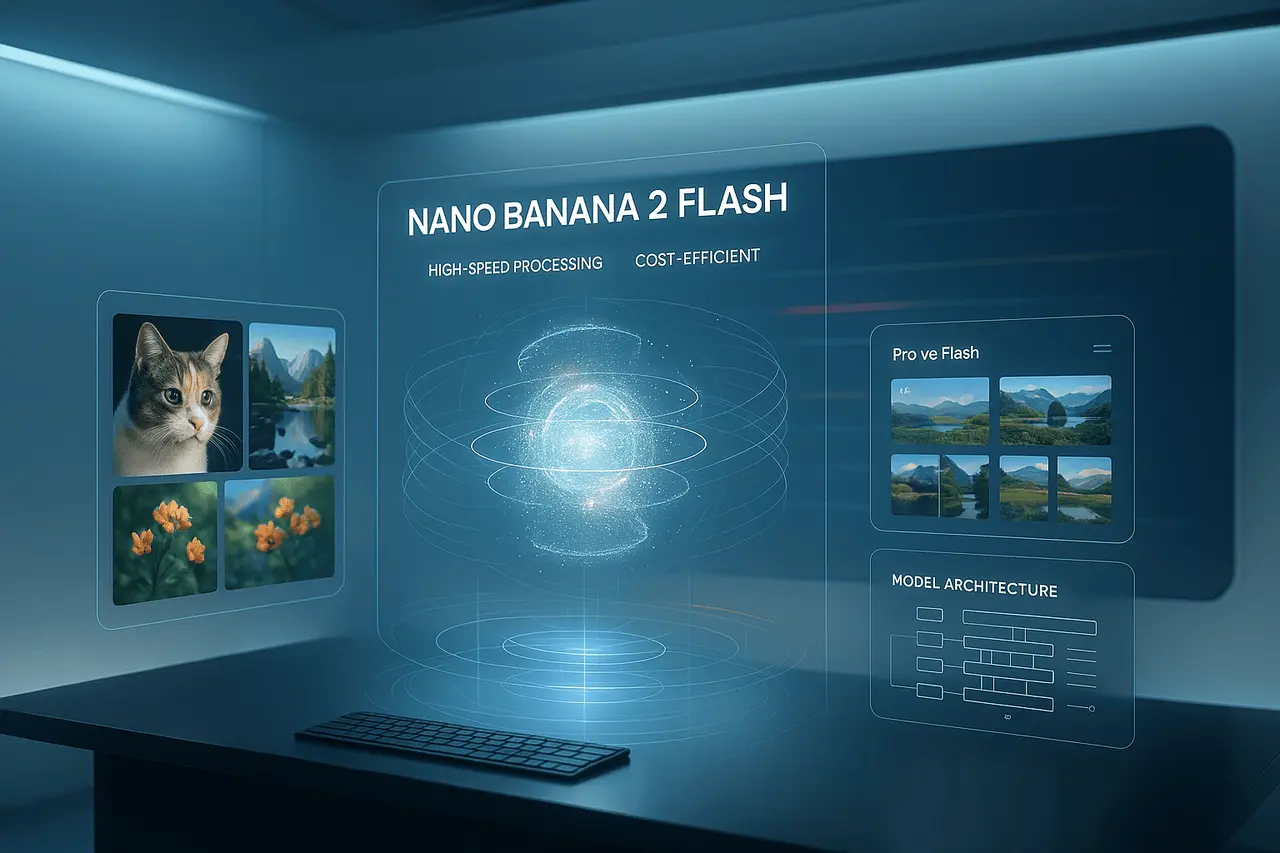
Google is planning to extend its AI image-generation system with the imminent launch of Nano Banana 2 Flash, a brand-new model set to deliver near-Pro-quality results at much lower cost and with higher performance. A company-internal codename, “Mayo,” was recently spotted in Gemini’s Gemini Web interface, indicating the launch is imminent. Initial testing suggests the Nano Banana 2 Flash could deliver advanced rendering, greater control, and higher-quality outputs while remaining efficient. For developers, creators, and companies seeking a balance between performance and cost, this option could soon be among the most affordable yet powerful tools for image generation in Google’s lineup.
What is Nano Banana?
Nano Banana is the popular AI image-generation and editing software developed by Google DeepMind, powered by the wider Gemini platform. The first official launch was in August 2025 under the title “Gemini 2.5 Flash Image.” Nano Banana quickly gained attention for its ability to create and edit clear, consistent photos from simple text prompts or user-supplied pictures.
Nano Banana supports features such as multi-image mixing, prompt-based editing (for instance, changing the background, clothing, or lighting), and maintaining aesthetic consistency (for example, keeping a subject’s look consistent across several edits). The outputs are also accompanied by the invisible “SynthID” watermark to indicate AI-generated content.
Thanks to its speed and ease, Nano Banana was integrated into applications such as Google Search (via Lens), the Gemini app, and other developer interfaces like Google AI Studio and Vertex AI.
Introducing Nano Banana 2 Flash And What “Flash” Means here?
Just a few days after Nano Banana’s launch, news emerged of an improved model called Nano Banana 2, expected to offer enhanced capabilities, including more intelligent image understanding, greater contextual awareness, more accurate rendering of infographics and text, and greater control over aspects such as aspect ratio and resolution.
In addition, the word “Flash” (as in “Nano Banana 2 Flash”) refers to a setup designed to reduce latency and costs — thereby sacrificing some computational burden to speed up generation and increase access — which is similar to the earlier Gemini “Flash” models.
In the early days of December 2025, news reports indicate that Google is expected to launch Nano Banana 2 Flash in the next few weeks. Model code references known as “Mayo” have appeared in the Gemini application’s codebase -an indicator commonly used by beta-tracking experts.
Based on preliminary reviews, Nano Banana 2 Flash is said to feature images nearly identical to those of Nano Banana 2’s “Pro” variant — all while maintaining the speed and lower cost of Flash versions.
What Could Nano Banana 2 Flash Offer?
Nano Banana 2 Flash: High-quality output and enhanced control
The previous version, Gemini 2.5 Flash Image, already enabled editing with prompts, multi-image-fusion background adjustments, filter and style applications, and basic Compositing.
Nano Banana 2 promises to improve on that. Early reports suggest improved treatment of text (for poster designs, infographics, or images with annotations). More precise rendering and more flexible aspect ratios and outputs at higher resolution make it more appropriate for publishing, design, or content creation tasks.
Nano Banana 2 Flash: Lower cost, faster generation
Flash variations are used to achieve lower latency and lower cost. In the case of Nano Banana 2 Flash, Google appears to be looking towards the “sweet spot” — offering image quality comparable to that of the Pro model, but at a price/performance ratio that allows for greater access, perhaps including the free tier or creators that require speed.
Nano Banana 2 Flash: Accessibility to more people and scaling
With a low-cost, high-quality product, Google can scale Nano Banana 2’s use to a broader audience, ranging from professional content creators and designers to users seeking speedy image editing, style transfers, or a more creative way to create images. Initial reports suggest that the Flash version may be available beyond the premium levels.
What’s the difference between this and Nano Banana Pro?
The latest high-end model, Nano Banana Pro (based on Gemini 3 Pro Image), is optimized for maximum quality, control, and features that are more advanced, such as precise text rendering, precise charts and infographics, as well as outputs with high resolution up to 2K, and possibly even higher.
Nano Banana Pro is currently the preferred choice for professional-grade creative and design software that demands precision, polish, and fine control.
Conversely, Nano Banana 2 Flash is targeted at users seeking speed, efficiency, and general-purpose image creation, offering the same quality as Pro but with improved speed and file size. In most senses, Flash democratizes access, but Pro is the best choice for high-quality output.
Why the New Release Matters?
The imminent launch of Nano Banana 2 Flash is an essential event for a variety of reasons:
- Affording More use of Creative AI instruments: By lowering cost and increasing speed with no significant quality reduction, Google can open up AI-powered image making to a larger audience that includes hobbyists, marketers, educators, social media creators, small-scale businesses, and many more.
- Speedier Processes: For tasks like conceptual art, mock-ups, social media visuals, and quick prototyping, Flash delivers results in a matter of seconds, allowing for the process of iterative design and experimentation.
- The Ability to Scale: For developers, startups, agencies, or content platforms that must create many images, a cost-effective approach makes scaling easier.
- Impact on Culture: Given how the initial Nano Banana already fuelled viral trends (including 3D figurine-style images), A high-performance, widely accessible new model may spark new creativity across social media platforms.
What Is Still Unknown or Unconfirmed?
Despite the hype, however, there are some open questions
- Date of Release and the Availability: While reports suggest that HTML0 will be launched “in the coming weeks,” no specific date or timeframe for the rollout has been announced publicly. It’s unclear whether this model is accessible worldwide or will be a region-specific rollout.
- Pricing and Access for all users: Will Flash be included in the free tier, or will it require an annual subscription or a pay-per-use fee? Initial signs suggest a cost-effective model, but the final pricing and restrictions (rate limits and image quotas) are not yet known.
- Limitations in Comparison to Nano Banana Pro: Though the early feedback suggests that it is close to Pro quality, there could be instances of extremes, such as highly detailed compositions or intricate infographic creation, in which Pro is still superior. As long as Pro is widely used, the distinctions will only become apparent over time.
- Ethics, Policy, and Watermarking: While Ghost-style invisible watermarking (SynthID) is part of the model’s protections, responsible usage, particularly for images that involve people, similar content, or copyrighted or other content, is an essential concern for users.
What does this mean for Users and Creators?
If you’re an artist in the digital realm, a marketer, a content creator, or simply someone passionate about making pictures, Nano Banana 2 Flash can be a fast, efficient tool. It can create high-quality images without any input.
Agencies and developers who work at scale, developing tools that create customized images, mockups, and avatars, could greatly benefit from a system that balances cost and quality.
Small businesses, educators, or those interested in social media may find Flash ideal for design tasks, as it requires no technical expertise or significant investment.
In the same way, professionals who require pixel-perfect photos, advanced typography, or intricate layouts may prefer Nano Banana Pro, but with the Flash version, there’s an alternative that balances quality, speed, and cost.
In essence, Flash could democratize professional-grade image production, while keeping the quality of the professional-grade tier for when high-quality is necessary.
Final Thoughts
Nano Banana 2 Flash represents an essential milestone in Google’s broader effort to make high-quality AI image creation easier to access at scale. With performance comparable to professional-grade quality at a lower operating expense, it can support a wide range of situations, from routine production to high-volume workflows.
While essential details such as pricing, rollout areas, and feature limits are not yet announced, early indications suggest a model designed to be fast, flexible, and mass-market. As AI-powered creative tools continue to evolve, Nano Banana 2 Flash could be a significant link between professional-grade models and affordable, fast consumer models, setting the bar for what users can expect from high-quality, fast images.
Frequently Asked Questions (FAQs)
1. How does Nano Banana 2 Flash compare to the original Nano Banana?
Nano Banana 2 Flash is a new version of Google’s AI image model, designed to offer the latest features of Nano Banana 2 — including improved resolution, improved infographic and text rendering, and more flexible formats — while delivering lower latency and greater cost-efficiency for Flash users.
2. Is Nano Banana 2 Flash available for free, or require a monthly fee?
Google has not yet announced pricing or availability details. However, due to its “Flash” label and early reports of cost-efficiency, it may be part of the lower or free tiers, though usage restrictions or rate caps may apply.
3. What does Nano Banana 2 Flash compare to Nano Banana Pro in output quality?
Early previews indicate that the Flash version can produce outputs of “almost the same quality” as the Pro model. However, for highly detailed work, such as intricate overlays, fine typography, infographics, or studio-quality images, Nano Banana Pro may have an advantage.
4. What platforms or tools will be compatible with Nano Banana 2 Flash?
If it’s released, it’s likely to be included in the same way as the current Nano Banana models, such as the Gemini application, Google Search (via Lens or AI Mode), and a developer platform like Google AI Studio or Vertex AI.
5. For what kind of tasks is Nano Banana 2 Flash best suited?
It’s an excellent choice for fast editing and image generation: social media images, conceptual art, mockups, creative prompts, background changes, style transfers, and any other situation where speed and sound quality are more important than perfection.
6. What date can we anticipate the release date of Nano Banana 2 Flash?
As of the beginning of December 2025, Google is reported to be launching Nano Banana 2 Flash “in the coming weeks.” There is no official date yet.
Also Read –
Introducing Nano Banana Pro: Studio-Quality Image Creation Arrives