
Machine translation is in an era where efficiency, speed and openness are merging. Tencent’s HY-MT1.5 release clearly illustrates this shift. Two open-source translation models are available: 1.8B and 7B parameters. HY-MT1.5 is designed to operate across both cloud and hardware environments, so teams don’t have to sacrifice speed or quality.
Unlike earlier generations of translation systems that were either lightweight but limited or powerful but infrastructure-heavy, HY-MT1.5 targets both ends of the spectrum. It focuses on practical deployment realities: latency, memory footprint, and competitive translation quality at scale.
This article explains the benefits that HY-MT1.5 provides, the reasons it is essential for both businesses and developers and how it fits into the changing models of translation.
What Is Tencent HY-MT1.5?
HY-MT1.5 is the latest Open-Source Machine Translation Model Family. It has two versions:
- HY-MT1.5 1.8B is designed to maximise efficiency and use on devices
- HY-MT1.5 7B is designed to improve translation quality in cloud and server environments.
These two types of models were designed to handle real-world translation tasks, which range from mobile apps and edge devices to large-scale multilingual systems for enterprises.
A noteworthy aspect of this release is that it is open source, allowing developers to review and fine-tune the models without locking in proprietary code.
Why Open-Source Translation Models Matter Now?
Translation is an essential component for all global products: search, customer support, ecommerce, education, and even content applications all depend on it. But many top-quality translation tools aren’t available or are expensive to run.
Open-source translation models like HY-MT1.5 offer several advantages:
- Transparency: Teams can evaluate model behaviour and biases
- Customisation: Fine-tuning for domain-specific language is possible
- Control of costs • Reduced dependence on APIs from third parties
- Deployment flexibility: On-device, private cloud, or hybrid setups
HY-MT1.5 coincides with this trend, while also aiming to close the gap in quality between proprietary and open platforms.
HY-MT1.5 1.8B: Built for Consumer Hardware
The 1.8B parameter model was designed with efficiency as its primary purpose. It focuses on environments where computing and memory are in short supply; however, low latency is essential.
Key Characteristics
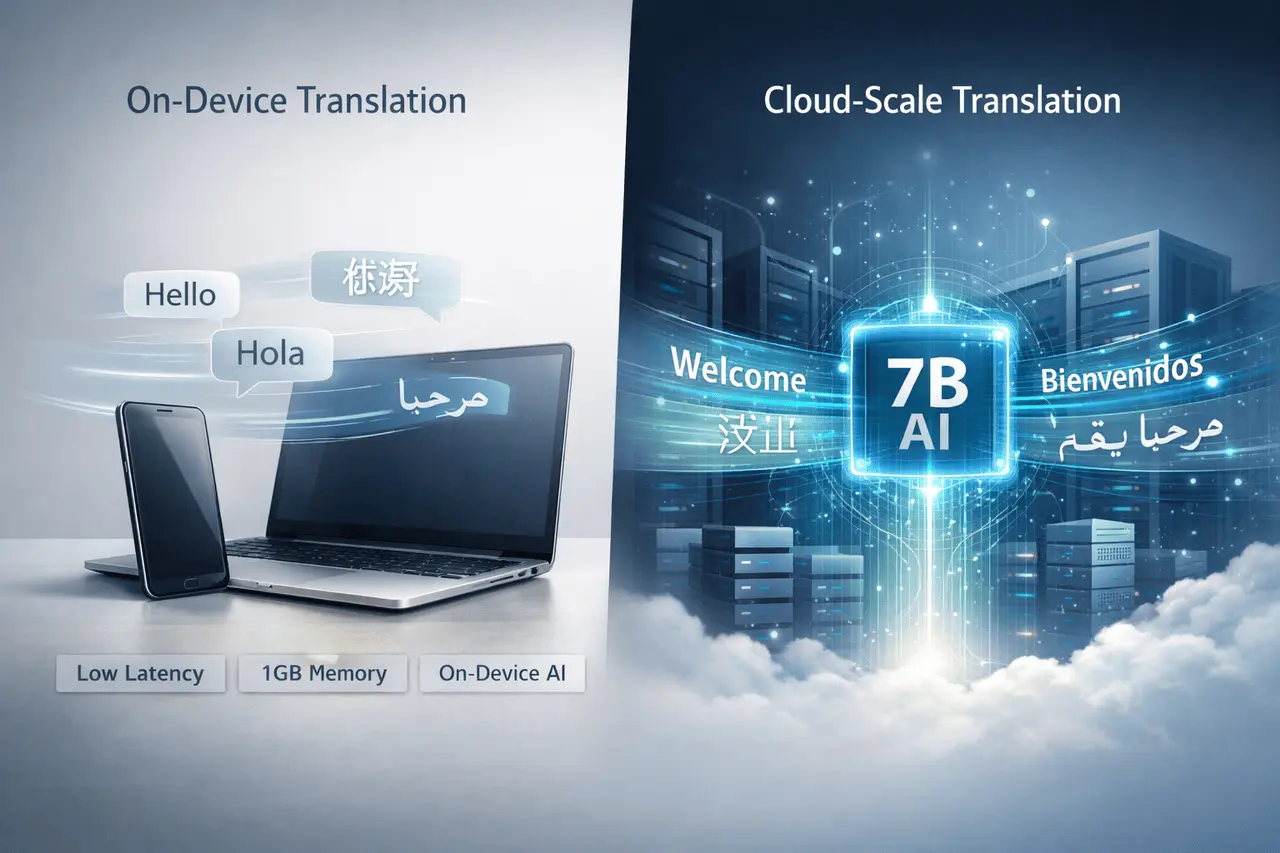
- Low latency: Approximately 0.18 seconds for generating 50 tokens
- Memory footprint: The memory footprint is around 1GB, which makes it ideal for consumer-grade hardware
- Deployment focus: On-device translation, edge computing, and lightweight servers
The 1.8B valuable model in scenarios such as:
- Desktop and mobile translators
- Offline or privacy-sensitive translation scenarios
- Chat and messaging in real-time translation
- Systems embedded in consumer devices
A combination of fast inference and low memory usage makes it a viable alternative to cloud-based translation APIs.
HY-MT1.5 7B: High-Quality Translation at Scale
The 7B model is geared toward users who require higher-quality translation and greater infrastructure.
Performance Positioning
- Created specifically to outdo the majority of mid-sized translation models
- offers a quality of translation that is equivalent to that of the top performance level of the largest private systems
- is suitable for cloud deployment as well as the pipeline for high-throughput language
This model can be beneficial for:
- Multilingual content platforms
- Enterprise translation services
- Large-scale document and media localisation
- Artificial-powered systems for customer service
In a way similar to the performance of the bigger models, HY-MT1.5 7B provides a compromise between performance and cost.
On-Device vs Cloud: One Model Family, Two Strategies
One of the most distinctive features of HY-MT1.5 is that both models are integrated into a single, consistent design principle. Instead of treating on-device and cloud translation as distinct issues, Tencent offers options optimised for each environment.
On-Device Advantages (1.8B)
- Lower latency and no dependency on networks
- Better security and privacy
- Reduced cloud infrastructure costs
Cloud Advantages (7B)
- Better accuracy in translation and nuance
- Improved handling of complicated language structures
- Scalability for large-scale workloads
This dual-model approach lets teams select based on their constraints rather than forcing a one-size-fits-all solution.
Developer and Enterprise Use Cases
HY-MT1.5 is designed to support a broad range of customers:
- Start-ups developing multilingual products with low API costs
- Enterprises seeking private translation infrastructure
- Researchers exploring multilingual modelling and evaluation
- Device makers integrate the translation directly into hardware
Since the models are open-source, they can also be tweaked to fit specific domains, such as technical, medical, legal, or regional languages.
How HY-MT1.5 Fits Into the Translation Model Landscape?
Recent years have witnessed dramatic gains in translation quality, aided by large-scale language models. But these improvements often require more computational resources.
HY-MT1.5 stands out by emphasising:
- Practical latency benchmarks
- Memory efficiency
- High-quality without excessive scale
It makes it especially important for teams that require production-ready translation, not just the ability to test performance at any price.
My Final Thoughts
Tencent’s HY-MT1.5 represents a shift in AI transformation towards models that are not only strong but also adaptable. By combining a quick, efficient 1.8B memory model with a highly performing 7B model, it can address real-world issues teams are currently facing.
For developers and organisations seeking to balance translation quality, delays, and operational controls, HY-MT1.5 represents a practical, open-source, forward-looking component for the translation community.
Frequently Asked Questions (FAQs)
1. What is it that makes HY-MT1.5 different from other models of translation?
HY-MT1.5 concentrates on efficiency in deployment as well as translation quality. It offers the user a light on-device model as well as a more efficient cloud model, both built on the same open-source community.
2. Is it possible to use HY-MT1.5 on a mobile device?
Yes. The 1.8B model was designed for on-device use and supports offline translation when integrated locally.
3. Is HY-MT1.5 suitable for enterprise-scale translation?
7B is suitable for work in enterprise environments, especially when it is deployed in private or cloud-based infrastructure environments.
4. How does memory use compare with other models?
The 1.8B model operates with 1GB of memory, making it considerably superior to similar translation systems.
5. Can developers fine-tune HY-MT1.5?
Yes. Since it is an open-source model, HY-MT1.5 can be tuned for specific language or domain-specific needs.
6. Is HY-MT1.5 meant to replace the traditional APIs for translation?
It could be an alternative for teams who need more control over their costs, as well as privacy and customisation, but the choice depends on the quality of the infrastructure and their needs.
Also Read –
Tencent HY-Motion 1.0: Open-Source Text-to-Motion AI