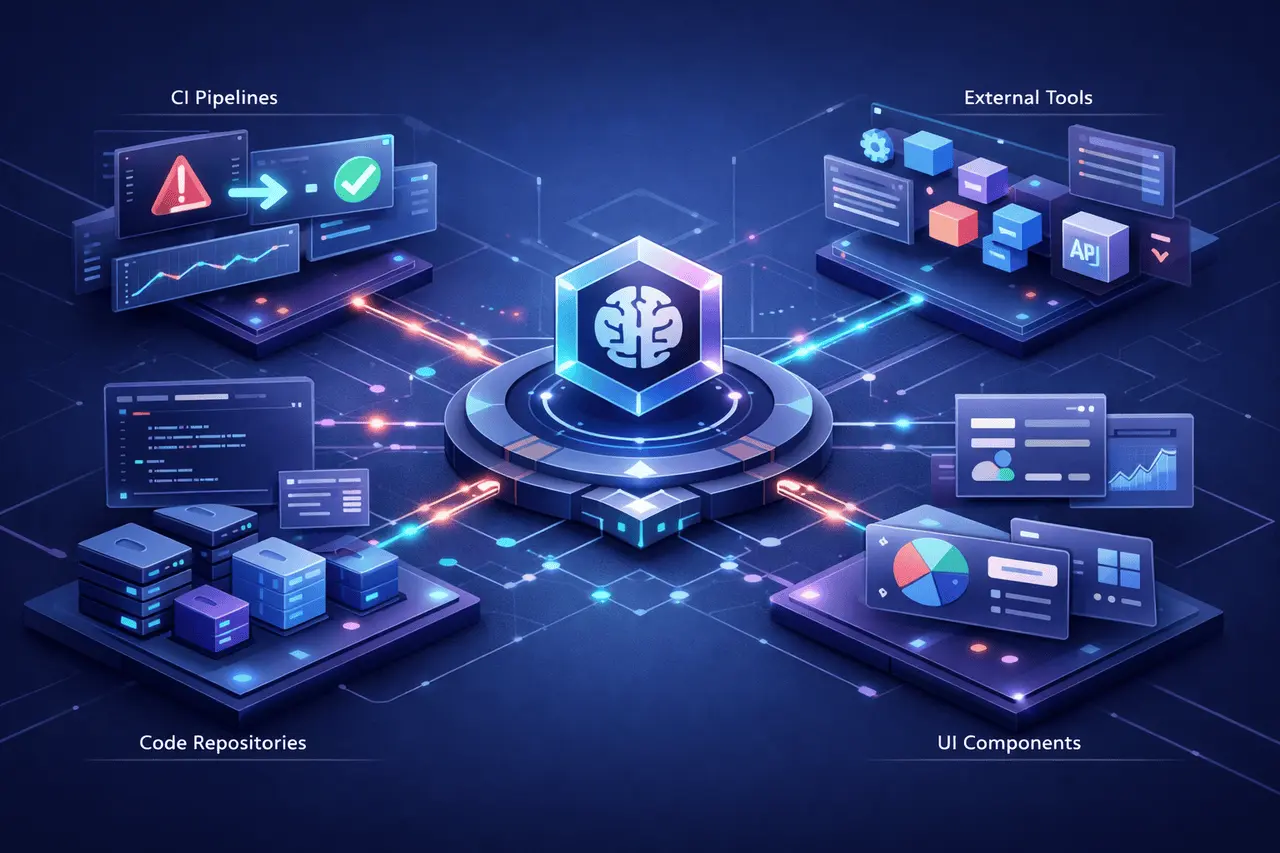


Sarvam Arya is a multi-agent orchestration system that offers a fresh approach to building solid, high-quality production AI agents. Built on solid engineering principles and with an AI-assisted development experience for developers, Arya solves the long-standing issues in current orchestration frameworks.
In a test involving an actual ETL task of extracting financial metrics from unstructured PDFs, Arya achieved approximately 5x the accuracy at a 10x lower cost than a frontier setting up a coding agent. The results indicate an evolution towards an infrastructure-grade, scalable AI agent that is suitable for enterprise deployment.
(adsbygoogle = window.adsbygoogle || []).push({});What Is Sarvam Arya?
Sarvam Arya can be described as a multiple-agent orchestration system created to facilitate sophisticated AI workflows using:
- Infrastructure-grade execution guarantees
- Hybrid agentic and deterministic control flow
- Immutable state tracking
- Declarative system configuration
- Debugging and development using LLM
In contrast to traditional agent frameworks, which focus on rapid prototyping, Arya has been designed to ensure high reliability in production and high-volume execution.
Why Sarvam Arya Matters?
The current AI agent workflows typically fall into two types:
- Simple LLM chains — autonomous but limited in complexity
- Frontier-coding agents -strong, but dependent on the supervision of a human
What’s missing is the production-grade agent advanced systems that run thousands of times per day without any manual intervention.
Sarvam Arya aims to bridge this gap by shifting advanced model use from runtime to compilation. Instead of relying on inference decisions made live, powerful models can help in:
- Translating developer intent
- Iteratively debugging systems
- Improving orchestration design
- Refining execution flows
This method takes more efficient models, better coordination, and higher quality as complements rather than substitutes.
Real-world benchmark: ETL obtained from Financial Documents
To demonstrate Arya’s capabilities, an organized ETL benchmark was run.
Task Overview
- Extract 200 financial as well as business-related metrics
- From 27 PDF documents
- Covering multi-year company performance
- Output structured information based on an established schema
Accuracy measure: Percentage of metrics extracted correctly
Results measured include execution time and the cost of each run.
Performance Comparison Table
| System Configuration | Accuracy | Cost per Run | Runtime |
|---|---|---|---|
| Frontier coding agent (baseline) | ~17% | ~$12 | 40+ minutes |
| Sarvam Arya (final iteration) | 86% | ~$1.2 | <3 minutes |
The enhancement was made by implementing a structured design through Arya’s orchestration system.
Iterative System Improvements in Arya
The ETL pipeline was developed through six design variations:
1. Single-Agent Baseline
- Initial specification-driven design
- Result: 0% accuracy
2. Parallel “Wider Agent” Architecture
- Parallel processing across years
- Smart aggregation logic
- +44% accuracy
3. Deterministic Schema Validation
- Blocks of deterministic code added
- Schema error detection
- Selective re-runs for failed metrics
- +31% accuracy
4. Prompt Refinement
- Better parsing instruction
- +1% accuracy
5. Selective Model Downsizing
- Smaller model for specific components
- -80% cost
- -1% accuracy
These enhancements emphasize Arya’s organized replay and debug capabilities, enabling efficient performance improvements rather than a trial-and-error approach to tuning.
Core Design Principles of Sarvam Arya
Arya is based on four fundamental principles that differentiate it from other orchestration tools.
1. Composable Primitives
Each system was created with eight fundamentals:
- LLM
- Agent
- MCP
- Node
- Ledger
- Task Graph
- Code Interpreter
- Artefact
This minimalist, but striking design minimizes architectural confusion.
2. Declarative Configuration
Systems are defined using a declarative syntax that separates the runtime logic from the configuration.
Key benefits:
- Clear system definitions
- Version-controlled workflows
- Integrated DevOps pipeline
- It is easier to debug and test.
3. Immutable State
Every agent write operation is an atomic commit within the append-only ledger.
This allows:
- Strong execution semantics
- Schema validation enforcement
- Replayability
- Full auditability
This design reflects the reliability of a database and is suitable for enterprise use.
4. Controlled Dynamism
Arya blends:
- The logic of determinism (loops and conditionals)
- Agentic routing decisions (LLM-driven)
This control flow hybrid guarantees:
- Structural reliability
- Intelligent flexibility
- Unpredictability reduced
Traditional Orchestration vs Sarvam Arya
| Capability | Traditional Agent Frameworks | Sarvam Arya |
|---|---|---|
| Execution guarantees | Limited | Infrastructure-grade |
| State management | Often ad-hoc | Immutable ledger |
| Debug/replay tools | Minimal | Built-in step-wise replay |
| Configuration style | Imperative | Declarative |
| Production scalability | Experimental | Designed for scale |
This shift in architecture brings AI agents closer to established engineering methods for systems.
Practical Applications
Sarvam Arya can be ideally suited to:
- Financial document ETL
- Regulatory reporting automation
- Enterprise document intelligence
- Extracting structured data at a large scale
- Internal analytics pipelines
- Multi-step, complex reasoning system
Companies that handle high volumes and schema-sensitive workflows benefit most from Arya’s reliability model.
(adsbygoogle = window.adsbygoogle || []).push({});Benefits of Sarvam Arya
Performance Gains
- Significant accuracy improvements
- Lower operational cost
- Runtime latency is reduced
Operational Reliability
- Deterministic validation
- Immutable execution logs
- Schema enforcement
Developer Experience
- LLM-assisted system design
- Structured debugging
- Replayable execution traces
Limitations and Considerations
- Requires architectural planning; it is not a light prototyping tool.
- Ideal for repeatable, structured workflows, it was designed for production environments rather than single-use tasks.
Companies must assess the complexity of their workloads and deployment requirements before implementing an orchestration system with multiple agents.
Open-Source Roadmap
Sarvam intends to open-source Arya and position it as an infrastructure-as-a-service offering, similar to databases and container orchestration systems.
It will comprise:
- Full containerized runtime
- Interface for replay and debug
- LLM-powered development tooling
This is a signal of an intention to standardize production-grade agent orchestration.
(adsbygoogle = window.adsbygoogle || []).push({});My Final Thoughts
Sarvam’s Arya multi-agent orchestration platform offers an organized, systems-engineering approach that can be applied to AI Agent workflows. By combining declarative design, impermanent state changes, controlled dynamism, and modeling-assisted design, Arya addresses reliability and scalability issues in current agent frameworks.
The improvements it has demonstrated, which have reached 86% accuracy in only a fraction of the cost and duration, show the advantages of orchestration for production. As AI agents shift from tools for experimentation to enterprise infrastructure, platforms such as Arya indicate the next stage of reliable, flexible AI systems.
FAQs
1. What exactly is the Sarvam Arya multi-agent orchestration platform?
Sarvam Arya is an enterprise-oriented AI orchestration system that enables robust, scalable workflows across multiple agents through declarative configuration and mutable state.
2. How can Arya help improve ETL accuracy?
Arya combines deterministic document validation with structured debugging and iterative design refinement to improve extraction accuracy during document processing.
3. What is the significance of immutable state for AI agents?
Immutable state ensures that every agent’s action can be recorded atomically, improving the traceability, reproducibility, and reliability of production workflows.
4. Are Arya appropriate for real-time applications?
Yes, as long as the workflow is well-structured and repeatable. Arya’s architecture allows for the use of low-latency systems once they have been designed and compiled.
5. How can Arya help reduce the cost of operations?
By deploying smaller models into non-critical components and optimizing orchestration, Arya reduces unnecessary inference overhead.
6. What is it that makes Arya different from other LLM chains?
In contrast to standard LLM pipelines, Arya provides infrastructure-level quality assurances, modular observation, deterministic validation, and enterprise-scale scalability.
Also Read –
ChatGPT Ads Explained: What Users Should Know?