At the end of 2025, the AI research community announced an essential update to image-generation technology, Qwen-Image-2512. It was released as an upgrade to the Qwen Image series. This model delivers significant improvements in visual realism, clarity, and text processing, positioning it as a leading contender among open-source text-to-image models. Tests conducted on the model have shown that Qwen-Image-2512 is not only a leader in the open-source community but also capable of competing with a variety of proprietary models.
What Is Qwen-Image-2512?
Qwen-Image-2512 is a sophisticated text-to-image generation model within the Qwen family of AI models developed by Alibaba. It is built on the foundation of earlier Qwen-Image releases. It contains targeted updates aimed at improving texture quality, realism, and multi-element composition, particularly where people figures and embedded text are used. It is available under the Apache-2.0 license, which means developers and individuals can utilise and modify it in accordance with open-source guidelines.
Key Improvements in Qwen-Image-2512
Version 2512 includes various technical improvements over previous versions and is divided into three categories:
1. More Realistic Human Representation
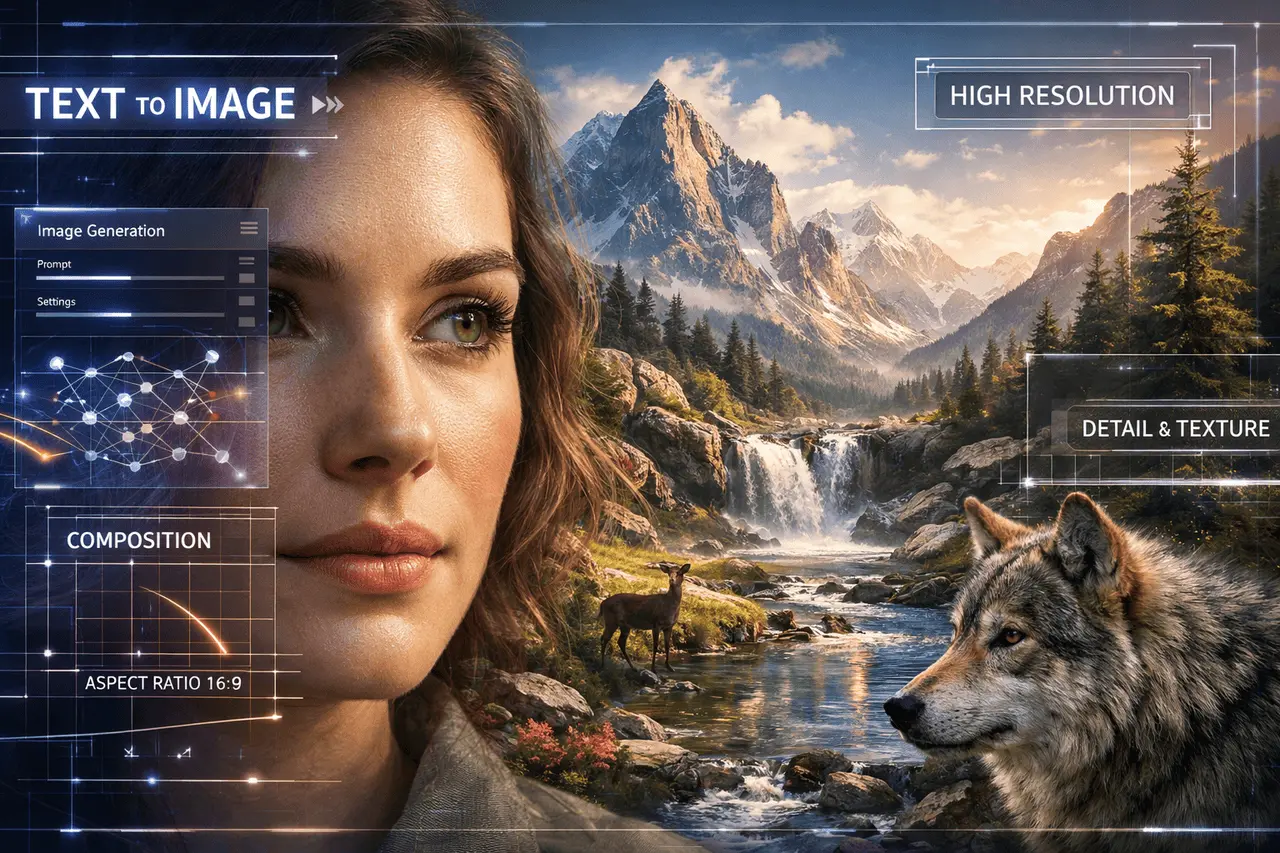
The most noticeable enhancements in Qwen Image-2512 are its ability to render human figures with greater authenticity. The model has drastically diminished the recognisable “AI look,” the artificial smoothness and absence of anatomical nuance in previous AI-generated faces or images. In its place, the model creates greater facial features, better age-related details, and the most natural-looking skin tones, resulting in renderings that look more like the real world or professional illustrations.
This feature is essential in applications that range from character design and artistic visualisation to marketing and digital art, where the authenticity of human images is necessary.
2. Finer Natural Textures
Beyond the face, Qwen-Image-2512 offers better, more detailed renditions of elements from nature, such as water bodies, landscapes, animal fur, and diverse materials like wood or textiles. These enhancements aren’t just cosmetic; they result from improvements in pattern recognition and gradient synthesis. These result in images with more quality and depth.
For developers and creators, it means images require less manual tweaking and fewer adjustments, streamlining workflows for creating high-quality AI-assisted content.
3. Stronger Text Rendering and Composition
The biggest challenge for AI image generation modellers is the precise rendering of text embedded in images, for instance, when creating posters, diagrams, or mockups for user interfaces. Qwen-Image-2512 addresses this issue dramatically, with greater text precision, more efficient layout control, and higher-quality reproduction of content across multiple lines.
This enhancement broadens the applications to include educational and technical materials, branding images, and other scenarios where text clarity is essential.
Performance in Benchmarks
To demonstrate its capabilities, Qwen-Image-2512 underwent more than 10,000 blind test rounds on an independent testing platform, AI Arena. Through rigorous tests that pit algorithms for generating images against a wide variety of real-world stimuli, the model was deemed the best open-source image generation system, highly rated against many closed-source rivals.
This is a position of leadership, given the competition in which many high-performance models are exclusive and developed by utilising extensive private data for training.
Accessibility and Open-Source Value
Qwen-Image-2512 is readily available to researchers, developers, and enthusiasts via platforms such as Hugging Face and ModelScope. Since it’s licensed under the Apache-2.0 licence, users can examine, tweak, or incorporate the model into their applications without any restrictions.
Apart from performance enhancements, the open-source design enables community participation, creating a community-driven development environment that will improve performance and encourage wider use.
Implementation is assisted through integrations with tools such as ComfyUI, which enable the model to be executed locally on compatible hardware, including systems without the most powerful GPUs or the correct configuration.
Real-World Use Cases
The enhancements included in Qwen Image-2512 let you unlock or enhance multiple real-world applications.
- Creative Content Production: Professional designers and artists can utilise the model to create concept artwork, character designs, and landscapes with high-quality visuals.
- Marketing and Branding: With improved text, the system enables the creation of promotional materials, including posters, product visuals, and social media content.
- Educational and Technical Visuals: Precise rendering of diagrams and mixed text-image content can aid in the design of educational materials.
- Prototyping and UX/UI Mockups: Designers can create digital interfaces with integrated text more effectively than before.
These examples demonstrate the significant benefits of an efficient, open-source image generation system across commercial and non-commercial endeavours.
Challenges and Future Directions
Despite its strengths, Qwen Image-2512, like any other generative model, has flaws. Specific highly complex compositions may be prone to synthesis errors, and the performance of Qwen-Image-2512 may be affected by prompt quality. It is essential to recognise that achieving photorealistic results across all domains is an ongoing challenge in AI research.
Future versions could focus on reducing artwork and improving scene quality with greater detail, as well as enhancing control over stylistic effects.
Final Thoughts
Qwen Image-2512 illustrates how far open-source image generation has come in a short period. Its enhancements in image quality, visual realism, and text accuracy expand the range of possible applications, from creative marketing and design to prototyping and education, without the limitations typical of proprietary software. The combination of robust benchmark performance, flexible licensing, and a wide range of access makes it an excellent choice for creators and developers who require both control and quality. Although no generative model is free of limitations, Qwen Image-2512 establishes a new standard for the capabilities open-source image models can achieve, indicating that a future driven by community AI tools will stand alongside closed-source platforms.
Frequently Asked Questions
1. What is the main difference between Qwen-Image-2512 and other models of image generation?
Qwen-Image-2512 is distinguished by its realistic human-like rendering, natural-looking enhanced textures, and robust text integration. In addition, it is regarded as an industry-leading open-source software model, as evidenced by benchmark tests conducted by independent experts.
2. Where can I get access to or use Qwen-Image-2512?
The model is accessible via Hugging Face and ModelScope, and can also be run locally in programs such as ComfyUI when your hardware meets the memory requirements.
3. Does Qwen Image-2512 come with a free license to use to create commercial-use projects?
Yes. The Apache-2.0 license allows broad commercial use, provided you abide by its terms.
4. Does this model support images that contain multilingual text?
The new text-rendering capabilities are now available in multilingual settings. Qwen-Image-2512 can effectively create complex text layouts in a variety of languages.
5. How does this model stack up with closed-source alternatives?
While specific proprietary systems may still be the best in particular areas, Qwen-Image-2512 has its own strengths in testing and competition. It typically delivers image quality comparable to that of other tools, especially given its open-source nature.
6. What kind of hardware is best for use in a local setting?
To run locally, sufficient system memory is essential. Even without a dedicated GPU, the model will run on systems that have adequate combined RAM/VRAM if configured correctly.
Also Read –
Qwen Image Edit 2511: Advanced AI Image Editing Model