
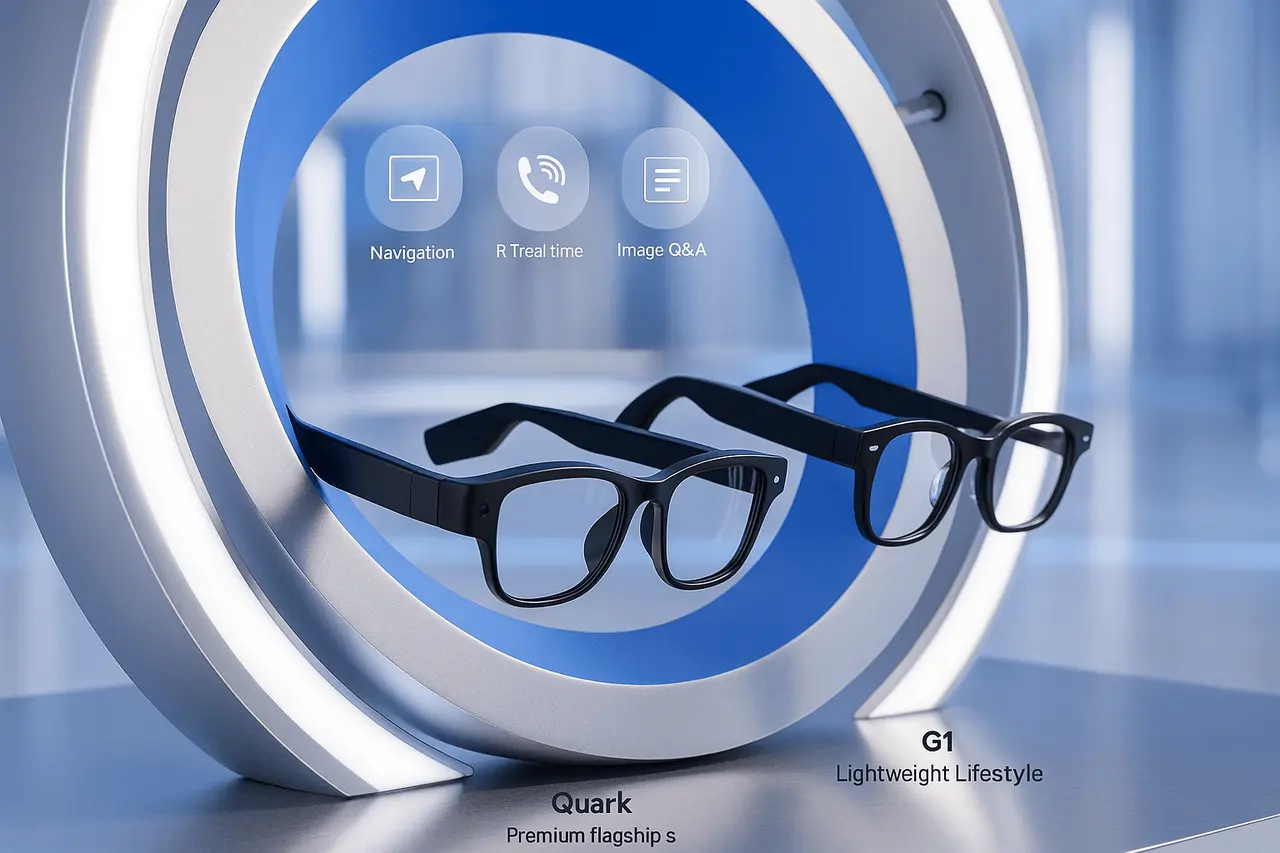
Alibaba has officially joined in the AI Wearables game with Quark -the smart glasses that are designed to incorporate generative AI features and a full e-commerce integration into a product that looks and feels like normal glasses. The Quark line is available with two versions that include the top of the line S1 featuring micro-display lenses and a more lifestyle-oriented G1. Both models heavily rely on Alibaba’s Qwen large-scale model of language and Alibaba’s network (Alipay, Taobao, Amap and music services) which aims to make every day tasks, from translation to payment -available through your glasses.
In this article, you will get to know about Quark AI Glasses, their features, specifications, real-world use cases, and how the S1 and G1 models redefine wearable AI.
Quark AI Glasses are actual practical features
Quark’s main selling feature is the fact that it offers a modern LLM experience using hands-free tools that are actually used by people. The early report and Alibaba’s pages for products showcase the features like near-eye navigation, translation on the fly of meetings, meeting transcription, picture questions and answers (point your camera at the screen and ask questions), as well as audio through bone conduction, and a direct connection with Alipay to make quick payments, and Taobao to search for prices. These features are intended for travellers, shoppers and professionals who need help with context, without having to reach for a mobile.
Hardware and design two different models with distinct goals
The S1 is the top-of-the-line model. It comes with bright micro-display motors (reported in the form of micro-LED, or micro-OLED based on the coverage) and adjustable settings for viewing and a frame that’s designed to work with prescription lensesspecifically designed for those who require an ergonomic display for long-term use. The G1 is slimmer and is positioned as a more casual, fashionable alternative. It retains cameras and AI capabilities, however it does not have the S1’s bright twin displays in order to reduce weight and costs. Initial hands-on leaks and spec leaks suggest bone-conduction audio integrated cameras for context vision, as well as the ability to control voice and touch in the arm rests.
The battery’s life span and practical useability
One of Quark’s best-known design choices is a dual-battery swappable system that Alibaba claims can extend the battery’s usage up to a whole day (reports indicate up to 24 hours of combined usage, based on the configuration). This kind of modular battery system is a solution to a problem of earlier smart glasses designs: the limited time to run. With batteries that are user-replaceable Alibaba hopes to eliminate one of the biggest issues that hinders real-world applications.
Platform and performance: Where the AI is running?
Quark AI Glasses are built on an architecture with multiple chips. The media reports speak of the Snapdragon AR1 (or similar AR-focused SoC) that is paired with a coprocessor to perform tasks on the device efficiently while also relying on cloud connectivity to Qwen for more sophisticated multimodal reasoning. The hybrid approach is designed to combine low-latency, always-on capabilities (like notification and standard instructions) along with cloud-based AI for more complex queries using text and images. Since Qwen is Alibaba’s own LLM, the product is directly integrated to Alibaba services for payments and commerce.
Quark AI Glasses: Prices and availability
Alibaba introduced Quark in China the first time. Pricing snapshots from various retailers provide the S1 at around 3,799 Y (around $500-$540) while the G1 at around 1,899 (around $265-$270), and are available through the major Chinese retailers and Alibaba’s platforms. International availability is expected in the coming year, based on company announcements, but specific dates and markets were not set when the product launched.
How Quark stands up to its competitors?
Quark’s closest competitors are wearable products that are made available by Meta (Ray-Ban/Meta Collaborations), Xiaomi, Xreal and a few different AR startups. What sets Quark apart from Alibaba is its tight integration of payments and commerce: While other companies focus on games or social, Alibaba is leaning into shopping, navigation using maps, and seamless payment flows, which is a strategy to convert the physical world into commerce without a lot of hassle. This strategy is logical for a company whose core strengths are a network of services and apps.
Quark AI Glasses: Privacy and practical concerns
Smart glasses are bound to bring security and privacy issues. Quark’s cameras onboard, the always-listening microphones, as well as the extensive integration with payment and e-commerce applications will raise questions about the data that is stored locally and what data is transferred to Alibaba’s cloud, the length of time that images and transcripts are stored, and what integrations with third party companies are approved. Alibaba’s marketing emphasises convenience for the ecosystem but customers should verify official privacy guidelines and regional guidelines for the product when it is shipped outside of China.
The initial coverage does not yet contain complete privacy information, therefore both enterprise and consumer buyers need to be sure to check for complete security documents prior to deploying large-scale installations.
Who should think about Quark glasses?
- Frequent travelers who require real-time navigation and translation.
- Shoppers who can benefit from immediate price checks and payments flow.
- Knowledge workers who require meetings transcription, notes that are hands-free.
- Early adopters who value more of a tight ecosystem experience and live in areas where Alibaba’s offerings are the mainstay.
If you’re not part of Alibaba’s ecosystem, certain services (payments and localized shopping) are naturally less engaging.
Final Thoughts
Quark AI Glasses from Alibaba are Alibaba’s most explicit statement that the next generation of computing for consumers will combine smaller screens, multimodal AI and deep integration with services. For customers already in Alibaba’s ecosystem Quark promises useful, features that make the glasses into a useful assistant. For all other users, Quark raises the stakes for its competitors.
The real winner will be the one that resolves the issues of battery life, privacy control and truly practical uses without making wearables an unintentional privacy nightmare.
FAQs
1. Are Quark glasses AR? Do they overlay graphics onto the real world?
The S1 uses near-eye micro-display technology (micro-LED/micro-OLED and diffractive waveguides in some reports), which places graphics in your field of view in a way similar to other AR eyewear. The G1 concentrates more on camera/AI functions, with no bright dual display.
2. How can I pay using the Quark Glasses?
Yes. Alibaba insists on Alipay integration for contactless payments as well as Taobao price lookups as a key convenience feature. The way that payments are handled in other countries will be dependent on local agreements as well as payment rails.
3. Can Quark run without internet access?
The most basic on-device functions (notifications and audio commands, voice) can be performed offline. However, more multimodal queries that are based on Qwen’s cloud inferencefor example, intricate image Q&A, or long conversation in context — will require internet connectivity. Dual-battery technology helps improve availability, however connectivity is still crucial to fully function.
4. What is the comfort of frames of Quark?
The reports describe fairly light frames (S1 51 g in certain areas) as well as temple styles that are designed for a balanced weight distribution. Alibaba also provides prescription lens assistance. Actual comfort will vary based on the individual and their prescription needs.
5. When and where can I buy them?
Quark was available in China initially via Tmall, JD.com and other channels. Alibaba has announced that the availability of international versions in the coming year, although the exact date and markets remain unknown. Prices at launch were 399 dollars for S1 and 1,899 dollars for G1.