
Phoenix-4 real-time human rendering represents a significant advancement in AI-driven avatars and digital humans. Designed to generate every pixel at runtime while expressing dynamic emotional states, Phoenix-4 moves beyond traditional video synthesis into fully interactive, behaviour-aware AI.
Unlike pre-rendered or loop-based avatar systems, this model generates continuous facial behaviour, listens actively, and reacts contextually in real time. The result is a human behaviour engine capable of delivering natural, emotionally responsive conversations across industries such as healthcare, therapy, and education.
What Is Phoenix-4 Real-Time Human Rendering?
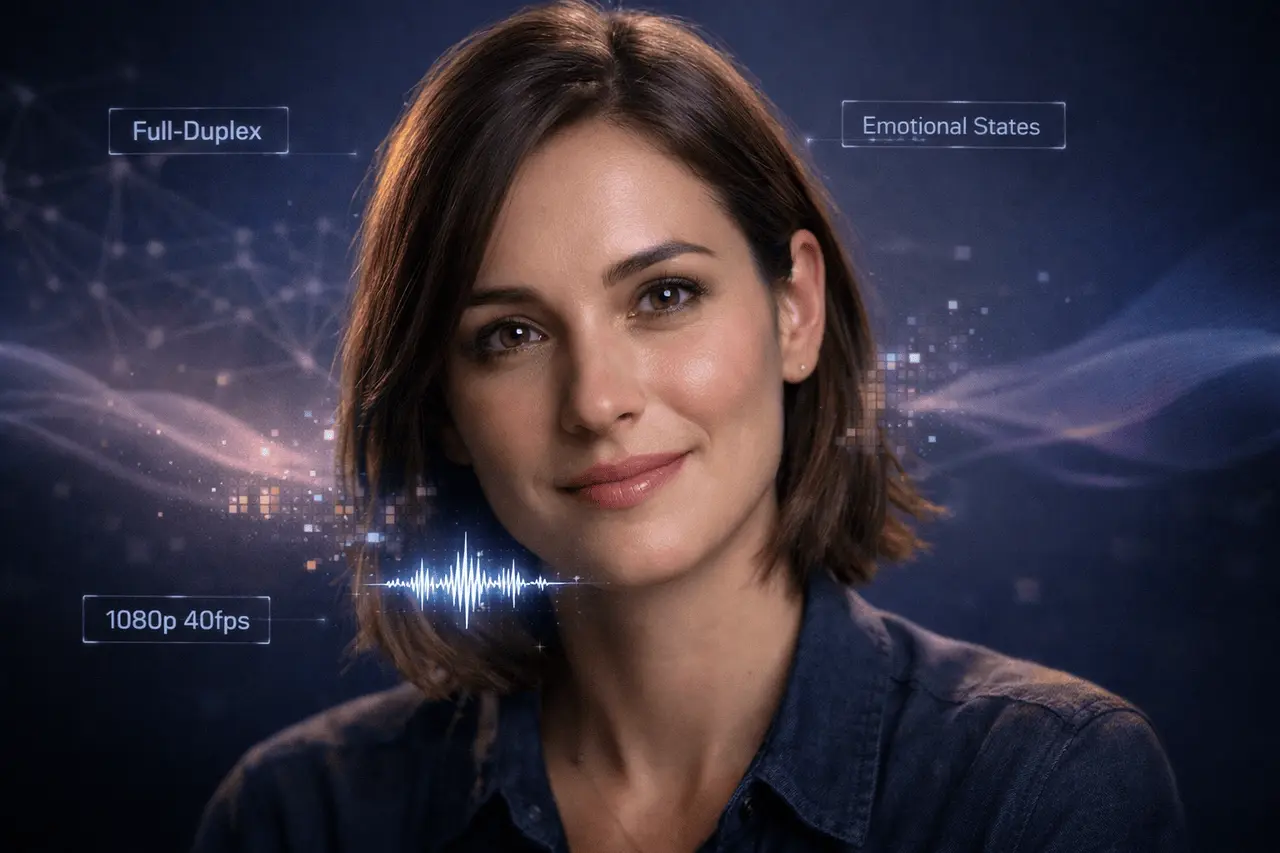
Phoenix-4 is a real-time AI model built for fully dynamic human rendering. It produces full-face video, including eyes, lips, head pose, and hair, at 40 frames per second (fps) in 1080p resolution, with low latency suitable for live interaction.
Key characteristics include:
- Runtime pixel generation (no pre-rendered frames)
- Continuous emotional expression
- Full-duplex listening and response
- Identity preservation across expressions
- Context-aware behavioural cues
Rather than animating predefined states, the system learns a continuous behavioural representation of human movement and conversational dynamics.
How Phoenix-4 Differs from Traditional Avatar Systems?
Traditional AI avatars typically rely on:
- Pre-recorded video loops
- Scripted emotional states
- Latency-heavy rendering pipelines
- Limited facial microexpression control
Phoenix-4 introduces a fundamentally different approach.
Traditional Approach vs Phoenix-4
| Feature | Traditional Avatars | Phoenix-4 |
|---|---|---|
| Frame Generation | Pre-recorded or stitched | Every pixel rendered in real time |
| Emotional Control | Limited, discrete states | 10+ emotional states with seamless transitions |
| Listening Behavior | Looping idle animations | Context-aware nods, gaze, microexpressions |
| Architecture | Animation-based pipelines | Hybrid Gaussian–diffusion model |
| Output Performance | Variable | 40fps at 1080p |
This shift enables more natural interaction patterns that resemble real human conversation.
Emotional Intelligence in Real Time
Generating and Controlling Emotional States
Phoenix-4 can generate and control more than ten emotional states, including:
- Happiness
- Sadness
- Anger
- Surprise
- Fear
- Excitement
Emotions transition seamlessly during live conversations. They can be:
- Directed externally via a large language model (LLM)
- Generated contextually through integrated perception systems such as Raven-1
Instead of switching between rigid facial presets, the model produces continuous, emergent microexpressions that evolve naturally with conversational flow.
Identity Preservation Across Emotions
A common challenge in generative human rendering is maintaining facial identity during extreme emotional shifts. Phoenix-4 preserves identity consistency even across subtle or intense expressions, ensuring realism and trustworthiness in high-stakes interactions.
Full-Duplex Listening: Real-Time Reaction While You Speak
Human conversation depends as much on listening as speaking. Phoenix-4 introduces full-duplex behaviour, meaning it:
- Listens while the user speaks
- Understands context in real time
- Generates responsive visual feedback immediately
This includes:
- Context-aware nods
- Eye gaze shifts
- Head movements
- Microexpressions synchronised with speech rhythm
Rather than replaying idle animations, the system generates listening frames dynamically based on what is being said. This reduces conversational friction and increases perceived engagement.
The Hybrid Gaussian–Diffusion Architecture
Phoenix-4 is built on a novel hybrid Gaussian–diffusion architecture designed for real-time pixel generation.
How does it work?
- Gaussian modelling helps maintain a stable structure and identity.
- Diffusion processes generate fine-grained facial detail.
- Every frame is newly generated rather than interpolated.
This architecture allows the model to:
- Produce full-face and head-pose behaviour
- Synchronise expressions to conversational emotion
- Maintain high fidelity at 40fps in 1080p
The result is smooth, low-latency rendering suitable for live, interactive applications.
Real-World Applications of Phoenix-4
The technology is particularly impactful in environments where empathy and engagement are essential.
Use Cases by Industry
| Industry | Application | Benefit |
|---|---|---|
| Healthcare | Virtual patient intake, remote consultations | Improved trust and engagement |
| Therapy | AI-assisted emotional support | More natural emotional mirroring |
| Education | AI tutors and instructors | Increased student focus and connection |
| Customer Support | High-touch digital agents | Enhanced conversational realism |
In these contexts, the ability to express emotional nuance and to engage in active listening can significantly enhance the user experience.
Benefits of Phoenix-4 Real-Time Human Rendering
1. Natural Human-AI Interaction
Microexpressions, eye movements, and synchronised head movements replicate real conversational cues.
2. Emotional Range and Control
Support for multiple emotional states with seamless transitions improves adaptability across use cases.
3. High Performance Rendering
Running at 40fps in 1080p ensures fluid motion without visual lag.
4. Continuous Behavioural Modelling
Rather than switching states, the system generates emergent behaviour from learned conversational patterns.
Limitations and Practical Considerations
While Phoenix-4 represents a significant step forward, organisations should evaluate:
- Infrastructure requirements for real-time 1080p rendering
- Integration complexity with LLM-driven systems
- Latency sensitivity in live environments
- Ethical considerations in deploying emotionally expressive AI
High-quality real-time rendering may require optimised hardware environments depending on deployment scale.
Why Phoenix-4 Matters for the Future of Digital Humans?
Human communication evolved face-to-face. Meaning is conveyed not only through words but through subtle physical cues, microexpressions, nods, gaze, and emotional transitions.
By modelling these behaviours in real time, Phoenix-4 moves AI avatars closer to true conversational presence. It shifts digital humans from scripted video interfaces to adaptive, emotionally responsive agents.
This evolution aligns with broader trends in:
- Generative AI
- Emotion-aware AI systems
- Real-time diffusion models
- Multimodal AI interaction
The technology sets a new benchmark for what human-AI interaction can feel like.
My Final Thoughts
Phoenix-4, a real-time human rendering system, represents a major advancement in AI-driven digital humans. By generating every pixel at runtime, modelling continuous behavioural dynamics, and supporting full-duplex emotional interaction, it bridges the gap between scripted avatars and natural human conversation.
With 40 fps 1080p performance, dynamic emotional control, and context-aware listening, Phoenix-4 sets a new standard for immersive human-AI interaction. As emotionally intelligent AI systems become more integrated into healthcare, education, and support environments, real-time human rendering technologies like Phoenix-4 will play a central role in shaping more natural and empathetic digital experiences.
FAQs About Phoenix-4 Real-Time Human Rendering
1. What makes Phoenix-4 different from other AI avatar models?
Phoenix-4 generates every pixel in real time using a hybrid Gaussian–diffusion architecture. It also supports full-duplex listening and dynamic emotional control.
2. What resolution and performance does Phoenix-4 support?
The model runs at 40 frames per second in 1080p resolution with low latency, suitable for live conversation.
3. Can Phoenix-4 control specific emotions on demand?
Yes. Emotional states can be directed through external LLM systems or generated contextually. The model supports more than ten emotional states.
4. What is full-duplex interaction in Phoenix-4?
Full-duplex means the system listens, processes, and reacts visually while the user is still speaking, producing real-time nods and microexpressions.
5. Is Phoenix-4 suitable for healthcare and therapy applications?
It is designed for environments where empathy and emotional responsiveness matter, including healthcare, therapy, and education.
6. Does Phoenix-4 use pre-recorded animations?
No. Every frame is generated at runtime. The model does not rely on looping video clips or predefined animation states.
Also Read –
Firecrawl Browser Sandbox for AI Web Automation