
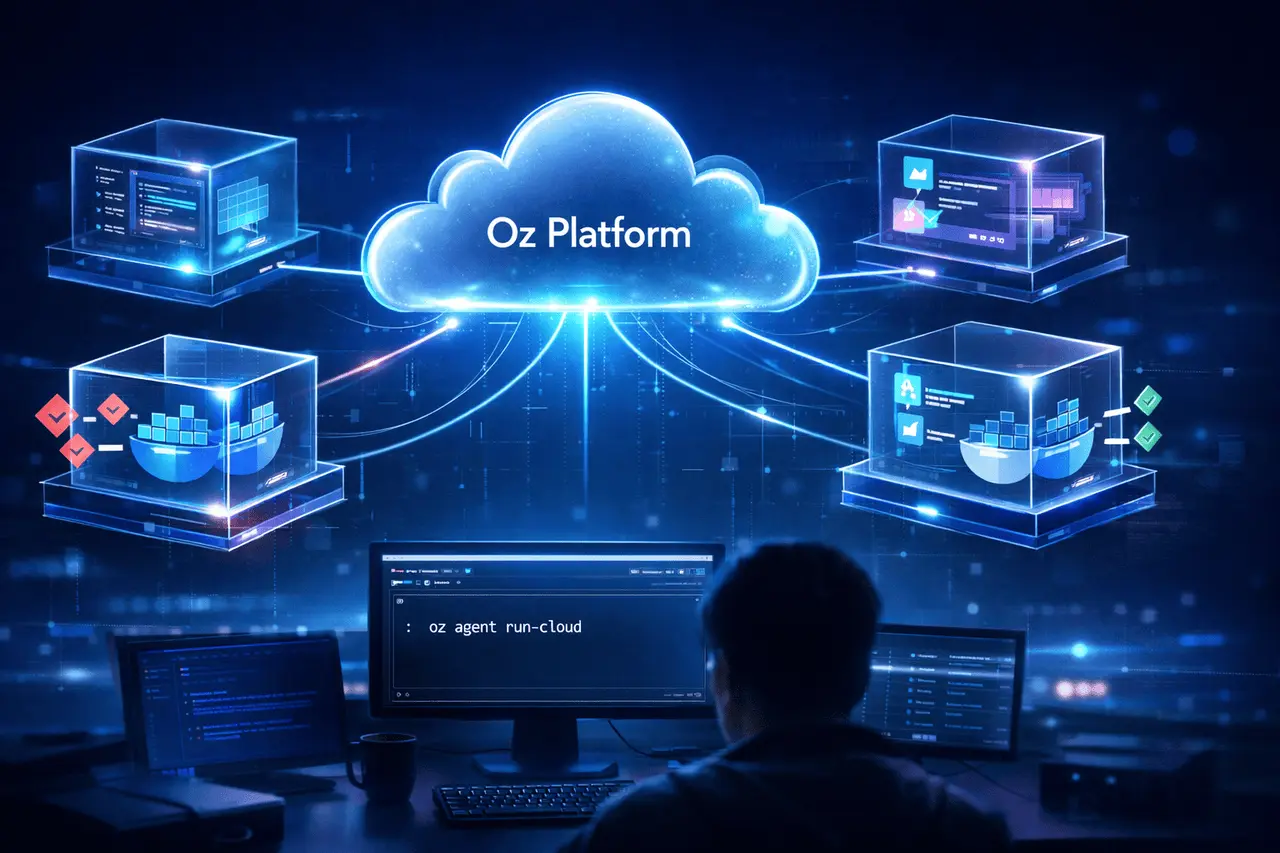
The Oz platform is an agent orchestration platform that runs in the cloud, designed to help engineering teams create, manage, and automate AI-powered programming agents at scale. Instead of having a single agent locally, Oz lets developers start hundreds of cloud-based agents, each with its own Docker environment, directly from a terminal, a browser, an API, or a mobile device.
The result is multitasking software development workflows that allow agents to create, test, and analyse, and even open pull requests, while developers focus on more complex tasks.
This article describes what the Oz Platform is, how it functions, what it does, and how teams could leverage it to scale AI automation in modern development process pipelines.
What is it? Oz Platform?
The Oz platform is an infrastructure layer that orchestrates AI agents running in the cloud.
Every agent runs within an isolated Docker Sandbox, which allows the agent to
- Modify and access Code repositories
- Install dependencies
- Execute tests
- Generate artifacts
- Open pull requests
- Perform automated tasks that are scheduled
Unlike local coding assistants, Oz agents work independently in cloud-hosted environments. It allows teams to deploy multiple concurrent agents without overburdening local machines.
Why Cloud Agent Orchestration Matters?
Modern software teams increasingly depend on AI Coding assistants. But, the traditional tools are limited because:
- local compute limitations
- Single-session workflows
- Limited repository scope
- Manual supervision
Oz platform solves these problems by creating a cloud-based agent orchestration that allows:
- Parallel task execution
- Multi-repository workflows
- Team-wide visibility
- Automated scheduling
- Persistent cloud environments
This transition shifts AI agents from interactive assisters into autonomous partners.
What is the Oz Platform Works?
1. Cloud-based Docker Environments
Every agent runs within the container it is in. Docker container.
This guarantees:
- Environment isolation
- Dependency flexibility
- Reproducible builds
- Secure sandboxing
Developers can modify the Dockerfile and add dependencies via the CLI. Agents aren’t only restricted to a single repository. They can work across all codebases and allow multiple PRs to be opened from a single command.
2. CLI-Driven Agent Management
The Oz platform is a programmable CLI (oz) that allows:
- Agents for launch within the cloud
- Scheduling automations
- Managing environments
Some examples of workflow are:
- An agent is running with a prompt
- Creating recurring automation schedules
- Updating cloud sandboxes
This design lets teams incorporate Oz into CI/CD pipelines and developer tools.
3. Live Session Management and UI Access
The platform comes with a central UI for teams where they can:
- Check all runs of the agent
- Live sessions
- Examine plans and artifacts
- Review Pull Requests for Revision
Every run comes with an interactive live link that allows developers to watch or even interfere while the agent is in action.
This transparency enhances the governance and debugging capabilities as compared to a black-box automation system.
Core Capabilities of the Oz Platform
Feature Comparison Table
| Feature | Oz Platform | Traditional Local AI Tools |
|---|---|---|
| Cloud execution | Yes | No |
| Docker sandbox per agent | Yes | No |
| Multi-repository support | Yes | Limited |
| Parallel agent runs | Yes | Limited by local hardware |
| Scheduled automation | Yes | Rare |
| Team-wide visibility | Yes | No |
| REST API & SDK support | Yes | Limited |
This architectural distinction allows considerably more flexible workflows.
Skills and Automation in Oz
A key feature of the Oz platform is its Skill system. Oz platform lies in its skill System.
A Skill is a reusable capability that can be deployed as a cloud computing agent.
Prebuilt Skills Include:
- Issue triage
- Audits of accessibility
- Test generation
Teams can also use and commit their own customized Skills.
Transforming Skills into Automations
Oz permits developers to transform skills into repeatable workflows with cron-based scheduling.
Examples include:
- Log analysis
- Cleaning stale feature flags
- Scan for vulnerability
- Automated maintenance of the repository
This allows for continual AI-driven maintenance tasks, without manual trigger.
Making Agent-Powered Apps
The Oz platform includes:
- REST API
- TypeScript SDK
- Python SDK
These interfaces enable teams to develop applications powered by cloud agents.
For example, developers can create:
- Issue triage dashboards
- Internal developer tooling
- Terminal-based TUI applications
- Automation pipelines
This takes Oz beyond orchestration and into platform-level AI technology.
Use Cases for Industry
| Use Case | Benefit |
|---|---|
| Large engineering teams | Parallelized PR generation |
| DevOps teams | Automated environment cleanup |
| Security teams | Scheduled vulnerability checks |
| Open-source maintainers | Issue triage and deduplication |
| QA teams | Automated test generation |
Flexible Docker environments enable Oz to adapt across different workflows.
Advantages of the Oz Platform
1. Massive Parallelization
Create hundreds of agents at once to manage:
- Refactoring
- Documentation updates
- Bug fixes
- Dependency upgrades
2. Environment Control
Full Docker customization ensures agents work with the exact equipment required.
3. Multi-Repo Coordination
Agents are able access multiple pull requests from different repositories in the same prompt.
4. Team Visibility
The management interface ensures transparency and accountability.
5. Automation at Scale
Scheduled tasks enable continuous AI-driven operations.
Limitations and Considerations
While it is powerful, businesses ought to think about:
- Governance guidelines to automate PR
- Infrastructure costs for cloud execution
- Security controls to control access to the repository
- Human review workflows
Autonomous systems are still subject to organized surveillance.
Practical Tips for Teams
Before implementing Oz: Oz platform
- Define clear automation policies
- Establish PR review standards
- Restrict access to tokens and secrets
- Monitor cloud resource usage
- A pilot that has a non-critical repository
A phased rollout helps ensure safe integration.
Oz Platform and the Future of AI Development
The Oz platform marks a shift from interactive AI aid to controlled AI execution.
Instead of directing only one person at a time, teams may:
- Deploy agent fleets
- Automate repetitive work
- Run maintenance is performed in the background
- Scale development workflows
This model is in line with trends that are more general in:
- AI agent orchestration
- Cloud-native automation
- DevOps integration
- Autonomous software systems
As AI tooling improves, orchestration layers such as Oz could become the foundational infrastructure for engineering teams.
My Final Thoughts: What is the significance of Oz Platform Matters?
The Oz platform offers a scalable cloud model that allows orchestration of agents in modern Software Development.
In combining Docker Sandboxing, programmable CLI controls, scheduled, multi-repository automated workflows, and the ability to see across teams, AI agents become an integrated unit of execution.
For companies that want to automate repetitive development tasks, scale AI-driven workflows, and build applications powered by agents, Oz represents a significant advancement toward cloud-based, self-contained engineering.
The development process increasingly incorporates AI and orchestration tools like Oz, which could be the next stage of the software delivery infrastructure.
Frequently Answered Questions (FAQs)
1. What exactly is the Oz platform being used to do?
The Oz platform can be used to manage AI agents in the cloud, enabling automated code tasks, pulling requests, triage, and planned maintenance workflows.
2. How does the Oz platform differ from local AI coding assistants?
Unlike local tools, Oz can run agents in cloud-based Docker environments that support parallel execution, enable multi-repository workflows, and allow team management from a central location.
3. Can Oz agents collaborate across different repositories?
Yes. Agents aren’t limited to one repository. They can open multiple pull requests across multiple projects from a single prompt.
4. Can the Oz platform support scheduling automation?
Yes. Teams can design cron-based schedules that run Skills automatically for tasks such as log analysis, vulnerability scanning, and cleanup.
5. Is Oz programmable via API?
Yes. The platform includes a REST API, TypeScript, and Python SDKs, enabling you to create customized applications powered by cloud-based agents.
6. Do teams have access to agent activities?
Yes. A management UI lets teams review their runs, examine the results, join live sessions, and view the pull requests they have created.
Also Read –
Pokee Ecommerce Strategy Agent for Automated Campaign Planning