
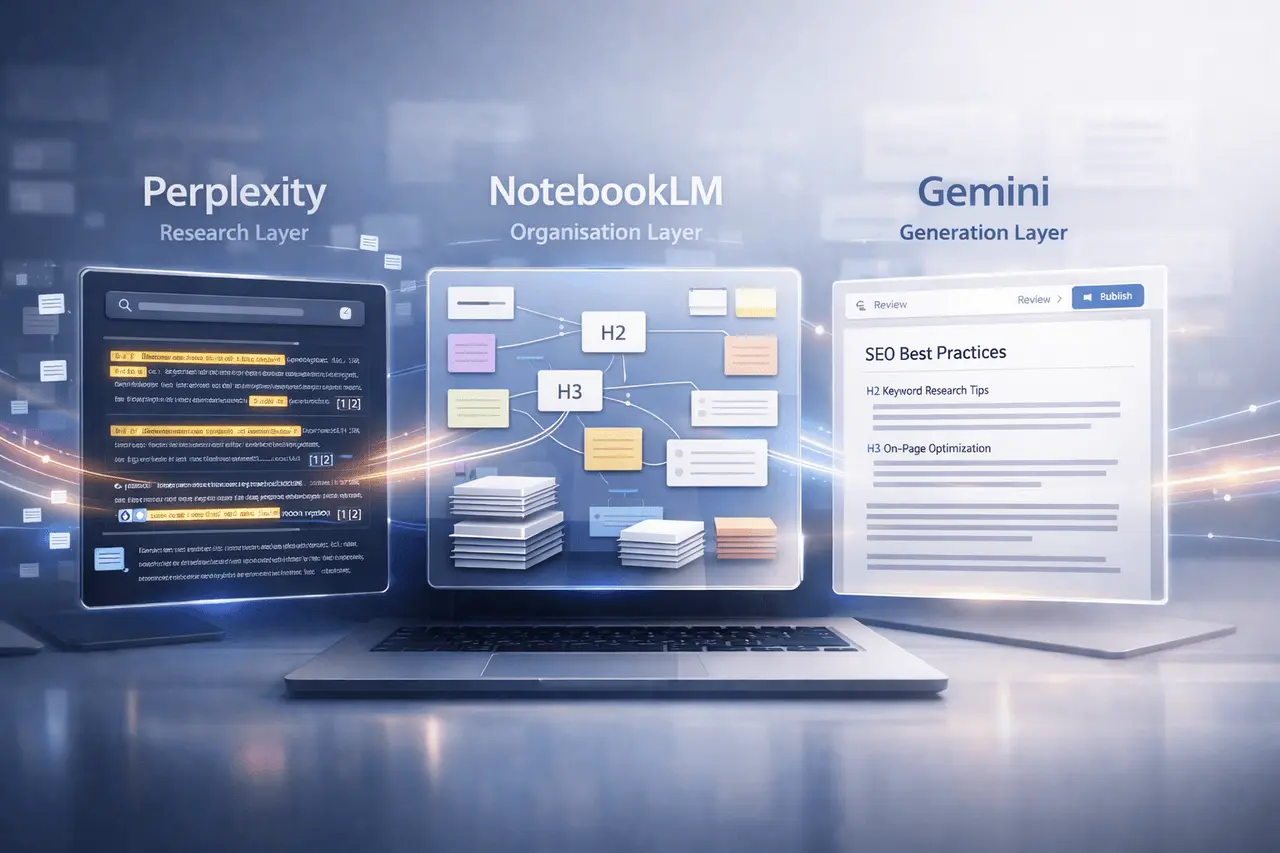
SEO has entered a phase where speed alone is no longer an advantage; structure, accuracy, and source awareness matter just as much. As search engines get better at assessing depth and credibility, the main problem is creating high-quality content swiftly without cutting corners. This is why a well-structured AI workflow that utilizes Perplexity, NotebookLM, and Gemini is a standout. Instead of relying solely on a single tool for everything, this method breaks down SEO work into distinct stages: research, organization, and generation, making the process more efficient, secure, and easier to scale.
In this article, I will explain the NotebookLM Perplexity Gemini SEO workflow, showing how these three AI tools work together to streamline research, organise insights, and generate high-quality, search-optimised content efficiently.
The Rise of AI-Driven SEO Workflows
SEO has always been about balancing between speed and precision. On one hand, SEO teams are under pressure to produce content more quickly. However, the quality of the content still depends on solid data, a clear structure, and precise analysis. In the last year, a brand-new workflow has attracted the attention of experts: it combines NotebookLM, Perplexity, and Gemini into a tightly integrated pipeline.
When used together, these tools can’t replace SEO essentials. Instead, they streamline the most laborious stages of research organization, drafting, and organization into a process that’s significantly quicker, while remaining rooted in actual sources.
Why SEO Still Breaks Without a Strong Process?
Many AI-generated articles fail for obvious reasons. They rely on insufficient training data, lack a clearly defined topical structure, or make unsubstantiated assertions. Search engines tend to reward content that exhibits the ability to comprehend sources, expertise, and a logical flow. This means that SEO content should remain grounded in authentic data and be structured to reflect the true intent of search.
The NotebookLM-Perplexity-Gemini workflow works because each tool focuses on a specific cognitive task rather than trying to do everything at once.
Step 1: Research With Perplexity for Live, Verifiable Data
The first step is research, managed by Perplexity. In contrast to traditional chatbots, Perplexity is more of an artificial intelligence-powered research assistant. It gathers live information from the internet and provides answers with citations.
In the SEO process, it is essential to consider two reasons. It reduces the risk of outdated information in rapidly changing areas such as technology, AI, and digital marketing. Additionally, including citations makes it easier to verify assertions before they reach the drafting stage.
In reality, this process can save you hours of manual Google or tab-switching and note-taking. Instead of accumulating links scattered across the internet, you create a more focused research set that is aligned to an exact keyword or subject cluster.
Step 2: Organise Insights in NotebookLM Using Gemini
After research has been conducted, the next task is structure. This is the place where NotebookLM becomes a central component. NotebookLM lets you upload your source materials, notes, documents, and copied research. It then uses Gemini to analyze and organize the data.
If the Perplexity findings, along with the citations, are incorporated into NotebookLM, Gemini can group similar ideas, identify patterns, and suggest appropriate headings. This usually results in a neat order of H2s and 3s, which resembles how well-optimized content should read.
The main benefit here is the fact that an outline isn’t created from abstract information. It is based on your research. It means that each part of the piece is linked to the real research, thus reducing the possibility of making false claims or filler that is off-topic.
Step 3: Generate a Publish-Ready Draft With Gemini
With a well-organized outline already in place, Gemini handles the drafting phase. Since the outline aligns with research-based sections, Gemini’s responsibility is execution, not invention. Gemini expands every heading into clear, easy-to-read paragraphs that adhere to SEO best practices.
This is where the benefits of time are evident. Instead of manually stitching documents and notes, you’re now instructing Gemini to create a close-to-final draft that is already in line with the search intent, topical depth, and flow.
The result isn’t an unfinished article you publish without thinking; however, it is a solid initial draft that usually needs only minor editing, tone changes, interlinking, and brand-specific tweaks.
The Power Move: Bringing Citations Into NotebookLM
The most efficient method in this workflow is to paste Perplexity’s citations directly in NotebookLM along with the research summary. This simple step can have a considerable impact.
By incorporating citations at the time of organization, Gemini’s outline generation process is implicitly restricted by real sources. Sections are based on facts and not on assumptions. For SEO teams concerned about the accuracy of their E-E-A-T signals or editorial standards, this strategy drastically reduces the risk of downstream exposure.
It also makes human-mediated review simpler. Editors can trace their sections back to their sources without redoing the research by hand.
Why This Workflow Saves So Much Time?
The traditional method of SEO content creation usually goes like this: research for hours, organize notes manually, draft slowly, then go through the revision process. The NotebookLM-Perplexity-Gemini pipeline compresses those stages into a focused sequence in which each tool performs one job well.
Research speeds up because Perplexity aggregation cites relevant information. The organization becomes more efficient because NotebookLM and Gemini automatically organize ideas. Writing becomes more efficient because Gemini draws on a clear outline, backed by research.
For experienced users, this can transform days of hard work into just a few minutes without sacrificing quality.
NotebookLM Perplexity Gemini SEO workflow: Limitations and Responsible Use
This workflow is effective, but it’s no replacement for expert knowledge. AI tools can help you think faster; however, they cannot create a strategy or a brand voice or provide original insights on their own. The final review is still vital, particularly for highly technical sectors or topics.
It is also crucial to ensure that you do not publish material without verifying its accuracy, even if citations are in place. AI-based SEO works best when combined with human judgment.
What does this mean for Modern SEO Teams?
Since search engines continue to prioritize applicable, well-structured content, workflows that follow these are more of an afterthought and more of an advantage in competition. Companies that implement well-structured AI pipelines can produce content more quickly and update it more frequently, adapting to the latest trending topics without burning writers out.
The actual value is not just speed, but the consistency of every article being based on a research-first, structured process that aligns with how search engines judge content quality.
Final Thoughts
The real strength of the NotebookLM-Perplexity-Gemini workflow is not that it automates SEO, but that it disciplines it. Research is rooted in real data, the structure is based on real sources, and the writing process becomes an exercise rather than guesswork. For SEO professionals, that means less struggle with unfinished pages and notes and more time focusing on strategies, intentions, and creativity. When used thoughtfully, this workflow not only saves hours but also improves the quality of SEO content, a quality that manual workflows cannot match at scale.
Frequently Asked Questions
1. What’s the difference in using just one AI software for writing?
This workflow divides research, organization, and writing into distinct stages. This reduces hallucinations and improves structure compared to single-step generation.
2. Do I have to confirm the accuracy of the content?
Yes. Although Perplexity provides the citations and NotebookLM manages them, human review is still required before publication.
3. Does this workflow work for SEO topics that are not technical?
Yes. It can be used for any topic with reliable sources, such as marketing and SaaS, as well as general technology-related content.
4. Could this be a way to be a substitute for human writers?
No. It speeds up the writing process, but it depends on human judgment to determine tone, strategy, and final editing.
5. Does this process enhance search engine rankings?
There aren’t any guarantees in SEO. It does, however, support best practices through improving the depth of research as well as structure and clarity.
6. Who is the most benefited from this strategy?
SEO experts, content strategists, and tech-savvy marketers need to create high-quality content simultaneously without sacrificing accuracy.
Also Read –
Google Opal AI Agents: Build 1-Click AI Tools in Gemini
Google NotebookLM Audio Lectures: 30-Minute Lecture Mode Tested