

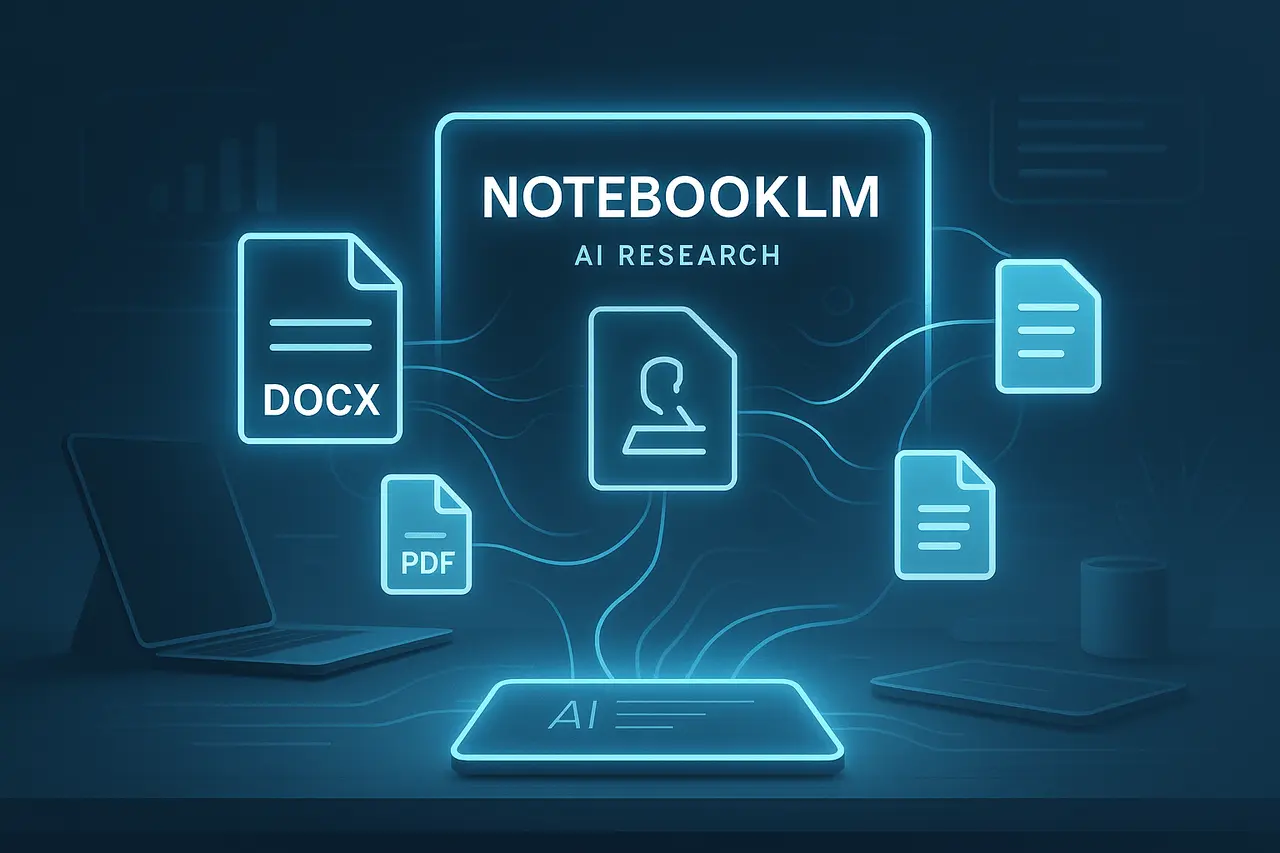
NotebookLM, an AI-powered note-taking and research tool developed by Google Labs, recently announced support for Microsoft Word’s native .docx format. This update, due to roll out around November 2025, forms part of a larger expansion of the accepted formats for source documents and is a significant advancement in user convenience and flexibility.
The article below will discuss the NotebookLM DocX support, and implications of this change in real-world terms, how it can improve workflows, the pitfalls that persist, and the next steps you can expect.
What exactly is NotebookLM, and why is support for files important
NotebookLM is designed to function as an “AI-first notebook”, rather than being a simple note-taking tool; it uses AI (specifically Gemini) to comprehend the contents of the documents you upload. The app can then produce notes, provide answers from the sources you have used, create timelines, study guides and much more.
For a long time, users were able to rely on a few file types, including PDFs, plain text, Google Docs/Slides, copied text, and web-based content. Although this already covered a variety of applications, it left a gnarly gap for those whose work was within Word documents. If you have ever had a .docx file, you had to convert it, whether by exporting to PDF or copying text manually, before NotebookLM could import it.
The situation changed in November 2025: NotebookLM will now accept .docx files natively as valid sources.
What the DocX Update Enables
Direct Word Document Uploads
With .docx support, it is now possible to add Microsoft Word documents directly, without conversion or copy/paste hassles. This reduces time and the stress of managing multiple document formats.
This means that your old drafts, research notes, memos, plans — everything you have stored in Word can be immediately incorporated into NotebookLM’s AI-driven analytics pipeline.
Integrating Richer Research Workflows
The upgrade is part of other enhancements to NotebookLM’s compatibility with files. Alongside Word documents, the platform now supports Google Sheets, PDFs (including from Google Drive), Drive URLs, and images (with additional formats in queue), as well as other formats previously supported, like Google Docs, plain text, Markdown, and web URLs.
This flexibility in multi-formats allows students, researchers and professionals to collect various sources- texts as well as spreadsheets, images, and other documents- all in one unified notebook. For example, you could combine a research paper (PDF) or interview notes (.docx) with data tables (Sheets), and then ask NotebookLM to incorporate them into a coherent summary report.
Smoother Workflow Integration
With the removal of the conversion step, this update eases the transition between the place you write documents (e.g., Word) and the place you conduct research or write a summary (NotebookLM). This means that you can make NotebookLM an ideal extension of the day-to-day workflows for planning projects or academic research, writing reports, or knowledge management.
What Still Doesn’t Work and Why?
Limited or No Native Support for CSV / Spreadsheet Files
Despite support for expanded formats, there are restrictions on tabular formats, particularly CSV (Comma-Separated Values) files or spreadsheets exported directly from Excel. Although NotebookLM supports spreadsheets in Google Sheets, direct support for CSV files isn’t yet available.
If you’ve got an Excel file (.xls or .xlsx) or CSV, however, you might have to reformat or convert it (for instance, saving it as .txt or putting tables into an Excel spreadsheet) before NotebookLM can effectively parse it.
Size and Source Limits
NotebookLM imposes limits on upload sizes. Each source can contain up to 500,000 pages or 200MB. There is a limitation on the number of sources you can connect to your notebook at a time (for several users, it is 50).
If you attempt to upload massive Word documents or long books, lengthy reports or other combined documents, you could exceed the limit and have to divide them into smaller chunks.
User Interface & Access Constraints
There are reports of “UI issues”: when you import files from Drive, the file picker could be hidden behind the source-panel windows. Additionally, the availability of newer features (especially more experimental ones) can vary by location or account type, though .docx support is typically rolling out worldwide.
Why This Update Matters — Who Benefits Most
The inclusion of DocX support dramatically lowers the barriers to using NotebookLM in everyday workflows. Here are a few common scenarios that can benefit:
- Students and Academics: Many essays, research papers, class notes, and collaborative documents reside in Word. With .docx support, these documents can be easily imported, which is excellent for summarising, separating the most important information, writing study guides or FAQs.
- Professionals and consultants: Reports, briefs, and proposals, typically written in Word, can be condensed into AI-generated timelines, summaries, or briefing papers.
- Cross-format researchers: People working with a mixture of formats (text tables, PDFs, etc.) can now combine all of them into one notebook, and then ask NotebookLM to incorporate them across different formats.
- Knowledge Workers: Teams that collaborate using Word and Drive: the upgrade ensures that NotebookLM will integrate into their existing workflows without requiring a massive change in how content is saved or created.
In short, this update will help NotebookLM become a genuinely global research hub where document format is no longer a problem.
What’s Next: CSV and Spreadsheet Support, and Beyond?
Even though the DocX upgrade is undoubtedly a significant leap forward, both users and developers are also looking for further improvements, particularly in structured data. As per official reports, support for CSV files (and broader spreadsheet/structured data formats) is high on the roadmap. Once this is implemented, NotebookLM could treat spreadsheets not as text but as structured data, enabling deeper, more detailed analysis. Questions like “What were the total sales for each region during Q1 to Q4?” or “Show trends in the data for each month” could be more fluid.
Beyond that, the increased accessibility to pictures (handwritten notes, scanned documents) as well as video transcripts and enhanced interaction with multimedia can expand the scope of applications.
NotebookLM DocX support: Practical Tips
- Direct Upload: Drag or drop the .docx document into NotebookLM. There is no need to convert or export.
- Divide Large Files: If your document is large, you might want to break it into smaller sections (chapters or sections) to keep it within the 500,000-word/200 megabyte limit.
- Combine Formats: Do not be afraid to combine uploaded .docx files with PDFs, Google Sheets, URLs, or other formats. NotebookLM excels at cross-referencing different sources.
- Look up Spreadsheet data: If your spreadsheet contains data in tabular format, think about importing it via Google Sheets or converting CSV data into a table based on text until the native CSV support becomes available.
- Stay Up-to-date: Features are released gradually. If a file type isn’t currently supported, make sure to check the official NotebookLM announcement notes or documentation for updates.
Final Thoughts
The inclusion of .docx support with NotebookLM is a significant move forward. By allowing users to download Word files directly, NotebookLM will eliminate a major obstacle between where you create content and how you analyse it.
Although there are some limitations (especially with structured data formats such as CSV or Excel), the new version significantly expands NotebookLM’s use for researchers, students, and professional teams. In addition to other enhancements in the pipeline, including Google Sheets support, richer media handling, and CSV connectivity, NotebookLM is fast becoming an all-in-one, multifaceted “AI brain” for organising, summarising, and analysing complex data workflows.
Frequently Asked Questions
1. Can NotebookLM now open Excel file formats (.xlsx) directly?
At present, however, native .xlsx and .csv uploads aren’t fully supported. At present, the only option is to support uploads to Google Sheets. If you require CSV-style information, you will have to convert it into text or copy and paste it manually.
2. Are there limits on the size of files for the upload of Word (.docx) documents?
Yes. Every source file should be less than 500,000 words or 200 MB. If your Word document is longer than this, you might need to split it into smaller pieces before uploading.
3. Does this upgrade make NotebookLM suitable for data analysis and spreadsheets?
Support for mixed formats can help, but since NotebookLM can’t natively read CSV or Excel files, more complex analyses (pivoting, filters, pivots, formulas) require external assistance. NotebookLM can help interpret data when it’s exported as plain text or via Google Sheets.
4. In the event of a big task (PDFs, Word docs, Images, sheets), can I put the various files into the same NotebookLM notebook?
One of the most significant benefits of this version is the ability to combine various document types into a single notebook. This makes it perfect for multi-format research projects, large projects, and team collaborations.
5. What happens when I upload a scan of a document or an image-based PDF?
NotebookLM might be a struggle, and the OCR (optical character recognition) of scanned PDFs or images may not be reliable. For the best outcomes, upload documents that contain machine-readable text (i.e., text that can be copied).
6. Does the new .docx support accessibility to all users daily?
The rollout started in November 2025. Google states that all users will be able to access the service within a week. However, availability can vary by region or account type.