
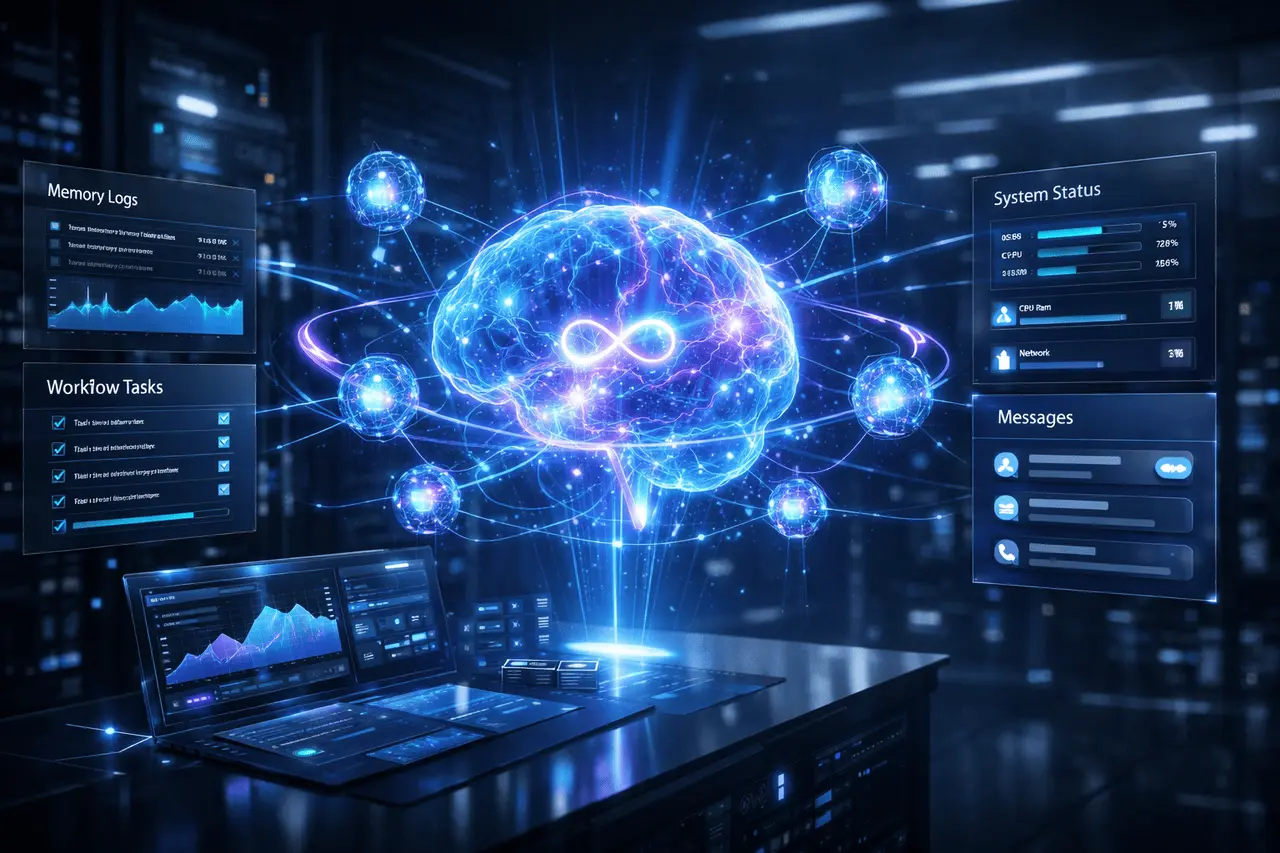
The Manus AI Always-On Agent introduces the possibility of a continuous, constantly running AI agent that can operate beyond single sessions or prompts. In contrast to traditional chatbots, this new technology enables longevity-based AI agents equipped with skills, subagents, memory, identity management, and messenger integration.
This change signifies a shift away from reactive AI tools toward autonomous AI agents that can handle tasks independently across different time periods and platforms.
What Is the Manus AI Always-On Agent?
The Manus AI Always-On Agent is an AI agent that operates continuously, rather than only when asked.
Traditional AI systems work through sessions that are based on interactions. After the session is over, the state and memory are usually deleted. However, this model stresses:
- Persistent operation
- Long-term contextual memory
- Multi-agent coordination
- Platform integration
This results in an autonomic AI system that can handle ongoing workflows without manual intervention.
Core Features of Manus AI Always-On Agent
1. Skills Framework
Skills enable a person to carry out controlled, repeatable actions. This could include:
- Data analysis
- Workflow automation
- API integrations
- Document generation
- Research aggregation
Skills enable the AI to be flexible and adaptable, allowing it to be structured automation rather than just free-form conversations.
2. AI Subagents
AI subagents are specially-trained agents that operate under the coordination of a primary agent.
Instead of being a single monolithic structure, the architecture allows:
- Task delegation
- Parallel processing
- Role specialization
- Orchestration hierarchical
This design aligns with the latest multi-agent systems used in the most advanced automated frameworks.
Feature Comparison Table
| Feature | Traditional AI Assistant | Manus AI Always-On Agent |
|---|---|---|
| Session-based interaction | Yes | No |
| Persistent memory | Limited | Yes |
| Subagent coordination | Rare | Yes |
| Continuous background work | No | Yes |
| Dedicated compute instance | No | Yes |
This structural change improves flexibility and autonomy.
3. Persistent Memory
Permanent AI memory allows the system to retain information over time.
Its key implications include:
- Context continuity
- Long-term project management
- Behavioral adaptation
- Personalized workflows
Persistent memory is a great option for use cases such as tracking research for ongoing analysis or operational monitoring, with no need for repeat configuration.
4. Dedicated Computer Instance
A separate AI instance is used to separate the agent’s environment from the shared session’s infrastructure.
Benefits include:
- Isolated computing environment
- Improved reliability
- Continuous task execution
- Security control with enhanced security
This architecture is similar to that of containers or virtual machines used in enterprise automation systems.
5. Identity and Messenger Support
Identity support lets an AI agent retain its persona and maintain its authorization scope.
Messenger integration enables:
- Cross-platform communication
- Real-time notifications
- External collaboration
- Workflows trigger the workflow
Through its operation in messaging environments, the AI agent is transformed from a passive participant to an embedded participant in operations.
How the Manus AI Always-On Agent Works?
On an organizational level, the system can combine:
- A persistent runtime-related environment
- Modular skills library
- Orchestration layer for subagents
- Long-term state management
- Communication endpoints
This architecture is compatible with the principles of design for autonomous agents in distributed AI systems and with task-based automation frameworks.
Simplified Workflow
- The agent receives the objective
- Delegates subtasks and tasks to subagents
- Executes skills in a dedicated example
- The outputs are stored in a persistent memory
- Communicates results via messenger channels
This loop runs indefinitely without requiring repeated prompts.
Real-World Applications
The Manus AI Always-On Agent model enables the creation of new operational patterns.
Use Cases by Industry
| Industry | Example Application | Benefit |
|---|---|---|
| SaaS Operations | Monitoring metrics and generating reports | Continuous oversight |
| Research | Ongoing literature tracking and summarization | Long-term context retention |
| Marketing | Campaign monitoring and automated optimization | Persistent campaign intelligence |
| Finance | Data aggregation and anomaly alerts | Real-time monitoring |
| Enterprise IT | System checks and workflow automation | Reduced manual intervention |
These cases show how long-lasting AI agents help reduce the need for human supervision.
Why the Manus AI Always-On Agent Matters
The trend towards autonomous AI agents is part of a larger development in the field of artificial intelligence.
The traditional AI tools are reacting.
The agents who remain on all the time are active.
The main advantages are:
- Reduced friction in operation
- Enhanced task Continuity
- Automated multi-step workflows
- Reduced cognitive burden for the users
This technology brings AI closer to digital workforce automation, rather than just supporting conversations.
Benefits of an Always-On Agent Model
1. Continuous Execution
Tasks can be run indefinitely without requiring manual launch.
2. Context Preservation
Long-term memory helps prevent onboarding repetition.
3. Task Specialization
Subagents boost efficiency by distributing roles.
4. Platform Integration
Messenger support expands operational reach.
Limitations and Practical Considerations
Although powerful, constantly-on AI systems pose difficulties.
Operational Complexity
Multi-agent systems require robust orchestration.
Resource Management
Dedicated compute instances boost the need for infrastructure.
Governance and Security
Persistent agents require clear authorization controls.
Monitoring Requirements
Autonomous systems will require human oversight for crucial workflows.
Organisations that adopt this model must assess the readiness of their infrastructure and policy frameworks.
Traditional AI vs Always-On AI Agents
| Dimension | Traditional AI Models | Always-On AI Agents |
|---|---|---|
| Activation | User-triggered | Continuous |
| Memory | Session-based | Persistent |
| Task Autonomy | Limited | High |
| Collaboration | Single-agent | Multi-agent |
| Infrastructure | Shared runtime | Dedicated instance |
This contrast reveals the evolution of AI technology’s structure.
My Final Thoughts
The Manus AI Always-On Agent is the evolution of structural aspects in AI agent performance. It combines capabilities, AI subagents, persistent AI memory, and the creation of a dedicated AI instance, identity management, and Messenger support. It transforms AI beyond reactive help to autonomous.
This technology enables continuous workflows, long-term context management, and scalable task delegation.
As AI systems become more mature, continuously-on agents will alter how companies use automation, shifting from traditional tools driven by prompts to digital agents that can manage complex, multi-step goals over time.
Frequently Asked Questions
1. What is the Manus AI Always-On Agent?
It’s a persistent AI agent feature that runs continuously, manages tasks autonomously, and retains long-term memory across interactions.
2. What is the difference between it and chatbots?
Contrary to chatbots operating in isolated sessions, the Manus AI Always-On Agent maintains context, uses subagents, and runs on a dedicated compute instance.
3. What exactly are AI subagents?
AI subagents are specialized agents coordinated by a principal agent that handle subtasks in sequence or in parallel.
4. Why is persistent memory important?
Persistent memory enables agents to keep track of ongoing projects, maintain context, and avoid repeated settings or instructions.
5. Does the system need a dedicated infrastructure?
Yes, it comes with an instance of a computer specifically designed to provide continuous runtime and an isolated process.
6. What are the most practical business scenarios?
Companies can use it to automate reports, system monitoring, research tracking, marketing optimization, and workflows.
Also Read –
Manus Agent Selection for Scheduled Tasks Explained