
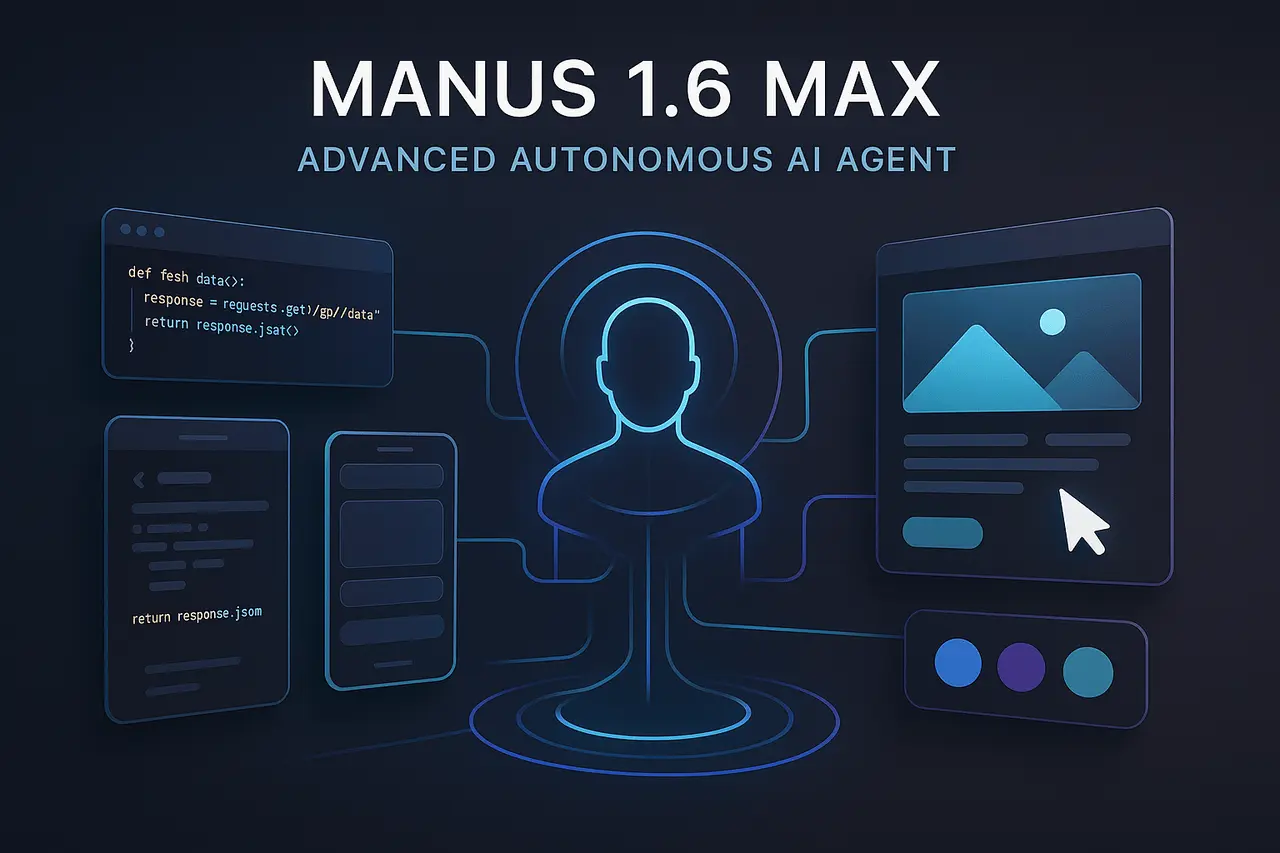
In December 2025, the self-learning AI platform Manus unveiled its latest significant update, Manus 1.6, which introduced an exclusive configuration, Manus 1.6 Max. This update brings significant enhancements across performance, creative control, and practical development workflows, marking an essential step in advancing the field of autonomous AI agents. Based on the platform’s core agent design, Manus 1.6 focuses on efficient task execution, with reduced oversight and capabilities that meet real-world efficiency requirements.
What is Manus?
Manus is an independent general AI agent created to convert human intention into action by designing, executing, and performing multi-step workflows with no user monitoring. Contrary to chatbots with traditional programming that respond to commands, Manus operates in an independent execution environment, which is a virtual machine that has access to the internet, storage for files and tool integration. This enables it to perform real-world tasks, from complex research to software development.
Since its launch in March 2025, Manus has been a hot topic for its ability to deliver full outputs rather than intermediate solutions, solving problems with minimal intervention and often working asynchronously in the cloud. Manus’s design is indicative of a larger trend in AI towards autonomous agents that are capable of delivering high-impact productivity.
Introducing Manus 1.6 Max: A Major Platform Update
It was released on December 15, 2025. Manus 1.6 brings significant platform enhancements that improve the agent’s performance, accessibility and creative capabilities. The key elements of Manus 1.6 are:
1. Manus 1.6 Max: Advanced Performance Mode
The main feature of this update is Manus 1.6 Max, a performance-focused agent configuration designed for more complex workflows and improved task performance.
- More Satisfaction and Success: The internal metrics used by the team responsible for development suggest that Max provides a significant improvement in task success rates and user satisfaction, with reported increases of about 19.2 per cent. This is a sign of improved performance and reliability in handling challenging tasks.
- A Lesser Need for Supervision: The new architecture enables the agent to require less human supervision when executing multi-stage tasks, allowing users to focus on strategic goals rather than continuous instruction.
Manus 1.6 Max has been designed to support more advanced analysis and workflows, making it an excellent option for professionals who depend on seamless, integrated automation.
2. The End-to-End Mobile App Development
The most striking feature of Manus 1.6 is its automated mobile app development tools. Users can now describe the app they’d like in natural language. Manus will oversee the development from conception to implementation.
- The Natural Language Application: Define the features, UI components, business logic or integrations in simple text. Manus creates and assembles the application code in line with.
- Holistic Workflow: It not only handles code generation but also environment setup, UI scaffolding, and integration tasks. It’s a massive leap from code fragments to complete, running applications.
This feature democratises the mobile application development process, enabling anyone with a technical background to develop ideas quickly while maintaining the quality of developers.
3. The New “Design View” for Creative Control
Manus 1.6 introduces Design View, an interactive interface that reinvents editing with a visual interface within the agents’ environment.
- Point-and-Click Editing: Instead of simply delivering text commands, users can now interact directly with a visual canvas, changing colours, text, and structural elements with a simple input.
- Flexible Image and Visual Assets: The upgrade will bridge the gap between instructional text and design creativity, giving artists greater precision and making Manus an effective tool for designers and developers.
Design View transforms AI software from an asynchronous text machine into an interactive, visual assistant, specifically for tasks involving image layout and manipulation.
Manus 1.6 Max: Broader Impact on Productivity and Workflows
The Manus 1.6 update aims to address one of the most significant problems in AI automation: reducing the need for continuous monitoring while improving final quality. By enhancing core performance (Max), introducing direct interfaces for creativity (Design View), and making it easier to develop apps in full, this update demonstrates an impressive improvement in making autonomous robots more accessible to a broader range of professionals.
Enhanced Task Automation
With Max’s optimised architecture, Manus can handle subtasks much more efficiently, without the need for repeated user prompts. This makes it more suitable to:
- Research synthesis
- Automated report generation
- Complex decision support
- Software and app development workflows
This boost in autonomy can increase productivity across a variety of industries, from data science to product design and engineering.
Lowering Technical Barriers
With the ability to generate whole mobile applications from natural language descriptions and to visually edit designs, Manus significantly lowers barriers to design, allowing users without coding or design expertise to create professional-looking outcomes.
What does this mean for Different Users?
- Developers: Rapider prototyping and automated boilerplate code, as well as seamless workflows for deployment.
- Designers: It is a powerful interactive tool for visual editing, designed to complement rather than replace conventional design programs.
- Business Professionals: Ability to automate complex workflows without extensive manual coordination or scripting.
- Start-ups, Small Teams: Rapid implementation and iteration of product concepts with reduced development cost.
Final Thoughts
Manus 1.6 is more than an incremental upgrade; it is a significant step forward in how the autonomous AI can be used within real-world work processes. The performance improvements made with Manus 1.6 Max, the capability to build complete mobile applications using natural language, and the introduction of Design View all point toward a future in which AI agents assume greater responsibility with greater precision. By reducing the need for supervision while enhancing technological and creative management, Manus positions itself as an efficient, productive tool rather than an experimental one. For those who want faster execution, more fluid automation, and greater freedom from AI software, Manus 1.6 marks a significant milestone in the development of agent-driven AI systems. AI systems.
Frequently Asked Questions (FAQs)
1. How do I define Manus 1.6 Max?
Manus 1.6 Max is a powerful version of Manus AI. Manus AI agent is designed to deliver higher-quality task execution with lower control requirements and greater satisfaction, particularly for complex workflows.
2. Does Manus 1.6 actually create mobile applications by analysing descriptions?
Yes. One of the new features introduced in Manus 1.6 lets users describe the mobile application they want to develop in natural language. Moreover, Manus handles the entire development process, including code generation and integration.
3. What exactly is Design View, and why does it have any significance?
Design View is an interactive interface for images and UI editing in Manus. It allows users to make point-and-click adjustments to layouts and visuals. It allows users to control their creativity beyond text commands.
4. How do Manus’s capabilities compare to other AI tools?
In contrast to traditional AI assistants that produce responses, Manus acts autonomously by scheduling and executing tasks within its sandbox, including code execution, research, and even content creation.
5. Who will profit from Manus 1.6?
Designers, developers, and business professionals and teams who want to streamline workflows or develop digital products can benefit from the speed and enhancements to the tooling available in Manus 1.6.
6. Is Manus accessible to anyone?
Access policies can change over time, and historically, Manus has relied on open beta or invitation-based phases to manage demand. Visit the official website for the most current access information.