
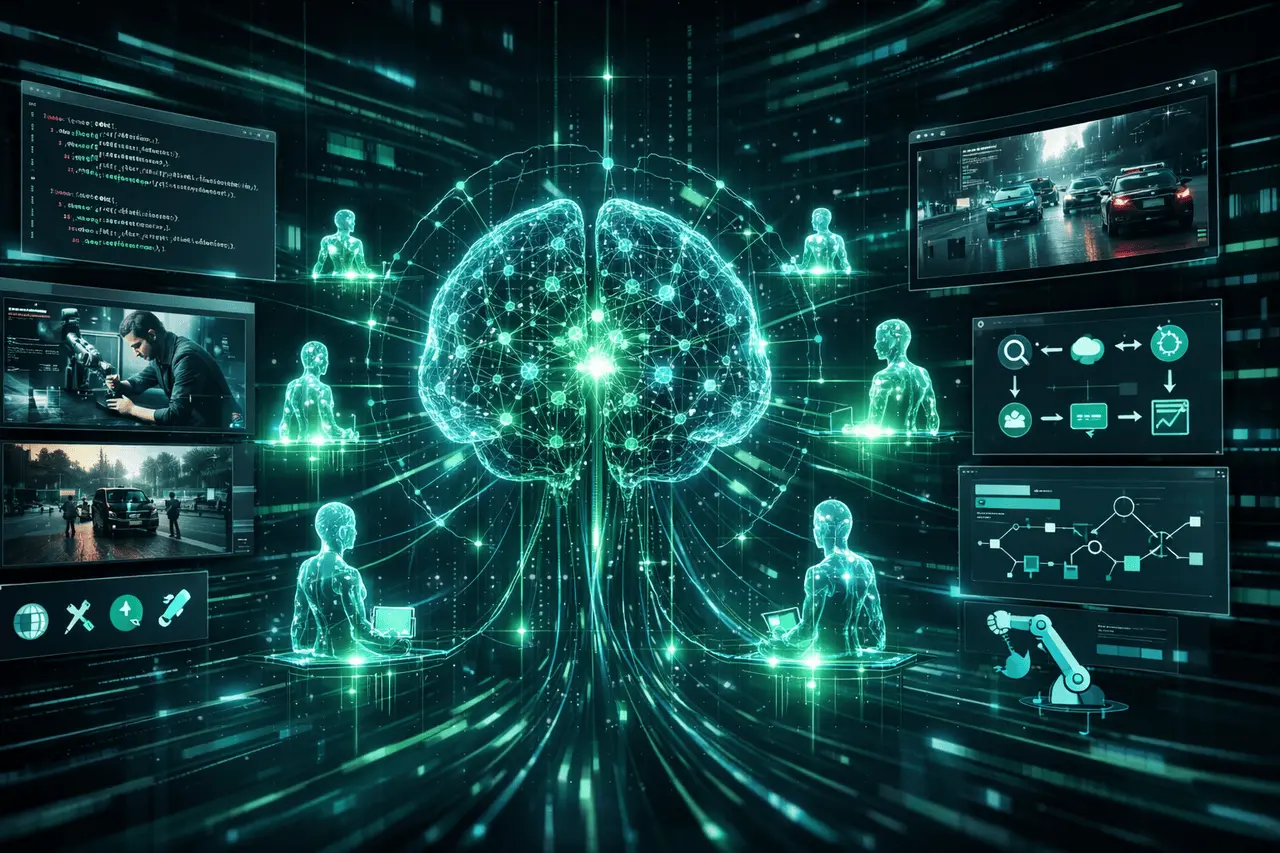
Kimi K2.5 is an open-source visual agentic intelligence system designed to integrate reasoning, vision, and coding within an agentic framework. The system is built to function with images, text, and videos. It can be used as a foundation for agent-based systems with high-performance procedures, visual comprehension, and production-grade software development.
In the current version, Kimi K2.5 focuses on benchmark-leading performance, parallel execution of agents, and support for agent and chat modes. This makes it worthwhile for researchers, developers, and companies looking into the possibility of scaling AI agents and multimodal intelligence.
What Is Kimi K2.5?
Kimi K2.5 is a multimodal agents-oriented AI model that integrates the ability to see, reason and coding to create a seamless system. It is not like traditional single-agent models. it was designed to coordinate several autonomous agents who cooperate on complex tasks.
In the end, Kimi K2.5 focuses on:
- Visual reasoning in videos and images
- Code generation and verification
- Planning for agents and tools usage
- Open-source accessibility that allows experimentation and expansion
This architecture supports both interactive and automated workflows for agents.
Why Kimi K2.5 Matters?
Artificial Intelligence systems for agents are moving beyond static prompt-response systems to enable continuous planning, tool execution, and collaboration. Kimi K2.5 is significant because it shows the ways open-source models can be competitive at the top of agentic benchmarks, while remaining flexible enough to be used in real-world scenarios.
Its key implications include:
- Faster execution via parallel agents
- Reducing bottlenecks in complicated reasoning tasks
- A strong alignment between the understanding of vision and the output of code
- Lowers the barriers for developers to create individual agent solutions
This capability is particularly useful to research and development software, automation, and visual-to-code software.
Benchmark Performance and Reported Results
Kimi K2.5 delivers the most advanced performance across various agentsic, visual and coding benchmarks at the time of publication. These benchmarks are widely used to measure the depth of reasoning multimodal understanding, as well as the performance of coding in real-world situations.
Agentic Benchmark Results
| Benchmark | Reported Score |
|---|---|
| HLE (Full Set) | 50.2% |
| BrowseComp | 74.9% |
These results demonstrate the effectiveness in browsing-based reasoning and long-horizon task-based agents.
Vision and Coding Benchmarks
| Benchmark | Reported Score |
|---|---|
| MMMU Pro | 78.5% |
| VideoMMMU | 86.6% |
| SWE-bench Verified | 76.8% |
Together these benchmarks suggest a an alignment of visual understanding and code generation that is executable.
How Kimi K2.5 Works?
Kimi K2.5 functions as a visually agentic system, not one monolithic model. Its design focuses on the decomposition of tasks, parallelism and execution driven by tools.
Multimodal Input Handling
The model is based on and supports:
- Natural language prompts
- Static images
- Video sequences
It allows workflows in which visual inputs directly influence logic and code generation.
Agent-Based Execution Model
Instead of having a single agent, Kimi K2.5 can create multiple agents that operate concurrently. Each agent can:
- Analyze a sub-task
- Call tools on their own
- Share intermediate results
This structure boosts the speed and reliability of complex, multi-step challenges.
Agent Swarm Architecture (Beta)
A key characteristic of Kimi K2.5 is Agent Swarm, which is currently in beta.
Key Capabilities
- Up 100 parallel sub-agents
- Approximately 1,500 tool calls per task
- Reports indicate 4.5x speed improvement over single agent configurations
Practical Advantages
| Aspect | Single Agent | Agent Swarm |
|---|---|---|
| Task Parallelism | Limited | High |
| Execution Speed | Linear | Significantly Faster |
| Fault Tolerance | Low | Higher via redundancy |
| Scalability | Constrained | Designed for scale |
The Agent Swarm is particularly suitable for large-scale research, automated programming, and sophisticated processing pipelines.
Visual-to-Code and Aesthetic Web Output
Kimi K2.5 is a strong example of what it refers to as “code with taste.” This is a reference to its ability to convert chats, videos, and images into a structured, visually refined Web output.
Notable characteristics include:
- Clean, readable code generation
- Motion expressive and layout awareness
- Alignment between the visual intent and frontend implementation
This is a valuable feature for rapid prototyping, design-to-code workflows, and the development of ideas.
Deployment Modes and Availability
Kimi K2.5 is available in multiple operational modes, providing various users to choose from a variety of options.
Access Options
- Chat mode that allows for interaction
- Agent mode to facilitate structured workflows
- Agent Swarm (beta) for high-tier users
For developers focused on software engineering reliability. Kimi K2.5 is able to be combined together with Kimi Code to meet high-end coding requirements in production.
Real-World Applications
Kimi K2.5’s architecture allows for a wide variety of applications.
Common Applications
- Software development automation and test
- Video analysis and visual reasoning
- Research assistants who assist with long-term strategy
- Design-to-code and the generation of UI
- Multi-agent task orchestration
Industry Relevance
| Industry | Example Use Case |
|---|---|
| Software Engineering | Verified code generation |
| Research | Autonomous literature and data analysis |
| Media & Design | Visual-to-web pipelines |
| AI Operations | Scalable agent workflows |
Benefits and Strengths
Kimi K2.5 provides several clear advantages:
- Open-source accessibility
- Strong reported benchmark performance
- Agent-based architecture with scalable scale
- Coding and vision integrated capabilities
- Flexible deployment modes
This makes it a good choice as a fundamental model for agents rather than a narrow tool for specific tasks.
Limitations and Practical Considerations
While it is not without merit, there are a few essential points to be considered:
- Agent Swarm is currently in beta
- Access to the highest level is required for certain advanced features.
- Systems with multiple agents require an attentive orchestration and cost control
- Benchmark results could differ dependent on the task’s configuration and the evaluation conditions
Organisations must assess the need for infrastructure as well as operational complexity prior to large-scale deployment.
My Final Thoughts
Kimi K2.5 is a significant milestone in open-source visual intelligence that combines multimodal understanding and scalable agent orchestration. The benchmarks it has reported, Agent Swarm architecture, and capabilities for visual-to-code highlight the shift towards self-directed, autonomous AI systems.
As models based on agents continue to develop, Kimi K2.5 offers a practical guide to how open-source systems facilitate advanced reasoning, faster execution, and even real-world deployment. The trajectory of its development suggests increasing importance as AI workflows evolve toward large-scale, multi-agent, collaborative intelligence.
FAQs
1. What exactly is Kimi K2.5 used to do?
Kimi K2.5 is used for multimodal reasoning, agent-based workflows, and advanced code generation for images, text, and video.
2. Is Kimi K2.5 open-source?
Absolutely, Kimi K2.5 is positioned as an open-source visual Intelligence System that allows customization for research and use.
3. What is it that makes Agent Swarm different from single-agent AI?
Agent Swarm allows multiple autonomous agents to operate in parallel, increasing speed, scalability and task performance compared to single agent configurations.
4. Can Kimi K2.5 generate production-ready code?
To create production-quality code, Kimi K2.5 can be used with Kimi Code,, which was developed to improve security and reliability.
5. Does Kimi K2.5 help with video and vision?
Yes, it can support both video and image reasoning, as evidenced by the performance reported on multimodal tests.
Also Read –
Context7 Skills: Search, Install and Build AI Skills Faster