
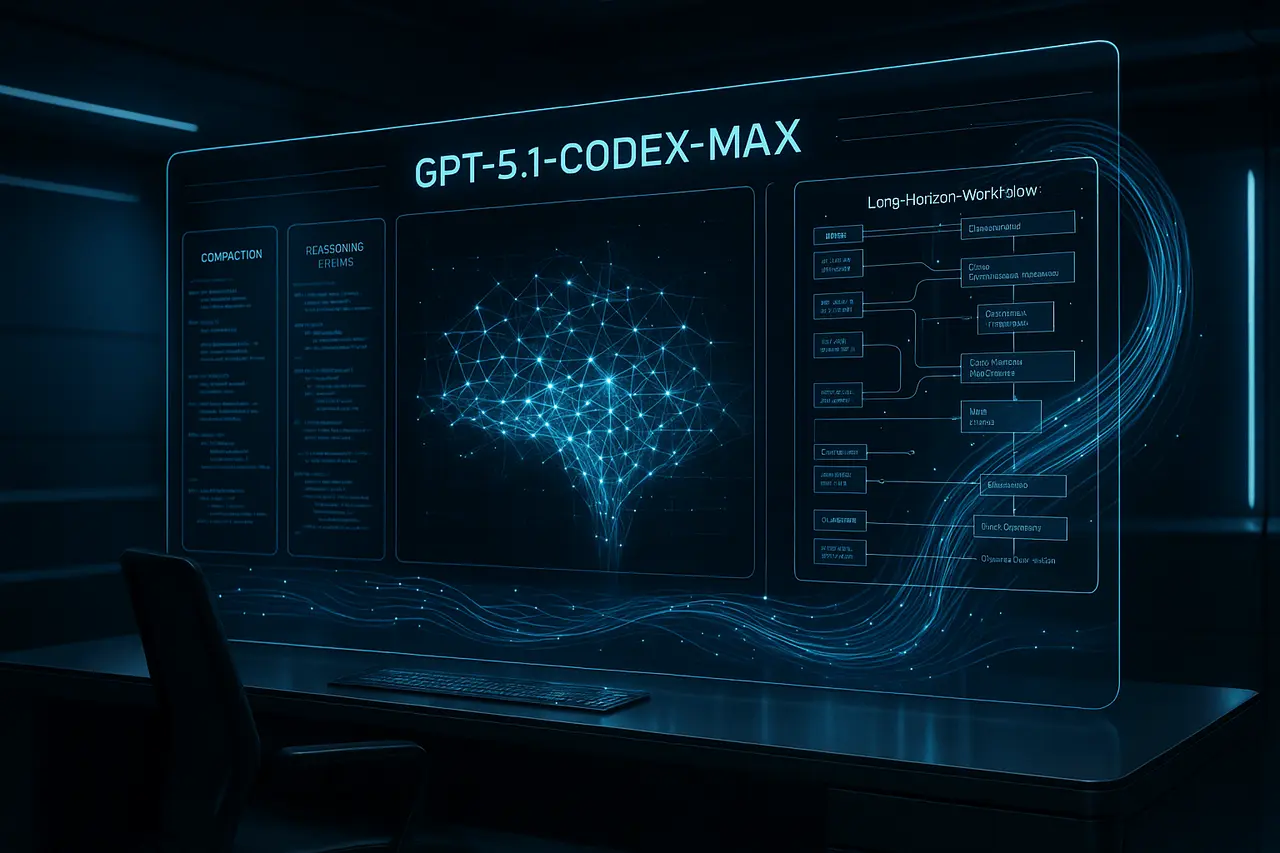
OpenAI released a new codex model at the end of 2025: GPT-5-Codex Max. This is a “specialised” AI for coding — it’s not only tuned for a one-off code, but also for multi-step, extended autonomous coding workflows.
Codex-Max, unlike other general-purpose models, is optimized for the real world of software engineering. This includes multi-file refactoring, long-running sessions, project-level reasoning, automated code reviews, test-driven design, etc.
GPT-5.1 Codex-Max is designed to be a “coding partner” that can maintain context across huge codebases and even complex workflows. Previous models struggled with this when projects grew large or included many files.
What problems does Codex-Max solve?
Long-Horizon Multi-File Workflows
Traditional LLM-based models are often unable to cope with tasks involving many files, complex dependencies, or sessions lasting hours or days. The model loses track of changes or forgets certain parts of the structure as context windows fill up. Codex-Max solves this problem by introducing contextual compaction. It automatically prunes the less relevant parts of a conversation or code history, while preserving important context.
This makes tasks requiring sustained reasoning, such as refactoring large codebases, applying systemic changes across multiple files, or running multi-step loops (e.g., test-fix-test-refactor), much more reliable.
Improvements in Token Efficiency, Cost Performance, and Balance
Codex-Max, compared to its predecessor (GPT 5.1-Codex), uses around 30 % fewer “thinking symbols” when comparing reasoning effort for many benchmarks.
This translates into faster responses, reduced resource consumption, and, in token-based models, lower costs. This allows teams to iterate more quickly and for less money, particularly on complex or large tasks.
Improved suitability for agentic and tool-heavy tasks
Codex-Max can generate more than just a few functions and snippets. It is specifically tuned for agents’ use cases – i.e., workflows in which the model uses tools like shell commands, testers, code review harnesses, maintains state over many steps, and coordinates complex tasks with persistent context.
OpenAI ran Codex-Max in internal demonstrations for more than 24 hours across tasks, including refactoring and
code generation. They also used test-driven cycles, which was not possible with older models.
Where Can You Use Codex-Max — and How?
Surfaces: CLI, IDE Extensions, Cloud & Code Review Tools
GPT-5.1 Codex-Max can be used instantly for a wide range of surfaces that are associated with Codex.
- Codex CLI standalone (for terminal-based workflows).
- IDE extensions (e.g., for VS Code, JetBrains, etc.)
- Cloud-based interfaces, code review tools, and Codex integration.
Codex-Max is the model users will use in environments like these.
API Access Coming Soon
OpenAI will make the API available to developers who want to integrate Codex-Max in custom apps or workflows.
Users will be able to access the new model via the same “Responses” API endpoint they use for other Codex models.
Benchmarks & Performance: What Evidence So Far Shows
Performance reports and documentation of the system:
- Codex-Max outperforms GPT 5.1-Codex on benchmark tasks such as multi-file refactoring and long-code reasoning, as measured by reasoning accuracy and reliability.
- It can achieve similar or even better results on many of these tasks by using fewer internal reasoning tokens – roughly 30% less. This improves efficiency.
- The output quality of large projects is superior to previous generations when set at “high effort” (for maximum code quality).
Codex-Max’s metrics indicate a significant improvement in reliability, speed, and cost-effectiveness for software engineering workloads with large codebases, complex projects, and iterative workflows.
When to Use Codex-Max ?(And When Not)
Best Use Cases
- Large or old codebases that require multi-file refactoring or significant changes.
- Workflows that repeat cycles: code, test, debug, refactor, and test.
- Projects that require automated assistant support for many hours or even days, e.g., automated PR generation, maintenance, and project-wide upgrades.
- Environments in which context preservation is important: project history, file-to-file logic, dependencies, and testing pipelines.
- You need to justify your decisions when cost-efficiency is essential, while still presenting a strong argument. Token efficiency and compaction help you with this.
There are some cases where it might be overkill.
- Small tasks: Single-file editing, quick snippet creation, or simple instant code completion.
- For tasks that require high latency, it is sufficient to use minimalistic models or editor-based completions. In these cases, older, lighter models may be more cost-effective.
- Research / experimental code that does not require long-term maintenance, stability, or context.
Practical Considerations for Developers
- Upgrade Codex CLI / IDE Extension: Update your local Codex extension or make sure your IDE integration selects the “gpt 5.1-codex max” model.
- Plan long-context tasks: When working with large codebases, consider breaking them into logical milestones. But remember: Codex Max is designed for long sessions.
- Use backups and version control: Treat outputs as suggestions, particularly when dealing with large-scale changes or automated refactorings. Review thoroughly before committing.
- Monitor token usage: While Codex-Max has higher token efficiency, long-term, heavy sessions can still consume significant resources. Be sure to monitor token usage, especially if you are using metered billing.
- Keep an eye out for the API release: If you need to integrate Codex-Max with custom tools or CI/CD pipelines in your workflow, watch OpenAI’s announcements for updates on API availability.
What It Means for the Future of AI-Driven Software Engineering?
GPT-5.1 Codex-Max represents a significant shift in the way AI assistants will be positioned. From simple autocomplete and snippet generation to long-term project collaboration.
Models like Codex Max can act as autonomous engineers. They can refactor code, maintain test suites, and apply consistent upgrades to multiple modules.
This would be a huge productivity boost, especially for teams struggling to maintain code or legacy codebases. This is not only theoretically feasible but also practical and affordable at a large scale.
By providing a persistent, stable “memory” over long sessions, these models also reduce context fragmentation, a significant limitation of older tools. This opens the door to a collaborative multi-step automation process between AI agents and human developers.
Final Thoughts
GPT-5.1 Codex-Max, the latest coding model from OpenAI designed for real-world workflows in software engineering, is currently the most advanced. It pushes the boundaries of AI-assisted software development by combining token-efficient reasoning and long-horizon context-management with strong support for multiple-step agentic tasks.
Codex-Max is a powerful tool for developers working on large, complex codebases. This includes projects that involve many files, refactoring, or continuous integration. It also applies to workflows driven by tests, multiple edit cycles, and so on. API access could lead to the creation of new developer tools, including AI-driven code maintenance assistants, automated PR bots, and large-scale refactoring assistance.
Codex-Max, despite its many strengths, is not a replacement for human judgment. As of now, it is best to use Codex-Max as a productivity enhancer, while continuing with human review and testing, along with safe development practices.
GPT-5.1 Codex-Max, in short, is more than just “a better generator of code”. It’s a new breed of AI collaborator, persistent, context-aware, and designed to support real engineering work. The future of software development has just become more exciting for teams and developers who adopt it carefully.
Frequently Asked Questions (FAQ)
1. Is GPT 5.1-Codex Max available for everyone?
At launch, GPT 5.1-Codex Max is available on Codex Surfaces (CLI, IDE Extensions, Cloud Tools, Code Review Tools) to users with supported plans (e.g., Pro, Enterprise). API access, i.e., integration of custom applications through API keys, was planned but wasn’t available at launch.
2. What is different about Codex-Max from GPT 5.1-Codex and other GPT 5.1 models?
Codex Max is optimized for coding workflows that require long-horizon context. Multi-file operations. And a persistent state. It uses fewer reasoning tokens and performs better on large-scale coding tasks than general-purpose GPT 5.1.
3. Does using Codex-Max cost more than older models?
The overall cost of using Codex-Max can be reduced because it has a higher token efficiency.
4. Are there tasks Codex-Max is not suitable for?
Yes. Codex-Max is overkill for small-scale edits or quick completions. In these cases, lighter models are more cost-effective. If you only need to perform trivial tasks and require the lowest possible latency, a simple model will suffice.
5. Is Codex-Max reliable for long-term or major projects?
Should I trust Codex-Max to rewrite large codebases? A: Although Codex Max brings substantial improvements, its output is still best treated as suggestions. Use good versioning practices, review changes carefully, run tests, and manually inspect before merging. Long-horizon capabilities are a significant advantage, but human oversight remains essential.
6. When will API access be available for Codex-Max?
OpenAI announced API support was planned, but had not launched it yet. Watch for updates in the Codex documentation and official OpenAI announcements to learn more about the rollout.