
In December 2025, Google announced significant improvements to its Gemini Audio models, advancing the way artificial intelligence handles audio and spoken language. These enhancements include real-time speech translation, refined speech-to-text (TTS) technology, and more natural-sounding conversational AI. Created to power both consumer experiences and developer tools, these updated models aim to deliver fluid, context-aware audio intelligence across a wide range of applications.
This article delved into Google Gemini Audio Updates to find out what’s New, how updates improve the capabilities of existing ones and what they have to offer developers and users.
What Are Gemini Audio Models?
Google’s Gemini family of products includes sophisticated large-language models (LLMs) that support multimodal functions for images, text, and audio within a single structure. Although earlier versions focused primarily on text and pictures, the latest versions can now support sophisticated audio applications, including speech recognition, synthesis, and translation.
In this community, Gemini Audio models are optimised to comprehend and generate human speech, providing developers with the tools needed to build natural voice interactions and real-time voice assistants.
Live Speech-to-Speech Translation: Breaking Language Barriers
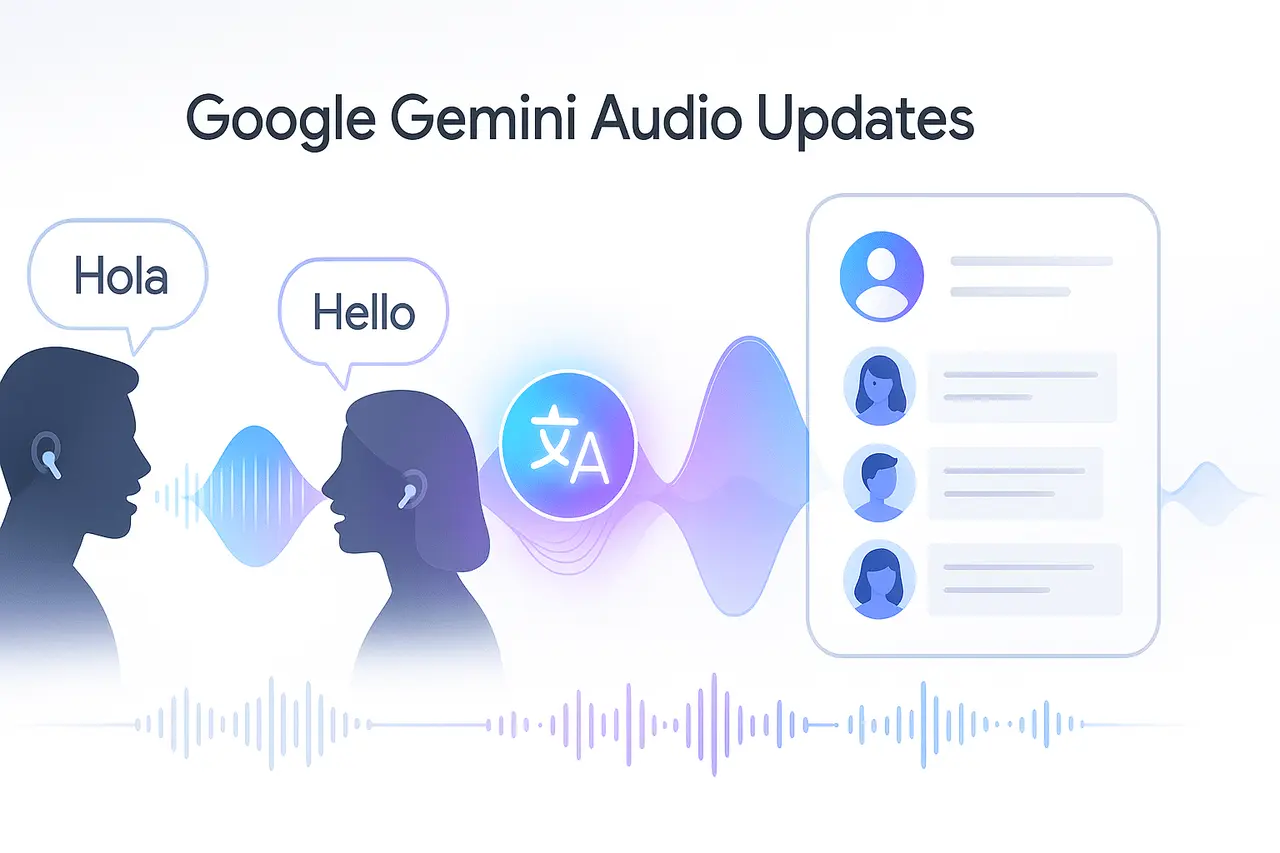
The most important update is the launch of live speech-to-speech translation. Utilising Gemini’s Native Audio technology, this feature enables seamless, real-time translation across languages while preserving essential vocal characteristics, such as intonation, pacing, and pitch. It’s made so that multilingual interactions seem natural and intuitive.
Google Gemini Audio Updates: Key Features of Live Translation
- Real-time streaming: Converts spoken words into another language as they are spoken, allowing for an open, two-way conversation.
- Natural Speech Preservation: The translated output preserves the voice’s cadence and emotional nuance. This makes conversations feel more human rather than robotic.
- Broad Language Support: Covers over 70 languages and more than 22,000 language pairs, enabling reach worldwide.
- Automatic Recognition: This software detects the language of input without user input, improving use in multilingual environments.
- Noise Robustness: Algorithmic filtering minimises disturbance from background noise, improving performance in real-world settings such as cafes or streets.
The beta feature is accessible via Google Translate. Google Translate app on Android devices in the U.S., Mexico, and India, with broader regional and iOS support expected in the coming months.
What’s New in Gemini Text-to-Speech?
The technology of text-to-speech has seen significant enhancements with the release of the most recent Gemini 2.5 Flash and Pro TTS preview models. These improvements focus on expressing in pacing, precision and scalability across multiple speakers.
Enhanced Control and Naturalness
- Expression Voices: The latest models are more accurately following fashion guidelines, providing voices that communicate mood, tone, and personality with more fidelity.
- Context-Aware Pacing: The speech generation smartly adapts its speed to the context, such as speeding up for exuberance and slowing down for greater emphasis.
- Multi-Speaker Consistency: When generating dialogues involving various characters or voices, they maintain distinct voices, which is essential for programs such as audiobooks and interactive experiences.
Developers can experiment with these TTS capabilities in today’s environments, such as Google AI Studio or the Gemini Playground.
Google Gemini Audio Updates: Native Audio and Conversation Quality
At the core of these audio improvements is Gemini’s 2.5 Flash Native Audio model, which brings improved conversations to AI-driven experiences. Compared to previous versions, the 2.5 Flash model is more reliable at responding to users’ instructions, can sustain coherent multi-turn conversations, and incorporates additional functionality such as fetching the latest information and avoiding interruptions to the flow of conversation.
The improved native audio capabilities aren’t limited to TTS or translation; they also power tools such as voice assistants and customer service bots, as well as interactive agents across Google products, including Search Live.
Google Gemini Audio Updates: Real-World Use Cases
Global Communication
Imagine travellers speaking to locals with no language barriers. Speech is instantly translated into headphones while maintaining natural vocal habits. This could transform the way people communicate across cultures in diplomacy, tourism, and international business.
Accessibility and Learning
Advanced live translation and TTS can aid language learners by providing real-time feedback on auditory perception. Also, those who have difficulty with reading or speech might benefit from expressive, context-aware synthesised speech.
Enterprise Voice Applications
Enterprises can incorporate such models into customer service workflows, voice-activated interfaces, and automated agent systems, allowing for better, more personalised customer interactions. Early adopters have reported improved communication coherence and understanding even in noisy environments.
Google Gemini Audio Updates: Limitations and Future Developments
While Live speech-to-text and better TTS are giant leaps forward, they’re still in active rollout phases. Beta features could develop based on user or developer feedback. Additionally, expanded support for regions and devices is expected. Furthermore, the performance of real-world applications will vary depending on device hardware, network quality, and surrounding noise.
Developers who want to build with these technologies should keep an eye on changes to the Gemini API and documentation for incremental improvements and greater public access.
Final Thoughts
The most recent Gemini Audio enhancements highlight Google’s long-term goal of making voice interaction more natural, flexible, and globally accessible. Speech-to-speech translation in real time reduces the friction of multilingual conversations, while improved text-to-speech technology opens the way to more immersive storytelling, clearer accessibility tools, and stimulating applications powered by voice. In addition, the improvements in native audio processing enhance Gemini’s capacity to handle complex conversations and track users’ intent more accurately.
Although some features are in beta or preview, the trend is evident: audio is no longer a second-class feature in AI systems. It’s becoming an integral part of the AI system. As Gemini Audio models mature and become more widely adopted, they will play a significant role in shaping how people and companies communicate across platforms, languages, and digital environments.
Frequently Asked Questions
1. What is live speech-to-speech?
Live speech-to-speech translation instantly converts spoken language into another language, preserving the voice’s characteristics and enabling bilingual conversations.
2. What languages do Gemini live translation support?
The system supports translation into over 70 languages and over 2,000 language pairs.
3. What makes the new version of text-to-speech different from the previous versions?
The latest TTS models offer greater expressiveness, with context-aware pacing and consistent character voices, enhancing quality of life and control.
4. Are developers able to use these audio features right now?
Yes. Developers can experiment with improved TTS and native sound capabilities using tools such as Google AI Studio, and the live translation beta is now available in the Google Translate application.
5. Is live translation available offline?
Live translation is currently only available with an Internet connection. Offline support hasn’t yet been officially announced as a standard feature. (No currently available indication of offline mode. )
6. What products will benefit from these enhancements?
The update extends to Google Translate, Search Live, and developer platforms like Vertex AI and the Gemini API.
Also Read –
Pomelli Animate: Google Labs New AI Marketing Animation Tool
NotebookLM DocX Support: What the New Update Means