
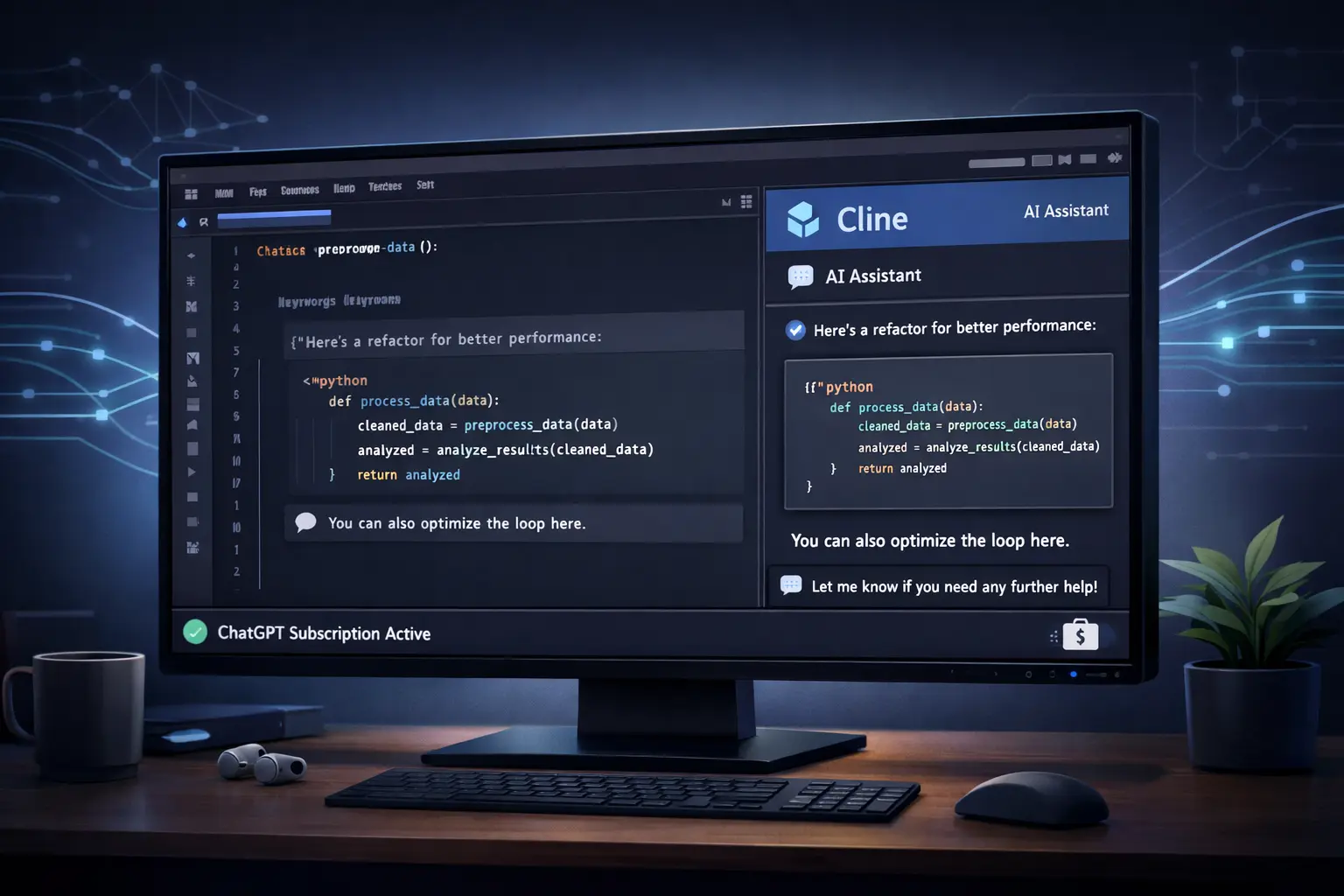
Integrating an existing ChatGPT subscription directly into Cline is a significant change in how developers can access AI inferences within their code workflows. Through an alliance with OpenAI, Cline now allows users to sign in with their current ChatGPT subscription and access models supported by the API without managing API keys or paying per-token costs. Instead, the inference process runs under a flat-rate subscription model tied to the user’s ChatGPT plan, simplifying cost management and setup.
This integration was intended to ease friction, increase predictability, and make more advanced AI models more accessible in an environment that is focused on developers.
In this article, we will explore ChatGPT subscription in Cline, how it works, why it matters for developers, and how it simplifies AI-powered coding with flat-rate inference and seamless model access.
What Is the ChatGPT Subscription Integration in Cline?
It is a ChatGPT subscription integration that allows Cline users to authenticate with their OpenAI account and then use the models included in the ChatGPT subscription to infer. Instead of generating API keys for storage, users sign in once and instantly gain access to the models they are eligible for.
Key characteristics include:
- Direct sign-in using your OpenAI Account
- Models are through the user’s ChatGPT account
- No per-token billing inside Cline
- Flat-rate use is in line with the subscription plan
This method prioritises convenience and predictability over traditional usage-based pricing.
Why This Integration Matters for Developers?
AI-assisted development tools are becoming essential in modern workflows. However, API-based access to traditional APIs creates a variety of issues, including variable costs, credential management, and administrative overhead.
Allowing developers to connect the existing ChatGPT subscription to Cline will address the most common issues:
- Pricing Predictability: It eliminates unexpected bills associated with token-based pricing.
- Simple Onboarding: There are no API keys needed to create, turn or secure
- Faster Setup: Authentication replaces manual configuration
- Uniform Experience: A single service is used with ChatGPT as well as Cline
For developers, whether individuals or small groups, the advantages will significantly reduce barriers to continuous AI use.
How the Integration Works?
In the simplest terms, Cline uses OpenAI’s authentication flow to link the user’s ChatGPT subscription to the extension. When authenticated, Cline will route inference requests to the provider selected with the models in the subscription.
Set Up Steps in the Cline Extension
The procedure is deliberately simple:
- Open Cline settings
- Choose OpenAI Codex from the dropdown menu of providers
- Select to sign in using OpenAI
After logging in to the account, Cline immediately detects all models accessible to the user and activates them for inference.
Subscription-Based Inference vs API-Based Access
The integration offers an alternative to the traditional API use—the table below details the main differences.
Subscription vs API Access Comparison
| Aspect | ChatGPT Subscription in Cline | Traditional API Access |
|---|---|---|
| Authentication | OpenAI account sign-in | API key generation |
| Pricing model | Flat-rate subscription | Per-token billing |
| Cost predictability | High | Variable |
| Setup complexity | Low | Moderate |
| Credential management | Minimal | Ongoing |
This example demonstrates the reasons why subscription-based inference is particularly attractive for continuous, day-to-day use.
Models and Access Considerations
After logging in, users can access the models included in their current ChatGPT subscription. Model availability depends on the plan and OpenAI’s current offerings. If a model is not included in an OpenAI subscription plan, it won’t be available in Cline.
Practical aspects comprise:
- Model access aligns with the subscription tier.
- Modifications to the subscription impact the available models
- A separate configuration for billing is required within Cline
This strict alignment ensures system transparency and eliminates duplicate costs.
ChatGPT subscription in Cline: Real-World Use Cases
Incorporating ChatGPT subscription-related inferences into Cline provides a broad range of development scenarios.
Common Use Cases
- Coding generation, refactoring, and accelerating iterations with no concern over token use
- Inline explanations for understanding unfamiliar codebases during reviews
- Prototyping with AI-assisted functions at an affordable cost
- Learner workflows, self-learning, and students who subscribe to subscription plans for practising
These cases show that predictable pricing enables more frequent and reliable AI use.
ChatGPT subscription in Cline: Benefits and Limitations
Every integration has trade-offs. Knowing both sides of the coin helps teams determine whether this method is the best choice.
Key Benefits
- Flat-rate pricing simplifies budgeting
- There is no API key rotation or exposure risks
- Faster onboarding for new users
- Consistent experience across tools
Potential Limitations
- Models are only available within the scope of a subscription
- A little less granular usage tracking in comparison to APIs
- Not suitable for high-volume, server-side workloads
For large-scale or backend automation, an API-based connection might still be needed.
Practical Considerations for Teams and Businesses
Before establishing a standard for the basis of subscription, Cline teams should evaluate: Cline Teams should consider:
- If all the models that are required are included in the subscription
- Expected patterns of usage and concurrency
- Compliance and requirements for data handling
In many instances, a hybrid approach that combines subscriptions for individual developers and APIs used by production systems provides the best balance.
My Final Thoughts
The ability to integrate the benefits of a ChatGPT subscription directly into Cline is a significant advancement in AI-assisted development workflows. By removing API keys, eliminating per-token costs, and aligning inference to a flat-rate subscription, the integration reduces friction and improves cost predictability for daily use. As AI tools develop and become more sophisticated, subscription-based access models like these will likely become increasingly important alongside traditional APIs, particularly for developers who are not part of large teams and want to keep things simple without sacrificing capabilities.
FAQs
1. Can I continue to use an old ChatGPT account in Cline?
Yes. You can sign in with an OpenAI account to access the models included in your current ChatGPT subscription.
2. Do I require an API key to be able to use Cline together with ChatGPT?
No. The integration eliminates the need for API keys by using account-based authentication.
3. Are prices still based on tokens?
No. Usage is based on the flat-rate price included with your ChatGPT subscription, not per-token billing.
4. What models are available for purchase after the sign-up process?
You have access to all models that are included in the specific ChatGPT service plan.
5. Do I have the option of switching back to API-based services at a later date?
Yes. The choice of provider in Cline can be set up, and allows users to switch providers at any time.
Also Read –
ChatGPT Age Prediction: How Teen Safeguards Work?