

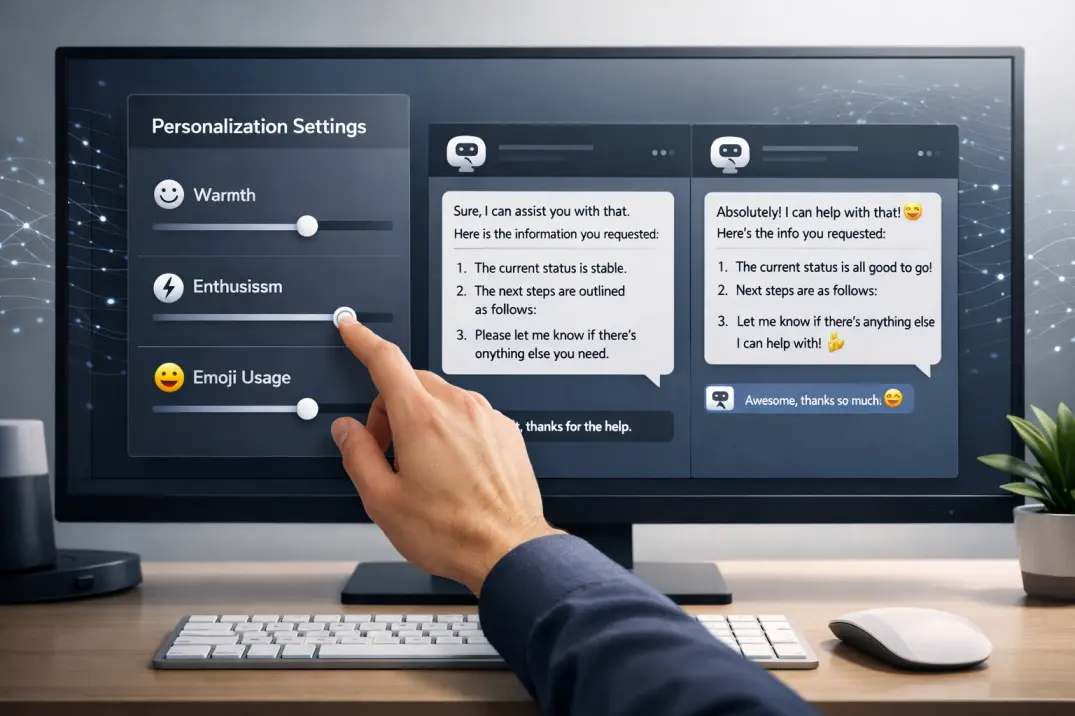
AI assistants are now everyday workplace tools, and the way they interact with users is just as important as what they say. Understanding that, OpenAI has introduced personalisation features in ChatGPT that let users modify specific aspects of the responses. You can now alter elements like enthusiasm, warmth, and emojis directly by accessing ChatGPT’s Personalisation settings.
This update provides users with greater control over tone and design, making ChatGPT more suited for professional, informal, educational, or other situations. You can choose to have short, neutral responses or more expressive, welcoming responses. These settings will help you ensure that the chat assistant’s messages are in line with your expectations.
This article will explain ChatGPT Personalisation Settings, the meaning behind ChatGPT personalisation, what it is, how these new controls work, the reasons they’re essential, and the best way to make them work effectively.
What Are ChatGPT Personalisation Settings?
Personalisation options for ChatGPT are integrated preferences that affect how the assistant reacts, rather than the way it is used. Instead of adjusting the prompts each time you begin an interaction, personalisation lets you set your preferred communication characteristics.
With the most current version, users can directly alter:
- Warmth, how emotional or supportive reactions are
- Enthusiasm; the intensity and expressiveness in responses
- Emoji use is how often emojis show up in response
These options are accessible in the personalisation part of ChatGPT settings, and allow for a consistent behaviour throughout conversations.
AI assistants are now everyday workplace tools, and the way they interact with users is just as important as what they say. Understanding that, OpenAI has introduced personalisation features in ChatGPT that let users modify specific aspects of the responses. You can now alter elements like enthusiasm, warmth and emojis directly by accessing ChatGPT’s Personalisation settings.
This update provides users with greater control over tone and design, making ChatGPT more suited for professional, informal, educational, or other situations. You can choose to have short, neutral responses or more expressive, welcoming responses. These settings will help you ensure that the chat assistant’s messages are in line with your expectations.
This article will explain the meaning behind ChatGPT personalisation, what it is, how these new controls work, the reasons they’re essential, and the best way to make them work effectively.
What Are ChatGPT Personalisation Settings?
Personalisation options for ChatGPT are integrated preferences that affect how the assistant reacts, rather than the way it is used. Instead of adjusting the prompts each time you begin an interaction, personalisation lets you set your preferred communication characteristics.
With the most current version, users can directly alter:
- Warmth: How emotional or supportive reactions are
- Enthusiasm: The intensity and expressiveness in responses
- Emoji Use: It is how often emojis show up in response
These options are accessible in the personalisation part of ChatGPT settings, and allow for a consistent behaviour throughout conversations.
ChatGPT Personalisation Settings: Adjusting Warmth: From Neutral to Friendly
Warmth affects how emotional ChatGPT’s replies are.
- Lower temperature creates more neutral, straightforward responses ideal for technical documents such as research summaries or formal communications.
- A higher degree of warmth increases emotional reassurance, empathy and conversational ease that can be beneficial for coaching, learning or in customer-facing situations.
This is particularly beneficial for those who seek uniformity. For instance, developers may prefer to keep their debugging sessions cool during sessions, whereas learners or content creators may choose an approach that encourages.
ChatGPT Personalisation Settings: Controlling Enthusiasm Levels
Exuberance affects how lively and expressive reactions feel.
- Low energy keeps responses clear, calm, and with a clear focus.
- The high level of enthusiasm is a more expressive form of language that includes exclamation marks and motivational phraseology.
This setting helps to adapt ChatGPT’s style to your workflow. Report writers for business or emails usually prefer to be sluggish in their energy, whereas brainstorming sessions or writing creatively could require a more lively voice.
In addition, the emotion of a person doesn’t alter the accuracy of facts; it only affects how you deliver your message.
ChatGPT Personalisation Settings: Managing Emoji Usage
Emoji usage is now an option for personalisation that is specifically designed to bridge a long-standing preference gap.
- Disabled or reduced Emoji usage makes it an excellent choice for academic, professional, or technical areas.
- A greater use of emojis could make the responses more casual and attainable, particularly in casual chats or projects.
In putting emoji preferences to settings, users do not need to repeatedly ask “no Emojis” or “use only emojis sparingly” in messages.
Where to Find Personalisation Settings in ChatGPT
The new settings are available within the Personalisation section of ChatGPT’s settings menu. Once set, these settings will be applied automatically to all future chats until they are modified.
This technique shifts tone control away from instruction-level prompts to a preference at the system level, which reduces friction and increases reliability.
Why This Update Matters?
1. Better Alignment With User Intent
Different tasks require different communication styles. Personalisation will ensure that ChatGPT matches the intent of the user, without repeated clarification.
2. Improved Professional Usability
For academic, business, and technical users. Managing enthusiasm, warmth and emojis ensures professionalism and clarity.
3. More Human-Centred AI Interaction
Tone customisation is a way of acknowledging that users feel AI emotional responses and also informationally.
4. Reduced Prompt Engineering Overhead
Instead of incorporating tones within each prompt, users can depend on their preferences to last.
ChatGPT Personalisation Settings: Practical Use Cases
Content Creation
Writers can boost the enthusiasm and energy for ideas. Then, they can decrease both while editing drafts.
Software Development
Developers can reduce the heat and use emojis in order to give clear, tech-related explanations.
Education and Learning
Students may want warmer, more positive reactions when tackling complex subjects.
Customer Support Simulation
Chatbot scripts that are being tested by businesses can alter tone to fit the voice of their brand.
Limitations and What Personalisation Does Not Do ?
Although powerful, these settings are not without limits:
- These don’t alter the model’s intelligence or depth
- They are not able to interfere with safety policies
- These are not able to provide a guarantee of emotional interpretation in all situations
Personalisation affects style, but not reasoning or facts.
How Personalisation Fits Into the Broader ChatGPT Experience?
This update represents a broader trend towards the control of users’ AI behaviour. Instead of a one-size-fits-all approach, ChatGPT increasingly adapts to the individual’s preferences.
Together with features such as memory, custom instructions, and history of conversations, Personalisation settings make ChatGPT appear more personal and in line with the user’s individual style of communication.
Final Thoughts
The ability to alter the level of enthusiasm, warmth, and emoji use marks an essential change in the way users use ChatGPT. With the inclusion of tone controls in personalisation settings, ChatGPT becomes easier to adjust, more consistent, and more suited to a variety of situations, both personal and professional.
For those who are tech-savvy and appreciate control and efficiency, this update will reduce the need for repetitive prompting while also increasing the quality of communications. In the future, as AI devices continue to be integrated into workflows that are routinely used, personalised features will likely be expected as standard rather than merely optional features.
Frequently Asked Questions (FAQs)
1. Where can I change the energy and enthusiasm in ChatGPT?
You can change these attributes within the personalisation area of the ChatGPT settings. This is where the tone-related preferences are saved.
2. Are personalisation settings applicable to all chats?
Once set, your personalisation preferences will apply automatically to all subsequent conversations until you modify them.
3. Does changing enthusiasm affect accuracy?
No. It only alters the way in which responses are formulated and not the accuracy or quality of the information.
4. Can I turn off all emojis in ChatGPT?
Yes. Emojis can be used in a way to reduce or be entirely disabled by personalisation options.
5. Are personalisation settings accessible across all of your users?
Accessibility may be dependent on the ChatGPT version and the status of your rollout. However, the feature is intended to be accessible to all.
6. Can I change the personalisation of prompts?
Yes. You are still able to give clear instructions using a prompt, and when you wish to have an alternative tone for the conversation you are having.
Also Read –
ChatGPT Apps Directory: OpenAI’s New In-Chat App Platform
ChatGPT Images: Features, GPT Image 1.5 and How It Works?