
The development of AI systems, known as agentic AI, that can autonomously reason, plan, and execute in multi-step sequences has accelerated rapidly, resulting in a pressing demand for standards that provide interoperability, security, and transparency. To address this increasing complexity, an organisation called the Agentic AI Foundation (AAIF) was established under the Linux Foundation umbrella, co-founded by OpenAI, Anthropic, and Block. The goal of the initiative is to create an open-source, nonpartisan governance framework for specifications and protocols that enable AI agents to operate consistently across platforms, tools, and ecosystems.
While AAIF focuses on standardising the infrastructure of agentic systems, Other innovators working in this field have significantly contributed to the development of AI-based agent systems. An example is Perplexity, which uses AI-based design concepts, including agent-based browsing experiences, to illustrate how autonomous agents can change the way we work. While Perplexity isn’t part of AAIF’s original group, its innovations illustrate the growing trend towards agent-driven interfaces and bolster the need for uniform standards.
What is Agentic AI and Why Standards Matter?
In recent times, AI has evolved beyond simple chatbots that respond to commands. The domain of agentic AI imagines systems composed of autonomous agents that think and plan actions in a coordinated manner, often using different tools, data sources, and services. Agents can perform various tasks, make decisions and even collaborate with other agents.
Such systems can support a range of applications, from automating business workflows and managing data pipelines to coordinating complex multi-step processes for users. But this promise comes with an important caveat: as many firms and tools develop agentic AI tools, there is a risk of fragmentation and vendor lock-in. Without a standard base and a common platform, agents built within one system might not be able to communicate with agents from another system.
This is why sharing protocols, standards, and neutral governance are crucial. Like the way the web is thriving due to open standards such as HTTP and HTML, the emergence of an “agentic web” requires standards that guarantee compatibility, portability, and innovation driven by communities.
Introducing the Agentic AI Foundation (AAIF)
The year 2025 was the month a brand new initiative dubbed”the Agentic AI Foundation (AAIF) was established under the auspices of the Linux Foundation. The foundation was founded by the top AI companies OpenAI, Anthropic and Block — and has received commitments from major tech companies like Google, Microsoft, Amazon Web Services (AWS), Cloudflare, Bloomberg and others.
The AAIF mission is to create an open, neutral, and community-governed foundation that provides transparent, interoperable infrastructure for agent-centric AI, enabling enterprises and developers to develop and share agentic AI without vendor lock-in or compatibility issues.
Agentic AI Foundation: Core Standards and Projects Under AAIF
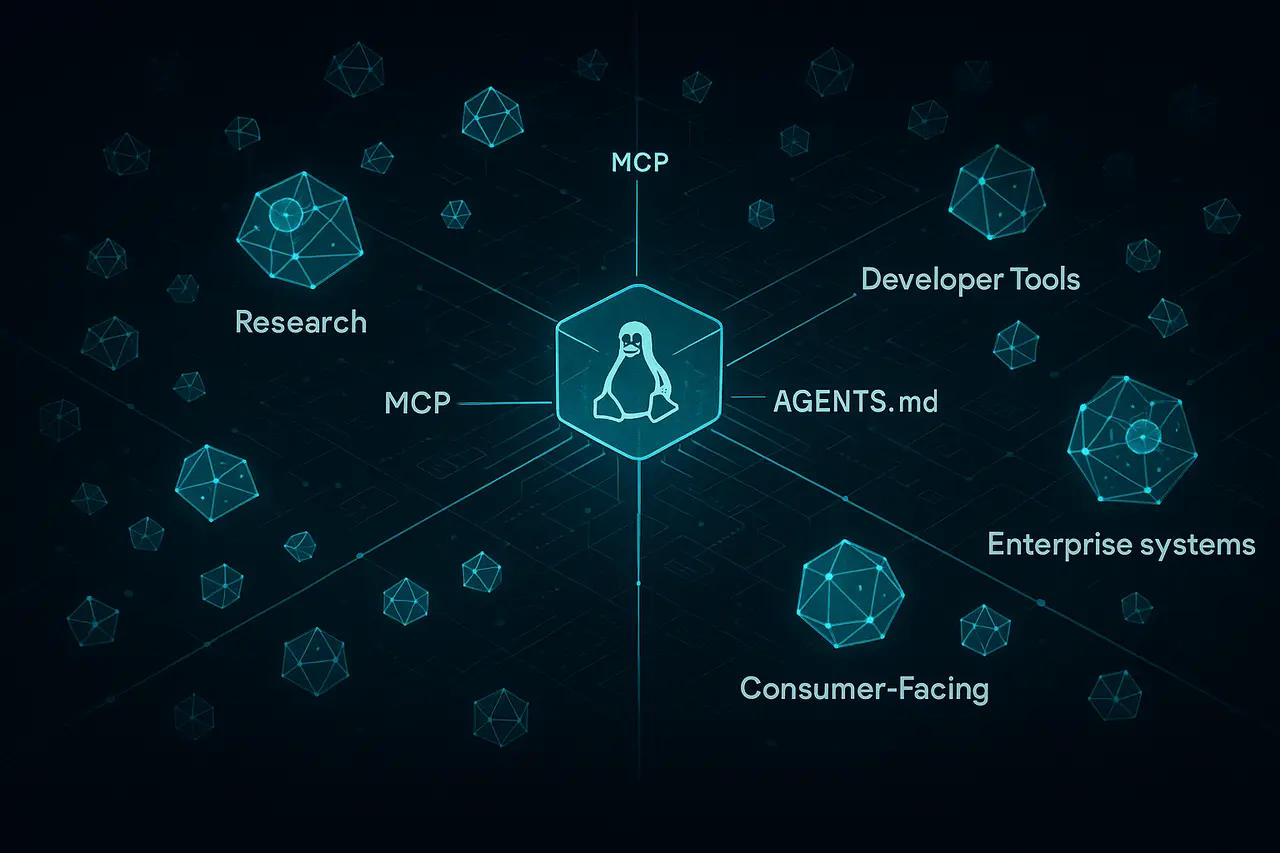
In its initial phase, AAIF is anchored by three important projects, each of which contributes to a specific component of the agentic-AI stack:
- Model Context Protocol (MCP): It was created by Anthropic. MCP is an open-source standard that defines how AI models interact with external data sources, tools, and applications. It specifies standard methods for reading files, calling functions, and delivering contextual messages, enabling the same communication between agents and the outside world.
- Goose: A framework for agents created by Block. Goose is described as a “local-first” and adaptable framework that blends tools, language models, and MCP-based connectivity to make agent development more scalable and flexible.
- AGENTS.md: It is a specification provided by OpenAI. AGENTS.md serves as a universal format that defines how agents in coding are supposed to behave — effectively acting as a “readme plus contract” which provides guidelines and context for agents regardless of the repository or platform they work on.
By putting these fundamental techniques under a non-biased, community-governed framework, AAIF aims to replicate the successes of previous open ecosystems and provide reliable, vendor-neutral foundations for AI agentic.
Why is the timing Critical?
The emergence of AAIF occurs at a crucial time. As AI agent technology moves from demos for experimental purposes to real-world production and enterprise use, the possibility of fragmentation is increasing. Enterprises experimenting with AI agents often create custom connectors and tools that are proprietary to the chains. These types of designs are likely to result in lock-in, integration issues, and limited vendor portability.
The open standards developed by AAIF can help enterprises avoid these risks. By defining how agents interact with tools, data, and other systems, and how they function using formats such as AGENTS.md, companies can create agents that are compatible, accessible, and maintainable over time.
Additionally, it is the Linux Foundation’s history of managing major open-source ecosystems, such as Kubernetes and the Linux kernel, as well as other internationally significant projects, which provides solid governance and neutrality. This experience helps ensure that AAIF’s standards remain open to the community and are not controlled by any single commercial company.
What This Means for Developers and Enterprises?
Interoperability and Portability
Developers can develop agents using protocols and frameworks under AAIF, and expect them to function across various platforms and tools. This makes it easier to share, reuse, or transfer agents, just as open web standards enable websites to function everywhere.
Reduced Lock-In, More Flexibility
Businesses that adopt agent AI will not be dependent on a single vendor or ecosystem. With open protocols that govern interactions between agents and tools, transferring data or integrating across multiple services becomes easier and more reliable.
Safety, Transparency, and Governance
With the help of community-based standards and guidelines, there’s a path towards greater transparency, auditability, and compliance. Frameworks and agents’ behaviours established through open standards (such as AGENTS.md) can be audited, inspected, and updated, leading to more secure and reliable AI deployments.
Accelerated Innovation and Collaboration
By lowering barriers to entry and standardising core plumbing, AAIF allows more software developers, startups, and companies to try out agentic AI. This creates a healthy environment rather than the isolation of incompatible tools.
Agentic AI Foundation: Challenges and Considerations
Even though AAIF is an exciting initiative, it has significant concerns and questions.
- Sustained Cross-Vendor Alignment: One study has noted that the most challenging part is keeping vendors aligned over time, not just in writing but also in how they behave. The incentives of vendors and business models that compete or have different priorities may impede long-term cohesion.
- Complexity of Agent Structures: The complexity of agent-based artificial intelligence systems is compounded by layers of perception, reasoning, execution and planning, as well as memory, state management, tool interaction, and coordination among agents. Research suggests that formalising and proving the correctness, security, coordination, and properties of multi-agent systems is an enormous technical hurdle.
- Governance and Resilience: Autonomous systems operating for the benefit of users, possibly across crucial business processes, raise issues of accountability, security, liability, and compliance that are more critical than ever before. Open standards can be helpful, but don’t alone solve the broader ethical, moral, legal, or ethical issues associated with agentic AI.
What’s Next: The Road Ahead for Agentic AI?
With the launch of AAIF, it is now the time for a robust, interoperable, and cooperative AI-agents ecosystem. In the upcoming weeks and months, you can anticipate:
- Development in the open source agent frameworks, tools and instruments based on MCP Goose along with AGENTS.md.
- More companies are adopting AI through agentic solutions that range from data orchestration automation to more complex workflows, without the fear of vendor locking-in.
- The new standards and specs are joining AAIF to form the basis, broadening, and could include agent-to-agent communication, security, observability, and conformity protocols.
- In-depth academic and industry research into secure, reliable, verified agentic systems, particularly about collaboration, workflows, distributed and error handling.
If the history of the internet is a guide, open standards with neutral oversight will be essential to ensure that agentic AI develops into a versatile, secure, reliable, and widely used technology, not a splintered patchwork locked in proprietary silos.
Final Thoughts
The creation of the Agentic AI Foundation marks a significant moment in the evolution of agent-based AI. In establishing open, interoperable standards, such as MCP Goose and AGENTS.MD, AAIF provides the technological foundation for agents to operate reliably across various environments. This standardisation is vital for reducing vendor lock-in, facilitating transparent auditing, and enabling scalable adoption across both developer and enterprise environments.
At the same time, companies like Perplexity continue to influence the current environment by integrating agents into everyday tools and workflows. Their innovative solutions demonstrate the potential of agents when they are integrated into real-world applications. They illustrate the importance of open standards to ensure that these systems remain available, secure, and compatible across platforms.
Together, these efforts, formalisation of standards on one hand and rapid innovation in products on the other hand, indicate the start of a new age in AI. As AI systems become more efficient and widespread, initiatives like AAIF will play a more vital role in guiding the industry toward transparency, reliability, and long-term, sustainable development.
FAQs
1. What does “Agentic AI” mean?
Agentic AI refers to AI systems composed of autonomous agents. They are more than just responding to commands; they plan and make decisions, communicate with data and tools from outside and complete multi-step tasks independently or in conjunction with other agents.
2. What is the goal for The Agentic AI Foundation (AAIF)?
The AAIF seeks to be an open-source, neutral space for the foundational guidelines and protocols for AI agents, ensuring interoperability, community governance, and long-term sustainability for the AI agent infrastructure.
3. Which standards fell under the AAIF when it was first launched?
In its initial release, AAIF includes three key elements: the Model Context Protocol (MCP) for data integration and AI tools; Goose, a programmable agent framework; and AGENTS.md, an established format for delineating coding-agent behaviour and setup.
4. Why are open standards essential in the field of agentic AI?
Open standards can prevent vendor lock-in, enable interoperability among platforms and tools, promote creativity, and allow businesses or developers to integrate, share, or transfer agents without being tied to any one vendor.
5. Are there risks or problems associated with AI agentic, or even AAIF?
Yes. Agentic AI creates complexities in coordination, security, safety, accountability and governance. While AAIF aids in standardising infrastructure, more general ethical, legal, and security concerns remain to be addressed.
6. What are the ways that developers and other organisations can be involved in AAIF?
Developers and other organisations can contribute to existing projects within AAIF or propose new ones. Since AAIF operates under an open governance model, contributions focus on demonstrable acceptance, community health, and alignment with open-source principles.
Also Read –
OpenAI Tests Memory Search for ChatGPT: A Full Breakdown